 Deal of the day
Aquacultured
Corals · Soft coral
Green Star Polyps
Briareum violaceum
Also called GSP, Star polyps, Starburst polyps, Green starburst polyp, Metallic green star polyps, Neon green star polyps
- CareEasy
- Reef safeYes
- TemperamentPeacefulPeaceful, but grows over neighbors
- Favorite foods
- Light (zooxanthellae)
- Micro-plankton
- Fine particulate foods
- Max size7 in (17.8 cm)
- Min tank10 gal
- LifespanThe colony is clonal and can keep…
- IUCN statusNot Evaluated
Quick answers
- How big does the Green Star Polyps get?
- Up to 7 in (17.8 cm).
- What size tank does it need?
- At least 10 gallons.
- How hard is it to keep?
- Care level: Easy.
- Is it reef safe?
- Yes. It does not sting, but it grows over and smothers neighboring corals, encrusts the glass, overflow and equipment, and is very hard to remove once it gets into the rockwork; any scrap left behind regrows.
- What does it eat?
- Light (zooxanthellae)
- Micro-plankton
- Fine particulate foods
- How long does it live?
- The colony is clonal and can keep growing indefinitely; aquarium strains are kept going for many years by fragging.
- What are good tankmates?
- Other hardy soft corals (leathers, mushrooms) kept a few inches away
- Peaceful reef fish such as clownfish, gobies, blennies and cardinalfish
- Cleanup crew snails, hermit crabs and cleaner shrimp
- Fast-growing corals that can be trimmed back
The 30-second version
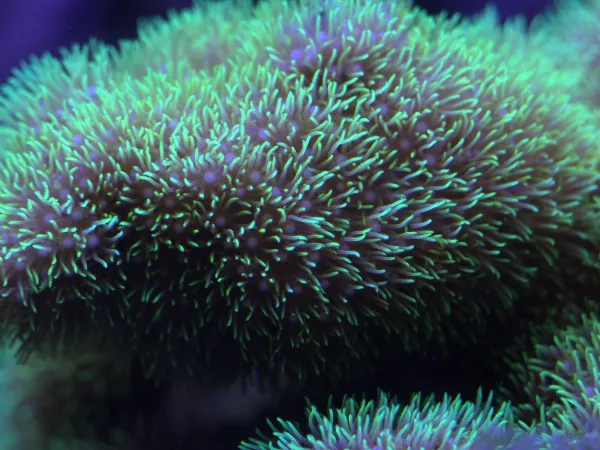
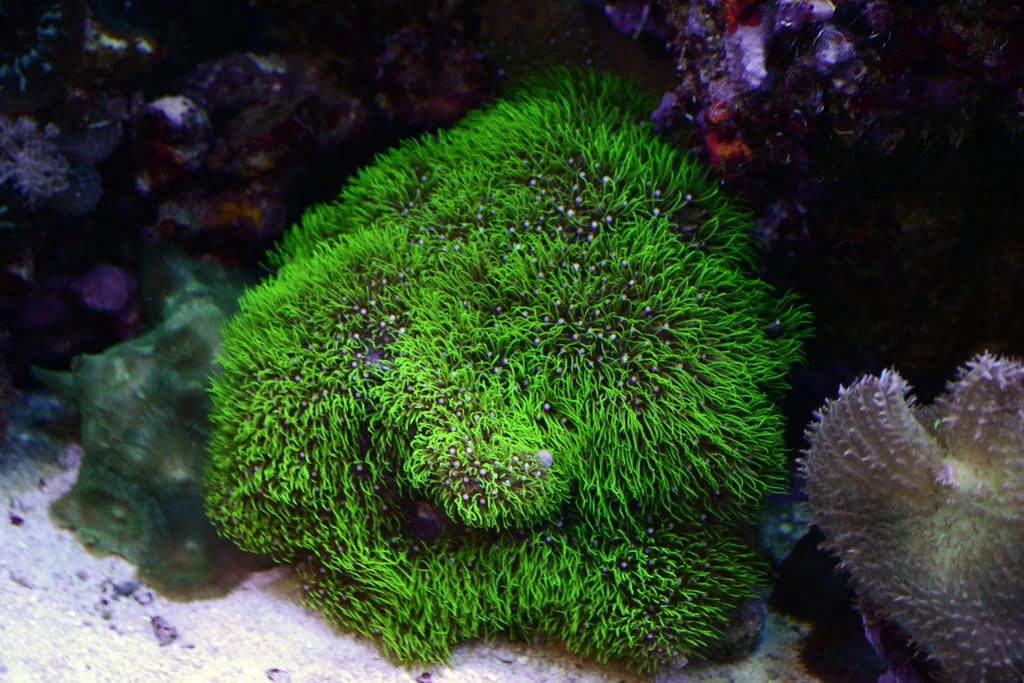
Green star polyps look like a purple carpet covered in tiny glowing green stars. Each star is a polyp: a little animal with eight feathery arms. Hundreds of polyps share one stretchy purple skin, so the whole mat is really one big family. Tiny algae live inside the polyps. The algae use light to make food and share it with the coral, so GSP mostly lives on light. When a fish bumps it, or when the lights go off, the stars pull inside and the carpet turns smooth and purple. Later they pop back out and wave in the water. GSP grows fast. It can creep across rocks, up the glass, and right over other corals. That is why reefers keep it on its own little rock island, where it can't take over the tank.
Water & care
One of the hardiest corals in the hobby and a classic first coral; some keepers call it an indicator coral, because if GSP will not grow, something basic in the system is wrong. It wants moderate light, moderate to strong random flow and stable salinity and alkalinity, and it tolerates a wide range of nutrient levels. New frags may stay closed for several days to a week or two while they settle. The real work is containment: plan where it can grow before you add it.
| Parameter | Keep it at | Where that sits on the usual reef range |
|---|---|---|
| Temperature | 74–80 °F | |
| Salinity (SG) | 1.023–1.026 | |
| pH | 8.1–8.4 | |
| Alkalinity | 8–12 dKH | |
| Calcium | 380–450 ppm | |
| Magnesium | 1,250–1,350 ppm | |
| Nitrate | 2–15 ppm | |
| Phosphate | 0.02–0.1 ppm |
Sources differ: LiveAquaria gives 72-78 F and 8-12 dKH; Top Shelf gives 75-80 F and 8-10 dKH; a Gensou guide gives 24-29 C (75-84 F). GSP is particularly sensitive to sudden salinity and alkalinity swings, so stability matters more than the exact number. Nitrate around 10-30 ppm and phosphate up to 0.1 ppm are reported to speed growth rather than harm it.
Feeding
DietPhotosynthetic
Favorite foods
- Light (photosynthesis by its symbiotic algae)
- Phytoplankton and fine particulate coral foods
- Rotifers and other micro-plankton
- Dissolved nutrients in the water
Target feeding is not needed. If you want faster growth, broadcast a small amount of phytoplankton, rotifers or a powdered coral food about once a week with pumps turned down. Do not let nutrients drop to zero; slightly nutrient-rich water (detectable nitrate and phosphate) speeds growth. Avoid squirting chunky meaty foods onto the mat, where they rot.
Tank & maintenance
- Minimum tank
- 10 gallons
- Aquascape
- Put it on an island rock or frag rock surrounded by sand, or let it cover a back panel you can remove; a sand gap of a couple of inches usually stops it. Do not place it on the main rock structure unless you want that structure purple and green.
- Lighting
- Low-moderate to high. About 50-150 PAR is plenty (Top Shelf suggests 100-200 PAR for best color), and acclimated colonies tolerate roughly 80-350 PAR. Blue and royal-blue heavy spectra bring out the green fluorescence; lots of warm or red light can dull it. Acclimate new frags over about a week.
- Water flow
- Moderate to strong, random or alternating; the polyps should sway briskly without being folded flat. In stagnant spots it retracts and film algae settle on the purple mat.
Routine upkeep
Trim the advancing edge about once a month with a razor blade, scraper or bone cutters, and peel any mat off the glass (a credit card or razor blade slides under it). Cut and remove trimmings outside the display so loose pieces do not reattach elsewhere. Baste detritus and film algae off the mat with a turkey baster. Wear gloves when peeling or cutting it, as with any coral.
Temperament & tankmates
TemperamentPeaceful
It has no sweeper tentacles and does not chemically burn neighbors the way some leathers can; it wins by overgrowing and shading them. LiveAquaria lists it as peaceful and Top Shelf Aquatics is inconsistent; we rate it semi-aggressive because of how quickly it smothers slower corals. It can itself be burned by aggressive LPS such as torch, hammer and Galaxea corals placed too close.
Reef safeYes
It does not sting, but it grows over and smothers neighboring corals, encrusts the glass, overflow and equipment, and is very hard to remove once it gets into the rockwork; any scrap left behind regrows. Keep it on an isolated rock surrounded by sand, a removable frag rock, or a dedicated back wall, and keep about 3-6 in (8-15 cm) of bare space between it and other corals (Top Shelf's figure); more is safer. It is harmless to fish and invertebrates.
Good tankmates
- Other hardy soft corals (leathers, mushrooms) kept a few inches away
- Peaceful reef fish such as clownfish, gobies, blennies and cardinalfish
- Cleanup crew snails, hermit crabs and cleaner shrimp
- Fast-growing corals that can be trimmed back
Avoid
- Slow-growing SPS and LPS within reach of the spreading mat
- Zoanthids or other encrusting corals placed right next to it
- Torch, hammer, frogspawn and Galaxea corals within sweeper range
- Polyp-nipping fish such as many Centropyge dwarf angelfish and rabbitfish
Help it thrive
- Decide where it is allowed to grow before you buy it; an island rock in a sand bed is the easiest way to keep it contained.
- Give it brisk, random flow so the polyps sway and the mat stays clean.
- Keep salinity and alkalinity steady; most 'my GSP won't open' problems trace back to swings, low flow or a film on the mat.
- Do not chase zero nutrients; a little nitrate and phosphate keeps it growing and green.
- Use plenty of blue light to show off the fluorescence.
- Be patient with new frags: closing for several days after a move is normal.
Common ailments
Polyps stay closed
- Signs
- The mat stays smooth and purple for days with few or no polyps out.
- Prevention
- Steady moderate-to-strong flow, stable parameters, a cycled tank, and leaving the colony in one place once settled.
- Treatment
- Check ammonia, salinity, alkalinity and magnesium; correct any swing slowly. Blow film, detritus or sand off the mat with a turkey baster, raise or redirect flow, and look for pests such as vermetid snails. New colonies may need one to two weeks before they open fully.
Film algae, diatoms or cyanobacteria on the mat
- Signs
- A brown, green or red film covers the purple tissue and the polyps stop extending.
- Prevention
- Good flow over the colony and reasonable nutrient control.
- Treatment
- Baste or gently brush the film off, increase flow, and address excess nutrients and light imbalances.
Bleaching or dull color
- Signs
- Polyps turn pale, white or brownish instead of bright green.
- Prevention
- Acclimate to strong lighting gradually; use a blue-heavy spectrum; avoid very low nutrients and old, faded bulbs.
- Treatment
- Lower the light intensity or move the colony lower, then raise light gradually; restore stable parameters and slightly higher nutrients if they were near zero.
Recession or peeling
- Signs
- The mat lifts away from the rock or shrinks back, leaving bare patches.
- Prevention
- Consistent flow and stable water chemistry.
- Treatment
- Fix flow and parameter instability; peel off any lifting healthy piece and reattach it to a plug or rubble as a new frag.
Polyp predators
- Signs
- Polyps are nipped or never open; bare patches appear. Camouflaged aeolid nudibranchs (Phyllodesmium briareum is a known Briareum specialist in the wild) can hide among the polyps.
- Prevention
- Dip and inspect new frags; avoid polyp-nipping fish such as many dwarf angelfish and rabbitfish.
- Treatment
- Remove nudibranchs by hand and repeat a coral dip; rehome the offending fish if nipping keeps the colony closed.
This is general hobby guidance, not veterinary advice. Quarantine new arrivals and treat in a separate tank whenever you can.
Risks of owning one
- It overgrows and smothers other corals, the glass, overflows and equipment, and once it is in the rockwork it is very hard to remove completely; any scrap left behind regrows.
- Removing it takes razor blades, scraping and patience, and the cut pieces must be fished out so they do not reattach elsewhere.
- Polyp-nipping fish can keep a colony permanently closed.
- Like all corals it is a living cnidarian; wear gloves when peeling or cutting it and wash your hands afterward.
Propagation & fragging
DifficultyEasy AquaculturedWidely available
Propagated asexually by fragging: any piece of the mat with polyps will attach to a new surface and grow. In the wild Briareum also spreads by fragments, and the Caribbean relative B. asbestinum reproduces sexually by releasing gametes once a year, but sexual reproduction is not done at home.
- Wear gloves and work over a container of tank water.
- Slide a razor blade or credit card under the edge of the mat and peel off a strip, or cut a section with a scalpel.
- Cut the strip into pieces about 1 in (2-3 cm) across.
- Hold each piece against a frag plug or rubble with a rubber band, mesh or a dab of reef-safe cyanoacrylate gel, or let it settle loose in a rubble tray.
- Keep frags in moderate light and flow; they usually attach within days to a week.
- Remove the rubber band once the tissue has grown onto the plug.
Deep dive The science, history and family tree
The science
Briareum violaceum is a zooxanthellate octocoral in the family Briareidae (order Scleralcyonacea). Colonies form thin, rubbery encrusting sheets over rock, rubble and dead coral, though the genus can also grow upright cylindrical lobes. The mat is violet to magenta: in this species the sclerites are magenta in both layers of the coenenchyme, a character that separates it from the other Indo-Pacific Briareum species (Samimi-Namin & van Ofwegen 2016). Cortex sclerites are tuberculate spindles up to about 1 mm long. The polyps are monomorphic and fully retractile, rising from calyces that range from barely raised to tall; specimens with very tall calyces were the basis of the former genus Pachyclavularia. Each polyp carries eight pinnate tentacles, typically green to grey-green and strongly fluorescent under blue light. Recorded localities include southern Japan (Ryukyu and Bonin Islands), Taiwan, the Coral Triangle, the Great Barrier Reef and Vanuatu, with examined material from about 2 to 31 m. Like other Briareum it is confined to shallow, well-lit water, gaining most of its energy from symbiotic dinoflagellates and supplementing it by suspension feeding. The specialist aeolid nudibranch Phyllodesmium briareum feeds on briareid soft corals, has been recorded on this species, and keeps the coral's zooxanthellae alive in its own digestive gland. Aquarium 'green star polyps' are almost never identified to species, and specimens with differing characters are routinely sold under the single label Pachyclavularia violacea, so the trade form may include more than one Briareum species.
- Appearance
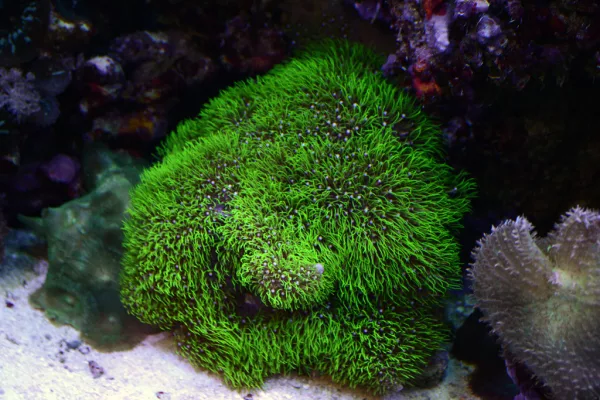
- A flat, rubbery mat that is purple to magenta (sometimes tan or brownish) studded with short polyps that open into bright green, yellow-green or grey-green eight-armed stars. Under blue or actinic light the polyps fluoresce strongly. When closed, the colony looks like smooth purple skin with tiny bumps. Trade forms are sold as 'metallic', 'neon' or 'short-tentacle' green star polyps, and there are long- and short-polyp forms; in very bright light polyps stay shorter and denser. Look-alikes: clove polyps (Clavularia) have larger, separate polyps on thin runners rather than a solid purple mat; pulsing xenia (Xenia) has white to tan polyps that open and close rhythmically; branching Briareum forms grow upright purple fingers. Older trade names for the green form include Clavularia viridis, which is actually a different coral.
- Native range
- Indo-West Pacific. Recorded from southern Japan (Ryukyu and Bonin Islands), Taiwan, the Coral Triangle (Indonesia, Philippines, Malaysia), the Great Barrier Reef and Vanuatu. Other Briareum species occur in the Red Sea, East Africa and the Persian Gulf (B. hamrum) and in the tropical western Atlantic and Caribbean (B. asbestinum).
- Habitat
- Shallow, well-lit reef habitats, where the genus is common. Examined specimens came from about 2-31 m (7-100 ft). It encrusts hard surfaces such as reef rock, rubble and the dead bases of other corals. As a zooxanthellate coral it is limited to the sunlit zone.
- Size
- 7 in (17.8 cm). A colonial mat with no fixed maximum size: it keeps spreading as long as it finds hard surface. One retailer guide reports the mat advancing several centimeters per month in good conditions and covering a 30 cm (12 in) rock face in three to four months.
- Lifespan
- The colony is clonal and can keep growing indefinitely; aquarium strains are kept going for many years by fragging.
- Conservation
- Not Evaluated. No IUCN Red List assessment was found. Soft corals such as Briareum are not listed under CITES. Nearly all aquarium GSP is aquacultured or hobbyist-propagated; it grows so readily that wild collection is unnecessary
In the aquarium vs in the wild
In your aquarium
A beginner staple and 'living carpet': an easy, fast, fluorescent coral used to cover an island rock or a back wall with motion, often included in beginner coral packs and traded constantly as frags. Its growth is also a rough health check for a new reef.
On the reef
An encrusting octocoral that competes for space on shallow reefs by overgrowing hard surfaces. It is food and camouflage for the specialist nudibranch Phyllodesmium briareum, which borrows the coral's algae to make its own food.
History
The species was first described as Clavularia violacea by Jean Quoy and Joseph Gaimard in 1833, in the zoology volumes of the French corvette Astrolabe's voyage. In 1908 Louis Roule described Pachyclavularia erecta for star polyps with tall calyces; Gohar (1940) treated it as the same species as violacea, and Fabricius and Alderslade (2001) merged Pachyclavularia into Briareum. The hobby kept the name Pachyclavularia violacea, and green forms were also sold as Clavularia viridis, so labels are still inconsistent. Easy to grow and spectacular under actinic lighting, GSP became one of the most widely traded frags in reef keeping.
Evolution & relatives
Octocorals (eight feathery tentacles per polyp) are one of the two great branches of Anthozoa; fossils show they existed by the Ordovician, and a 2021 phylogenomic study dates the origin of anthozoans to 648-894 million years ago. In 2022, McFadden, van Ofwegen and Quattrini reorganized octocorals into two orders using genome-scale data: Malacalcyonacea (most soft corals, including leathers, xenia and clove polyps) and Scleralcyonacea (sea pens, the blue coral Heliopora, precious red coral and Briareidae). So although GSP looks like a mat of clove polyps, it is more closely related to sea pens, blue coral and the Caribbean encrusting gorgonian Erythropodium than to Clavularia, Xenia or toadstool leathers. Within Briareum, species are told apart mainly by sclerite shape and color; DNA studies have confirmed some of these species but found other morphological types to be genetically very similar, so the genus still needs revision.
Family tree, from kingdom down
- Kingdom Animalia Animals Animals are living things made of many cells that must eat food to live. Fish, corals, crabs, snails and sea stars are all animals.
- Phylum Cnidaria Cnidarians Cnidarians are soft animals with tentacles. The tentacles have tiny stinging cells. Corals, sea anemones and jellyfish all belong here.
- Subphylum Anthozoa Corals and sea anemones These cnidarians spend their whole lives as polyps: a tube with a mouth ringed by tentacles. Unlike jellyfish, they never swim around as a bell-shaped medusa.
- Class Octocorallia Octocorals Each octocoral polyp has exactly eight feathery tentacles. Soft corals, sea fans and sea pens belong here.
- Order Scleralcyonacea Sea pens, blue corals and kin This order of octocorals includes sea pens, blue coral, red precious coral and star polyps. It was named in 2022, when scientists studied octocoral DNA.
- Family Briareidae Briareid soft corals This family of octocorals forms rubbery mats or fingers on rock. Its polyps can pull back into the mat when they are touched.
- Genus Briareum Star polyps Star polyps form a purple or brown mat covered in little star-shaped polyps. Green star polyps are a common aquarium coral.
- Species Briareum violaceum
See it on the Tree of Life Compare with another species
Closest relatives
- Briareum asbestinum Corky sea finger Same genus; Caribbean and western Atlantic species that forms both encrusting mats and tall fingers
- Briareum cylindrum Star polyp Same genus; described in 2016 from Australia, the Coral Triangle and China
- Briareum hamrum Star polyp Same genus; Red Sea, East Africa, Arabian Sea and Persian Gulf
- Briareum stechei Star polyp Same genus; Coral Triangle, Australia, Guam and Taiwan
- Erythropodium caribaeorum Encrusting gorgonian Same order (Scleralcyonacea), different family; another encrusting octocoral
- Heliopora coerulea Blue coral Same order (Scleralcyonacea); a skeleton-building octocoral
- Clavularia Clove polyps Look-alike in a different order (Malacalcyonacea)
Older scientific names: Pachyclavularia violacea, Clavularia violacea, Pachyclavularia erecta.
Fun facts
- The purple color comes from tiny magenta mineral spikes (sclerites) packed inside the mat; the green comes from glowing pigments in the polyps.
- A sea slug, Phyllodesmium briareum, lives on star polyps, looks just like them, and keeps the coral's algae alive inside its own body so it can make food from sunlight.
- Despite looking like clove polyps, DNA places GSP in the same order as sea pens, blue coral and precious red coral.
- The species was first described from specimens collected on the French exploration ship Astrolabe and published in 1833.
- A single small frag can cover a whole rock face in a few months in a healthy reef tank.
Learn more
- Top Shelf Aquatics: Green Star Polyps care guide topshelfaquatics.com
- LiveAquaria: Starburst Polyp (Briareum sp.) liveaquaria.com
- Samimi-Namin & van Ofwegen 2016, Overview of the genus Briareum in the Indo-Pacific (ZooKeys 557) zookeys.pensoft.net
- WoRMS: Briareum violaceum marinespecies.org
Sources
- WoRMS: Briareum violaceum (Quoy & Gaimard, 1833) marinespecies.org
- Samimi-Namin & van Ofwegen 2016, ZooKeys 557: 1-44 zookeys.pensoft.net
- Wikipedia: Briareum en.wikipedia.org
- Wikipedia: Briareum asbestinum en.wikipedia.org
- Reef Corals of the Indo-Malayan Seas: genus Briareum indo-malayan-reef-corals.linnaeus.naturalis.nl
- LiveAquaria: Starburst Polyp liveaquaria.com
- Top Shelf Aquatics: Green Star Polyps topshelfaquatics.com
- Gensou: Green Star Polyp care guide gensou.sg
- Reef Builders: Encrusting corals that take over the aquarium reefbuilders.com
- Sea Slug Forum: Phyllodesmium briareum seaslugforum.net
- Wikipedia: Phyllodesmium briareum en.wikipedia.org
- Wikipedia: Scleralcyonacea en.wikipedia.org
- Wikipedia: Octocorallia en.wikipedia.org
- Reef Builders: The New Octocorallia, Malacalcyonacea Part 1 reefbuilders.com
- McFadden et al. 2021, Phylogenomics, origin and diversification of anthozoans (Systematic Biology) academic.oup.com
Care facts
The care facts on this guide and its product pages (care level, reef safety, temperament, size, tank, diet, flow, purpose, foods, acclimation and origin) combine 19 independent sources, checked October 25, 2026.
- Green Star Polyp (LiveAquaria) LiveAquaria
- Green Star Polyps Coral Top Shelf Aquatics
- Coral Guide Seascape Studio
- Green Star Polyp Care Guide: GSP Growth, Spread and Control Gensou
- green star polyps Aquariadise
- Green Starburst Polyp Quality Marine
- Green Star Polyp Coral Care Fragbox
- Green Star Polyps Fish Tank Advisor
- green star polyps Dwazoo
- Biota Green Star Polyp (Briareum sp.), Medium AlgaeBarn (Biota product)
- Green Star Polyps Coral Care Saltwater Aquarium Blog
- Green Star Polyps: Care, Information, & Pictures Build Your Aquarium
- Starburst Polyp LiveAquaria
- Green Starburst Polyp Quality Marine
- Green Star Polyps Coral Care Guide Reef Chasers
- What Are Green Star Polyps? (page title shown as Wysiwyg Small Frogspawn Coral (C22)) Frag Box Corals
- Green Star Polyps (GSP) Care: Placement, Diet & Propagation Fish Tank Advisor
- Briareum violaceum Reef Guide
- Star Polyps (Pachyclavularia) Tidal Gardens
Scientific names and classification follow the World Register of Marine Species (AphiaID 517640). Last updated October 25, 2026.
Shop this species
Search the shop →
Deal of the day
Aquacultured