 Sold out
Fish · Damselfish
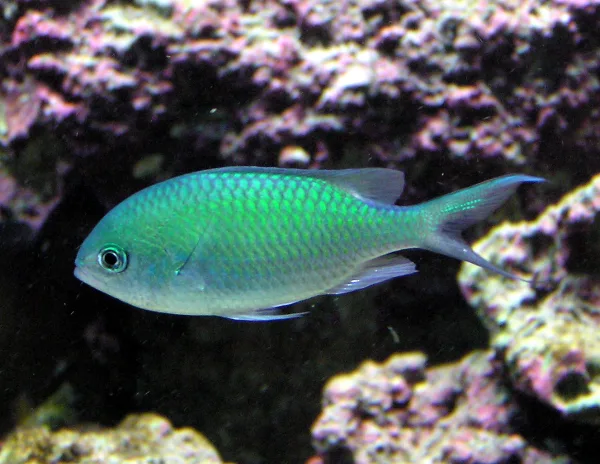
Green Chromis
Chromis viridis
Also called Blue-green Chromis, Blue-green Damselfish, Green Reef Chromis
- CareEasy
- Reef safeYes
- TemperamentPeacefulPeaceful; dominant fish bully weaker ones in small groups
- Favorite foods
- Frozen mysis / brine shrimp
- Marine flakes and pellets
- Algae / herbivore foods
- Max size3.5 in (8.9 cm)
- Min tank30 gal
- LifespanRetail and hobby sources give anywhere…
- IUCN statusLeast Concern
Quick answers
- How big does the Green Chromis get?
- Up to 3.5 in (8.9 cm).
- What size tank does it need?
- At least 30 gallons.
- How hard is it to keep?
- Care level: Easy.
- Is it reef safe?
- Yes. Completely reef safe: it eats plankton and prepared foods and ignores corals, clams and other invertebrates.
- What does it eat?
- Frozen mysis / brine shrimp
- Marine flakes and pellets
- Algae / herbivore foods
- How long does it live?
- Retail and hobby sources give anywhere from "more than 5 years" to 8-15 years with good water quality (LiveAquaria).
- What are good tankmates?
- Clownfish
- Cardinalfish
- Gobies and blennies
- Fairy and flasher wrasses
- Tangs
The 30-second version
The green chromis is a small fish that shines pale green and blue, like a piece of sea glass. In the wild, big groups swim together in a sparkly cloud over branching corals. When danger comes, they dive into the coral branches to hide. They eat tiny bits of floating food called plankton. They pick it out of the water one bite at a time. When it is time to have babies, the dad turns a bit yellow. He makes a nest on the sand or on bits of broken coral. Several moms lay eggs in his nest. He guards the eggs and fans them with his tail. They hatch in just two or three days. In a tank they look best in a group. They need a big tank, or they may pick on each other.
Water & care
A single green chromis is hardy and easy to feed, which is why retailers list it as Easy. Keeping a healthy school long-term is harder: freshly shipped chromis are stressed and prone to Uronema, ich and velvet, and in smaller tanks the dominant fish often harass the weakest until the group dwindles. Quarantine new arrivals, buy a group of five or more at once for a tank of 50 gallons or more, and feed small meals several times a day.
| Parameter | Keep it at | Where that sits on the usual reef range |
|---|---|---|
| Temperature | 72–78 °F | |
| Salinity (SG) | 1.020–1.025 | |
| pH | 8.1–8.4 | |
| Alkalinity | 8–12 dKH |
Ranges from LiveAquaria's care sheet. No species-specific calcium, magnesium, nitrate or phosphate target; follow your corals' needs in a reef. Stable, clean water matters more than exact numbers, because poor water quality and stress are what let Uronema take hold.
Feeding
DietOmnivore
Favorite foods
- Frozen mysis shrimp
- Frozen cyclops and copepods
- Enriched brine shrimp
- Small marine pellets
- Flake foods with spirulina
Feed small amounts several times a day; in the wild they pick plankton all day long. Small foods that drift through the water suit them best, and vitamin-enriched foods help keep their color. Make sure faster tankmates do not take everything.
Tank & maintenance
- Minimum tank
- 30 gallons
- Aquascape
- Open swimming space in the upper and middle water column, plus branching coral or rockwork they can retreat into at night or when frightened.
- Lighting
- No special needs.
- Water flow
- Moderate to strong; they are active swimmers that like to hold position in the current.
Routine upkeep
Quarantine all new chromis for 2-4 weeks (Uronema is a major killer in this species), keep a lid or mesh cover on the tank, feed small meals several times a day, and keep up regular partial water changes. Count the school daily so a sick or bullied fish is noticed early.
Temperament & tankmates
TemperamentPeaceful
Peaceful toward other species. Squabbles within the group are common, especially as the fish mature and males defend nest sites; in small tanks one or two fish may become dominant and pick on the rest until only a few remain.
Reef safeYes
Completely reef safe: it eats plankton and prepared foods and ignores corals, clams and other invertebrates.
Good tankmates
- Clownfish
- Cardinalfish
- Gobies and blennies
- Fairy and flasher wrasses
- Tangs
- Anthias
Avoid
- Large predators such as lionfish, groupers, eels and frogfish
- Aggressive damselfish and dottybacks in small tanks
- Boisterous triggerfish and other fish large enough to eat them
Help it thrive
- Buy five or more at once and add them together, so no fish is the newcomer.
- Quarantine and watch new fish for 2-4 weeks before they go into the display.
- Feed small meals three or more times a day.
- Give them a large tank with open water; bigger schools in bigger tanks are more stable.
- Remove a fish that is being constantly chased before it is worn down.
Common ailments
Uronema (scuticociliatosis, Uronema marinum)
- Signs
- Red sores or lesions on the body that spread quickly, rapid breathing and hiding; death can follow within 24-48 hours.
- Prevention
- Quarantine every new chromis, keep water quality high and stress low, and never add new fish straight to the display.
- Treatment
- Remove affected fish immediately. In a hospital tank, formalin baths followed by metronidazole (in the water and soaked into food) are the usual hobby protocol; the parasite can live freely in a tank, so be cautious about returning survivors to the same system.
Marine ich (Cryptocaryon irritans)
- Signs
- White, salt-grain spots on the body and fins, scratching or flashing against rocks, faster breathing, and loss of appetite in heavy infections.
- Prevention
- Quarantine all new fish, avoid temperature swings, and keep stress low (secure hiding places, compatible tankmates).
- Treatment
- Treat every fish in a hospital tank with copper or chloroquine phosphate, or use the tank-transfer method. The parasite lives on in the display, so leave it without fish for the full fallow period (commonly about 10-11 weeks).
Marine velvet (Amyloodinium ocellatum)
- Signs
- A fine gold-grey dusting on the skin, very rapid breathing, gasping near the surface or at the outflow, and sudden deaths, often within a few days.
- Prevention
- Quarantine and observe new fish (including captive-bred ones from mixed systems) for several weeks.
- Treatment
- Act immediately: hospital tank with copper or chloroquine phosphate; the display needs a fishless fallow period as for ich.
Group attrition (bullying)
- Signs
- One or two fish with torn fins or that hide constantly, a dominant fish chasing the others, and the school slowly shrinking.
- Prevention
- Buy a group of five or more at once, give them a large tank with plenty of swimming room, and feed several times a day.
- Treatment
- Rehome or isolate a heavily bullied fish; adding new chromis later to an established group usually makes things worse.
This is general hobby guidance, not veterinary advice. Quarantine new arrivals and treat in a separate tank whenever you can.
Risks of owning one
- Schools often shrink over time from in-fighting, especially in small tanks.
- Highly susceptible to Uronema, which can wipe out a group quickly and persist in the system.
- Almost all are wild-caught, so new arrivals often carry parasites; quarantine is essential.
- Active damselfish can jump out of uncovered tanks.
- The low price tempts people to buy too many fish for a small tank.
Breeding
DifficultyHard Captive-bredRare or wild-caught
Nest-spawning egg layer. Mature males turn yellowish and clean a nest on sand or rubble; several females lay sticky eggs there and the male guards and fans them. Eggs hatch in about 2-3 days into tiny planktonic larvae that need live rotifers and copepods; survival has been low (around 5%) even in research hatcheries. Hobbyists have occasionally spawned them in large, very stable systems without egg predators.
- Keep a well-fed group in a large, stable system without egg-eating tankmates.
- Watch for males turning yellow and cleaning a patch of sand or rubble; spawning usually follows.
- Leave the male to guard the nest; the eggs hatch after about 2-3 days.
- Collect the larvae into a dedicated rearing tank with green water, rotifers and copepod nauplii.
- Expect heavy losses; raising chromis is a research-level project.
Deep dive The science, history and family tree
The science
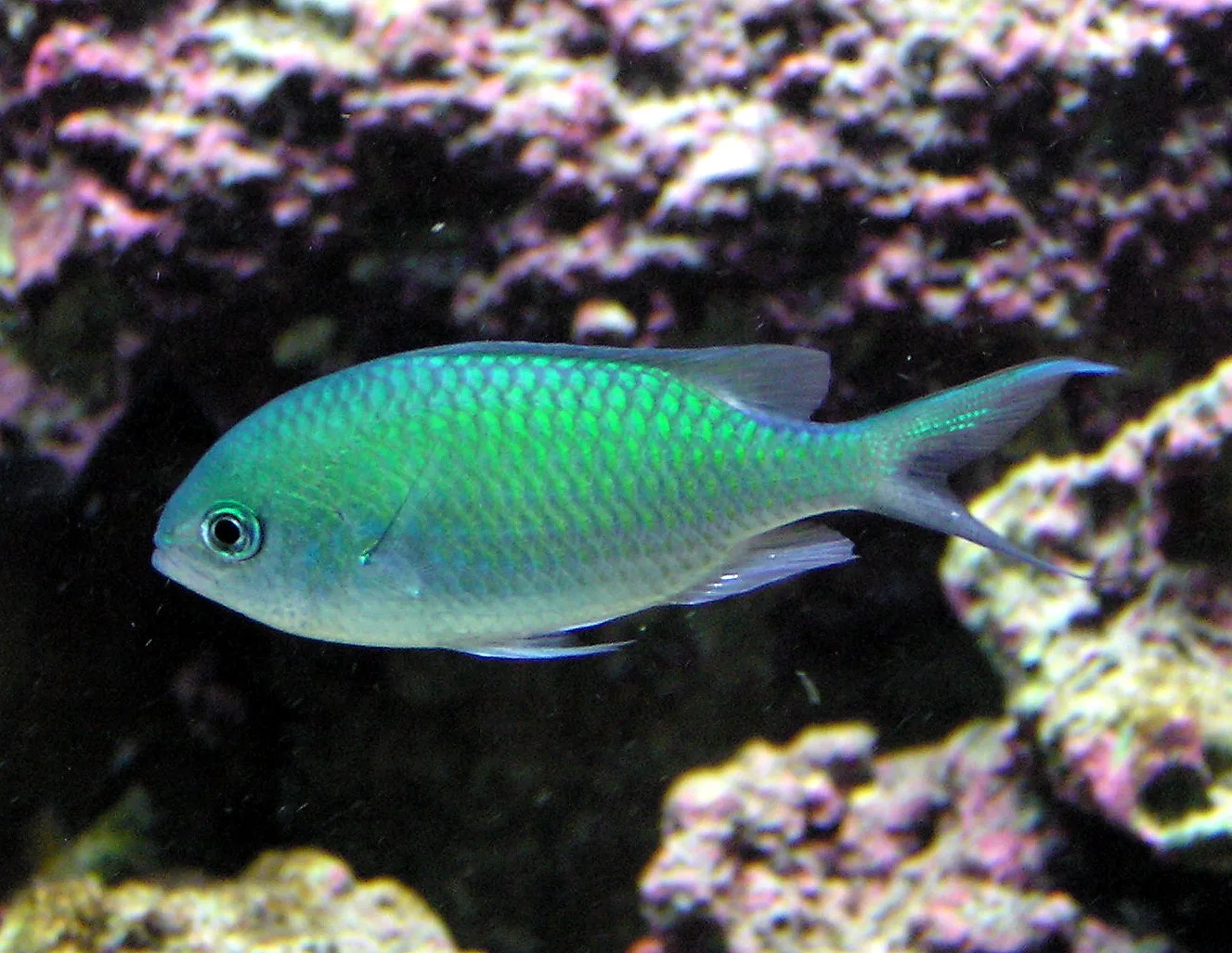
Chromis viridis is a small damselfish (Pomacentridae) that reaches about 10 cm total length. It has a deep, compressed body, a deeply forked tail and iridescent apple-green to pale blue coloring, with no bold markings; nesting males turn yellowish. It is very similar to the black-axil chromis, C. atripectoralis, with which it is often confused; that species has a black spot at the base of the pectoral fin.
The species is widespread in the Indo-Pacific, from East Africa and the Red Sea to the Line Islands and Tuamotu Archipelago, north to the Ryukyu Islands and south to the Great Barrier Reef and New Caledonia. Adults form large aggregations above thickets of branching Acropora coral in sheltered places such as subtidal reef flats and lagoons, at about 1-20 m, while juveniles stay close to individual coral heads. It feeds in the water column on plankton: FishBase describes it as a phytoplankton feeder, and other sources list zooplankton such as copepods and amphipods as well as algae.
Reproduction is typical of damselfishes. Males prepare nests on sand or rubble that are shared by several females; the eggs are demersal and stick to the substrate, and the male guards and ventilates them with his tail and eats eggs that fail to develop. Hatching takes about 2-3 days, and the larvae drift in the plankton before settling on the reef. The IUCN lists the species as Least Concern (assessed 2021). Nearly all aquarium specimens are wild-collected; larval rearing has so far succeeded mainly in research settings with low survival.
- Appearance
- Iridescent pale apple-green to light blue all over, with a deeply forked tail and no bars or spots; breeding males turn a muted yellow. Look-alikes: the Black-axil Chromis (C. atripectoralis) has a black spot where the pectoral fin meets the body; the Atlantic Blue Chromis (now Azurina cyanea) is a much deeper blue. In 2026 Indian researchers (ICAR-NBFGR) described Chromis veneta, a near-identical blue-green species from the Indian Ocean and parts of the western Pacific that may have been sold as C. viridis for decades; colour alone does not separate the two.
- Native range
- Indo-Pacific: East Africa and the Red Sea to the Line Islands and Tuamotu Archipelago, north to the Ryukyu Islands, south to the Great Barrier Reef and New Caledonia.
- Habitat
- Sheltered subtidal reef flats and lagoons at about 1-20 m, in large aggregations hovering above thickets of branching Acropora corals; juveniles stay close to individual coral heads.
- Size
- 3.5 in (8.9 cm). FishBase maximum 10 cm TL; LiveAquaria lists 4 in. Most are sold at 1-3 in.
- Lifespan
- Retail and hobby sources give anywhere from "more than 5 years" to 8-15 years with good water quality (LiveAquaria). In practice many aquarium groups lose fish much earlier to disease and in-fighting.
- Conservation
- Least Concern. IUCN Least Concern (assessed 2021). Not listed by CITES. Collected in large numbers for the aquarium trade; captive-bred fish are essentially unavailable commercially, although researchers have spawned the species and reared larvae with low survival (around 5%)
In the aquarium vs in the wild
In your aquarium
A peaceful schooling fish that fills the open water of a reef tank with color and movement, and helps shy fish feel safer by showing that the coast is clear.
On the reef
An abundant plankton feeder that lives in big shoals over Acropora thickets, turning plankton into fish that are in turn eaten by reef predators.
History
Georges Cuvier described the species in 1830 as Pomacentrus viridis; it was later moved to Chromis. Thanks to its color, low price and schooling behavior it has long been one of the most popular reef fish. Recent DNA-based revisions of the damselfishes have broken up the large genus Chromis: WoRMS now places the Atlantic Blue Chromis in Azurina and the Bicolor Chromis in Pycnochromis, but the green chromis remains in Chromis. Captive breeding has been reported in research studies (University of Florida's first small batch came from eggs received in 2012), but almost every green chromis in the trade is still wild-caught. In 2026 a cryptic look-alike, Chromis veneta, was described from the Indian Ocean, so some fish traded as green chromis may belong to that species.
Evolution & relatives
Chromis is one branch of the damselfish family Pomacentridae, so the green chromis is a cousin of the clownfishes: same family, different branch, without the anemone partnership. Damselfishes belong to Ovalentaria, a large group of spiny-rayed fishes that lay sticky eggs on the bottom and that also includes dottybacks, blennies and cichlids; gobies and cardinalfishes sit on a separate branch of the fish tree. Within Chromis, its closest look-alike and relative is the black-axil chromis, C. atripectoralis, which is often confused with it.
Family tree, from kingdom down
- Kingdom Animalia Animals Animals are living things made of many cells that must eat food to live. Fish, corals, crabs, snails and sea stars are all animals.
- Phylum Chordata Chordates Chordates have a stiff rod running down their back at some point in their lives. In fish and people, this rod is replaced by a backbone.
- Subphylum Vertebrata Vertebrates Vertebrates are animals with a backbone and a skull. Fish, frogs, birds and people are all vertebrates.
- Infraphylum Gnathostomata jawed vertebrates
- Parvphylum Osteichthyes bony fishes
- Gigaclass Actinopterygii ray-finned fishes
- Superclass Actinopteri
- Class Teleostei Teleost fishes Teleosts are bony fishes with thin, bendy fin rays and jaws that can push forward. Almost all of the fish in the world are teleosts.
- Order Ovalentaria (unplaced) Unplaced ovalentarian fishes Ovalentaria is a big group of fish with spiny fins. Scientists found it by studying DNA, and most of its fish lay eggs that stay stuck to the bottom. 'Incertae sedis' means 'place not sure': scientists have not settled which order damselfishes, dottybacks and basslets belong in.
- Family Pomacentridae Damselfishes and clownfishes Damselfishes are small, often colorful reef fish that guard their homes. Clownfish and chromis are damselfishes.
- Genus Chromis Chromises Chromis are small damselfish that swim in groups above the reef. They eat tiny animals floating in the water.
- Species Chromis viridis
See it on the Tree of Life Compare with another species
Closest relatives
- Chromis atripectoralis Black-axil Chromis Same genus; near-identical look-alike, often confused with it
- Azurina cyanea Blue Chromis Same family; formerly in Chromis, now moved to Azurina
- Pycnochromis margaritifer Bicolor Chromis Same family; formerly in Chromis, now moved to Pycnochromis
- Dascyllus aruanus Humbug Damselfish (Banded Dascyllus) Same family (Pomacentridae)
- Amphiprion ocellaris Ocellaris Clownfish Same family (Pomacentridae); clownfish branch Read guide · Compare
Fun facts
- Males turn yellowish when they are ready to nest.
- One male's nest can hold eggs from several females, and he guards them all.
- Their eggs hatch in only 2-3 days, much faster than clownfish eggs.
- The dad eats eggs that do not develop, which keeps the nest clean.
- It is often confused with the black-axil chromis, which has a black "armpit" spot at the base of each pectoral fin.
Learn more
- FishBase: Chromis viridis (Blue green damselfish) fishbase.se
- Wikipedia: Chromis viridis en.wikipedia.org
- LiveAquaria: Green Reef Chromis liveaquaria.com
- AquaHoy: Blue Green Damselfish (Chromis viridis) care guide aquahoy.com
Sources
- WoRMS: Chromis viridis marinespecies.org
- FishBase: Chromis viridis (Blue green damselfish) fishbase.se
- FishBase: Chromis atripectoralis (Black-axil chromis) fishbase.se
- Wikipedia: Chromis viridis en.wikipedia.org
- LiveAquaria: Green Reef Chromis liveaquaria.com
- AquaHoy: Blue Green Damselfish (Chromis viridis) care guide aquahoy.com
- AlgaeBarn: Uncommon saltwater diseases and infections (Uronema) algaebarn.com
- Wikipedia: Ovalentaria en.wikipedia.org
- Rising Tide Conservation: Green Chromis (larval rearing research) risingtideconservation.org
- ICAR: New species discovery puts Lakshadweep's blue-green chromis (Chromis veneta) in the spotlight (2026) icar.org.in
Care facts
The care facts on this guide and its product pages (care level, reef safety, temperament, size, tank, diet, flow, purpose, foods, acclimation and origin) combine 15 independent sources, checked October 25, 2026.
- Chromis viridis summary FishBase
- Blue/Green Reef Chromis (LiveAquaria) LiveAquaria
- Green Chromis - Chromis viridis - Small That Pet Place
- Green Chromis (Chromis viridis) Saltwater Aquarium Blog
- Green Chromis Aquariadise
- Green Chromis Fishkeeper UK
- Blue-green damselfish (Chromis viridis): A Complete Care Guide AquaHoy (Milthon Lujan)
- Blue Green Chromis Care: The Complete Guide Aquarium Source (Alison Yang)
- Green Chromis Care Guide: Hardy Schooling Fish for Reef Tanks Gensou (Singapore retailer)
- Blue / Green Chromis (Chromis viridis) Kraken Corals
- Blue Green Reef Chromis Quality Marine
- Green Chromis Top Shelf Aquatics
- 9 Easy Steps to Drip Acclimating New Saltwater Fish Bulk Reef Supply
- How to Drip Acclimation Quality Marine
- Acclimating Fish Using Drip Method Saltwater Aquarium Blog
Scientific names and classification follow the World Register of Marine Species (AphiaID 212811). Last updated October 25, 2026.
Shop this species
Search the shop →Sold out right now. We restock weekly, so check back soon.
Sold out