 Sold out
Fish · Rabbitfish
Foxface Rabbitfish
Siganus vulpinus
Also called Foxface, Foxface Lo, Fox Face Rabbitfish
- CareEasy
- Reef safeWith caution
- TemperamentPeacefulPeaceful; fights other rabbitfish; venomous spines
- Favorite foods
- Nori / algae sheets
- Macroalgae (seaweed)
- Spirulina pellets
- Max size9 in (22.9 cm)
- Min tank125 gal
- LifespanNot well documented
- IUCN statusLeast Concern
Quick answers
- How big does the Foxface Rabbitfish get?
- Up to 9 in (22.9 cm).
- What size tank does it need?
- At least 125 gallons.
- How hard is it to keep?
- Care level: Easy.
- Is it reef safe?
- With caution. Most well-fed foxfaces ignore corals and help control nuisance algae, but some individuals nip at fleshy LPS and soft coral polyps, especially when hungry.
- What does it eat?
- Nori / algae sheets
- Macroalgae (seaweed)
- Spirulina pellets
- How long does it live?
- Not well documented.
- What are good tankmates?
- Tangs
- Clownfish
- Wrasses
- Angelfish
- Gobies and blennies
The 30-second version
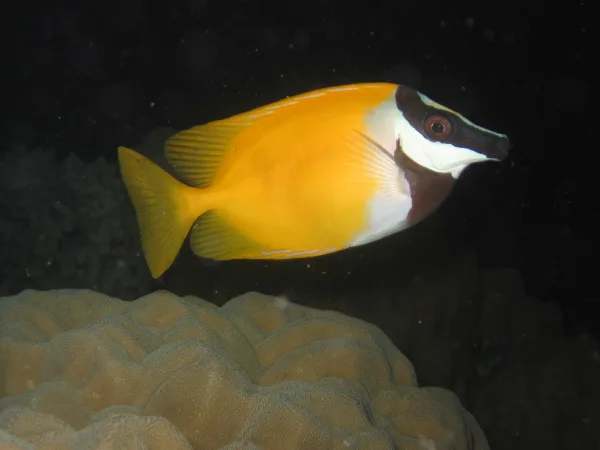
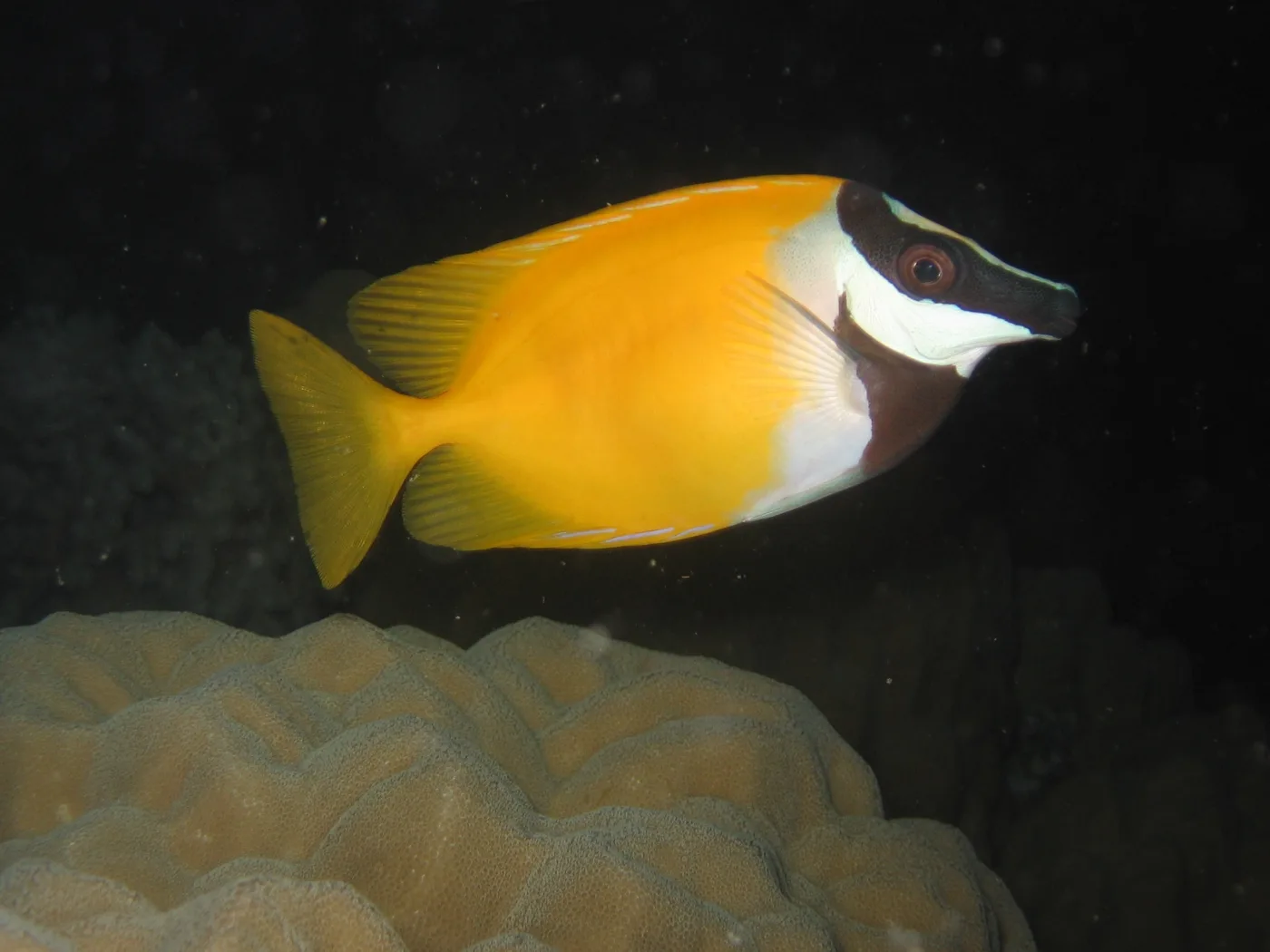
The foxface rabbitfish has a white face with a black stripe through its eyes, a black chest, and a bright yellow body. Its long, pointy snout makes it look a bit like a fox. That is how it got its name. It lives on coral reefs in the western Pacific Ocean. There it nibbles algae, often near branching corals. The spines on its fins carry venom, so a poke really hurts. When it is scared, or at night when it rests, it turns dark and blotchy so it is harder to see. Most other fish leave it alone because of those spines. In a home tank it is calm, tough and great at eating algae. Just remember the rule for this fish: look, but don't touch!
Water & care
Hardy and forgiving, eats readily and is often recommended for newer tanks, but it grows large and needs about 125 gallons as an adult (a 75-gallon tank is fine only while it is young). Its venomous spines make tank maintenance and netting the real hazard. Keep it well fed with algae to protect corals.
| Parameter | Keep it at | Where that sits on the usual reef range |
|---|---|---|
| Temperature | 72–78 °F | |
| Salinity (SG) | 1.020–1.025 | |
| pH | 8.1–8.4 | |
| Alkalinity | 8–12 dKH | |
| Calcium | 350–450 ppm | |
| Magnesium | 1,150–1,350 ppm | |
| Nitrate | 0–30 ppm | |
| Phosphate | 0–0.1 ppm |
Ranges are LiveAquaria's general marine fish guidelines (its foxface page gives the same temperature, pH, dKH and specific gravity). Calcium and magnesium matter for the tank rather than the fish. In a coral reef, keep specific gravity 1.023-1.025 and nutrients as low as your corals need. This is a hardy species that tolerates a range of conditions, but stable water is still best.
Feeding
DietHerbivore
Favorite foods
- Dried marine algae sheets (nori and other seaweed) on a clip
- Spirulina and algae-based flakes and pellets
- Frozen herbivore formulas
- Live macroalgae and nuisance algae growing in the tank
- Occasional mysis shrimp
Mostly green and marine plant foods, with occasional meaty foods such as mysis. Feed algae-based foods every day, ideally two or more small feedings; soaking dry foods in a vitamin and HUFA supplement helps. A hungry foxface is more likely to sample coral polyps.
Tank & maintenance
- Minimum tank
- 125 gallons
- Aquascape
- Rockwork with caves and overhangs to retreat into, plus open swimming space.
- Lighting
- No special needs; normal reef or fish-only lighting.
- Water flow
- Moderate flow is fine.
Routine upkeep
Routine water changes and filter care. The main issue is safety: know where the foxface is before putting your hands in the tank, and never handle it bare-handed. Use a container rather than a net to move it, since the spines tangle in netting.
Temperament & tankmates
TemperamentPeaceful
Generally indifferent to other fish, and even aggressive tankmates usually leave it alone because of its venomous spines. It may squabble with other rabbitfish, so keep one per tank unless the tank is very large. When threatened it raises its spines rather than attacking.
Reef safeWith caution
Most well-fed foxfaces ignore corals and help control nuisance algae, but some individuals nip at fleshy LPS and soft coral polyps, especially when hungry. As an algae eater it does not prey on shrimp, crabs or snails.
Good tankmates
- Tangs
- Clownfish
- Wrasses
- Angelfish
- Gobies and blennies
- Semi-aggressive community fish
Avoid
- Other foxfaces and rabbitfish in all but very large tanks
- Prized fleshy LPS or soft corals if you cannot keep it well fed
- Tanks under 125 gallons for adults
Help it thrive
- Feed marine algae every day; a well-fed foxface is less likely to nibble corals.
- Give it caves and rock overhangs to retreat to; a dark, blotchy color at night or when startled is normal.
- Keep only one rabbitfish unless the tank is very large.
- Plan for the adult size: about 9-10 inches and a 125-gallon tank.
- Quarantine it like any new fish before adding it to the display.
Common ailments
Marine ich (white spot, Cryptocaryon irritans)
- Signs
- Salt-grain white spots, scratching, rapid breathing and poor appetite.
- Prevention
- Quarantine new fish and keep water stable; foxfaces are hardier than most tangs but not immune.
- Treatment
- Treat in a hospital tank with copper or chloroquine phosphate (follow the product's directions), hyposalinity (SG about 1.009) or the tank-transfer method; never in a reef display. Leave the display fishless long enough for the parasite to die out (its cyst stage can last up to about 72 days).
Marine velvet (Amyloodinium ocellatum)
- Signs
- Fine gold or gray dusty coating, very rapid breathing, hiding and fast decline.
- Prevention
- Quarantine and observation of every new fish.
- Treatment
- A temperature- and pH-matched freshwater dip for quick relief, then copper treatment in a hospital tank following the product's directions, with the display left fishless.
Stress coloring mistaken for illness
- Signs
- Sudden dark, blotchy or mottled color, often with spines raised.
- Prevention
- Provide hiding places, avoid sudden disturbances, and learn its normal night coloring.
- Treatment
- Usually none needed: the color returns when it calms down. If it stays dark for days, stops eating or breathes fast, check water quality and look for parasites.
This is general hobby guidance, not veterinary advice. Quarantine new arrivals and treat in a separate tank whenever you can.
Risks of owning one
- Venomous spines in the dorsal, anal and pelvic fins can cause a very painful sting. First aid: remove any visible spine fragments, soak the wound for 30-90 minutes in hot but not scalding water, about 104-113 °F (40-45 °C) and never hotter, testing the temperature with an unaffected hand first, then clean it, and seek medical care for severe pain, deep spines, infection or symptoms such as dizziness, nausea or breathing trouble.
- The spines easily snag in nets; move it with a container instead.
- Some individuals nip fleshy LPS and soft corals, especially when underfed.
- Grows to about 10 inches and needs a large tank as an adult.
- Two rabbitfish in the same tank often fight.
Breeding
DifficultyHard Captive-bredRare or wild-caught
Rabbitfishes lay sticky eggs that sink and stick to surfaces, unlike tangs' floating eggs. A Chinese research institute patented an indoor hatchery method in 2016-2017: wild-caught adults spawned in the second half of the lunar month, eggs hatched in about 25 hours at 28 °C, and larvae were raised on rotifers and then copepods, producing over 1,000 juveniles but with survival the authors called 'not very satisfactory'. Spawning has not been documented in home aquariums, and captive-bred foxfaces are not sold.
- Condition healthy adults over about 18 cm on algae, pellets and some shrimp and clam meat with vitamin supplements, at about 27-31 °C (81-88 °F).
- Watch for spawning in the second half of the lunar month (around lunar days 26-30), usually in the evening.
- Collect the sticky, sinking eggs, rinse and disinfect them, and hatch them in aerated tanks; at 28 °C they hatch in about 25 hours.
- Feed larvae rotifers for about the first 15 days, then small copepods (under 1 mm) from about day 15, and larger copepods from about day 25.
- Wean juveniles onto finely minced seafood and small pellets.
Deep dive The science, history and family tree
The science
Siganus vulpinus is a rabbitfish (family Siganidae) with a deep, strongly compressed body, a tubular, fox-like snout with a small mouth, and a weakly forked tail. Like all rabbitfishes it has unusual pelvic fins with a spine on both the outer and inner edge, and its dorsal fin carries 13 spines and 10 soft rays while the anal fin has 7 spines and 9 soft rays. The fin spines have venom glands and can deliver a very painful sting. The body is vivid yellow, the head and front of the body are white, a black band runs from the mouth through the eye to the start of the dorsal fin, and a black area covers the breast. When threatened it can turn dark brown, and at night or under stress it shows a duller, mottled pattern. It reaches about 25 cm, with 20 cm more typical. The species ranges from the far eastern Indian Ocean through the western Pacific, from Indonesia and the Philippines east to the Marshall and Gilbert islands and Tonga, north to Taiwan and south to New Caledonia and Australia. It lives in coral-rich areas of lagoons and seaward reefs to about 30 m and is often associated with branching Acropora (staghorn) corals. Adults are usually solitary or paired; juveniles and subadults sometimes form large schools that feed on algae growing at the bases of dead coral branches. The diet is mainly algae with some zooplankton. Rabbitfishes lay sticky, sinking eggs. The very similar one-spot foxface (S. unimaculatus) shares its range and is not genetically distinct, and may be only a color morph.
- Appearance
- Bright yellow body with a white face and forehead, a black diagonal band from the snout through the eye, and a black throat and chest patch; long, narrow snout. Under stress or at night it becomes dark and mottled brown, which is normal. Look-alikes: the one-spot foxface (Siganus unimaculatus) is nearly identical but has a black spot on the rear of the body; the magnificent foxface (S. magnificus) and the bicolor foxface (S. uspi) have the same body shape with different colors.
- Native range
- Far eastern Indian Ocean and western Pacific: Indonesia and the Philippines east to New Guinea, the Caroline, Marshall and Gilbert islands, Nauru and Tonga; north to Taiwan; south to New Caledonia and Australia (Western Australia, Ashmore Reef, and the Great Barrier Reef south to the Capricorn group).
- Habitat
- Coral-rich lagoon and seaward reefs from near the surface to about 30 m (100 ft), often among branching Acropora (staghorn) corals. Adults are solitary or in pairs and sometimes territorial; juveniles and subadults can school among Acropora.
- Size
- 9 in (22.9 cm). Maximum about 25 cm (FishBase gives 25 cm standard length; Wikipedia 25 cm total length), with about 20 cm (8 in) more typical. LiveAquaria lists a maximum of 9 in.
- Lifespan
- Not well documented. Hobby sources commonly report about 5-10 years in aquariums with good care; no published age study was found.
- Conservation
- Least Concern. IUCN Least Concern (assessed 2015). Not listed by CITES. No catch statistics are kept; it is speared in mixed reef-fish catches in some areas. Aquarium specimens are wild-caught, mainly from Indonesia and the Philippines; captive-bred foxfaces are not in the trade
In the aquarium vs in the wild
In your aquarium
A hardy, peaceful algae eater for larger reef and fish-only tanks; it rivals tangs at controlling algae and readily eats undesirable algae growing in the tank.
On the reef
A grazing herbivore that feeds on algae around coral heads, including algae growing on the bases of dead Acropora branches, and also eats some zooplankton. Its venomous spines make it an unattractive prey item.
History
Hermann Schlegel and Salomon Müller described the species in 1845 as Amphacanthus vulpinus, from Ternate in the Moluccas, Indonesia. The name vulpinus means 'fox-like', probably for its pointed snout. It has also been placed in the genera Teuthis and Lo, and the old name Lo vulpinus survives in the trade name 'Foxface Lo'. It has long been a staple of the marine aquarium trade as a hardy, peaceful algae eater, and hobby writers commonly recommend it for newer tanks.
Evolution & relatives
Rabbitfishes form the family Siganidae, which has only one living genus, Siganus, with about 29 species. WoRMS places them in the order Acanthuriformes alongside the surgeonfishes and tangs, and current classifications of that order also include the Moorish idol, butterflyfishes, angelfishes and the scats; so the foxface is a fairly close cousin of tangs, but on a separate branch from all of them. The order's fossil record goes back to the Late Paleocene, and fossil relatives of rabbitfishes (such as Eosiganus and Protosiganus) are known. Within Siganus, the foxface belongs to a group of long-snouted, reef-dwelling species including the one-spot foxface (S. unimaculatus), which genetic studies cannot separate from S. vulpinus, and the magnificent foxface (S. magnificus). Several closely related rabbitfishes are thought to interbreed.
Family tree, from kingdom down
- Kingdom Animalia Animals Animals are living things made of many cells that must eat food to live. Fish, corals, crabs, snails and sea stars are all animals.
- Phylum Chordata Chordates Chordates have a stiff rod running down their back at some point in their lives. In fish and people, this rod is replaced by a backbone.
- Subphylum Vertebrata Vertebrates Vertebrates are animals with a backbone and a skull. Fish, frogs, birds and people are all vertebrates.
- Infraphylum Gnathostomata jawed vertebrates
- Parvphylum Osteichthyes bony fishes
- Gigaclass Actinopterygii ray-finned fishes
- Superclass Actinopteri
- Class Teleostei Teleost fishes Teleosts are bony fishes with thin, bendy fin rays and jaws that can push forward. Almost all of the fish in the world are teleosts.
- Order Acanthuriformes Surgeonfishes, angelfishes and kin This order of fishes includes surgeonfishes, marine angelfishes and rabbitfishes. Many have deep, flat bodies and graze on reefs.
- Family Siganidae Rabbitfishes Rabbitfishes nibble algae like rabbits nibble grass. Their fin spines have venom that can sting.
- Genus Siganus Rabbitfishes Siganus is the main group of rabbitfishes, including the foxface. They eat algae and have venomous fin spines.
- Species Siganus vulpinus
See it on the Tree of Life Compare with another species
Closest relatives
- Siganus unimaculatus One-spot Foxface Same genus; not genetically distinct and possibly the same species
- Siganus magnificus Magnificent Foxface Same genus; long-snouted foxface
- Siganus uspi Bicolor Foxface Same genus; long-snouted foxface
- Siganus puelloides Blackeye Rabbitfish Same genus
- Siganus corallinus Coral Rabbitfish Same genus
- Siganus lineatus Goldlined Rabbitfish Same genus
- Zebrasoma flavescens Yellow Tang Different family (Acanthuridae) in the same order, Acanthuriformes Read guide · Compare
Older scientific names: Lo vulpinus, Amphacanthus vulpinus, Teuthis vulpinus, Teuthis vulpina.
Fun facts
- Its scientific name, vulpinus, means 'fox-like', after its pointed snout.
- At night or when frightened it switches from bright yellow to dark, blotchy brown in seconds.
- Rabbitfish venom in at least three species resembles stonefish venom.
- Rabbitfishes have a pelvic fin found in no other fish family: two spines with three soft rays between them.
- The one-spot foxface looks almost identical and may turn out to be the same species, just with an extra black spot.
Learn more
- FishBase: Siganus vulpinus fishbase.se
- Wikipedia: Foxface rabbitfish en.wikipedia.org
- Reef Builders: Foxface rabbitfish, a hardy herbivore overview reefbuilders.com
- Top Shelf Aquatics: Handling rabbitfish safely topshelfaquatics.com
Sources
- WoRMS: Siganus vulpinus (Schlegel & Müller, 1845) marinespecies.org
- FishBase species summary: Siganus vulpinus fishbase.se
- Wikipedia: Foxface rabbitfish en.wikipedia.org
- Wikipedia: Rabbitfish en.wikipedia.org
- LiveAquaria: Foxface Lo (product page) liveaquaria.com
- LiveAquaria: Proper water parameters for home aquariums liveaquaria.com
- Reef Builders: Foxface rabbitfish, a hardy herbivore overview reefbuilders.com
- Top Shelf Aquatics: Handling rabbitfish safely (venomous spines) topshelfaquatics.com
- UF Health: Scorpion fish sting (hot-water first aid, 40-45 °C for 30-90 minutes) ufhealth.org
- Patent CN106688970A: Indoor artificial breeding of Siganus vulpinus fingerlings patents.google.com
- Wikipedia: Acanthuriformes en.wikipedia.org
- Wikipedia: Cryptocaryon en.wikipedia.org
Care facts
The care facts on this guide and its product pages (care level, reef safety, temperament, size, tank, diet, flow, purpose, foods, acclimation and origin) combine 17 independent sources, checked October 25, 2026.
- Foxface Lo (Siganus vulpinus) LiveAquaria
- Foxface Rabbitfish Saltwater Aquarium Blog (Albert B Ulrich III)
- Magnificent Foxface - The Ultimate Guide to Rabbitfish Tank Size & Growth Rate Top Shelf Aquatics
- Siganus vulpinus summary FishBase
- Foxface Rabbitfish Care Sheet: The Complete Guide Build Your Aquarium
- Foxface Rabbitfish Aquariadise (Jennifer Doll)
- Foxface Rabbitfish (Siganus vulpinus) - Tidal Arc Tidal Arc
- Foxface Rabbitfish (Siganus vulpinus) Tropic N Reef Aquariums
- Foxface Rabbitfish Saltwaterfish.com
- Foxface (Siganus vulpinus) - Care Guide - Eastwood Aquarium Eastwood Aquarium (Australia)
- Foxface - Siganus vulpinus Fishkeeper UK
- Siganus vulpinus AquaInfo.nl
- Foxface Rabbitfish (Siganus vulpinus) - Care Guide Reef Archive
- Foxface Lo Top Shelf Aquatics
- Foxface TankZen
- Foxface Rabbitfish Aquarium Source
- Foxface rabbitfish care guide Gensou
Scientific names and classification follow the World Register of Marine Species (AphiaID 273929). Last updated October 25, 2026.
Shop this species
Search the shop →Sold out right now. We restock weekly, so check back soon.
Sold out