Fish · Wrasse
Exquisite Wrasse
Cirrhilabrus exquisitus
Also called Exquisite Fairy Wrasse, Exquisite Fairy-wrasse
Reviewed by admin on October 29, 2026 · Meet the team
- CareEasy
- Reef safeYes
- TemperamentPeacefulMales spar with other male fairy wrasses
- Favorite foods
- Mysis shrimp
- Enriched brine shrimp
- Marine pellets
- Max size4.7 in (12 cm)
- Min tank70 gal
- LifespanNot documented for this species
- IUCN statusData Deficient
Quick answers
- How big does the Exquisite Wrasse get?
- Up to 4.7 in (12 cm).
- What size tank does it need?
- At least 70 gallons.
- How hard is it to keep?
- Care level: Easy.
- Is it reef safe?
- Yes. Does not bother corals, clams or other invertebrates, so it suits reef tanks.
- What does it eat?
- Mysis shrimp
- Enriched brine shrimp
- Marine pellets
- How long does it live?
- Not documented for this species.
- What are good tankmates?
- Tangs and surgeonfish
- Cardinalfish
- Chromis
- Rabbitfish
- Halichoeres wrasses
The 30-second version
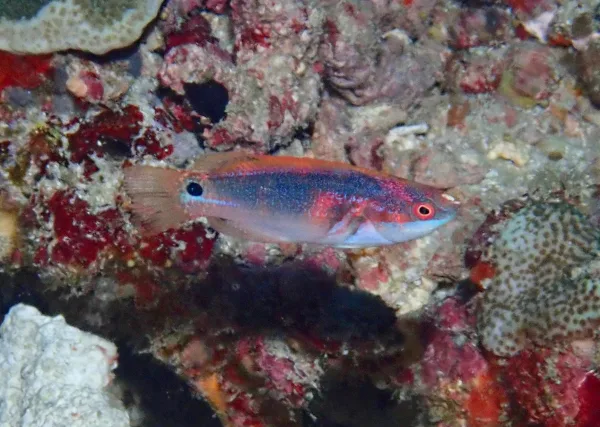
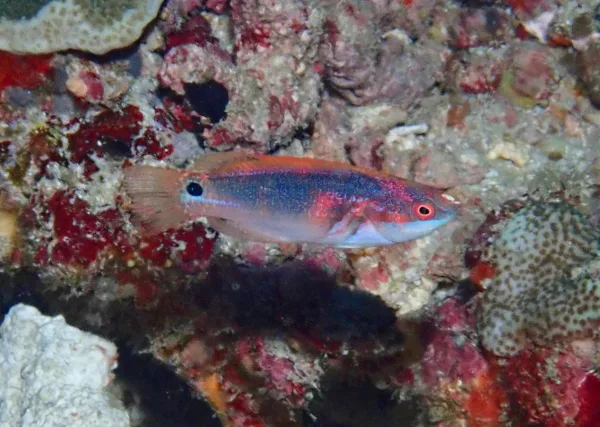
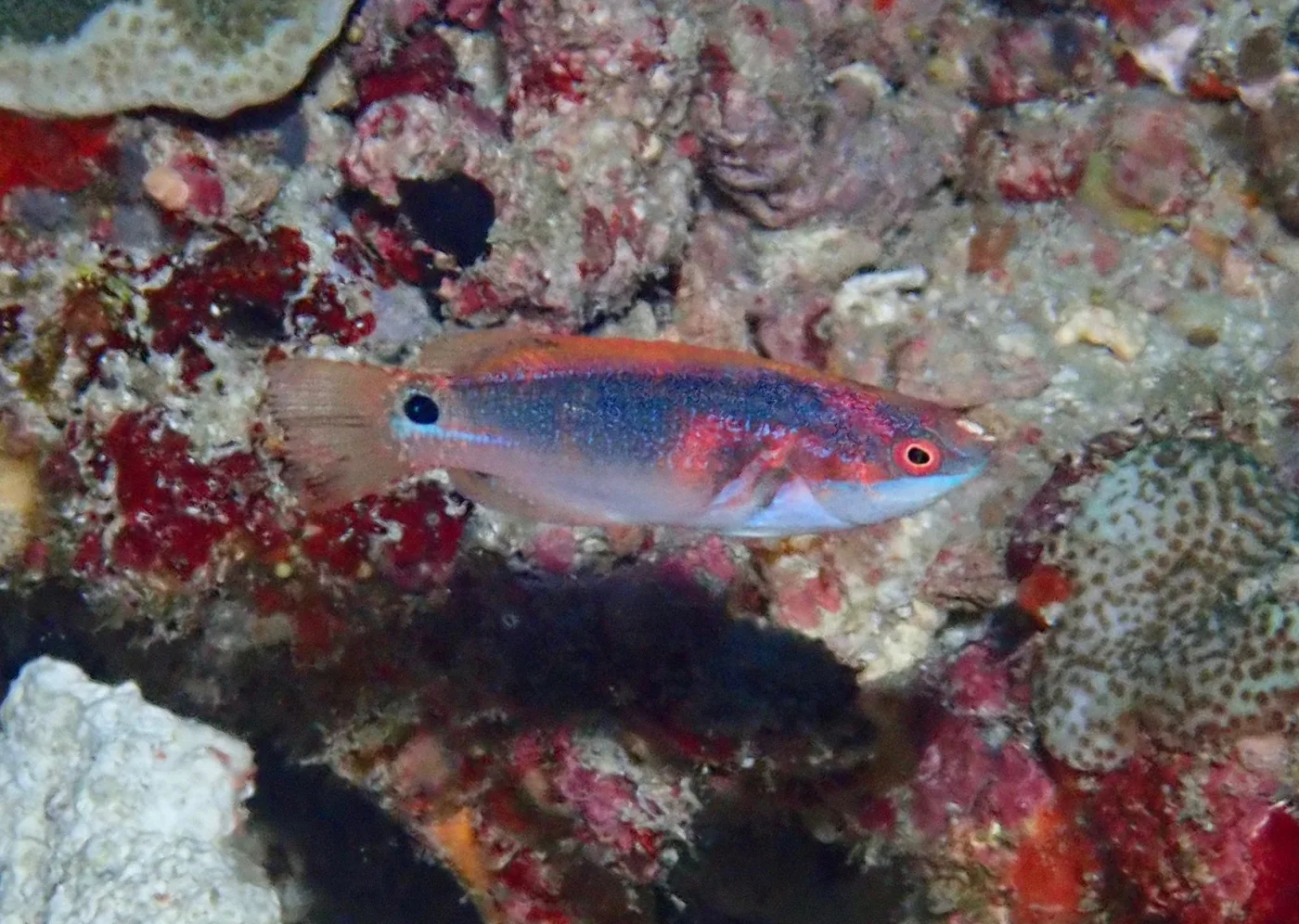
The exquisite wrasse is a small fish with bright colors. It grows to about four or five inches long. The boys are dark green. They have red on their fins and thin blue lines on the face. They also have a black spot near the tail. The girls and young fish are red, with a white tip on the nose. This fish lives on reefs from Africa to islands far out in the Pacific Ocean. It swims in groups above the rocks. It snaps up tiny animals that float by in the water. Most of these fish start life as girls. A big girl can turn into a boy. In a tank it leaves corals alone. But it is a good jumper, so the tank needs a tight lid.
Water & care
Hardy once it is eating. Start with vitamin-enriched frozen mysis and brine shrimp and other small meaty foods, then add flakes and pellets once it settles. Feed at least twice a day, ideally two or three small meals. Choose a fish that is alert, undamaged and already eating, because shipping can damage the mouth. Give it plenty of rockwork with caves for the night, open water to cruise in, a shaded area, brisk flow and a tight lid with a screened overflow.
| Parameter | Keep it at | Where that sits on the usual reef range |
|---|---|---|
| Temperature | 72–78 °F | |
| Salinity (SG) | 1.020–1.025 | |
| pH | 8.1–8.4 | |
| Alkalinity | 8–12 dKH |
LiveAquaria and Quality Marine agree on 72-78°F, SG 1.020-1.025, pH 8.1-8.4 and 8-12 dKH. In a reef tank it needs nothing beyond the parameters the corals need. No species-specific calcium, magnesium, nitrate or phosphate limits are published.
Feeding
DietPlanktivore
Favorite foods
- Vitamin-enriched frozen mysis shrimp
- Enriched brine shrimp
- Frozen copepods
- Finely chopped shrimp, clam and mussel
- Marine pellets and flakes
Feed small amounts at least twice a day; two or three meals, or several small portions spread through the day, are better. A new fish may hide while food is in the water, so offer small amounts repeatedly until it gains confidence.
Tank & maintenance
- Minimum tank
- 70 gallons
- Aquascape
- Plenty of rockwork with crevices and caves for shelter and sleeping, plus open swimming space above it. A deep sand bed is not needed because it does not bury itself. LiveAquaria recommends a shaded area. Use a tight-fitting lid and screen the overflow.
- Lighting
- No special requirement; normal reef or fish-only lighting.
- Water flow
- Brisk, varied flow like its current-swept rubble habitat; Quality Marine suggests combined flow of at least ten times the tank volume per hour.
Routine upkeep
Routine reef or fish-only upkeep with regular partial water changes. Check the lid and overflow cover often, since gaps are the usual way fairy wrasses are lost. Keep feeding frequent, and watch males for chasing if you add other fairy wrasses. A mucus cocoon from the night before may sometimes be seen; this is normal.
Temperament & tankmates
TemperamentPeaceful
Peaceful toward most community reef fish. Males can be territorial toward other male fairy wrasses, similar-looking species and other zooplankton feeders, mainly in cramped tanks. One aquarium profile (Aquatic Community) calls it semi-aggressive and says it can grow more aggressive over time. Keep one male, a male-female pair, or one male with several females added at the same time (or females first). It can itself be bullied by six line wrasses and other pushy fish.
Reef safeYes
Does not bother corals, clams or other invertebrates, so it suits reef tanks. Quality Marine and Top Shelf Aquatics note it may occasionally pick at very small crustaceans, so watch prized tiny shrimp or pods. It does not dig, so it will not disturb the sand bed. A startled fish can bolt into a strong-stinging anemone and be caught, so avoid very powerful anemones.
Good tankmates
- Tangs and surgeonfish
- Cardinalfish
- Chromis
- Rabbitfish
- Halichoeres wrasses
- Its own females in a harem with one male
Avoid
- Another male exquisite or similar-looking male fairy wrasse in a small tank
- Six line wrasses and other bullying rock wrasses
- Large damselfish
- Aggressive triggerfish and puffers
- Large, strong-stinging anemones
- Predators large enough to swallow it
Help it thrive
- Use a tight-fitting lid and a screened overflow; it rushes upward when startled.
- Feed two or three small meals of mysis, enriched brine and pellets every day.
- Buy a fish that is alert, undamaged and already eating.
- For a harem, add one male and several females at the same time, or the females first.
- Add it before feistier fish such as six line wrasses, or skip those fish.
Common ailments
Marine ich (Cryptocaryon irritans)
- Signs
- White, salt-like spots on the body, fins or gills, scratching, rapid breathing, cloudy eyes, hiding and loss of appetite.
- Prevention
- Quarantine new fish in a separate tank before adding them to the display, and keep water stable.
- Treatment
- Treat in a hospital tank, never in a reef display, using copper, chloroquine phosphate, hyposalinity or the tank-transfer method. Give the wrasse a cave or pipe to hide in during treatment. Leave the display without fish for about 11 weeks, because the cyst stage can last up to 72 days.
Mouth damage and refusing food after shipping
- Signs
- A new fish hides, ignores food in the water or cannot pick it up, and grows thin, with a pinched belly.
- Prevention
- Choose a fish that is alert, has an undamaged mouth and is already eating in the store.
- Treatment
- Offer small frozen foods such as enriched brine shrimp and mysis several times a day in a calm tank, and keep pushy tankmates away until it feeds well.
Stress from bullying tankmates
- Signs
- Constant hiding, torn fins, faded color and missed meals; a chased fairy wrasse may also jump.
- Prevention
- Avoid six line wrasses, large damsels and other bullies, and give it a large tank with plenty of rock.
- Treatment
- Move the bully or the wrasse, add more cover, and feed the wrasse well while it recovers.
This is general hobby guidance, not veterinary advice. Quarantine new arrivals and treat in a separate tank whenever you can.
Risks of owning one
- Jumps out of open tanks and through small gaps, especially when startled.
- Males fight with other male fairy wrasses in tanks that are too small.
- May pick at very small crustaceans.
- Can be stung and caught by powerful anemones when it bolts.
- Wild-caught only; fish from different regions look very different, and red markings on some western Pacific fish can fade in captivity.
Breeding
DifficultyNot achieved Captive-bredRare or wild-caught
A protogynous hermaphrodite: dominant females turn into males, and fish form distinct pairs to breed. Males display to each other and to females by brightening their colors. Wikipedia states that it has not been bred in captivity, and no captive-bred exquisite wrasses are sold. For fairy wrasses in general, the University of Hawaii at Hilo reports that captive females quickly change into males, which makes it hard to keep a group producing eggs.
- Keep one male with three to five females, all added together, in a large tank (Quality Marine suggests about 125 gallons for a small harem).
- Condition the group with several meaty meals a day.
- Watch for male displays, when the male brightens and spreads his fins.
- No one has documented raising the larvae, so any attempt is experimental.
Deep dive The science, history and family tree
The science
Cirrhilabrus exquisitus Smith, 1957 is a fairy wrasse (Labridae: Cirrhilabrinae) described from Pinda, Mozambique, and the most widespread member of its genus, ranging from East Africa and Sodwana Bay, South Africa, east to the Tuamotu Islands and north to the Ryukyu Islands. The dorsal fin has 11 spines and 8-9 soft rays, the anal fin 3 spines and 9 soft rays. Adult males are olive green above, shading to white, pale blue or pink below, with blue lines on the head and body, a blue-edged black bar at the pectoral-fin base, red in the median fins, a doubly emarginate caudal fin and an oval black spot on the caudal peduncle. Juveniles and small females are reddish with a white snout tip. Maximum size is about 11 cm TL. It lives over rubble and low patch reefs swept by current, at about 2-40 m, in mixed-sex groups that feed on zooplankton well above the bottom. It is a protogynous hermaphrodite that pairs to breed. Color varies by region, and it probably represents a complex of several species. IUCN: Data Deficient.
- Appearance
- Adult males are olive to deep green above and paler below, with thin blue lines on the head and body, red in the fins, a black bar edged in blue at the base of the pectoral fin and an oval black spot on the tail base. Males also grow longer, more pointed fins and a tail with two notches, and they flash brighter blues, oranges, yellows and purples when displaying. Females and juveniles are red with a blue-edged black spot on the tail base and a white spot on the tip of the snout. Color differs a lot by region: Reef Builders describes African males as fir green with a cherry-pink face, western Pacific males as deep green with scarlet-edged fins, and Fiji and Tonga males as very dark hunter green that show pale blue to white saddles on the dorsal fin in display. 'Supermale' is a trade term for a fully colored, dominant terminal-phase male. Scott's fairy wrasse (C. scottorum) overlaps with it across much of the Pacific and can look similar.
- Native range
- Indo-Pacific: East Africa from Kenya to Sodwana Bay, South Africa, east across the Indian Ocean (Seychelles, Maldives, Sri Lanka, Chagos, Andaman Sea) to Indonesia, the Philippines and Palau, north to the Ryukyu Islands and Taiwan, south to Ningaloo Reef, Ashmore Reef and the northern Great Barrier Reef, and east through Melanesia, Fiji, Tonga and Samoa to the Tuamotu Islands. Type locality: Pinda, Mozambique. Aquarium fish come from many of these places, including Kenya, Indonesia, the Philippines, Fiji and Tonga.
- Habitat
- Rubble areas and low patch reefs in places with current, reef edges, and coral heads within rubble zones, often on seaward reef slopes. Recorded from about 2 to 40 m, usually shallower than 10 m. Lives in fairly large groups of mixed sexes that feed on zooplankton well above the bottom. FishBase reports a possible link with the mushroom coral Heliofungia actiniformis.
- Size
- 4.7 in (12 cm). FishBase and Wikipedia give 12 cm (4.7 in) standard length for males; Fishes of Australia gives 11 cm total length. LiveAquaria and Top Shelf Aquatics say 5 in, and Quality Marine says males reach just under 5 in while females rarely exceed 3-3.5 in.
- Lifespan
- Not documented for this species. Hobby sources quote about 5-8 years for fairy wrasses in general; no published longevity study found.
- Conservation
- Data Deficient. Assessed Data Deficient by the IUCN (Yeeting and Rocha). FishBase rates its resilience high and its vulnerability to fishing low. All aquarium specimens are wild-collected; the species has not been bred in captivity. A taxonomic revision of the complex could change how its populations are assessed
In the aquarium vs in the wild
In your aquarium
A colorful, peaceful, open-water display wrasse for reef and fish-only tanks.
On the reef
A mid-water zooplankton feeder that swims in groups above rubble and patch reefs in current-swept areas.
History
J. L. B. Smith described Cirrhilabrus exquisitus in 1957 in a paper on western Indian Ocean wrasses, from fish collected at Pinda, Mozambique. Since then it has been recorded across the Indian and Pacific Oceans, but its colors change from place to place. FishBase notes an undescribed close relative in the western and central Pacific, and Fishes of Australia says it may be a complex of more than one species. In a 2015 Reef Builders review, Australian Museum ichthyologist Kai argued that only the African fish should be thought of as the true C. exquisitus. Quality Marine counts at least ten distinct populations. For now they are all treated as one species. In the hobby it is a popular, hardy fairy wrasse. Kenyan fish are common and moderately priced, while Fiji and Tonga fish cost more.
Evolution & relatives
Fairy wrasses (Cirrhilabrus) belong to the subfamily Cirrhilabrinae, which WoRMS also uses for the flasher wrasses (Paracheilinus), the lined wrasses (Pseudocheilinus, including the six line wrasse), Pseudocheilinops and Pteragogus. Populations of the exquisite wrasse in different ocean regions look different, especially the males, and FishBase, Fishes of Australia and Reef Builders all suggest that some may be separate species not yet described. In Japan it even hybridizes with the black-fin fairy wrasse, C. melanomarginatus. On the site's tree, it sits beside the six line wrasse in Cirrhilabrinae, on a different branch from Halichoeres wrasses such as the melanurus wrasse.
Family tree, from kingdom down
- Kingdom Animalia Animals Animals are living things made of many cells that must eat food to live. Fish, corals, crabs, snails and sea stars are all animals.
- Phylum Chordata Chordates Chordates have a stiff rod running down their back at some point in their lives. In fish and people, this rod is replaced by a backbone.
- Subphylum Vertebrata Vertebrates Vertebrates are animals with a backbone and a skull. Fish, frogs, birds and people are all vertebrates.
- Infraphylum Gnathostomata jawed vertebrates
- Parvphylum Osteichthyes bony fishes
- Gigaclass Actinopterygii ray-finned fishes
- Superclass Actinopteri
- Class Teleostei Teleost fishes Teleosts are bony fishes with thin, bendy fin rays and jaws that can push forward. Almost all of the fish in the world are teleosts.
- Order Eupercaria (unplaced) Unplaced eupercarian fishes Eupercaria is a huge group of fish with spiny fins. Scientists found it by studying DNA, and it holds wrasses, grunts, butterflyfishes and many more. 'Incertae sedis' means 'place not sure': scientists have not yet agreed which order wrasses belong in.
- Family Labridae Wrasses Wrasses are a huge family of colorful fish that swim by flapping their front fins. Many change color, and some change from female to male.
- Subfamily Cirrhilabrinae Fairy wrasses and allies
- Genus Cirrhilabrus Fairy wrasses
- Species Cirrhilabrus exquisitus
See it on the Tree of Life Compare with another species
Closest relatives
- Cirrhilabrus scottorum Scott's Fairy Wrasse Same genus; overlaps with it across much of the Pacific and can look similar
- Cirrhilabrus melanomarginatus Black-fin Fairy Wrasse Same genus; hybridizes with it in Japan
- Paracheilinus Flasher wrasses Same subfamily (Cirrhilabrinae)
- Pseudocheilinus hexataenia Six Line Wrasse Same subfamily (Cirrhilabrinae); a known bully of fairy wrasses Read guide · Compare
Older scientific names: Cirrhilabrus exquistius.
Fun facts
- Like other fairy wrasses, its cornea is split into two parts, and the central part may work as a close-up lens for spotting tiny prey.
- Fairy wrasses sleep inside a mucus cocoon that may hide their scent from predators that hunt at night.
- Scientists think the 'exquisite wrasse' may really be several species; Quality Marine counts at least ten distinct populations.
- In Japan it sometimes hybridizes with a different fairy wrasse, the black-fin fairy wrasse.
- FishBase reports that it may associate with the mushroom coral Heliofungia actiniformis.
Learn more
- FishBase: Cirrhilabrus exquisitus, Exquisite wrasse fishbase.se
- Fishes of Australia: Exquisite Wrasse fishesofaustralia.net.au
- Reef Builders: Fairy wrasses, the exquisitus complex (2015) reefbuilders.com
- TFH Magazine: Cirrhilabrus, the fairy wrasses tfhmagazine.com
Sources
- FishBase species summary: Cirrhilabrus exquisitus fishbase.se
- WoRMS taxon record 218954 marinespecies.org
- Wikipedia: Exquisite wrasse en.wikipedia.org
- Fishes of Australia: Exquisite Wrasse, Cirrhilabrus exquisitus fishesofaustralia.net.au
- Reef Builders: Fairy wrasses, the exquisitus complex (2015) reefbuilders.com
- LiveAquaria: Exquisite Fairy Wrasse liveaquaria.com
- Top Shelf Aquatics: Exquisite Fairy Wrasse care topshelfaquatics.com
- Quality Marine: Absolutely exquisite qualitymarine.com
Scientific names and classification follow the World Register of Marine Species (AphiaID 218954). Checked by our team. Last updated October 29, 2026.
Shop this species
Search the shop →