Fish · Wrasse
Six Line Wrasse
Pseudocheilinus hexataenia
Also called Sixline Wrasse, Six-lined Wrasse, Sixstripe Wrasse, Six Banded Wrasse, Pyjama Wrasse
- CareEasy
- Reef safeYes
- TemperamentSemi-aggressiveBullies other wrasses and small, shy fish
- Favorite foods
- Mysis shrimp
- Meaty frozen foods
- Carnivore pellets
- Max size3.5 in (8.9 cm)
- Min tank55 gal
- LifespanAbout 4-6 years is commonly quoted for…
- IUCN statusLeast Concern
Quick answers
- How big does the Six Line Wrasse get?
- Up to 3.5 in (8.9 cm).
- What size tank does it need?
- At least 55 gallons.
- How hard is it to keep?
- Care level: Easy.
- Is it reef safe?
- Yes. Leaves corals, clams and other sessile invertebrates alone.
- What does it eat?
- Mysis shrimp
- Meaty frozen foods
- Carnivore pellets
- How long does it live?
- About 4-6 years is commonly quoted for aquarium fish (Aquariadise); no published longevity study found.
- What are good tankmates?
- Tangs
- Angelfish
- Larger or more assertive wrasses
- Rabbitfish
- Community-friendly triggerfish
The 30-second version
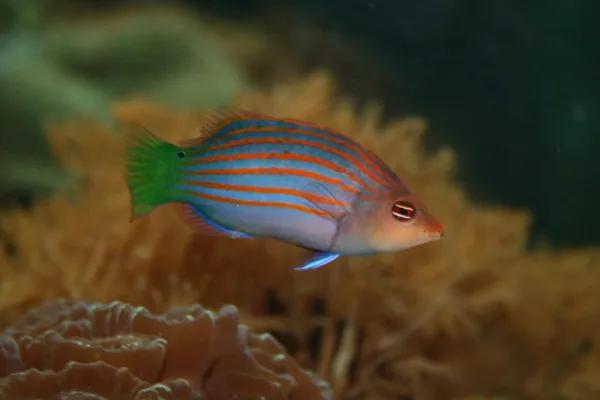
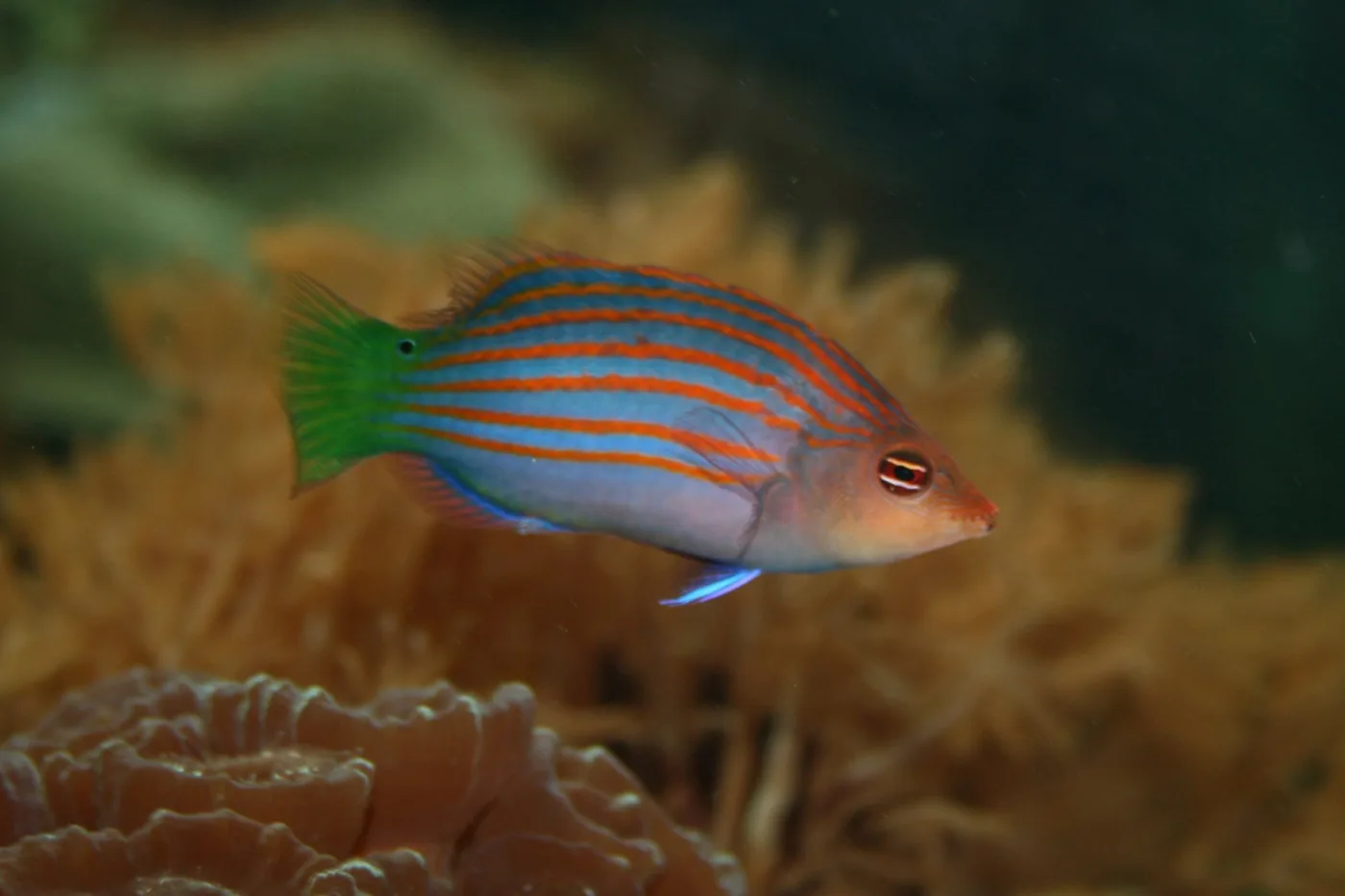
The six line wrasse is a tiny, fast fish about as long as your finger. It is purple and blue, with six thin orange stripes on its sides. It has a little dark spot near its tail that looks like an extra eye. It lives on coral reefs from the Red Sea all the way to the middle of the Pacific Ocean. It darts in and out of coral branches. It hunts tiny shrimp-like animals and worms in the rocks. Sometimes it even picks tiny pests off other fish to clean them. At bedtime it does something amazing. It wraps itself in a slimy sleeping bag that it makes itself. This may hide its smell from hungry fish that hunt at night. In a tank it is tough and busy. But it can be a bully to shy fish that come after it, and it can jump, so the tank needs a lid.
Water & care
Very hardy and active once settled. Most accept small meaty foods quickly, but a newly imported fish may need live foods (such as live brine or small feeder shrimp) at first before switching to frozen mysis, small pellets and flakes. Give it plenty of live rock to hunt through, a tight-fitting lid, and add it last to a community of peaceful fish. It is not a reliable pest-control tool on its own.
| Parameter | Keep it at | Where that sits on the usual reef range |
|---|---|---|
| Temperature | 72–78 °F | |
| Salinity (SG) | 1.020–1.025 | |
| pH | 8.1–8.4 | |
| Alkalinity | 8–12 dKH |
LiveAquaria and Quality Marine agree on 72-78°F, SG 1.020-1.025, pH 8.1-8.4 and 8-12 dKH; Aquariadise suggests 75-82°F. In a reef tank, keep normal reef targets for the corals; the fish has no special calcium, magnesium or phosphate needs. Keep nitrate low with regular water changes (one retailer guide suggests under 20 ppm, but no published species-specific limit exists).
Feeding
DietCarnivore
Favorite foods
- Live amphipods and copepods found on live rock
- Frozen mysis shrimp
- Enriched brine shrimp
- Small (about 1 mm) sinking pellets
- Finely chopped seafood
- Small flake foods
Feed two or three small meals a day of foods small enough for its tiny mouth, only as much as it eats within a few minutes. Frozen foods enriched with vitamins are helpful. Live rock with natural pods and worms gives it something to hunt between meals.
Tank & maintenance
- Minimum tank
- 55 gallons
- Aquascape
- Plenty of live rock with crevices and caves to hunt through and hide in, plus some open swimming space. A productive, pod-rich rockwork keeps it busy. A tight-fitting lid or mesh cover is essential.
- Lighting
- No special requirement; any reef or fish-only lighting.
- Water flow
- Moderate, varied flow, as on a normal reef.
Routine upkeep
Routine reef or fish-only upkeep: regular partial water changes, keep the lid closed and gap-free, and check that timid tankmates are not being harassed, especially after adding new fish. Watch for the mucus cocoons it sheds overnight; they may be seen floating in the morning and are normal.
Temperament & tankmates
TemperamentSemi-aggressive
Usually fine with robust, larger fish, but it can harass passive or similar-looking fish, especially those added after it: other small wrasses (fairy, flasher and other Pseudocheilinus), gobies, dartfish and other timid species. Some individuals pick on fish much larger than themselves, and hobbyists report aggression increasing as the fish gets older, sometimes months after it settles in. Keep only one per tank and add it last.
Reef safeYes
Leaves corals, clams and other sessile invertebrates alone. It hunts small mobile invertebrates (amphipods, copepods, small worms and bristleworms), so very small shrimp and tiny crustaceans may be eaten. It is often bought to help control flatworms and pyramidellid snails (clam parasites), but results vary from fish to fish. It also eats copepods, which can matter if you plan to keep a mandarin dragonet in a small tank.
Good tankmates
- Tangs
- Angelfish
- Larger or more assertive wrasses
- Rabbitfish
- Community-friendly triggerfish
- Robust fish added before it
Avoid
- Fairy wrasses, flasher wrasses and other small, peaceful wrasses
- Another six line wrasse or other Pseudocheilinus
- Gobies, dartfish, firefish and other timid fish added after it
- Mandarin dragonets in small tanks (it competes for copepods)
- Very small ornamental shrimp
- Predators large enough to swallow it
Help it thrive
- Add it last, after peaceful fish have settled and claimed their spots.
- Give it a large area of live rock to hunt through; a busy six line is a less aggressive six line.
- Use a tight-fitting lid or mesh cover; wrasses are good jumpers, especially when new.
- Offer foods small enough for its mouth, two or three times a day.
- Keep only one, and skip it if you want fairy or flasher wrasses.
Common ailments
Marine ich (Cryptocaryon irritans)
- Signs
- White, salt-like spots on the body, fins or gills, scratching (flashing), rapid breathing, cloudy eyes, hiding and loss of appetite.
- Prevention
- Quarantine new fish for at least two to three weeks in a separate tank before adding them to the display, and keep water stable.
- Treatment
- Treat in a hospital tank, never in a reef display, with copper, chloroquine phosphate or the tank-transfer method. Give the wrasse a hiding place, such as a section of PVC pipe, during treatment. Leave the display without fish for about 11 weeks, because the cyst stage can last up to 72 days.
Marine velvet (Amyloodinium ocellatum)
- Signs
- A fine dusty sheen on the skin, very fast breathing, gasping at the surface, scratching and lethargy. It can kill within 12 to 48 hours.
- Prevention
- Strict quarantine, and disinfect nets, buckets and equipment between tanks.
- Treatment
- Act immediately: a temperature- and pH-matched freshwater dip for quick relief, then copper or chloroquine phosphate in a hospital tank. Leave the display fallow with no fish.
Refusing food and wasting after shipping
- Signs
- A newly imported fish hides constantly, ignores prepared foods and grows thin, with a pinched belly.
- Prevention
- Buy fish that are already eating in the store, and add them to a tank with mature live rock full of natural pods.
- Treatment
- Offer live foods (live brine shrimp or small feeder shrimp) to trigger feeding, then mix in frozen mysis and tiny pellets, and switch over gradually. Keep aggressive tankmates away while it recovers.
This is general hobby guidance, not veterinary advice. Quarantine new arrivals and treat in a separate tank whenever you can.
Risks of owning one
- Can relentlessly harass timid fish and other wrasses, sometimes long after it first settles in.
- Jumps out of open tanks.
- May eat very small ornamental shrimp and compete with mandarins and other pod-eaters for copepods.
- Pest control (flatworms, pyramidellid snails) is unreliable and should not be the only plan.
- Wild-caught only; no captive-bred supply exists.
Breeding
DifficultyNot achieved Captive-bredRare or wild-caught
Pairs spawn in the water column near dusk, releasing floating eggs. A 2009 Breeder's Registry report documented daily evening spawns in a home system, with transparent eggs of about 800 microns, each with a single oil droplet, and up to 218 eggs collected in one night. No one has documented raising the larvae to juveniles, and no captive-bred six line wrasses are sold.
- Pair a larger male with a smaller female (the 2009 report used an 89 mm male and a 38 mm female); it may take months for them to settle together.
- Use a tank with about a foot of open water above the highest rockwork, since spawning happens with a quick dash upward.
- Condition them with several feedings a day of a varied, finely chopped seafood mix.
- Watch at dusk for chasing and courtship followed by a fast upward spawning rush.
- Collect the floating eggs from the overflow with an egg collector and move them to a larval tank. This is where documented attempts end; larval rearing would need tiny cultured live foods and has not yet succeeded.
Deep dive The science, history and family tree
The science
Pseudocheilinus hexataenia is a small wrasse (family Labridae) and the type species of its genus. The body is fusiform and laterally compressed, violet to bluish-purple with six bright orange longitudinal stripes along the flanks, a small black ocellus at the upper base of the caudal fin, a greenish tail, a blue stripe along the base of the anal fin, a blue streak on the pelvic fins, and red eyes. The dorsal fin has 9 spines and 11-12 soft rays, and the anal fin 3 spines and 9 soft rays. The maximum recorded total length is about 10 cm, although most individuals are 7-8 cm. It is one of the most widely distributed reef wrasses, ranging through the Indo-Pacific from the Red Sea and East Africa south to Natal, east to the Tuamotu Islands, north to the Ryukyu Islands and south to Lord Howe and the Austral Islands. It lives among the branches of live coral on seaward reefs, reef crests and upper slopes in clear water at about 1-35 m, usually in small loose groups, and is shy and secretive, rarely straying far from cover. The diet consists mainly of small crustaceans, and it also removes ectoparasites such as copepods and isopods from other fishes. It is active by day and shelters in a cavity at night inside a secreted mucus cocoon, thought to mask its scent from nocturnal predators. Pairs form for breeding; in the Izu Islands of Japan spawning occurs just before sunset, when the pair makes a very rapid dash toward the surface. The species is assessed as Least Concern by the IUCN.
- Appearance
- Purple-blue to lavender body with six bright orange horizontal stripes, a green-tinged tail and a small dark eyespot (ocellus) at the top of the tail base. The eye is red, with two white horizontal stripes. Males in courtship show more intense color; otherwise the sexes look alike, though males grow larger. Its relatives are named for their stripe counts too: the four-line wrasse (P. tetrataenia) and eight-line wrasse (P. octotaenia).
- Native range
- Indo-Pacific: Red Sea and East Africa south to Natal (South Africa), east across the Indian Ocean and western Pacific to the Tuamotu Islands, north to the Ryukyu Islands and southern Japan, south to northern Australia, Lord Howe Island and the Austral Islands. Type locality: Ambon, Molucca Islands, Indonesia. Most aquarium fish are collected in the western Pacific, especially Fiji.
- Habitat
- Coral reefs, among the branches of live coral on seaward reefs, reef crests and upper slopes in clear coastal water, at about 1-35 m (usually 4-35 m). Shy and secretive; usually seen in small loose groups that stay close to the protection of coral branches.
- Size
- 3.5 in (8.9 cm). FishBase and Wikipedia give 10 cm (3.9 in) total length as the maximum; most hobby sources (LiveAquaria, Reef Builders) say about 3 in (7-8 cm), which is typical in aquariums.
- Lifespan
- About 4-6 years is commonly quoted for aquarium fish (Aquariadise); no published longevity study found.
- Conservation
- Least Concern. Assessed Least Concern by the IUCN. Not listed by CITES. All aquarium specimens are wild-collected, mostly in the western Pacific (Fiji is a major source), because the species has not been raised in captivity
In the aquarium vs in the wild
In your aquarium
A small, colorful and very active reef fish, often bought to help control flatworms, pyramidellid snails and bristleworms.
On the reef
A micro-predator of small crustaceans living among coral branches, and a part-time cleaner that removes parasites from other fish.
History
Pieter Bleeker described the species in 1857 as Cheilinus hexataenia, from Ambon in the Molucca Islands. In 1862 he created the genus Pseudocheilinus and made this fish its type species. Later names for the same fish, such as Pseudocheilinus psittaculus (Kner and Steindachner, 1867) and Cossyphus echis (Guichenot, 1869), are now synonyms. The name hexataenia means 'six bands', and the genus name comes from the Greek for 'false' and 'lip', marking it as a 'false Cheilinus'. The six line wrasse became a reef aquarium staple because it is small, hardy, colorful and hunts pests in live rock. Hobbyists have spawned it in aquariums, but it has never been raised commercially, so every fish sold is wild-caught.
Evolution & relatives
Wrasses (Labridae) are one of the largest marine fish families, with about 600 species in around 80 genera, and the parrotfishes turn out to be a branch inside the wrasse family. Fossil wrasses are known from the Early Eocene of Monte Bolca in Italy. A broad DNA study by Westneat and Alfaro (2005) found that the 'pseudocheiline' wrasses are a separate lineage from the Cheilinus group they were once lumped with. Today, WoRMS places Pseudocheilinus in the subfamily Cirrhilabrinae with the fairy wrasses (Cirrhilabrus), flasher wrasses (Paracheilinus), Pseudocheilinops and Pteragogus. WoRMS places the wrasse family in the broad group Eupercaria. On the site's tree, the six line is therefore a cousin of fairy and flasher wrasses. It sits on a different branch from Halichoeres wrasses such as the melanurus, and far from tangs and angelfish (Acanthuriformes) and from clownfish (Ovalentaria).
Family tree, from kingdom down
- Kingdom Animalia Animals Animals are living things made of many cells that must eat food to live. Fish, corals, crabs, snails and sea stars are all animals.
- Phylum Chordata Chordates Chordates have a stiff rod running down their back at some point in their lives. In fish and people, this rod is replaced by a backbone.
- Subphylum Vertebrata Vertebrates Vertebrates are animals with a backbone and a skull. Fish, frogs, birds and people are all vertebrates.
- Infraphylum Gnathostomata jawed vertebrates
- Parvphylum Osteichthyes bony fishes
- Gigaclass Actinopterygii ray-finned fishes
- Superclass Actinopteri
- Class Teleostei Teleost fishes Teleosts are bony fishes with thin, bendy fin rays and jaws that can push forward. Almost all of the fish in the world are teleosts.
- Order Eupercaria (unplaced) Unplaced eupercarian fishes Eupercaria is a huge group of fish with spiny fins. Scientists found it by studying DNA, and it holds wrasses, grunts, butterflyfishes and many more. 'Incertae sedis' means 'place not sure': scientists have not yet agreed which order wrasses belong in.
- Family Labridae Wrasses Wrasses are a huge family of colorful fish that swim by flapping their front fins. Many change color, and some change from female to male.
- Subfamily Cirrhilabrinae Fairy wrasses and allies
- Genus Pseudocheilinus Lined wrasses These are small wrasses with stripes along their bodies, like the six line wrasse. They hunt tiny animals in the reef.
- Species Pseudocheilinus hexataenia
See it on the Tree of Life Compare with another species
Closest relatives
- Pseudocheilinus octotaenia Eight-lined Wrasse Same genus
- Pseudocheilinus tetrataenia Four-lined Wrasse Same genus
- Pseudocheilinus evanidus Striated Wrasse Same genus
- Pseudocheilinus ocellatus White-barred Wrasse (Mystery Wrasse) Same genus
- Cirrhilabrus Fairy wrasses Same subfamily (Cirrhilabrinae) Read guide · Compare
- Paracheilinus Flasher wrasses Same subfamily (Cirrhilabrinae)
Older scientific names: Cheilinus hexataenia, Pseudolabrus hexataenia, Pseudocheilinus psittaculus, Cossyphus echis.
Fun facts
- It sleeps inside a mucus 'sleeping bag' that it makes every night; discarded cocoons can sometimes be seen floating in the tank in the morning.
- Spawning pairs make a lightning-fast dash toward the surface just before sunset, which may help them avoid predators.
- It works as a part-time cleaner, picking tiny parasites off other fish.
- The genus name Pseudocheilinus means 'false Cheilinus', because it was split off from that genus.
- It is the type species of its genus: Bleeker created the genus Pseudocheilinus for it in 1862.
Learn more
- FishBase: Pseudocheilinus hexataenia, Sixline wrasse fishbase.se
- WoRMS: Pseudocheilinus hexataenia (Bleeker, 1857) marinespecies.org
- Wikipedia: Six-line wrasse en.wikipedia.org
- Reef Builders: Sixline Wrasse reefbuilders.com
Sources
- FishBase species summary: Pseudocheilinus hexataenia fishbase.se
- WoRMS taxon record 208915 marinespecies.org
- Wikipedia: Six-line wrasse en.wikipedia.org
- Wikipedia: Pseudocheilinus en.wikipedia.org
- Wikipedia: Labridae en.wikipedia.org
- LiveAquaria: Six Line Wrasse liveaquaria.com
- Quality Marine: Six Line Wrasse qualitymarine.com
- Reef Builders: Sixline Wrasse (2014) reefbuilders.com
- Aquariadise: Six Line Wrasse care aquariadise.com
- Gensou: Six Line Wrasse care guide gensou.sg
- Oregon Coast Aquarium: Six-line Wrasse aquarium.org
- Breeder's Registry spawning report PSEHEX-053109-BERAND-001 breedersregistry.org
- Westneat and Alfaro 2005, Phylogenetic relationships and evolutionary history of the Labridae (PubMed) pubmed.ncbi.nlm.nih.gov
- Wikipedia: Cryptocaryon irritans en.wikipedia.org
- Wikipedia: Amyloodinium ocellatum en.wikipedia.org
Care facts
The care facts on this guide and its product pages (care level, reef safety, temperament, size, tank, diet, flow, purpose, foods, acclimation and origin) combine 14 independent sources, checked October 25, 2026.
- Pseudocheilinus hexataenia summary FishBase
- Six Line Wrasse - LiveAquaria LiveAquaria
- Sixline Wrasse - That Pet Place That Pet Place
- Six Line Wrasse - Aquariadise (Alison Page) Aquariadise
- Six Line Wrasse - Quality Marine Quality Marine
- WRASSE - SIX LINE Pseudocheilinus hexataenia - Aquatics Unlimited Aquatics Unlimited
- Six Line Wrasse Care Guide - Fish Tank Advisor Fish Tank Advisor
- Six Line Wrasse Care Guide: Colourful but Territorial Gensou
- 183 Pseudocheilinus hexataenia - Reeflex Reeflex
- Six-Line Wrasse Care Guide & Species Profile Fishkeeping World
- Wrasse Care Guide: Reef-Safe Wrasses For Modern Reef Tanks Top Shelf Aquatics
- Six Line Wrasse Top Shelf Aquatics
- Drip acclimation guide (generic; wrasses grouped) Algae Barn
- Six Line Wrasse The Happy Reef
Scientific names and classification follow the World Register of Marine Species (AphiaID 208915). Last updated October 25, 2026.
Shop this species
Search the shop →