 Only 1 left
Fish · Tang
Epaulette Surgeonfish
Acanthurus nigricauda
Also called Epaulette Tang, Blackstreak Surgeonfish, Eye-line Surgeonfish, Eye-Stripe Surgeonfish, Shoulderbar Surgeonfish, White-tail Surgeonfish, Black-barred Surgeonfish
Reviewed by admin on October 29, 2026 · Meet the team
- CareModerate
- Reef safeYes
- TemperamentSemi-aggressiveFairly calm; spars with similar-shaped tangs
- Favorite foods
- Nori / seaweed sheets
- Herbivore pellets
- Mysis shrimp
- Max size17.8 in (45.3 cm)
- Min tank250 gal
- LifespanNot documented in the sources we checked
- IUCN statusLeast Concern
Quick answers
- How big does the Epaulette Surgeonfish get?
- Up to 17.8 in (45.3 cm).
- What size tank does it need?
- At least 250 gallons.
- How hard is it to keep?
- Care level: Moderate.
- Is it reef safe?
- Yes. Does not eat corals; it grazes film from sand and rock.
- What does it eat?
- Nori / seaweed sheets
- Herbivore pellets
- Mysis shrimp
- How long does it live?
- Not documented in the sources we checked; no published longevity study or reliable captive lifespan figure was found.
- What are good tankmates?
- Robust community fish
- Larger wrasses and angelfish
- Tangs of a different shape in very large tanks
- Corals and invertebrates
The 30-second version
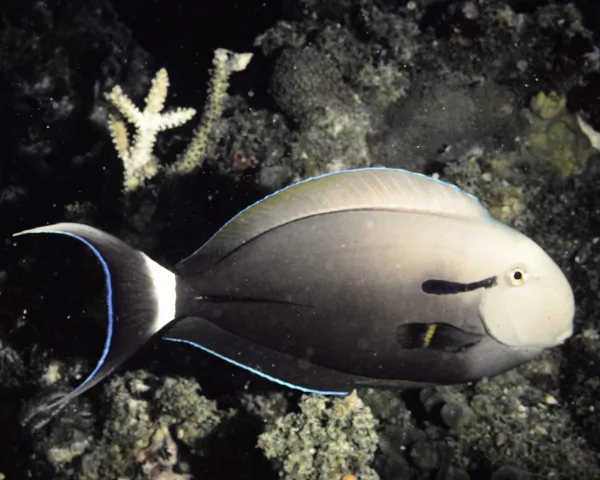
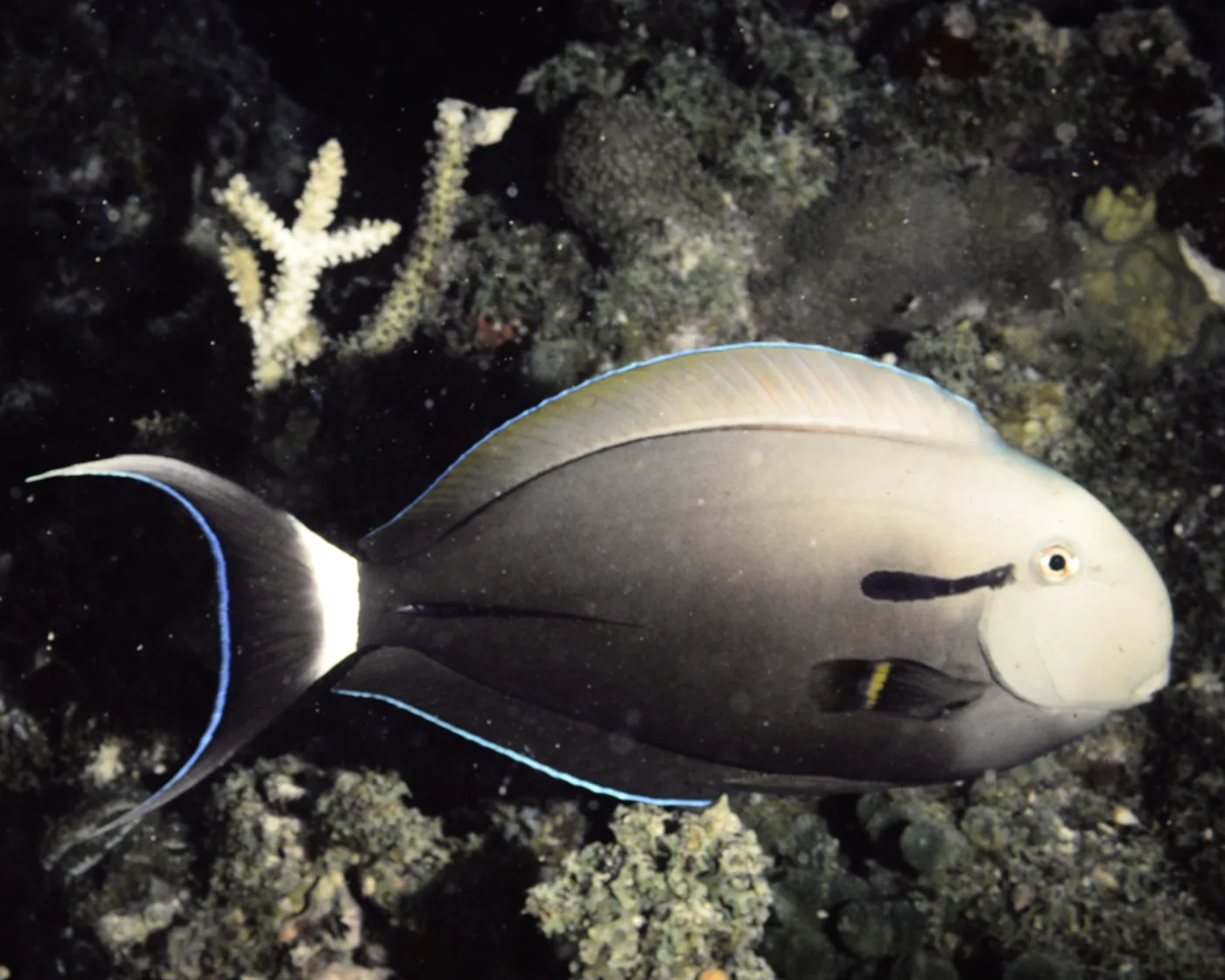
The epaulette surgeonfish is a big gray to dark brown fish. It has a black stripe behind each eye. The stripe looks like the patch that some soldiers wear on the shoulder of a uniform. That patch is called an epaulette. Its tail has a white band, and its fins have thin blue edges. It lives in the warm Indian and Pacific Oceans. Most tangs stay near coral, but this one likes sandy bottoms in bays and lagoons. It swims over the sand and sucks up the thin film of dirt and tiny algae on top. Like all surgeonfish, it has a sharp spine near its tail. It can grow longer than a school ruler, so it needs a very big tank with lots of room to swim.
Water & care
Hardy and calmer than many surgeonfish, but very large: an adult needs a showcase tank of about 250 gallons with long, open swimming lanes. Give it an open sand bed, rockwork with several territories, strong flow and algae foods several times a week. Choose a fish that is eating, quarantine it, and plan for its adult size even when buying a medium fish.
| Parameter | Keep it at | Where that sits on the usual reef range |
|---|---|---|
| Temperature | 72–78 °F | |
| Salinity (SG) | 1.023–1.025 | |
| pH | 8.1–8.4 | |
| Alkalinity | 8–12 dKH |
Ranges from LiveAquaria (72-78°F, SG 1.023-1.025, pH 8.1-8.4, 8-12 dKH). Wild water is about 73-82°F (23-28 °C, FishBase). Calcium, magnesium, nitrate and phosphate are left null because no species-specific values are published; keep normal reef targets in a reef tank.
Feeding
DietDetritivore
Favorite foods
- Biofilm and detritus on sand and rock
- Dried seaweed (nori) on a clip
- Marine algae and spirulina foods
- Mysis, krill or brine shrimp as extras
- Marine flakes and frozen marine foods
Offer dried seaweed at least three times a week, plus frequent small meals of algae-based foods to suit its grazing habit. Meaty foods are accepted and can be given as a supplement. An open sand bed lets it forage the way it does in the wild.
Tank & maintenance
- Minimum tank
- 250 gallons
- Aquascape
- A long showcase tank with open swimming lanes, an open sand bed for foraging, and live rock arranged into several territories so other fish can get out of sight.
- Lighting
- No special need; any reef or fish-only lighting.
- Water flow
- Strong, well-distributed water movement to suit a nearly nonstop swimmer.
Routine upkeep
Regular water changes and strong filtration for a big, active fish. Keep the sand bed clean but not sterile, feed several times a day, and watch for white spots and for fights with other tangs.
Temperament & tankmates
TemperamentSemi-aggressive
LiveAquaria calls it one of the more peaceful surgeonfish in the hobby, and Top Shelf one of the more even-tempered. It will still defend space when crowded and is most likely to fight with similarly shaped tangs. Mix it with other surgeonfish only in very large tanks, and give subordinate fish rockwork that breaks lines of sight.
Reef safeYes
Does not eat corals; it grazes film from sand and rock. LiveAquaria and Top Shelf Aquatics list it as reef safe. Top Shelf notes that 'reef safe' does not mean invertebrate-proof: an underfed fish may pick at small invertebrates, so regular algae feeding is the main safeguard.
Good tankmates
- Robust community fish
- Larger wrasses and angelfish
- Tangs of a different shape in very large tanks
- Corals and invertebrates
Avoid
- Similarly shaped Acanthurus tangs in anything but very large tanks
- Small or crowded tanks
- Timid fish that cannot handle a large, fast swimmer
Help it thrive
- Plan for an adult of about 16 inches and a tank of at least 250 gallons.
- Give it an open sand bed and long swimming lanes.
- Offer seaweed at least three times a week, plus small daily meals of algae foods.
- Quarantine it before adding it to the display.
- Avoid similarly shaped tangs unless the tank is very large.
Common ailments
Marine ich (white spot, Cryptocaryon irritans)
- Signs
- Small white spots on the skin, fins or gills, scratching, fast breathing, cloudy eyes and loss of appetite.
- Prevention
- Quarantine new fish in a separate tank and keep water stable.
- Treatment
- Treat in a hospital tank with copper, chloroquine phosphate, hyposalinity (SG about 1.009) or the tank-transfer method, following the product's directions. The parasite's resting stage can last up to 72 days, so leave the display without fish long enough for it to die out.
Head and lateral line erosion (HLLE)
- Signs
- Small pits of eroded skin around the head and along the lateral line.
- Prevention
- Good water quality and a varied, algae-rich diet; activated carbon has been linked to HLLE in marine tanks.
- Treatment
- Rarely fatal. Large water changes may reverse it, but moving the fish to a tank that has never had HLLE is the most common fix.
This is general hobby guidance, not veterinary advice. Quarantine new arrivals and treat in a separate tank whenever you can.
Risks of owning one
- Grows very large and needs a showcase tank of about 250 gallons.
- Can fight with similarly shaped tangs.
- Can bring marine ich into a tank if it is not quarantined.
- The sharp tail spines can cut hands during netting.
- An underfed fish may pick at small invertebrates.
Breeding
DifficultyNot achieved Captive-bredRare or wild-caught
Sexes are separate, and both mature at about 15 cm. In the wild large aggregations gather at breeding time and release eggs and sperm into open water; FishBase says it probably spawns in pairs. We found no record of captive spawning or rearing.
Deep dive The science, history and family tree
The science
Acanthurus nigricauda is a large, deep-bodied, laterally compressed surgeonfish. Adults are uniformly pale grey to dark brown, with a paler head, a bold black streak running back from the eye to the gill cover (the 'epaulette'), a slender black line in front of the caudal spine, an orange-based pectoral fin, a yellowish dorsal fin with a blue edge, and a tail with a white base and a dark, blue-edged outer part. Juveniles are deep brown and change color at 5-10 cm. The dorsal fin has 9 spines and 25-28 soft rays and the anal fin 3 spines and 23-26 soft rays. Maximum size is about 40-45 cm. It ranges from East Africa, Madagascar and the Mascarenes to the Tuamotu Islands, north to the Ryukyu Islands and south to the Great Barrier Reef and New Caledonia, but not the Red Sea. Unlike most Acanthurus, it favors sandy and rocky bottoms of bays and lagoons near isolated coral heads, at 0-30 m (usually 2-15 m). It grazes the film on sand, and its stomach contents are mostly organic detritus rather than algae. It has a gizzard-like stomach, sexes are separate and maturity is reached at about 15 cm.
- Appearance
- Gray, bluish-gray, purplish-gray or dark brown body, often with a paler head, and a bold black streak behind the eye that runs back to the gill cover. A thin black line sits just in front of the tail spine, and the tail has a white band at its base. The pectoral fins have an orange base, and the dorsal and anal fins have thin blue edges. It can change shade quickly during courtship, aggression or when asking cleaners for service. Juveniles start out deep brown and change color between 5 and 10 cm.
- Native range
- Indo-Pacific: East Africa, Madagascar and the Mascarene Islands east to the Tuamotu Islands, north to the Ryukyu Islands and southern Japan, south to the southern Great Barrier Reef, eastern Australia and New Caledonia. Not found in the Red Sea. Type locality: Mussau Island, St Matthias Islands, Papua New Guinea.
- Habitat
- Sandy and rocky bottoms of bays and lagoons and clear seaward reefs around isolated coral heads, from the surface to about 30 m (usually 2-15 m), in water of 23-28 °C. It is seldom found over coral, unlike most of its genus. FishBase describes it as solitary or in small groups; Wikipedia says it forms shoals, sometimes with the orangeband surgeonfish.
- Size
- 17.8 in (45.3 cm). FishBase gives a maximum of 45.3 cm (17.8 in) fork length and 2.7 kg; Wikipedia gives 40 cm (16 in). LiveAquaria lists 16 in, and Top Shelf Aquatics about 16 in in aquariums and up to about 18 in in the wild. Both sexes mature at about 15 cm (6 in).
- Lifespan
- Not documented in the sources we checked; no published longevity study or reliable captive lifespan figure was found.
- Conservation
- Least Concern. IUCN Least Concern (assessed 2010, per FishBase). It is caught with nets for food and for the aquarium trade; FishBase notes it is sometimes poisonous to eat. No captive-bred fish are known; all are wild-caught
In the aquarium vs in the wild
In your aquarium
A large, calm showcase surgeonfish for very big tanks that grazes film from sand and rock.
On the reef
A grazer of the detritus and algae film on sandy and rocky bottoms near coral, recycling organic matter in bays and lagoons.
History
Georg Duncker and Erna Mohr described this fish in 1929 as a subspecies of the black surgeonfish, Acanthurus gahhm, from Mussau Island in Papua New Guinea. John E. Randall showed in 1987 that it is a separate species. The name nigricauda means 'black tail', for the dark brown tail base that set it apart from the other form. In the hobby it is an occasional import for large display tanks.
Evolution & relatives
The epaulette surgeonfish belongs to Acanthurus, the largest surgeonfish genus, and was first classed as a form of the Red Sea black surgeonfish (A. gahhm). FishBase notes it has a gizzard-like stomach. A nine-gene surgeonfish timetree (Sorenson et al. 2013) found that this thick-walled stomach evolved only once, in a lineage that also includes the bristletooth tangs (Ctenochaetus), which suggests these grazers of detritus share a common ancestor. The same study dated the surgeonfish subfamily Acanthurinae to about 42 million years ago, with most living species appearing in the last 21 million years.
Family tree, from kingdom down
- Kingdom Animalia Animals Animals are living things made of many cells that must eat food to live. Fish, corals, crabs, snails and sea stars are all animals.
- Phylum Chordata Chordates Chordates have a stiff rod running down their back at some point in their lives. In fish and people, this rod is replaced by a backbone.
- Subphylum Vertebrata Vertebrates Vertebrates are animals with a backbone and a skull. Fish, frogs, birds and people are all vertebrates.
- Infraphylum Gnathostomata jawed vertebrates
- Parvphylum Osteichthyes bony fishes
- Gigaclass Actinopterygii ray-finned fishes
- Superclass Actinopteri
- Class Teleostei Teleost fishes Teleosts are bony fishes with thin, bendy fin rays and jaws that can push forward. Almost all of the fish in the world are teleosts.
- Order Acanthuriformes Surgeonfishes, angelfishes and kin This order of fishes includes surgeonfishes, marine angelfishes and rabbitfishes. Many have deep, flat bodies and graze on reefs.
- Family Acanthuridae Surgeonfishes and tangs Surgeonfishes have a sharp spine, like a tiny knife, on each side of the tail. Most graze on algae on reefs.
- Genus Acanthurus Acanthurus surgeonfishes This is the biggest group of surgeonfishes, with sharp tail spines. The powder blue tang belongs here.
- Species Acanthurus nigricauda
See it on the Tree of Life Compare with another species
Closest relatives
- Acanthurus gahhm Black Surgeonfish Same genus; it was first described as a subspecies of this fish
- Acanthurus olivaceus Orangeband Surgeonfish Same genus; sometimes shoals with it
- Ctenochaetus binotatus Two Spot Bristletooth Tang Bristletooths share the gizzard-like stomach lineage
- Acanthurus triostegus Convict Tang Same genus Read guide · Compare
Older scientific names: Acanthurus gahm nigricauda, Acanthurus nigricaudus.
Fun facts
- The black streak behind its eye looks like a soldier's shoulder patch, or epaulette, which gives the fish its name.
- Most surgeonfish stay over coral, but this one prefers sand flats in bays and lagoons.
- Its stomach is thick-walled like a bird's gizzard, and most of what it eats is detritus rather than algae.
- It can change its shade quickly when courting, fighting or asking a cleaner fish for service.
- Its name nigricauda means 'black tail'.
Learn more
- FishBase: Acanthurus nigricauda, Epaulette surgeonfish fishbase.se
- Wikipedia: Acanthurus nigricauda en.wikipedia.org
- Top Shelf Aquatics: Epaulette Tang care guide topshelfaquatics.com
Sources
- WoRMS: Acanthurus nigricauda Duncker & Mohr, 1929 marinespecies.org
- FishBase species summary: Acanthurus nigricauda fishbase.se
- Wikipedia: Acanthurus nigricauda en.wikipedia.org
- LiveAquaria: Epaulette Surgeonfish liveaquaria.com
- Top Shelf Aquatics: Epaulette Tang care guide topshelfaquatics.com
- Europe PMC record: Sorenson et al. 2013, A multi-locus timetree of surgeonfishes (Mol. Phylogenet. Evol. 68:150-160) ebi.ac.uk
- Wikipedia: Cryptocaryon en.wikipedia.org
- Wikipedia: Head and lateral line erosion en.wikipedia.org
Scientific names and classification follow the World Register of Marine Species (AphiaID 219626). Checked by our team. Last updated October 29, 2026.
Shop this species
Search the shop →
Only 1 left