 Sold out
Aquacultured
Corals · LPS coral
Duncan Coral
Duncanopsammia axifuga
Also called Duncan, Whisker coral, Daisy coral, Branched disc coral
- CareEasy
- Reef safeYes
- TemperamentPeacefulPeaceful; no sweepers, but harmed by stingy neighbors
- Favorite foods
- Light (zooxanthellae)
- Mysis shrimp
- Frozen zooplankton
- LifespanNo fixed lifespan
- IUCN statusLeast Concern
Quick answers
- How hard is it to keep?
- Care level: Easy.
- Is it reef safe?
- Yes. Peaceful and harmless to fish and invertebrates.
- What does it eat?
- Light (zooxanthellae)
- Mysis shrimp
- Frozen zooplankton
- How long does it live?
- No fixed lifespan.
- What are good tankmates?
- Most other LPS and soft corals placed an inch or two away
- Peaceful community reef fish
- Reef-safe snails and hermit crabs
- Other easy, low-light corals in a calm lower zone
The 30-second version
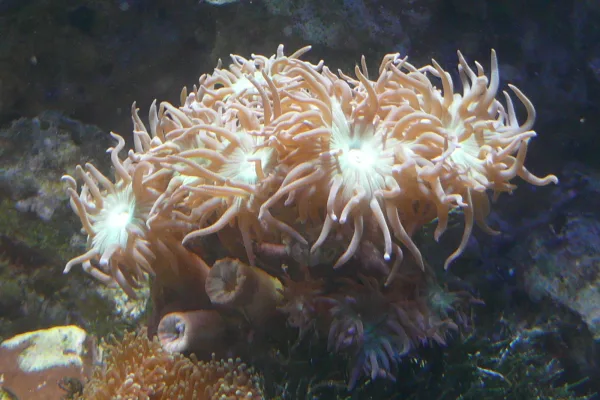
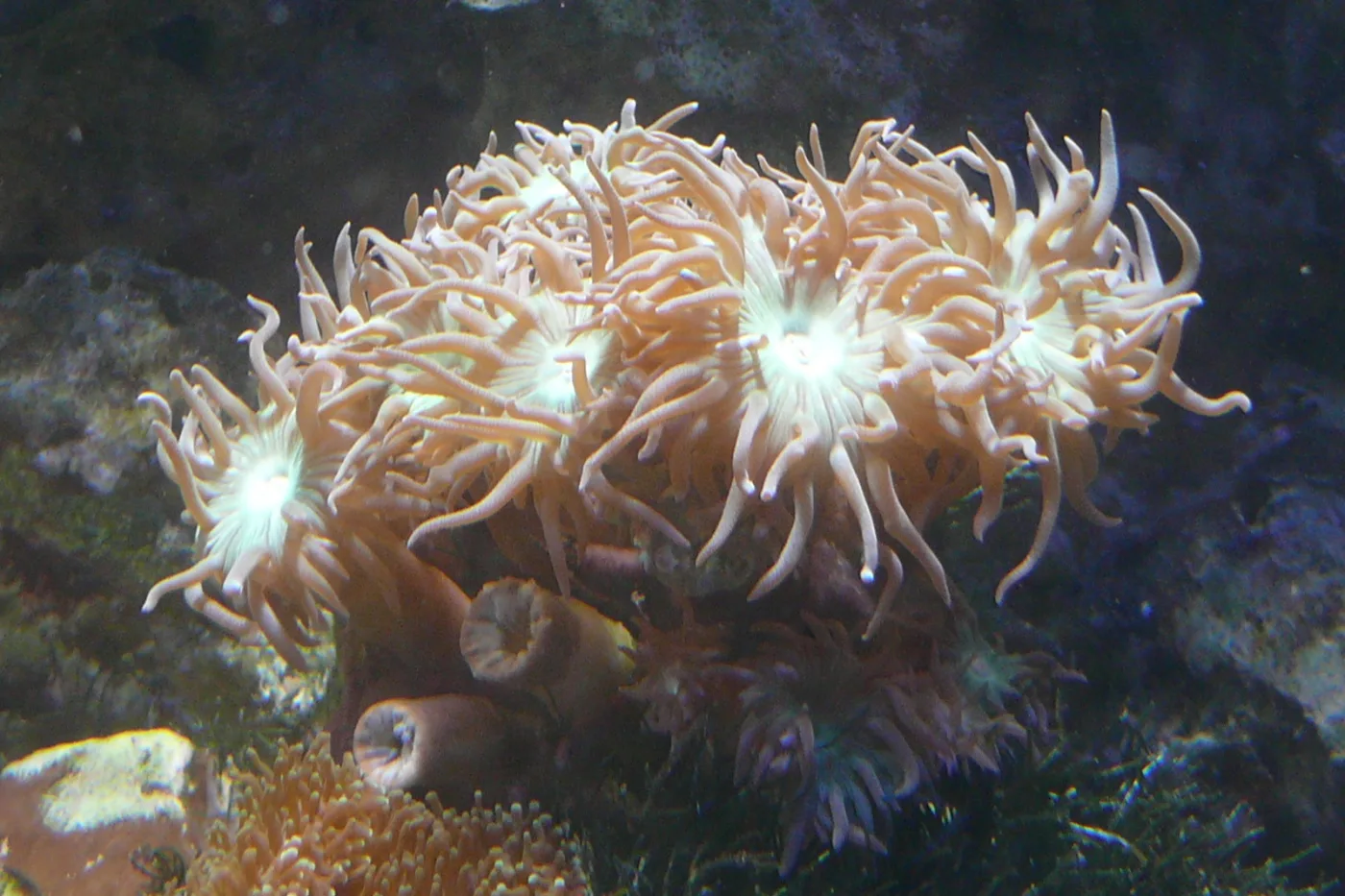
A Duncan coral looks like a little bunch of flowers. Each flower is a polyp. It has a round, flat top with a mouth in the middle and a ring of short, soft tentacles around the edge. Most Duncans are green or blue-green. Each polyp sits on top of its own stony tube. New tubes sprout from the sides, so the coral slowly grows into a little bush. Tiny living things called algae live inside the coral and make food from light. But Duncans also love to eat. Drop a bit of food on one, and the tentacles grab it and fold it into the mouth. Duncans are gentle. They don't have long stinging tentacles, so they get along well with most other corals. In the wild they live mostly around northern Australia, often near sandy sea floors.
Water & care
One of the easiest stony corals and a common first LPS: tolerant of a wide range of light, flow and nutrient levels, and an eager feeder that grows quickly. Its main needs are stable alkalinity and calcium, gentle flow, room to grow and occasional feeding. It sulks (polyps closed, extra slime) under strong direct flow, too much light, or when crowded.
| Parameter | Keep it at | Where that sits on the usual reef range |
|---|---|---|
| Temperature | 75–80 °F | |
| Salinity (SG) | 1.024–1.026 | |
| pH | 8–8.4 | |
| Alkalinity | 8–10 dKH | |
| Calcium | 400–460 ppm | |
| Magnesium | 1,250–1,400 ppm | |
| Nitrate | 5–20 ppm | |
| Phosphate | 0.03–0.2 ppm |
Wikipedia gives 75-80°F; Reef Chasers suggests tolerance of 77-84°F, 8-9 dKH, 430-460 ppm calcium, nitrate 10-20 ppm and phosphate 0.1-0.2 ppm, all kept stable. Duncans tolerate slightly 'dirty' water better than most stony corals but still do best with stable, measurable nutrients. Magnesium is general reef practice (natural seawater is about 1300 ppm).
Feeding
DietPhotosynthetic
Favorite foods
- Mysis shrimp
- Brine shrimp
- Microplankton and other filter-feeder foods
- Powdered coral food slurries
- Small LPS pellets
Gets much of its energy from zooxanthellae but feeds readily, and target feeding speeds up the budding of new heads. Drop small meaty foods onto the open polyps 1-3 times a week with the pumps turned down. Feeding is helpful but not required. Avoid pieces larger than the mouth and remove leftovers.
Tank & maintenance
- Aquascape
- Low in the tank: on the sand bed, on a low rock, or in a dim, calm corner, with room to branch upward and outward. Leave space so new heads do not shade each other or touch neighbors. No species-specific minimum tank size is published; it suits small reefs as long as conditions are stable.
- Lighting
- Low to moderate: about 50-150 PAR. Too much light easily stresses it, and dimmer spots often work well.
- Water flow
- Low to moderate, indirect flow that makes the polyps wave gently. Strong direct flow makes them retract and can damage tissue; very weak flow lets detritus collect between the branches.
Routine upkeep
Routine reef maintenance plus occasional target feeding. Every so often blow detritus out from between the branches and check for sponge or algae growing inside the clump, which can choke inner polyps. Frag crowded colonies so inner heads keep getting light and flow.
Temperament & tankmates
TemperamentPeaceful
Not aggressive and without sweeper tentacles; it rarely threatens neighboring corals unless they are placed touching it. When stressed or crowded it retracts its polyps and produces slime rather than fighting.
Reef safeYes
Peaceful and harmless to fish and invertebrates. It has no sweeper tentacles, though its short tentacles can still damage soft or delicate corals in direct contact, so leave an inch or two. It is easily stung by aggressive neighbors such as Euphyllia, Galaxea or Acans.
Good tankmates
- Most other LPS and soft corals placed an inch or two away
- Peaceful community reef fish
- Reef-safe snails and hermit crabs
- Other easy, low-light corals in a calm lower zone
Avoid
- Torch, hammer, frogspawn and Galaxea corals within sweeper reach
- Fish that nip LPS polyps, such as some angelfish and butterflyfish
- Strong direct flow
- Very intense light without acclimation
Help it thrive
- Feed it: Duncans respond to target feeding with faster budding of new heads.
- Start low on the sand or a low rock under modest light.
- Keep flow gentle and indirect; if the polyps stay closed, try a calmer spot.
- Thin out crowded colonies so the inner polyps get light and flow.
- Keep nitrate and phosphate measurable and stable rather than near zero.
Common ailments
Flow or light stress
- Signs
- Polyps staying closed or only half open, extra slime, and tissue pulling down from the top of the corallite.
- Prevention
- Gentle, indirect flow and about 50-150 PAR; acclimate new colonies low in the tank.
- Treatment
- Move the colony to a calmer, dimmer spot and feed lightly once polyps reopen.
Starvation and shrinking polyps
- Signs
- Polyp discs getting smaller, no new heads forming, and tissue receding down the stalks in very clean, nutrient-poor tanks.
- Prevention
- Target-feed 1-3 times a week and keep nitrate and phosphate measurable.
- Treatment
- Increase small, regular feedings and let nutrients rise slightly; recovery usually shows as fuller discs within weeks.
Sponge or algae overgrowth inside the colony
- Signs
- Sponge or algae growing between the branches, blocking flow, with inner polyps shrinking or staying closed.
- Prevention
- Adequate flow through the colony, regular detritus removal, and fragging before the colony gets too dense.
- Treatment
- Remove the growth with a small water jet (Reef Builders used a miniature pressure washer) or brush, then frag the colony into smaller pieces to open it up.
Sting damage from neighbors
- Signs
- Polyps on one side closed or receding where they face another coral, especially Euphyllia, Galaxea or Acans.
- Prevention
- Keep Duncans well away from aggressive corals and their sweeper tentacles.
- Treatment
- Move the Duncan or the aggressor, and frag off heads that have lost their tissue.
This is general hobby guidance, not veterinary advice. Quarantine new arrivals and treat in a separate tank whenever you can.
Risks of owning one
- Stings from aggressive neighbors are a common way Duncans are lost in mixed reefs.
- Crowded colonies shade and smother their own inner heads if never thinned.
- Wild colonies come almost entirely from Australia, where collection is limited by quota; buying captive-grown frags avoids that pressure.
- Its tentacles carry stinging cells that feel sticky; wear gloves when handling any coral.
Propagation & fragging
DifficultyEasy AquaculturedWidely available
Propagated by separating heads: each polyp sits on its own tube, so single heads or small clusters are cut or snapped off the colony and glued to plugs. New heads bud from the sides of existing corallites, so a single head soon becomes a small colony. Sexual reproduction plays no part in the aquarium supply.
- Choose a colony with plenty of heads and let the polyps retract.
- Cut or snap through a stalk below the polyp tissue with bone cutters or a saw, keeping at least one full head per frag.
- Optionally dip the frag, then glue the bare skeleton to a plug.
- Place it low in gentle flow and moderate light.
- Target-feed once the polyps reopen to speed up budding.
Deep dive The science, history and family tree
The science
Duncanopsammia axifuga is a colonial, zooxanthellate large-polyp stony coral in the family Dendrophylliidae and the type species of the genus Duncanopsammia. Colonies are phaceloid to arborescent: long, round tubular corallites 10-14 mm in diameter fork at irregular intervals and face upward, forming loose, branching clumps. Septa follow the Pourtalès plan typical of dendrophylliids, the walls are made of porous coenosteum, and the columella is broad and deep-seated. Living polyps have a broad, flat oral disc 2-3 cm across, usually light brown, green or teal and sometimes faintly striped, ringed by short, thin tentacles. Polyps open and close in response to stimuli and use the tentacles to pass prey to the mouth. The species is known mainly from tropical Australia, with records from Papua New Guinea and Timor and a 2022 first record for Indonesia from West Papua, described as its northernmost record (older listings for the South China Sea and the Philippines are doubtful). It lives at about 0-30 m on sandy and rocky seabeds near the base of reefs; Veron describes it as rare but conspicuous, usually below 20 m and attached to hard substrate in sandy areas, while the West Papua population was on a turbid inshore reef at 5 m. The genus was erected by Wells (1936); a second species, D. peltata (formerly Turbinaria peltata), is now accepted by WoRMS on morphological and phylogenetic grounds, making the Duncan a close relative of the plate- and cup-forming Turbinaria corals. It combines photosynthesis by symbiotic dinoflagellates with active feeding on zooplankton. It is assessed as Least Concern on the IUCN Red List (2023) and listed on CITES Appendix II; almost all wild-collected aquarium specimens have come from Australia, where collection is quota-managed, and captive-propagated frags are widespread.
- Appearance
- Branching clumps of tube-like corallites, each topped by a wide, flat, disc-shaped polyp (2-3 cm) with a ring of short tentacles; usually teal, green or light brown, often with a contrasting center. Two growth patterns are traded: short, bushy branches, and longer, more pronounced branches, which are more sought after. Look-alikes: the pagoda cup coral (D. peltata) grows as bowls or plates like Turbinaria; sun corals (Tubastraea) have orange or black polyps without zooxanthellae; Acan Lords form a solid mat of fleshy polyps rather than separate stalked heads.
- Native range
- Indo-West Pacific, centred on tropical Australia, where nearly all aquarium specimens are collected, with records from Papua New Guinea and East Timor and a 2022 first record for Indonesia from the Bird's Head Peninsula, West Papua, which its authors described as the species' northernmost record (Subhan et al. 2022). Wikipedia and SeaLifeBase also list the South China Sea and the Philippines, but those records are doubtful. A syntype in the Natural History Museum, London, is from Australia's Northern Territory.
- Habitat
- About 0-30 m. Grows on sandy and rocky seabeds near the reef foundation; Corals of the World describes it as usually deeper than 20 m, attached to solid substrate in areas dominated by soft sand, and rare but conspicuous. The Indonesian population was in murky water about 5 m (16 ft) deep on a sediment-rich inshore reef, with some colonies attached to dead coral and others living loose on the sediment.
- Size
- . Corallites are 10-14 mm in diameter and polyp discs 2-3 cm across when open. Colonies keep branching, and no reliable maximum colony size is published.
- Lifespan
- No fixed lifespan. One Reef Builders colony was kept for about 10 years through six or seven tank setups, growing from four or five heads into enough material for many frags and four medium colonies.
- Conservation
- Least Concern. Least Concern on the IUCN Red List (assessed 26 October 2023), although reef corals as a group are increasingly threatened (the 2024 IUCN reassessment found 44% of reef-building corals threatened). CITES Appendix II. Wild supply is almost entirely Australian: the EU's CITES Scientific Review Group examined Australian Duncanopsammia imports in 2020, and Queensland has had species-level harvest limits on D. axifuga since 2022. Captive-propagated frags are cheap and widely available, making them the sustainable choice
In the aquarium vs in the wild
In your aquarium
A classic beginner LPS and frag-swap favorite: hardy, fast-growing, inexpensive, peaceful and fun to target-feed.
On the reef
A small reef-building coral of sandy and rocky bottoms near reef bases and of turbid inshore reefs, where it captures zooplankton and adds small-scale structure.
History
Described in 1848 by Henri Milne Edwards and Jules Haime as Dendrophyllia axifuga, based on material that includes a syntype from Australia's Northern Territory now in the Natural History Museum, London. In 1936 John W. Wells erected the genus Duncanopsammia with this species as its type, and for decades it was treated as the only species in the genus. Australian collection made Duncans a hobby classic, and imports have come almost entirely from Australia; propagation by hobbyists and coral farms has since made them cheap and common. The EU reviewed Australian Duncanopsammia imports in 2020 and Queensland introduced harvest limits in 2022. Also in 2022, Duncans were documented in Indonesia (West Papua) for the first time, and WoRMS now accepts a second species, D. peltata, transferred from Turbinaria.
Evolution & relatives
Duncans belong to the Dendrophylliidae, a family on the 'complex' branch of stony corals (suborder Refertina), the same major branch as torches, hammers and frogspawn (Euphylliidae) and as Acropora and Montipora, but a different family. Most dendrophylliids lack zooxanthellae and live as solitary or colonial cup corals, including the orange sun corals (Tubastraea) and Dendrophyllia; photosynthetic members include the scroll and cup corals (Turbinaria) and Duncanopsammia. Cairns (2001) monographed the family on skeletal characters, and a molecular study by Arrigoni et al. (2014) found that most dendrophylliid genera with more than one species were not natural groups. The pagoda cup coral, long called Turbinaria peltata, has since been transferred into Duncanopsammia, so the Duncan's closest known relative grows as plates and bowls. On the tree of life the Duncan is therefore closer to torches and sun corals than to the Acan Lords it superficially resembles, which sit on the 'robust' branch.
Family tree, from kingdom down
- Kingdom Animalia Animals Animals are living things made of many cells that must eat food to live. Fish, corals, crabs, snails and sea stars are all animals.
- Phylum Cnidaria Cnidarians Cnidarians are soft animals with tentacles. The tentacles have tiny stinging cells. Corals, sea anemones and jellyfish all belong here.
- Subphylum Anthozoa Corals and sea anemones These cnidarians spend their whole lives as polyps: a tube with a mouth ringed by tentacles. Unlike jellyfish, they never swim around as a bell-shaped medusa.
- Class Hexacorallia Hexacorals In this group the tentacles and body parts come in sixes or multiples of six. It includes stony corals, sea anemones, mushroom corals and zoanthids.
- Order Scleractinia Stony corals Stony corals build hard skeletons out of limestone under their soft polyps. Over many years, these skeletons pile up and make coral reefs.
- Suborder Refertina Complex corals
- Family Dendrophylliidae Dendrophylliid corals This stony coral family includes Duncan corals, cup corals and orange sun corals. Many have big, colorful polyps, and some have no algae inside them.
- Genus Duncanopsammia Duncan corals Duncan corals grow tubes topped with big, round polyps that look like little flowers. They are a popular, easy aquarium coral.
- Species Duncanopsammia axifuga
See it on the Tree of Life Compare with another species
Closest relatives
- Duncanopsammia peltata Pagoda cup coral Same genus; formerly Turbinaria peltata
- Turbinaria reniformis Yellow scroll coral Same family; photosynthetic plate-forming relative
- Tubastraea coccinea Orange sun coral Same family; non-photosynthetic cup coral
- Euphyllia glabrescens Torch coral Same suborder (Refertina, complex corals), different family Read guide · Compare
Older scientific names: Dendrophyllia axifuga.
Fun facts
- Each Duncan polyp works like a tiny sea anemone, grabbing food with its tentacles and folding it into its mouth.
- Its closest relative, the pagoda cup coral, was sold for years as a Turbinaria before being moved into Duncanopsammia.
- Duncans are closer cousins of torch and hammer corals than of Acan Lords, even though they look more like Acans.
- Reefers long thought of Duncans as uniquely Australian, until a population turned up on a muddy reef in West Papua, Indonesia, in 2022.
- Its skeleton is made of separate tubes, so fragging is often as simple as snapping off a head.
Learn more
- Reef Builders: Pagoda cup coral, the Duncan coral that never was reefbuilders.com
- Reef Builders: The beloved Duncan coral discovered in Indonesia reefbuilders.com
- Wikipedia: Duncanopsammia en.wikipedia.org
- WoRMS: Duncanopsammia axifuga marinespecies.org
Sources
- WoRMS: Duncanopsammia axifuga (Milne Edwards & Haime, 1848) marinespecies.org
- WoRMS: genus Duncanopsammia Wells, 1936 marinespecies.org
- WoRMS: Duncanopsammia peltata (Esper, 1790) marinespecies.org
- SeaLifeBase: Duncanopsammia axifuga sealifebase.se
- Wikipedia: Duncanopsammia en.wikipedia.org
- Reef Chasers: Duncan coral care guide reefchasers.com
- Reef Builders (2024): Pagoda cup coral, the Duncan coral that never was reefbuilders.com
- Reef Builders (2022): The beloved Duncan coral discovered in Indonesia reefbuilders.com
- Reef Builders (2020): Fragging Duncan coral reefbuilders.com
- Reef Builders (2020): CITES Europe to discuss restrictions on Australian corals reefbuilders.com
- Reef Builders (2021): Revised Queensland coral exports approved until 2024 reefbuilders.com
- Wikipedia: Dendrophylliidae en.wikipedia.org
- IUCN (2024): Over 40% of coral species face extinction iucn.org
- Subhan et al. 2022, A new northernmost distribution record of the reef coral Duncanopsammia axifuga at Bird's Head Peninsula, West Papua, Indonesia (Diversity) doi.org
- Corals of the World: Duncanopsammia axifuga factsheet (Veron et al.) coralsoftheworld.org
Care facts
The care facts on this guide and its product pages (care level, reef safety, temperament, size, tank, diet, flow, purpose, foods, acclimation and origin) combine 13 independent sources, checked October 25, 2026.
- How to Care for Duncan Corals: A Complete Guide Top Shelf Aquatics
- Duncan Coral Care Fragbox
- Duncanopsammia Coral Quality Marine
- Duncan coral care guide: placement, light, food & fragging Saltwater Aquarium Blog
- Icy Blue Duncan Care Guide ReefBay
- Duncan Coral Care Guide - Lighting, Flow & Growth MetaReef
- Green & Purple Duncan (Duncanopsammia axifuga) The Reef Farm
- ORA Duncanopsammia Coral Bulk Reef Supply
- How to Care for Duncan Corals Shrimp and Snail Breeder
- Duncan Coral: A Vibrant Addition to Your Home Aquarium Aquariadise
- Duncan Coral Fish Tank Advisor
- Duncan Coral Care Guide Gensou
- TSA Blue Sea Duncan Coral Top Shelf Aquatics
Scientific names and classification follow the World Register of Marine Species (AphiaID 289843). Last updated October 25, 2026.
Shop this species
Search the shop →Sold out right now. We restock weekly, so check back soon.
Sold out
Aquacultured