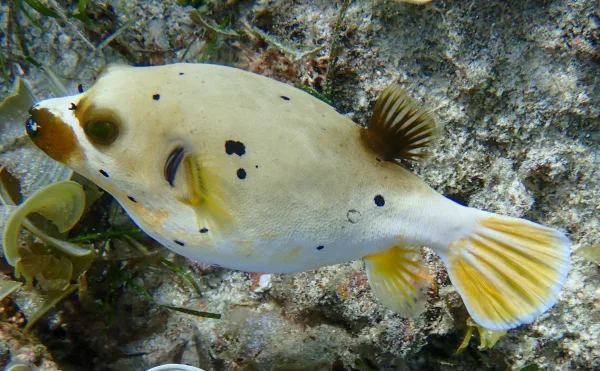
Fish · Pufferfish
Dogface Puffer
Arothron nigropunctatus
Also called Black-Spotted Puffer, Blackspotted Puffer, Dog-faced Puffer, Arothron Dog Face Puffer, Black Spot Puffer, Fat Puffer
Reviewed by admin on October 29, 2026 · Meet the team
- CareModerate
- Reef safeNo
- TemperamentSemi-aggressiveEats invertebrates; may nip small or slow fish
- Favorite foods
- Whole clams and mussels
- Hard-shelled shrimp
- Squid and krill
- Max size13 in (33 cm)
- Min tank150 gal
- LifespanNot documented
- IUCN statusLeast Concern
Quick answers
- How big does the Dogface Puffer get?
- Up to 13 in (33 cm).
- What size tank does it need?
- At least 150 gallons.
- How hard is it to keep?
- Care level: Moderate.
- Is it reef safe?
- No. Not reef safe.
- What does it eat?
- Whole clams and mussels
- Hard-shelled shrimp
- Squid and krill
- How long does it live?
- Not documented: no published longevity figure for wild or aquarium fish was found.
- What are good tankmates?
- Robust fish of similar size
- Large tangs
- Larger wrasses (they also clean up scraps)
- Other puffers no more aggressive than itself, in a very large tank
The 30-second version
The dogface puffer has a round face with a short snout. Many people think it looks a bit like a dog. Most are gray with black spots, but some are yellow, blue or brown. It lives on coral reefs from Africa to the middle of the Pacific Ocean. It can grow to about a foot long. It has a strong beak made of four teeth joined together. It uses the beak to crush shells and crabs, and to bite the tips off corals. When it is scared, it gulps water and puffs up into a ball. Its body holds a strong poison, so other fish do not want to eat it. In a tank it soon gets to know the people who feed it. It needs a big tank and lots of crunchy food. It will eat corals, snails, shrimp and crabs.
Water & care
Hardy once settled and very interactive, but it needs a large, well-filtered fish-only tank and a steady supply of hard-shelled foods to keep its beak worn down. Shell-crushing meals are messy, so plan for a strong protein skimmer and regular water changes. Quality Marine recommends a glass tank, because the teeth can scratch acrylic, and caves or ledges where it can rest. It is shy at first and alarmed by nets, so move it with a container. Do not hand-feed: the jaws are powerful and the teeth very sharp.
| Parameter | Keep it at | Where that sits on the usual reef range |
|---|---|---|
| Temperature | 72–78 °F | |
| Salinity (SG) | 1.020–1.025 | |
| pH | 8.1–8.4 | |
| Alkalinity | 8–12 dKH |
LiveAquaria and Quality Marine agree on 72-78°F, SG 1.020-1.025, pH 8.1-8.4 and 8-12 dKH. No species-specific calcium, magnesium, nitrate or phosphate values are published; its heavy bioload makes regular water changes and good skimming important for keeping nitrate low.
Feeding
DietOmnivore
Favorite foods
- Whole clams and mussels
- Hard-shelled shrimp
- Squid
- Krill
- Sponge- or algae-based foods
A voracious feeder. Offer a varied diet of larger meaty foods such as clams, hard-shelled shrimp, squid and krill, with shelled items regularly to wear down the beak, and supplement with algae- or sponge-based foods (Quality Marine). Use tongs or drop food in rather than hand-feeding. Remove leftover shells, and size meals so water quality holds up.
Tank & maintenance
- Minimum tank
- 150 gallons
- Aquascape
- Large fish-only tank with caves or ledges for resting and plenty of open swimming room. Quality Marine suggests a footprint of at least 4 ft by 2 ft and a glass tank rather than acrylic.
- Lighting
- No special requirement; Quality Marine lists medium light.
- Water flow
- Gentle to moderate. Wild fish live in coral areas with little current and puffers are weak swimmers (Quality Marine), so avoid blasting powerheads while keeping strong filtration.
Routine upkeep
Strong filtration and protein skimming, frequent partial water changes and removal of shell debris after meals. Check the beak regularly and the acrylic, if any, for scratches. Keep hands clear of the mouth during maintenance.
Temperament & tankmates
TemperamentSemi-aggressive
LiveAquaria rates it semi-aggressive and Quality Marine aggressive, while Quality Marine's care article calls it generally peaceful but able to nip slow or small tankmates. It tolerates other puffers that are no more aggressive than itself (LiveAquaria). Choose robust, active tankmates of similar size. Quality Marine notes that a female guarding eggs may harm other fish in the tank.
Reef safeNo
Not reef safe. Wild fish bite the tips off Acropora and eat sponges, tunicates, crustaceans and molluscs, and in aquariums it eats coral and small invertebrates such as young clams, snails, shrimp and crabs (LiveAquaria, Quality Marine). Keep it in a fish-only tank.
Good tankmates
- Robust fish of similar size
- Large tangs
- Larger wrasses (they also clean up scraps)
- Other puffers no more aggressive than itself, in a very large tank
Avoid
- Corals, clams and other reef invertebrates
- Shrimp, crabs and snails
- Small or slow-moving fish that it may nip
- Aggressive fish that bully it
Help it thrive
- Feed whole, shell-on foods such as clams, mussels and shrimp often to keep the beak worn down.
- Use a large glass tank with open swimming room and caves or ledges for naps.
- Run a strong skimmer and change water often; it is a messy, heavy eater.
- Move it with a container, never a net, and never tease it into puffing.
- Do not hand-feed; the beak is sharp and powerful.
Common ailments
Marine ich (Cryptocaryon irritans)
- Signs
- White, salt-like spots on the body, fins or gills, scratching (flashing), rapid breathing, cloudy eyes, hiding and loss of appetite.
- Prevention
- Quarantine new fish in a separate tank for several weeks before adding them to the display, and keep water stable.
- Treatment
- Treat in a hospital tank. Options include copper, chloroquine phosphate, hyposalinity and the tank-transfer method; follow the product's directions. Leave the display without fish for about 11 weeks, because the cyst stage can last up to 72 days.
Overgrown beak (teeth)
- Signs
- The fused teeth look long or overlap, the fish struggles to bite food, eats less and loses weight.
- Prevention
- Feed hard-shelled foods such as snails, cockles, clams and shell-on shrimp, and make sure tankmates are not taking them first.
- Treatment
- A fish vet can trim the beak while the fish is sedated; in a 2022 case reported by Your Aquarium a porcupine puffer was eating again within hours. Then keep up the hard foods.
Stress from inflating or swallowing air
- Signs
- The fish puffs up during netting or handling, or stays bloated, floats or struggles to swim afterward.
- Prevention
- Move it in a container under water rather than with a net, and never lift it into air or tease it into puffing.
- Treatment
- Remove the stressor, dim the lights and let it recover on its own (That Fish Place). Do not squeeze the fish to deflate it.
This is general hobby guidance, not veterinary advice. Quarantine new arrivals and treat in a separate tank whenever you can.
Risks of owning one
- Eats corals, clams, snails, shrimp and crabs; not for reef tanks.
- Grows to about 13 in (33 cm) and needs a very large tank.
- The sharp beak can bite fingers and scratch acrylic; do not hand-feed.
- Contains tetrodotoxin and is poisonous to eat.
- A heavy, messy eater that strains filtration.
Breeding
DifficultyNot achieved Captive-bredRare or wild-caught
Little is known about breeding. Wild pairs form on reefs and are nest builders, and the pair defends the nest after the eggs are laid. Well-conditioned fish in large aquariums have laid eggs, but the species is not bred in captivity (Quality Marine), and no captive-bred fish are sold.
- Pairs are rarely offered for sale; adults are usually solitary.
- If eggs appear, expect the guarding fish (often the female) to become aggressive toward tankmates.
- Raising the larvae has not been documented.
Deep dive The science, history and family tree
The science
Arothron nigropunctatus is a medium-sized pufferfish (family Tetraodontidae) of Indo-Pacific reefs. The body is oval and rather elongate, without scales, pelvic fins or a lateral line, and its skin is covered with small prickles; the short snout bears two pairs of nostrils, and the jaws carry four strong, fused teeth. There are no fin spines, and the 10-11 dorsal and 10-12 anal soft rays sit far back on the body. Background color is highly variable, from gray, light brown or bluish to bright or orange-yellow or bicolored, with irregular dark blotches and dark coloring around the eyes and mouth; fully yellow fish make up only about 1% of the population. It reaches 33 cm total length. The species ranges from East Africa to Micronesia and Samoa, north to southern Japan and south to New South Wales, and is replaced in the Red Sea by the masked puffer, A. diadematus. It is usually solitary, with adults often in pairs, and lives from coastal waters to outer reef crests and slopes rich in invertebrates at 0-60 m. It feeds on corals, usually Acropora tips, plus sponges, tunicates, crustaceans, molluscs and algae. Like other puffers it inflates when threatened and contains tetrodotoxin.
- Appearance
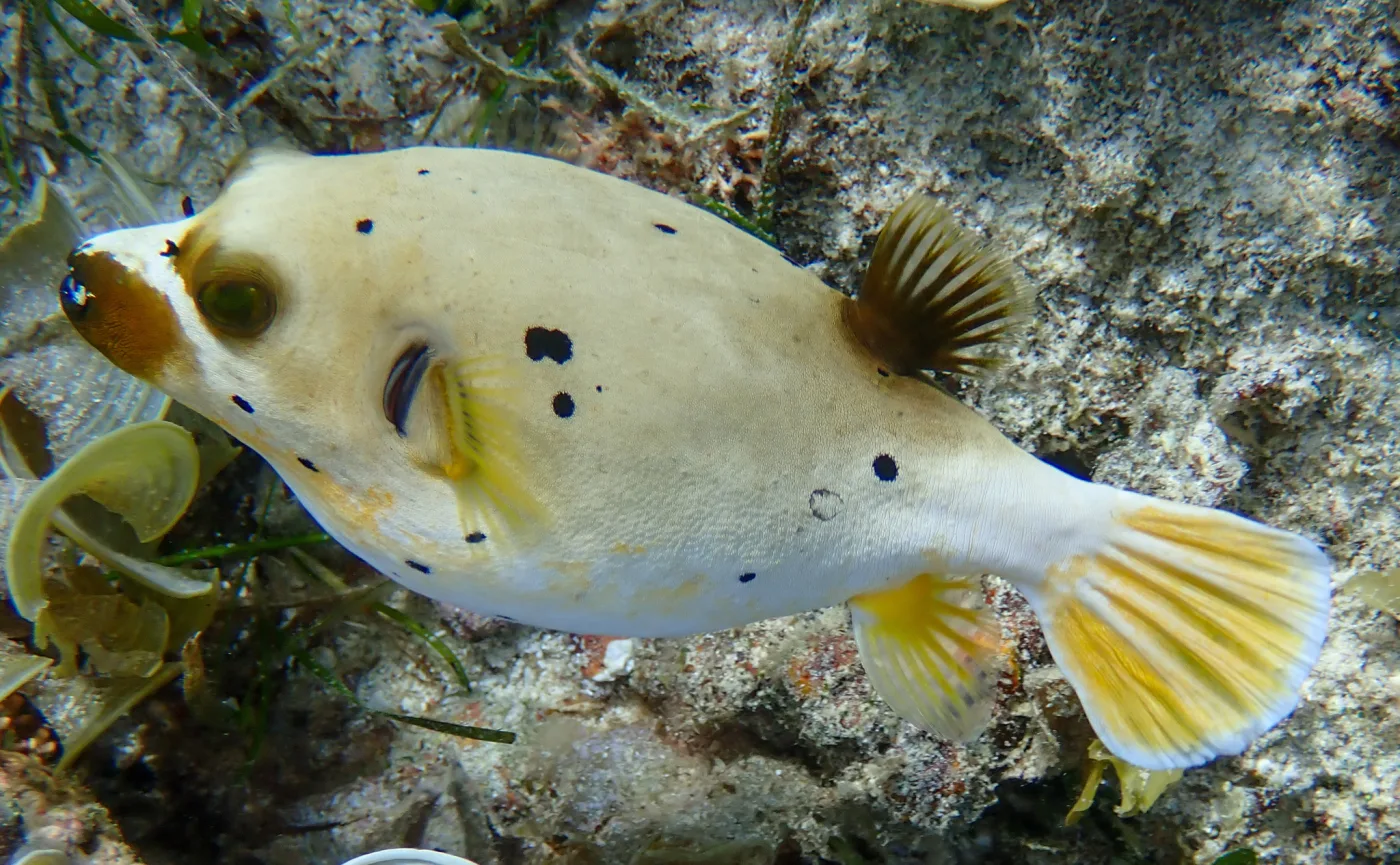
- A round-faced puffer with a short snout, prickly skin and large dark spots. The common gray phase is gray with black markings around the mouth, eyes and dorsal fin and yellowish pectoral fins; other fish are light brown, bluish, half yellow (yellow belly under a dark gray back) or fully yellow, gold or orange, but fully yellow fish usually keep the dark markings around the mouth, eyes and dorsal-fin base. Color changes are rare in aquariums. Look-alike: yellow forms closely resemble yellow guineafowl puffers (A. meleagris), and suspected hybrids between the two have been seen at Reunion Island.
- Native range
- Indo-Pacific from East Africa to Micronesia and Samoa, north to southern Japan and south to New South Wales. Absent from the Red Sea, where the masked puffer (A. diadematus) replaces it.
- Habitat
- Coastal waters to the outer reef crest and slopes with rich invertebrate growth, at 0-60 m (Wikipedia gives 0-25 m). Mostly a shallow-reef fish of coral areas with little current; Quality Marine describes puffers as weak swimmers. Active by day, usually solitary and territorial, with adults often in pairs.
- Size
- 13 in (33 cm). FishBase and Wikipedia give 33 cm (13 in) total length; LiveAquaria lists 13 in and Quality Marine 'almost 13 in', while its care article says about a foot.
- Lifespan
- Not documented: no published longevity figure for wild or aquarium fish was found.
- Conservation
- Least Concern. Assessed Least Concern by the IUCN (2011). Not evaluated by CITES. FishBase lists commercial fisheries and public aquariums; it is poisonous to eat. Aquarium fish are wild-collected, and Quality Marine notes the species is not bred in captivity
In the aquarium vs in the wild
In your aquarium
A personable centerpiece for large fish-only tanks, kept for its expressive face, varied color phases and habit of recognizing its keepers.
On the reef
A reef browser that crops Acropora tips and eats sponges, tunicates, crustaceans, molluscs and algae on coastal reefs and outer slopes.
History
Marcus Bloch and J. G. Schneider described the species in 1801 as Tetrodon nigropunctatus. It now belongs to Arothron, the genus J. P. Müller named in 1841. Günther's 1870 names for a variety, citrinella, and Arothron citrinellus are now treated as synonyms. In the hobby it is best known as the dogface puffer, a name the trade also uses loosely for other Arothron species, and Quality Marine describes it as perhaps the most personable aquarium fish. Suspected hybrids with the guineafowl puffer have been seen at Reunion Island.
Evolution & relatives
Arothron contains 14 species of mostly coastal puffers in the warm Atlantic, Indian and Pacific Oceans, from this 33 cm species to the stellate puffer, which reaches 1.2 m. The dogface and guineafowl puffers are both highly polymorphic, with typical, fully yellow and intermediate forms. The oldest known Arothron fossils are early Pleistocene specimens, about 1.95-1.35 million years old, from southern Taiwan. The pufferfish family split from the porcupinefishes 89-138 million years ago, and WoRMS places it in the suborder Tetraodontoidei of the order Tetraodontiformes, together with the triggerfishes in a separate suborder. On the site's tree, the dogface is a close cousin of the stars and stripes puffer and a more distant cousin of the small sharpnose puffers (Canthigaster).
Family tree, from kingdom down
- Kingdom Animalia Animals Animals are living things made of many cells that must eat food to live. Fish, corals, crabs, snails and sea stars are all animals.
- Phylum Chordata Chordates Chordates have a stiff rod running down their back at some point in their lives. In fish and people, this rod is replaced by a backbone.
- Subphylum Vertebrata Vertebrates Vertebrates are animals with a backbone and a skull. Fish, frogs, birds and people are all vertebrates.
- Infraphylum Gnathostomata jawed vertebrates
- Parvphylum Osteichthyes bony fishes
- Gigaclass Actinopterygii ray-finned fishes
- Superclass Actinopteri
- Class Teleostei Teleost fishes Teleosts are bony fishes with thin, bendy fin rays and jaws that can push forward. Almost all of the fish in the world are teleosts.
- Order Tetraodontiformes Pufferfishes, triggerfishes and allies This order holds puffers, triggerfish, filefish and boxfish. Many have strong teeth or beaks for crunching shells.
- Suborder Tetraodontoidei Puffers and allies
- Family Tetraodontidae Pufferfishes Puffers can gulp water and blow up like a ball when they are scared. Their teeth are joined into a strong beak, and many have poison in their bodies.
- Genus Arothron Dogface puffers
- Species Arothron nigropunctatus
See it on the Tree of Life Compare with another species
Closest relatives
- Arothron meleagris Guineafowl Puffer Same genus; yellow forms look alike and suspected hybrids are known
- Arothron diadematus Masked Puffer Same genus; replaces it in the Red Sea
- Arothron hispidus Stars and Stripes Puffer Same genus
- Arothron stellatus Stellate Puffer Same genus; the largest species, to 1.2 m
Older scientific names: Tetraodon nigropunctatus, Arothron citrinellus, Tetrodon nigropunctatus citrinella.
Fun facts
- Only about 1 in 100 dogface puffers is fully yellow; in its cousin the guineafowl puffer about 1 in 10 is.
- Quality Marine says it quickly learns to recognize its keepers.
- Its beak can scratch acrylic, so a glass tank is recommended.
- It takes rest periods, or 'naps', in caves and on ledges.
- Wild dogface puffers often bite the tips off Acropora corals.
Learn more
- FishBase: Arothron nigropunctatus, Blackspotted puffer fishbase.se
- WoRMS: Arothron nigropunctatus (Bloch & Schneider, 1801) marinespecies.org
- Wikipedia: Blackspotted puffer en.wikipedia.org
- Quality Marine: The most puffed up personality qualitymarine.com
Sources
- FishBase species summary: Arothron nigropunctatus fishbase.se
- WoRMS taxon record 219921 marinespecies.org
- Wikipedia: Arothron nigropunctatus en.wikipedia.org
- Wikipedia: Arothron en.wikipedia.org
- Wikipedia: Tetraodontidae en.wikipedia.org
- LiveAquaria: Arothron Dog Face Puffer liveaquaria.com
- Quality Marine: Dogface Pufferfish qualitymarine.com
- Quality Marine: The most puffed up personality qualitymarine.com
- Quality Marine: Dalmatian Dogface Pufferfish qualitymarine.com
- That Fish Place: Papuan Toby Puffer (puffer handling) thatpetplace.com
- Your Aquarium: The dentist will see you now (puffer beak trim) youraquarium.co.uk
- Wikipedia: Cryptocaryon irritans en.wikipedia.org
Scientific names and classification follow the World Register of Marine Species (AphiaID 219921). Checked by our team. Last updated October 29, 2026.
Shop this species
Search the shop →