 Only 3 left
Fish · Wrasse
Diana's Hogfish
Bodianus diana
Also called Diana Hogfish, Red Diana Hogfish, Spotted Hogfish, Diana's Pigfish, Diana's Wrasse
Reviewed by admin on October 29, 2026 · Meet the team
- CareModerate
- Reef safeWith caution
- TemperamentAggressiveHarasses smaller, timid tankmates
- Favorite foods
- Mysis shrimp
- Chopped shellfish
- Krill
- Max size6.7 in (16.9 cm)
- Min tank100 gal
- LifespanNo published lifespan figure was found…
- IUCN statusLeast Concern
Quick answers
- How big does the Diana's Hogfish get?
- Up to 6.7 in (16.9 cm).
- What size tank does it need?
- At least 100 gallons.
- How hard is it to keep?
- Care level: Moderate.
- Is it reef safe?
- With caution. Usually leaves corals alone, but it is not invertebrate-safe.
- What does it eat?
- Mysis shrimp
- Chopped shellfish
- Krill
- How long does it live?
- No published lifespan figure was found for this species in the sources checked.
- What are good tankmates?
- Larger angelfish
- Tangs
- Robust damselfish
- Mild-mannered triggerfish
- Other fish of similar size and temperament
The 30-second version
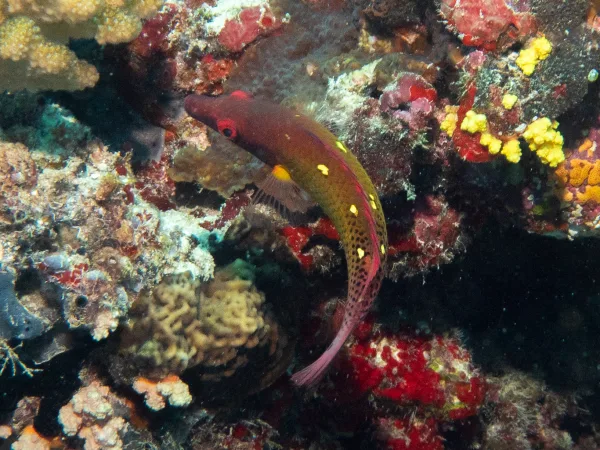
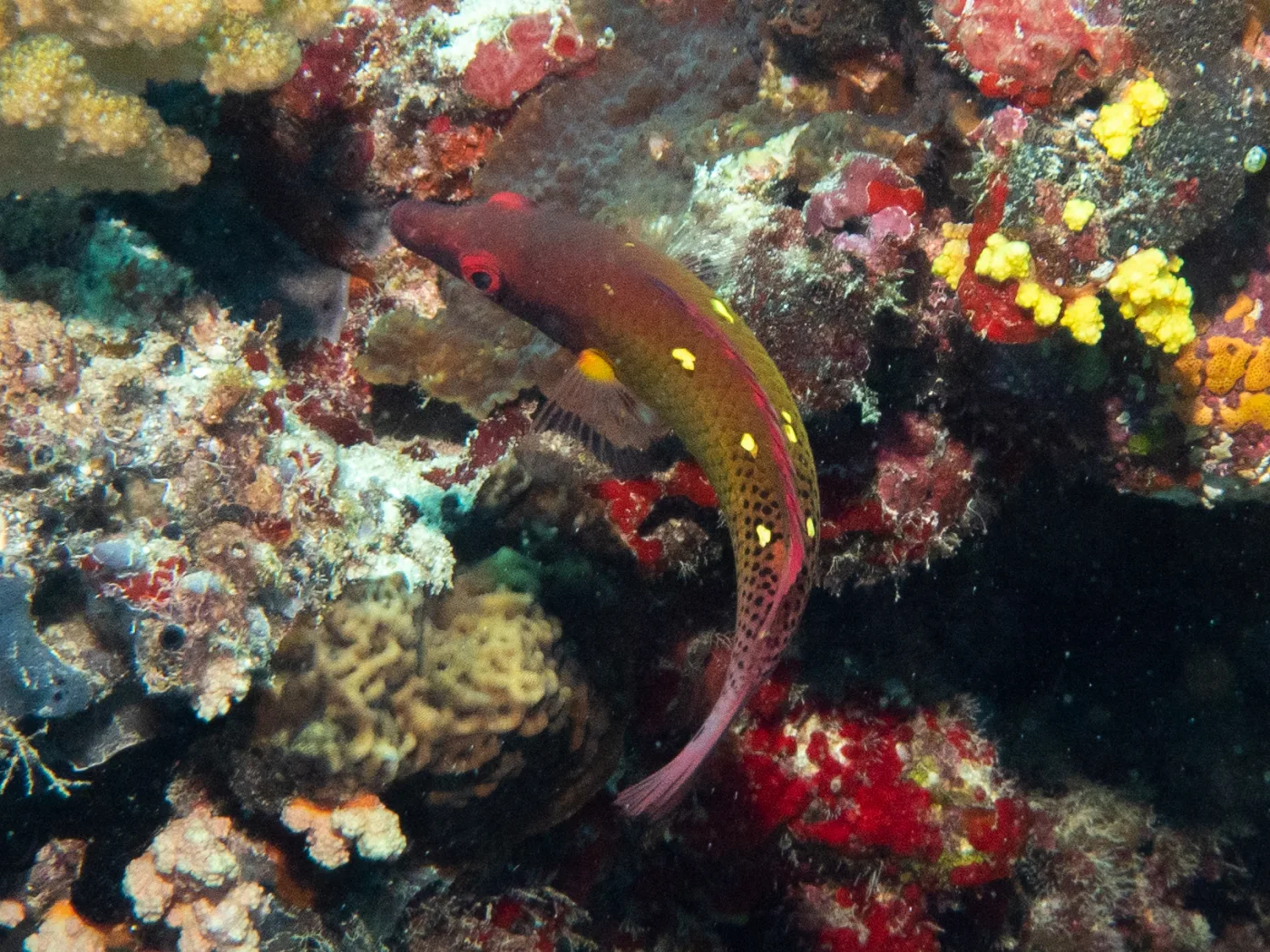
Diana's hogfish is a wrasse with a long snout and sharp front teeth. A grown-up fish is red and orange. It has a row of white spots on its back, like little pearls. Babies look very different. They are dark brown with lots of white dots. This fish lives on coral reefs in the Indian Ocean. Its twin in the Pacific Ocean looks almost the same. In 2006, experts gave the twin its own name. The hogfish hunts near the bottom. It eats snails, crabs and other small animals with hard shells. Young ones also clean other fish. They pick tiny bugs off their skin. In a tank it is tough and full of energy. But it is bossy with small, shy fish. It will also eat shrimp, crabs and snails, so it is not right for every reef tank.
Water & care
A hardy, hungry fish that takes aquarium foods readily. The challenges are space, its appetite for invertebrates and its bossy nature. Give it a long tank with stable rockwork, open swimming room and a sand bed it can dive into when frightened, and feed meaty foods several times a day. Add it after peaceful fish have settled, choose tankmates of similar size and temperament, and quarantine it before it goes into a display.
| Parameter | Keep it at | Where that sits on the usual reef range |
|---|---|---|
| Temperature | 72–78 °F | |
| Salinity (SG) | 1.020–1.025 | |
| pH | 8.1–8.4 | |
| Alkalinity | 8–12 dKH |
LiveAquaria and Quality Marine agree on 72-78°F, SG 1.020-1.025, pH 8.1-8.4 and 8-12 dKH. That Pet Place gives 75-82°F, SG 1.020-1.024 and pH 8.0-8.4, and FishBase lists it from tropical water of 24-28°C (75-82°F). Keep normal reef targets in a reef; no species-specific calcium, magnesium, nitrate or phosphate values are published.
Feeding
DietCarnivore
Favorite foods
- Frozen mysis shrimp
- Chopped mussel, scallop and shrimp
- Krill
- Meaty pellets
- Frozen meaty marine mixes
A voracious eater: feed a varied, high-quality meaty diet several times a day, in portions it finishes within a few minutes. In the wild it eats snails, clams and crustaceans, so hard-shelled foods such as krill and chopped shellfish suit it. A well-fed hogfish is less likely to hunt the cleanup crew.
Tank & maintenance
- Minimum tank
- 100 gallons
- Aquascape
- Plenty of stable rockwork with caves for hiding, a deep sand bed it can dive into when frightened, and open swimming room. Secure rocks and coral frags so its foraging cannot topple them, and keep the tank covered.
- Lighting
- No special requirement; Quality Marine lists medium light.
- Water flow
- No published flow preference; moderate, varied flow as on a normal reef suits it.
Routine upkeep
Routine fish-only or reef upkeep with regular partial water changes. This big eater produces a lot of waste, so size filtration and skimming generously. After it has been foraging, check that rocks and frags are still secure, keep the lid closed, and watch tankmates for harassment.
Temperament & tankmates
TemperamentAggressive
LiveAquaria rates it aggressive, and That Pet Place calls it one of the more aggressive hogfish, likely to harass tankmates. Quality Marine describes it as a bit territorial but generally compatible with most tank inhabitants. It does best with larger, robust fish and is a poor choice with small or timid species. Add it last and keep only one.
Reef safeWith caution
Usually leaves corals alone, but it is not invertebrate-safe. Adults eat snails, worms, mussels and other small bivalves, shrimp and crabs, and hogfish can knock over loose corals while foraging in the rockwork. LiveAquaria rates it not reef compatible, while That Pet Place rates it reef safe with caution but not invertebrate safe. In a reef, expect to lose ornamental shrimp, small crabs, snails and fan worms, and glue frags and rocks in place.
Good tankmates
- Larger angelfish
- Tangs
- Robust damselfish
- Mild-mannered triggerfish
- Other fish of similar size and temperament
Avoid
- Small or timid fish such as gobies, firefish and small wrasses
- Ornamental shrimp and small crabs
- Snails, small clams and mussels
- Feather dusters and other fan worms
- Another Diana's hogfish
Help it thrive
- Add it last, after the other fish have settled, and pick tankmates its size or bigger.
- Give it a long tank with open swimming room and a sand bed to dive into.
- Feed meaty foods several times a day so it is not hungry enough to hunt the cleanup crew.
- Glue down rocks and coral frags before it arrives.
- Quarantine it before it goes into the display.
Common ailments
Marine ich (Cryptocaryon irritans)
- Signs
- White, salt-like spots on the body, fins or gills, scratching (flashing), rapid breathing, cloudy eyes, hiding and loss of appetite.
- Prevention
- Quarantine new fish in a separate tank for several weeks before adding them to the display, and keep water quality stable.
- Treatment
- Treat in a hospital tank, never in a reef display, with copper, chloroquine phosphate or the tank-transfer method; give the hogfish a hiding place during treatment. Leave the display without fish for several weeks so the cysts in the rock and sand die out.
Marine velvet (Amyloodinium ocellatum)
- Signs
- A fine dusty sheen on the skin, very fast breathing, gasping at the surface, scratching and lethargy. It can kill very quickly.
- Prevention
- Strict quarantine, and disinfect nets, buckets and equipment between tanks.
- Treatment
- Act at once: a temperature- and pH-matched freshwater dip for quick relief, then copper or chloroquine phosphate in a hospital tank. Leave the display fallow with no fish.
This is general hobby guidance, not veterinary advice. Quarantine new arrivals and treat in a separate tank whenever you can.
Risks of owning one
- Eats ornamental shrimp, crabs, snails, small clams and worms, so it can wipe out a cleanup crew.
- Can bully smaller or timid fish and claim the rockwork as its territory.
- Its foraging can topple loose rocks and coral frags.
- Grows to about 7 in or more (sources say up to 10 in) and needs a large tank long-term.
- Fish sold as Diana's hogfish may be the very similar Pacific species B. dictynna.
Breeding
DifficultyNot achieved Captive-bredRare or wild-caught
Hogfishes are hermaphrodites that can change from female to male, and FishBase lists this species as an egg-layer that forms distinct pairs when breeding. No report of captive spawning or larval rearing was found in the sources checked, and fish in the trade appear to be wild-collected.
Deep dive The science, history and family tree
The science
Bodianus diana is a hogfish in the wrasse family Labridae (subfamily Hypsigenyinae). The body is fusiform and laterally compressed, with an elongate head and snout and prominent canine teeth at the front of both jaws; the dorsal fin has 12 spines and 10 soft rays and the anal fin 3 spines and 12 soft rays. Adults are red to orange with a row of white spots below the dorsal fin, while juveniles are brown with numerous small white spots on the head and snout. The maximum recorded size is 16.9 cm standard length. Since Gomon's 2006 revision of the genus, the species has been restricted to the Indian Ocean, from East Africa to the Nicobar and Cocos-Keeling islands; Pacific fish formerly given this name are B. dictynna. It lives in coral-rich areas of seaward reefs at 6-80 m, mostly shallower than 25 m. Adults feed mainly on benthic molluscs and crustaceans, and juveniles remove parasites from other fishes. Hogfishes can change sex, and pairs form for spawning. The IUCN lists it as Least Concern.
- Appearance
- Adults are red to orange-red, often with gold tones and red-edged fins, with a row of about four white spots along the back below the dorsal fin. Juveniles are dark brown to maroon with many white spots and a dark mark on each fin; subadults show a mix of both patterns. The look-alike is the Pacific Diana's hogfish (B. dictynna). Fishes of Australia separates them by spot pattern: B. diana juveniles have numerous small white spots on the head and snout above the mouth, with the spots behind the eye often in rows, and terminal-phase males lack prominent black spots on the rear of the dorsal fin and the middle of the anal and pelvic fins. B. dictynna juveniles have few head spots and none on the snout, with the spots below and behind the eye joining into irregular stripes, and its males carry large black spots on those fins.
- Native range
- Indian Ocean: from East Africa, the Comoros, Aldabra, the Seychelles, Mauritius and Reunion east through the Chagos Archipelago, Maldives and Sri Lanka to the Nicobar Islands and the Cocos-Keeling Islands, with records off northwestern Australia. Records from the Red Sea, Gulf of Aden and Somalia are doubtful. In the tropical western Pacific it is replaced by B. dictynna, and in the Line Islands by B. prognathus; older reports of B. diana from the Pacific refer to those species.
- Habitat
- Coral-rich areas of seaward reefs at 6-80 m, usually 6-25 m. It has been reported living with the long-tentacled mushroom coral Heliofungia actiniformis, and juveniles have been seen sheltering among its tentacles. Juveniles also act as part-time cleaners, removing parasites from other fishes.
- Size
- 6.7 in (16.9 cm). FishBase gives 16.9 cm and Fishes of Australia 17 cm standard length (measured without the tail fin), so total length is somewhat longer. Retailers disagree widely: Quality Marine says almost 7 in, while LiveAquaria and That Pet Place say 10 in.
- Lifespan
- No published lifespan figure was found for this species in the sources checked.
- Conservation
- Least Concern. Assessed Least Concern by the IUCN (FishBase lists a 2008 assessment; Wikipedia cites Russell 2010). It is of minor importance to local fisheries and is collected for the aquarium trade. No captive-bred supply was found, so aquarium fish appear to be wild-collected
In the aquarium vs in the wild
In your aquarium
A colorful, active display fish for large fish-only tanks or carefully planned reef tanks without small invertebrates.
On the reef
A bottom-foraging predator of molluscs and crustaceans on seaward reefs; juveniles are part-time cleaners of other fishes.
History
Bernard Germain de Lacepède described the species in 1801 as Labrus diana in his Histoire naturelle des poissons. It was later placed in the genus Lepidaplois, and J. L. B. Smith's Lepidaplois aldabrensis (1956) is now a synonym. For a long time the name covered similar fish across the Indo-Pacific, until M. F. Gomon's 2006 revision of Bodianus restricted B. diana to the Indian Ocean and named the Pacific population B. dictynna, after another name for the goddess Diana. In the aquarium trade it is sold as Diana's hogfish or red Diana hogfish.
Evolution & relatives
Hogfishes belong to the subfamily Hypsigenyinae. A broad DNA study of the wrasse family by Westneat and Alfaro (2005) found the hogfish and tuskfish group to be the sister of all other wrasses, so hogfishes sit near the base of the wrasse tree. Santini, Sorenson and Alfaro (2016) built the first multi-gene tree of Bodianus: the genus only forms a natural group if the creole wrasse (Clepticus) and the sheepheads (Semicossyphus) are counted with it, and hogfishes began to diversify in the Early Miocene, about 20 million years ago, in the Indo-West and southwest Pacific before spreading to other oceans several times. WoRMS now places Bodianus in the tribe Clepticini, and Semicossyphus has been merged into Bodianus. B. diana and B. dictynna are a closely related Indian Ocean and Pacific pair. On the site's tree, Diana's hogfish is a distant cousin of Halichoeres wrasses such as the melanurus and of the six line wrasse.
Family tree, from kingdom down
- Kingdom Animalia Animals Animals are living things made of many cells that must eat food to live. Fish, corals, crabs, snails and sea stars are all animals.
- Phylum Chordata Chordates Chordates have a stiff rod running down their back at some point in their lives. In fish and people, this rod is replaced by a backbone.
- Subphylum Vertebrata Vertebrates Vertebrates are animals with a backbone and a skull. Fish, frogs, birds and people are all vertebrates.
- Infraphylum Gnathostomata jawed vertebrates
- Parvphylum Osteichthyes bony fishes
- Gigaclass Actinopterygii ray-finned fishes
- Superclass Actinopteri
- Class Teleostei Teleost fishes Teleosts are bony fishes with thin, bendy fin rays and jaws that can push forward. Almost all of the fish in the world are teleosts.
- Order Eupercaria (unplaced) Unplaced eupercarian fishes Eupercaria is a huge group of fish with spiny fins. Scientists found it by studying DNA, and it holds wrasses, grunts, butterflyfishes and many more. 'Incertae sedis' means 'place not sure': scientists have not yet agreed which order wrasses belong in.
- Family Labridae Wrasses Wrasses are a huge family of colorful fish that swim by flapping their front fins. Many change color, and some change from female to male.
- Subfamily Hypsigenyinae Hogfishes and allies
- Tribe Clepticini
- Genus Bodianus Hogfishes
- Species Bodianus diana
See it on the Tree of Life Compare with another species
Closest relatives
- Bodianus dictynna Pacific Diana's Hogfish (Redfin Hogfish) Same genus; Pacific sister species, split from B. diana in 2006
- Bodianus mesothorax Coral Hogfish (Splitlevel Hogfish) Same genus Read guide · Compare
- Bodianus axillaris Axilspot Hogfish Same genus
- Bodianus rufus Spanish Hogfish Same genus; Atlantic species linked to the genus's type species
Older scientific names: Lepidaplois diana, Labrus diana, Lepidaplois aldabrensis.
Fun facts
- Since 2006 the Indian Ocean and Pacific fish have been separate species; the Pacific twin, B. dictynna, is named after Dictynna, another name for the goddess Diana.
- Young Diana's hogfish work as cleaners, picking parasites off other fish.
- It has been found living with the long-tentacled mushroom coral Heliofungia actiniformis, with juveniles hiding among the tentacles.
- Like other hogfishes it can change sex, from female to male.
- A frightened hogfish may dive into the sand to hide.
Learn more
- Fishes of Australia: Diana's Pigfish, Bodianus diana fishesofaustralia.net.au
- Wikipedia: Bodianus (hogfishes) en.wikipedia.org
- Santini, Sorenson and Alfaro 2016, Phylogeny and biogeography of hogfishes and allies (PubMed) pubmed.ncbi.nlm.nih.gov
- Westneat and Alfaro 2005, Phylogenetic relationships and evolutionary history of the Labridae (PubMed) pubmed.ncbi.nlm.nih.gov
Sources
- FishBase species summary: Bodianus diana fishbase.se
- WoRMS taxon record 218931 marinespecies.org
- Wikipedia: Diana's hogfish en.wikipedia.org
- Fishes of Australia: Diana's Pigfish, Bodianus diana fishesofaustralia.net.au
- Fishes of Australia: Pacific Diana's Pigfish, Bodianus dictynna fishesofaustralia.net.au
- LiveAquaria: Red Diana Hogfish liveaquaria.com
- Quality Marine: Red Diana Hogfish qualitymarine.com
- That Pet Place: Diana Hogfish thatpetplace.com
Scientific names and classification follow the World Register of Marine Species (AphiaID 218931). Checked by our team. Last updated October 29, 2026.
Shop this species
Search the shop →
Only 3 left