Fish · Clownfish
Cinnamon Clownfish
Amphiprion melanopus
Also called Fire Clownfish, Red and Black Anemonefish, Black-backed Anemonefish, Dusky Anemonefish, Yellow Tail Cinnamon Clownfish
Reviewed by admin on October 29, 2026 · Meet the team
- CareEasy
- Reef safeYes
- TemperamentSemi-aggressiveGuards its host; fights other clownfish
- Favorite foods
- Frozen mysis shrimp
- Marine pellets
- Herbivore / algae foods
- Max size4.7 in (12 cm)
- Min tank30 gal
- LifespanNot documented for this species
- IUCN statusLeast Concern
Quick answers
- How big does the Cinnamon Clownfish get?
- Up to 4.7 in (12 cm).
- What size tank does it need?
- At least 30 gallons.
- How hard is it to keep?
- Care level: Easy.
- Is it reef safe?
- Yes. Does not eat corals or invertebrates.
- What does it eat?
- Frozen mysis shrimp
- Marine pellets
- Herbivore / algae foods
- How long does it live?
- Not documented for this species.
- What are good tankmates?
- Tangs in suitably large tanks
- Robust wrasses and dwarf angelfish
- Other sturdy community fish of similar or larger size
- Bubble Tip Anemone (Entacmaea quadricolor) as a host
The 30-second version
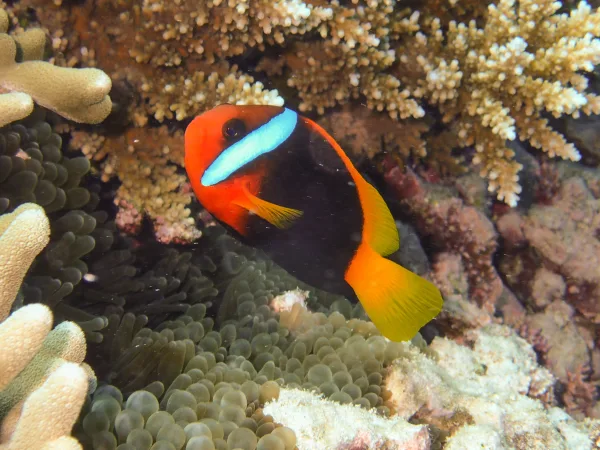
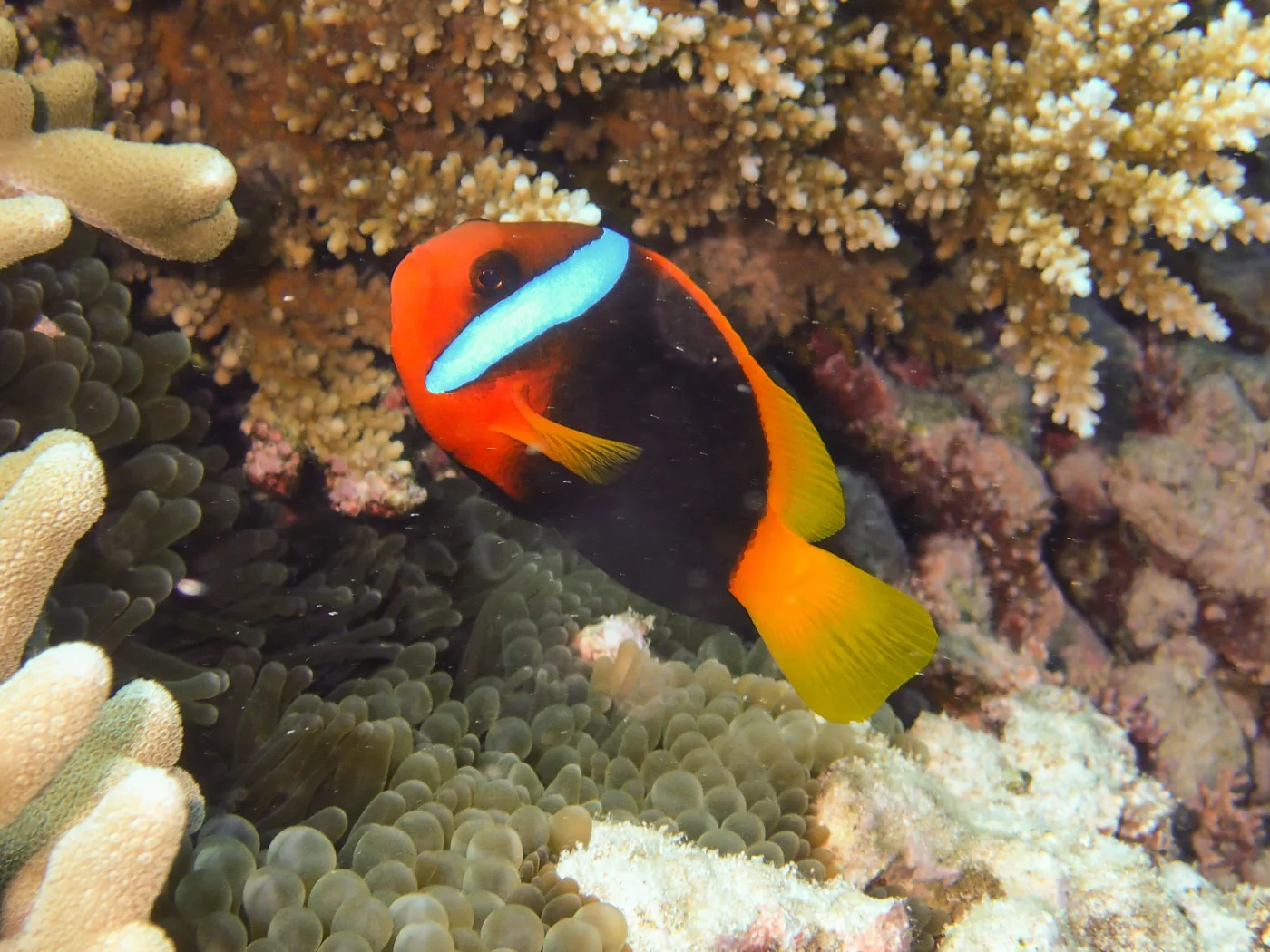
The cinnamon clownfish is a red and black clownfish. It has one wide white stripe on its head, just behind the eye. Its belly fins are black. Its name means black feet! It lives on reefs in the west part of the Pacific Ocean. Its home is a sea anemone, most often a bubble tip anemone. The anemone has arms that sting. A slimy coat keeps the clownfish safe. In turn, the clownfish chases off fish that want to bite its home. All clownfish start out as boys. The biggest one in the group turns into a girl, and she is the boss. The dad guards the eggs and fans them with his fins. This clownfish gets grumpy as it grows, so it needs room and just one mate.
Water & care
Hardy and an eager eater; Quality Marine rates it Easy. The challenge is temperament rather than care: as it matures it becomes territorial and can turn aggressive, more so than ocellaris or percula clownfish. Keep one fish or one pair, add a pair together, and give them a 30-gallon or larger tank with rockwork. An anemone is optional; if you add one, the bubble-tip anemone is its usual host in the wild and the easiest host to keep. Choose captive-bred fish when you can, because wild-caught clownfish often carry Brooklynella.
| Parameter | Keep it at | Where that sits on the usual reef range |
|---|---|---|
| Temperature | 72–78 °F | |
| Salinity (SG) | 1.020–1.025 | |
| pH | 8.1–8.4 | |
| Alkalinity | 8–12 dKH |
Ranges from Quality Marine's care sheet. The fish has no specific calcium, magnesium, nitrate or phosphate target; follow your corals' or anemone's needs in a reef. Keep ammonia and nitrite at zero and nitrate low with regular water changes.
Feeding
DietOmnivore
Favorite foods
- Frozen mysis shrimp
- Enriched frozen brine shrimp
- Marine pellets and flakes
- Spirulina and other algae-based foods
Feed small meals of meaty frozen foods mixed with algae-based foods two or three times a day, only what is eaten in a minute or two. Captive-bred fish take pellets and flakes readily. Wild fish eat mainly planktonic copepods and algae.
Tank & maintenance
- Minimum tank
- 30 gallons
- Aquascape
- Rockwork with caves and a sheltered spot the pair can claim. An anemone is optional; if you keep a bubble-tip anemone, the tank should be mature, and pump intakes should be covered.
- Lighting
- No special needs for the fish. A host anemone or corals need proper reef lighting.
- Water flow
- Moderate; clownfish stay close to home and are not strong swimmers.
Routine upkeep
Routine reef or fish-only upkeep: test salinity, temperature, ammonia, nitrite and nitrate regularly and do partial water changes. Quarantine every new fish for 2-4 weeks first, because clownfish easily catch Brooklynella, ich and velvet. Keep fingers away from a spawning pair's nest.
Temperament & tankmates
TemperamentSemi-aggressive
Quality Marine tags it Aggressive, while other retailers list it as Semi-aggressive. It is usually fine with robust community fish, but it defends its anemone and eggs hard, can bite hands, and fights other clownfish. Keep only one pair per tank and do not mix it with other clownfish species.
Reef safeYes
Does not eat corals or invertebrates. Wikipedia notes that it may move corals or cover them with sand, and a pair guarding an anemone or a nest will shove other animals away. If it adopts a coral as a stand-in host, check that the coral can still open.
Good tankmates
- Tangs in suitably large tanks
- Robust wrasses and dwarf angelfish
- Other sturdy community fish of similar or larger size
- Bubble Tip Anemone (Entacmaea quadricolor) as a host
Avoid
- Other clownfish species
- More than one pair of cinnamon clownfish
- Small, timid fish in small tanks
- Large predators such as lionfish, groupers and eels
Help it thrive
- Buy captive-bred fish: they eat prepared foods from day one and carry far fewer parasites than wild-caught clownfish.
- Add your clownfish as a pair, or as two small juveniles together; the bigger one becomes the female.
- Give the pair a cave or a bubble-tip anemone they can call home, away from strong pump outlets.
- Make it the only clownfish species in the tank.
- Feed a varied diet of meaty frozen foods plus algae-based pellets or flakes.
Common ailments
Brooklynella ("clownfish disease", Brooklynella hostilis)
- Signs
- Slightly folded fins and lethargy at first, then heavy skin mucus, fast breathing, fading color, refusing food and hanging in one spot. Once signs are advanced, death can follow within hours.
- Prevention
- Buy captive-bred clownfish (wild-caught clowns are hit hardest) and quarantine every new fish.
- Treatment
- Move the fish to a hospital tank at once. Reef Builders lists chloroquine (a 14-day course) or daily formalin dips, dosed strictly by the label, and lowering the hospital tank's salinity to about 1.018 as support. Never dose formalin in a reef.
Marine ich (Cryptocaryon irritans)
- Signs
- White, salt-grain spots on the body, fins or gills, scratching against rocks, cloudy eyes, faster breathing and loss of appetite.
- Prevention
- Quarantine all new fish, avoid temperature swings and keep stress low.
- Treatment
- Treat every fish in a hospital tank with copper or chloroquine phosphate, or use the tank-transfer method; none of these belong in a reef display. The cyst stage can last up to 72 days, so leave the display without fish for about 11 weeks.
Marine velvet (Amyloodinium ocellatum)
- Signs
- A fine, dusty sheen on the skin, very fast breathing, gasping at the surface, scratching and sudden deaths, sometimes within 12-48 hours.
- Prevention
- Strict quarantine, and separate nets and buckets for quarantine and display tanks.
- Treatment
- Act immediately: a temperature- and pH-matched freshwater dip for quick relief, then copper or chloroquine in a hospital tank, and a fishless fallow period for the display.
This is general hobby guidance, not veterinary advice. Quarantine new arrivals and treat in a separate tank whenever you can.
Risks of owning one
- Grows territorial and can bully tankmates or bite hands during maintenance, especially near eggs or its anemone.
- Fights other clownfish; mixing species or adding a third fish to a pair usually ends badly.
- An anemone bought for it is a separate, more demanding animal that can wander into pumps and sting corals.
- Wild-caught clownfish often carry Brooklynella, which can spread to other fish.
- Long-lived: plan for many years of care.
Breeding
DifficultyModerate Captive-bredWidely available
Egg-layers with male parental care, like other clownfish. A bonded pair lays sticky eggs on hard surfaces next to its anemone or cave, and the male guards and fans them until they hatch. FishBase records the species as reared in captivity, and Quality Marine reports that captive-bred fish are now more common in the trade than wild ones. Larvae are raised the same way as other clownfish larvae, on rotifers and then newly hatched brine shrimp.
- Start with two small captive-bred juveniles or a proven pair; the larger fish becomes the female.
- Feed the pair generously with varied frozen foods to bring them into breeding condition.
- Offer a flat rock or tile near their home; eggs are laid there and guarded by the male.
- Move the eggs or the newly hatched larvae to a separate rearing tank, because larvae are eaten in a display.
- Feed rotifers at first, then newly hatched brine shrimp, and wean the young onto fine prepared foods once they settle.
Deep dive The science, history and family tree
The science
Amphiprion melanopus is an anemonefish of the damselfish family (Pomacentridae) that reaches about 12 cm total length. Adults are dark red to orange with blackish or mahogany flanks, a single broad white bar behind the eye, and usually black pelvic and anal fins; the name melanopus means 'black feet'. Juveniles can show extra white bars that fade with age. It has 10 dorsal spines. The species ranges through the western Pacific from eastern Indonesia and the Philippines to Palau, Micronesia and the Marshall Islands, and south through Papua New Guinea, the Solomon Islands, Vanuatu and New Caledonia to the Great Barrier Reef. Older records from Fiji, Tonga and Samoa are now assigned to A. barberi. Adults live in lagoons and on outer reefs at 1-18 m, usually in the bubble-tip anemone Entacmaea quadricolor, occasionally in Heteractis crispa and rarely in H. magnifica. Each group has a breeding pair and smaller non-breeders ranked by size, and fish change sex from male to female. The diet is mainly planktonic copepods and algae. The IUCN lists it as Least Concern.
- Appearance
- Adults have a dark red to orange head and fins, blackish to mahogany sides, one white (sometimes light blue) bar just behind the eye, black pelvic and anal fins, and a lighter, sometimes cinnamon-colored dorsal fin and tail. Juveniles may carry extra white bars that disappear as they grow. Look-alikes belong to the same 'tomato' group: the Tomato Clownfish (A. frenatus), the Red Saddleback Anemonefish (A. ephippium), the Australian Anemonefish (A. rubrocinctus, northwestern Australia only) and Barber's Anemonefish (A. barberi) from Fiji, Tonga and Samoa, which has a red-orange rather than dark body and fewer spines on the upper gill cover (11-19 versus 19-26).
- Native range
- Western Pacific: eastern Indonesia (Bali and Sulawesi eastward) and the Philippines to Palau, Micronesia, Guam and the Marshall Islands, and south through Papua New Guinea, the Solomon Islands, Vanuatu, New Caledonia, the Coral Sea and the Great Barrier Reef (eastern Queensland). Records from Fiji, Tonga and Samoa now refer to Barber's anemonefish (A. barberi).
- Habitat
- Lagoons and outer reef areas at 1-18 m. It lives only with sea anemones: usually the bubble-tip anemone (Entacmaea quadricolor), occasionally the sebae anemone (Heteractis crispa) and rarely the magnificent anemone (H. magnifica). Each anemone holds a breeding pair and a few smaller non-breeders.
- Size
- 4.7 in (12 cm). FishBase and Wikipedia give 12 cm TL; Quality Marine says almost 5 in. Females are the largest fish in a group; FishBase gives maturity at about 5 cm.
- Lifespan
- Not documented for this species. Clownfish are long-lived for their size: the related orange clownfish (A. percula) has been estimated at about 30 years in the wild (Buston and García 2007, cited by Litsios et al. 2012), so plan for a long commitment.
- Conservation
- Least Concern. IUCN Least Concern (assessed 2010, per FishBase). Not listed by CITES. Wikipedia names coral bleaching, ocean acidification and collection for the aquarium trade as threats. Quality Marine notes that captive-bred cinnamon clownfish are now offered more often than wild-caught ones, which makes captive-bred fish the easy responsible choice
In the aquarium vs in the wild
In your aquarium
A hardy, richly colored display clownfish for aquarists who want something bolder than an ocellaris, often kept as a pair with a bubble-tip anemone.
On the reef
A small omnivore that eats plankton and algae while living in partnership with sea anemones: the anemone shelters it, and the fish drives off anemone-eating fishes.
History
Pieter Bleeker described the species in 1852. The name melanopus is Greek for 'black feet', after the black pelvic fins. For decades clownfish from Fiji, Tonga and Samoa were treated first as a color form of A. rubrocinctus (1972) and then of A. melanopus (1980); in 2008 Allen, Drew and Kaufman described them as a separate species, Barber's anemonefish (A. barberi), with DNA support. In the aquarium trade A. melanopus is sold as the Cinnamon Clownfish or Red and Black Anemonefish, and captive-bred fish have become common.
Evolution & relatives
Clownfishes (genus Amphiprion) are one branch of the damselfish family Pomacentridae, which belongs to Ovalentaria, the large group of spiny-rayed fishes that mostly lay sticky eggs on the bottom. Litsios et al. (2012) dated the clownfish lineage to roughly 19 million years and showed that the partnership with sea anemones acted as a key innovation that sped up their speciation; other studies give different dates. In current family trees the cinnamon clownfish sits in the ephippium or 'tomato' group with Barber's, Tomato, Red Saddleback and Australian anemonefishes, a separate branch from the ocellaris and percula clownfish.
Family tree, from kingdom down
- Kingdom Animalia Animals Animals are living things made of many cells that must eat food to live. Fish, corals, crabs, snails and sea stars are all animals.
- Phylum Chordata Chordates Chordates have a stiff rod running down their back at some point in their lives. In fish and people, this rod is replaced by a backbone.
- Subphylum Vertebrata Vertebrates Vertebrates are animals with a backbone and a skull. Fish, frogs, birds and people are all vertebrates.
- Infraphylum Gnathostomata jawed vertebrates
- Parvphylum Osteichthyes bony fishes
- Gigaclass Actinopterygii ray-finned fishes
- Superclass Actinopteri
- Class Teleostei Teleost fishes Teleosts are bony fishes with thin, bendy fin rays and jaws that can push forward. Almost all of the fish in the world are teleosts.
- Order Ovalentaria (unplaced) Unplaced ovalentarian fishes Ovalentaria is a big group of fish with spiny fins. Scientists found it by studying DNA, and most of its fish lay eggs that stay stuck to the bottom. 'Incertae sedis' means 'place not sure': scientists have not settled which order damselfishes, dottybacks and basslets belong in.
- Family Pomacentridae Damselfishes and clownfishes Damselfishes are small, often colorful reef fish that guard their homes. Clownfish and chromis are damselfishes.
- Genus Amphiprion Clownfishes Clownfish live among the stinging tentacles of sea anemones without getting hurt. They all start life as males, and the biggest can turn into a female.
- Species Amphiprion melanopus
See it on the Tree of Life Compare with another species
Closest relatives
- Amphiprion barberi Barber's Anemonefish Same genus and group; Fiji, Tonga and Samoa fish once counted as this species
- Amphiprion frenatus Tomato Clownfish Same genus; tomato group look-alike
- Amphiprion ephippium Red Saddleback Anemonefish Same genus; tomato group
- Amphiprion ocellaris Ocellaris Clownfish Same genus; a different branch of the clownfish tree Read guide · Compare
Fun facts
- Its scientific name, melanopus, means 'black feet', after its black pelvic fins.
- Every cinnamon clownfish starts life as a male. The biggest fish in a group becomes the female, and if she dies her mate changes sex to replace her.
- Clownfish from Fiji, Tonga and Samoa were once called this species, until DNA showed they are a separate one, Barber's anemonefish, named in 2008.
- Its favorite natural home is the bubble-tip anemone, the same anemone most reef keepers buy.
Learn more
- FishBase: Amphiprion melanopus (Fire clownfish) fishbase.se
- Wikipedia: Amphiprion melanopus en.wikipedia.org
- Quality Marine: Cinnamon Clownfish qualitymarine.com
Sources
- WoRMS: Amphiprion melanopus Bleeker, 1852 marinespecies.org
- FishBase: Amphiprion melanopus (Fire clownfish) fishbase.se
- Wikipedia: Amphiprion melanopus en.wikipedia.org
- Wikipedia: Amphiprion barberi en.wikipedia.org
- Wikipedia: Clownfish en.wikipedia.org
- Quality Marine: Cinnamon Clownfish qualitymarine.com
- Litsios et al. 2012, Mutualism with sea anemones triggered the adaptive radiation of clownfishes (BMC Evol Biol) pmc.ncbi.nlm.nih.gov
- Reef Builders: Brooklynellosis, clownfish disease (Jeff Kurtz, 2015) reefbuilders.com
Scientific names and classification follow the World Register of Marine Species (AphiaID 278398). Checked by our team. Last updated October 29, 2026.
Shop this species
Search the shop →