Fish · Blenny
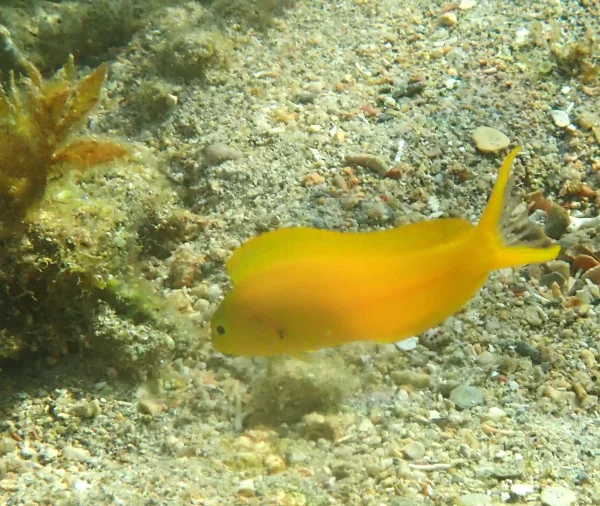
Canary Blenny
Meiacanthus oualanensis
Also called Canary Fang Blenny, Canary Fangblenny, Oualan Forktail Blenny
Reviewed by admin on October 29, 2026 · Meet the team
- CareModerate
- Reef safeYes
- TemperamentPeacefulPeaceful; fights its own kind, bites if attacked
- Favorite foods
- Mysis shrimp
- Enriched brine shrimp
- Frozen herbivore foods
- Max size3.9 in (10 cm)
- Min tank30 gal
- LifespanNot documented
- IUCN statusLeast Concern
Quick answers
- How big does the Canary Blenny get?
- Up to 3.9 in (10 cm).
- What size tank does it need?
- At least 30 gallons.
- How hard is it to keep?
- Care level: Moderate.
- Is it reef safe?
- Yes. Will not disturb corals or other invertebrates (Bulk Reef Supply); LiveAquaria lists it as reef compatible.
- What does it eat?
- Mysis shrimp
- Enriched brine shrimp
- Frozen herbivore foods
- How long does it live?
- Not documented; no published lifespan for aquarium or wild fish was found.
- What are good tankmates?
- Most peaceful community reef fish
- Clownfish, gobies and other small peaceful fish
- Corals, clams and ornamental shrimp
The 30-second version
The canary blenny is a small fish that is bright yellow, just like a canary bird. It comes from the reefs of Fiji in the Pacific Ocean. It eats tiny animals that drift by in the water. It has two big fangs in its lower jaw. If a bigger fish grabs it, the blenny bites. The bite has venom in it. The venom does not hurt much, but it makes the attacker feel weak. Its jaws go loose, and the blenny swims away. Fish learn to leave it alone. Some other blennies even copy its yellow color so they look scary too! In a tank it gets along with most fish and leaves corals alone. It likes small meaty foods and some plant foods. Keep a lid on the tank, because it can jump.
Water & care
Hardy and an eager feeder: feed small amounts of meaty and herbivore foods two or three times a day. It needs plenty of rockwork with holes to hide in and hunt over, and a tight-fitting lid, because it jumps. Handle with care: it can bite with venomous fangs. LiveAquaria warns it should be kept only with caution around children, and Bulk Reef Supply notes that incidents with keepers are rare. LiveAquaria and Bulk Reef Supply both rate it Moderate.
| Parameter | Keep it at | Where that sits on the usual reef range |
|---|---|---|
| Temperature | 72–78 °F | |
| Salinity (SG) | 1.020–1.025 | |
| pH | 8.1–8.4 | |
| Alkalinity | 8–12 dKH |
LiveAquaria's ranges. Bulk Reef Supply lists 75-78°F in its care notes but 'Tropical (77-82°F)' in its spec table. No species-specific calcium, magnesium or nutrient values are published.
Feeding
DietOmnivore
Favorite foods
- Mysis shrimp
- Vitamin-enriched brine shrimp
- Finely chopped crustacean flesh
- Frozen herbivore foods
- Sinking pellets
Feed small amounts two or three times a day (Bulk Reef Supply). LiveAquaria recommends finely chopped crustacean flesh, mysis, vitamin-enriched brine shrimp and frozen herbivore preparations. It also hunts and grazes over live rock between meals.
Tank & maintenance
- Minimum tank
- 30 gallons
- Aquascape
- Plenty of live rock with holes and caves to hide in and hunt over, and open water to swim in. A tight-fitting lid or mesh cover is essential.
- Lighting
- No special requirement.
- Water flow
- Moderate; in the wild it feeds on plankton carried by currents in lagoons and on reefs.
Routine upkeep
Routine partial water changes. Work carefully with hands in the tank and never hand feed it, since it can bite. Keep the lid closed and check for gaps.
Temperament & tankmates
TemperamentPeaceful
Generally peaceful, but it may act aggressively toward other fish if provoked, bites back when attacked, and may be aggressive toward its own species. Keep one per tank unless you have a breeding pair. LiveAquaria rates it semi-aggressive; Bulk Reef Supply calls it peaceful.
Reef safeYes
Will not disturb corals or other invertebrates (Bulk Reef Supply); LiveAquaria lists it as reef compatible.
Good tankmates
- Most peaceful community reef fish
- Clownfish, gobies and other small peaceful fish
- Corals, clams and ornamental shrimp
Avoid
- Another canary blenny, unless a breeding pair
- Other Meiacanthus and similar-shaped blennies
- Large predators that might try to eat it
Help it thrive
- Feed small meals two or three times a day.
- Give it lots of rockwork with holes it can claim as a home.
- Keep the tank covered; it jumps.
- Keep one per tank unless you buy a breeding pair.
- Keep fingers away at feeding time; a fang bite can hurt.
Common ailments
Wasting from underfeeding
- Signs
- A thin body and pinched belly, slow movement and constant searching for food.
- Prevention
- Feed small amounts two or three times a day, and do not keep it with fast, greedy feeders that take all the food.
- Treatment
- Increase the number of small meals with mysis and enriched brine shrimp, and move it to a calmer tank if tankmates outcompete it.
Jumping out of the tank
- Signs
- A missing fish, usually after it was chased or startled.
- Prevention
- Use a tight-fitting lid or mesh cover with no gaps.
- Treatment
- There is no treatment once it is out of the water for long; prevention is the only reliable answer.
Fight injuries with its own kind
- Signs
- Torn fins and bite marks when two canary blennies or similar blennies share a tank.
- Prevention
- Keep one per tank unless you have a breeding pair, and avoid similar-shaped blennies.
- Treatment
- Separate the fish, keep the water very clean so fins regrow, and treat any secondary infection in a hospital tank.
This is general hobby guidance, not veterinary advice. Quarantine new arrivals and treat in a separate tank whenever you can.
Risks of owning one
- It can give a painful, venomous bite if handled or hand fed.
- Jumps out of open tanks.
- May fight with another canary blenny or similar blennies.
- Wild fish come only from Fiji; captive-bred supply is limited to a few producers.
Breeding
DifficultyHard Captive-bredWidely available
Oviparous with distinct pairing: adhesive eggs are attached to the substrate by a filament-like pad, and the larvae are planktonic (FishBase). Males are generally larger than females and change color during breeding (LiveAquaria). ORA raises it commercially and its captive-bred juveniles are sold by retailers such as Bulk Reef Supply, but the rearing method has not been published.
- Buy a pair, or two fish of clearly different sizes; males are generally larger.
- Give them a cave or hole in the rockwork where eggs can be attached.
- Condition them with varied meaty and herbivore foods two or three times a day.
- Watch for the male's breeding colors before spawning.
- Move the hatched larvae to a rearing tank with tiny live foods; commercial methods are not public.
Deep dive The science, history and family tree
The science
Meiacanthus oualanensis is a fangblenny (Blenniidae: Blenniinae) known only from Fiji. FishBase gives a maximum of 10 cm standard length, and aquarium specimens reach about 4-5 in. The body is elongate and bright yellow, with a greenish tinge on top of the head, a faint greenish stripe on the dorsal fin and a dark spot at the base of the pectoral fin; the caudal fin is lunate with elongated lobes in large adults. The dorsal fin has 4-5 spines and 25-28 soft rays, and the anal fin 2 spines and 16-18 soft rays. Like other Meiacanthus it has large canine fangs in the lower jaw. A 2017 study of fangblenny venom found an opioid peptide, a neuropeptide and a lipase; the venom lowers a predator's blood pressure rather than causing pain, so the attacker releases the blenny. A yellow Fijian form of Plagiotremus laudandus is a Batesian mimic of this species. Reproduction is oviparous with distinct pairing; adhesive eggs are attached to the substrate and the larvae are planktonic. The IUCN lists it as Least Concern.
- Appearance
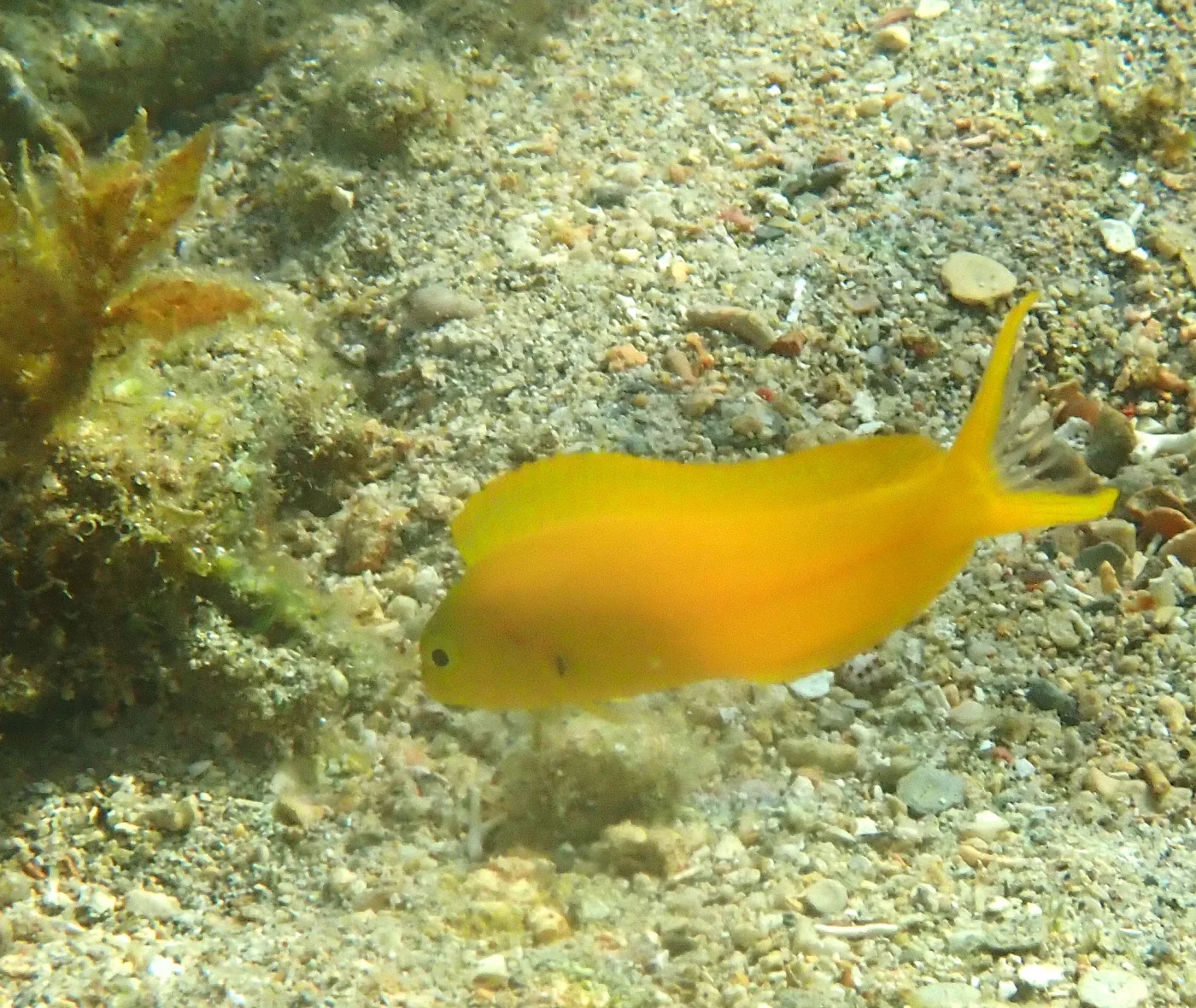
- Solid bright yellow, with a greenish tinge on top of the head, a faint greenish stripe in the dorsal fin, a small dark spot where the pectoral fin meets the body, and a clear tail with dusky rays; large adults develop a crescent-shaped tail with long lobes. Males are generally larger than females and change color when breeding (LiveAquaria). Look-alikes: a yellow Fijian form of the mimic blenny Plagiotremus laudandus copies its color, and in Tonga a similar yellow fangblenny, M. tongaensis, takes its place.
- Native range
- Western central Pacific: known only from Fiji (FishBase, Wikipedia). Some retailers say Fiji and Tonga, but the yellow fangblenny mimicked in Tonga is M. tongaensis. The species was named after the island of Ovalau in Fiji.
- Habitat
- Reef-associated. Retailer descriptions of ORA's captive-bred fish say it lives in the currents of lagoons and reefs, where it feeds on zooplankton. FishBase gives no depth range.
- Size
- 3.9 in (10 cm). FishBase: 10 cm (3.9 in) standard length, which does not include the tail; Wikipedia: 5 cm SL. LiveAquaria gives a maximum of 5 in and Bulk Reef Supply 4-5 in total length.
- Lifespan
- Not documented; no published lifespan for aquarium or wild fish was found.
- Conservation
- Least Concern. Assessed Least Concern by the IUCN (2009 assessment cited by FishBase; Williams 2014 cited by Wikipedia). Not evaluated by CITES. Its known range is small (Fiji only), and captive-bred fish from ORA are sold by US retailers alongside wild-collected fish
In the aquarium vs in the wild
In your aquarium
A bright yellow, reef-safe display fish that is easy to spot as it swims around the rockwork.
On the reef
A small plankton-eating fangblenny whose venomous bite protects it from predators and whose color is copied by a mimic blenny.
History
Albert Günther described the canary blenny in 1880 as Petroscirtes oualanensis, in his report on the shore fishes collected during the voyage of HMS Challenger (1873-1876). He named it after the island of Ovalau in Fiji, but the name was spelled oualanensis; FishBase notes it should have been ovalauensis, and the spelling Meiacanthus ovalauensis still appears in the trade. John Roxborough Norman named the genus Meiacanthus in 1944; the name comes from Greek words for 'less' and 'thorn'. Captive-bred canary blennies from ORA are now sold alongside wild fish.
Evolution & relatives
Meiacanthus is a genus of about 30 fangblennies (WoRMS lists 31) in the western Pacific and Indian Oceans. With Plagiotremus, Petroscirtes, Aspidontus, Blennius and others, it belongs to the subfamily Blenniinae, the smaller of the two subfamilies of combtooth blennies (16 genera and 95 species). The larger subfamily, Salariinae, holds the algae-grazing blennies such as the lawnmower and bicolor blennies. A 2017 study in Current Biology (Casewell and colleagues) examined the evolution of fangs, venom and mimicry in these blennies; Meiacanthus venom acts on opioid receptors and is being studied as a possible source of new painkillers. Venomous Meiacanthus are the models for several mimics: Plagiotremus laudandus, for example, has a blue and yellow form that copies M. atrodorsalis and yellow forms in Fiji and Tonga that copy M. oualanensis and M. tongaensis. Combtooth blennies belong to the order Blenniiformes.
Family tree, from kingdom down
- Kingdom Animalia Animals Animals are living things made of many cells that must eat food to live. Fish, corals, crabs, snails and sea stars are all animals.
- Phylum Chordata Chordates Chordates have a stiff rod running down their back at some point in their lives. In fish and people, this rod is replaced by a backbone.
- Subphylum Vertebrata Vertebrates Vertebrates are animals with a backbone and a skull. Fish, frogs, birds and people are all vertebrates.
- Infraphylum Gnathostomata jawed vertebrates
- Parvphylum Osteichthyes bony fishes
- Gigaclass Actinopterygii ray-finned fishes
- Superclass Actinopteri
- Class Teleostei Teleost fishes Teleosts are bony fishes with thin, bendy fin rays and jaws that can push forward. Almost all of the fish in the world are teleosts.
- Order Blenniiformes Blennies and kin This order includes blennies and their relatives. Most are small fish that perch on the bottom and peek out of holes.
- Family Blenniidae Combtooth blennies Combtooth blennies are small fish with rows of comb-like teeth and no scales. Many scrape algae and peek out from holes in rock.
- Subfamily Blenniinae Fangblennies and kin
- Genus Meiacanthus Fangblennies
- Species Meiacanthus oualanensis
See it on the Tree of Life Compare with another species
Closest relatives
- Meiacanthus grammistes Striped Fang Blenny Same genus; the species used in venom research
- Plagiotremus laudandus Poison-fang Blenny Mimic Same subfamily (Blenniinae); its yellow Fijian form mimics the canary blenny
- Ecsenius bicolor Bicolor Blenny Same family (Blenniidae), different subfamily (Salariinae) Read guide · Compare
Older scientific names: Meiacanthus ovalauensis, Petroscirtes oualanensis, Petroscirtes auratus.
Fun facts
- Its venom acts on opioid receptors and lowers a predator's blood pressure instead of causing pain.
- In Fiji, a different blenny has a yellow form that copies the canary blenny so predators leave it alone.
- Its scientific name is a misspelling: it was meant to honor the Fijian island of Ovalau.
- It was first described from the HMS Challenger expedition of the 1870s.
- Large adults grow a crescent-shaped tail with long tips.
Learn more
- FishBase: Meiacanthus oualanensis, Canary fangblenny fishbase.se
- LiveAquaria: Canary Blenny liveaquaria.com
- Wikipedia: Meiacanthus grammistes (fangblenny venom) en.wikipedia.org
Sources
- FishBase species summary: Meiacanthus oualanensis fishbase.se
- WoRMS: Meiacanthus oualanensis (Günther, 1880) marinespecies.org
- Wikipedia: Meiacanthus oualanensis en.wikipedia.org
- Wikipedia: Meiacanthus grammistes en.wikipedia.org
- Wikipedia: Plagiotremus laudandus en.wikipedia.org
- Wikipedia: Blenniinae en.wikipedia.org
- LiveAquaria: Canary Blenny liveaquaria.com
- Bulk Reef Supply: ORA Canary Blenny bulkreefsupply.com
Scientific names and classification follow the World Register of Marine Species (AphiaID 279316). Checked by our team. Last updated October 29, 2026.
Shop this species
Search the shop →