Fish · Toadfish
Atlantic Toadfish
Opsanus sp.
Also called Toadfish, Oyster Toadfish, Gulf Toadfish, Orange Toadfish, Orange Gulf Toadfish, Leopard Toadfish, Oyster Toad, Oyster Cracker, Bar Dog, Ugly Toad
Reviewed by admin on October 29, 2026 · Meet the team
- CareEasy
- Reef safeNo
- TemperamentAggressiveSwallows small fish; eats all crustaceans
- Favorite foods
- Shrimp
- Squid and krill
- Carnivore pellets
- Max size17 in (43.2 cm)
- Min tank75 gal
- LifespanAbout 8 years for the oyster toadfish…
- IUCN statusLeast Concern
Quick answers
- How big does the Atlantic Toadfish get?
- Up to 17 in (43.2 cm).
- What size tank does it need?
- At least 75 gallons.
- How hard is it to keep?
- Care level: Easy.
- Is it reef safe?
- No. It eats shrimps, crabs, hermit crabs, snails, clams and worms, swallows small fish, and digs in the sand, which can topple rock and corals.
- What does it eat?
- Shrimp
- Squid and krill
- Carnivore pellets
- How long does it live?
- About 8 years for the oyster toadfish in the wild (Wikipedia; FishBase also uses 8 years as its maximum age), with maturity at 2-7 years.
- What are good tankmates?
- Robust fish of similar or larger size that do not need bottom shelter
- Large, calm fish-only tankmates such as large angelfish or tangs
- A species-only tank
The 30-second version
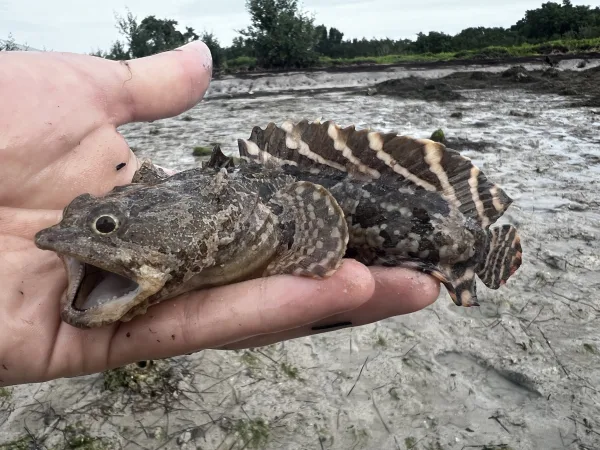
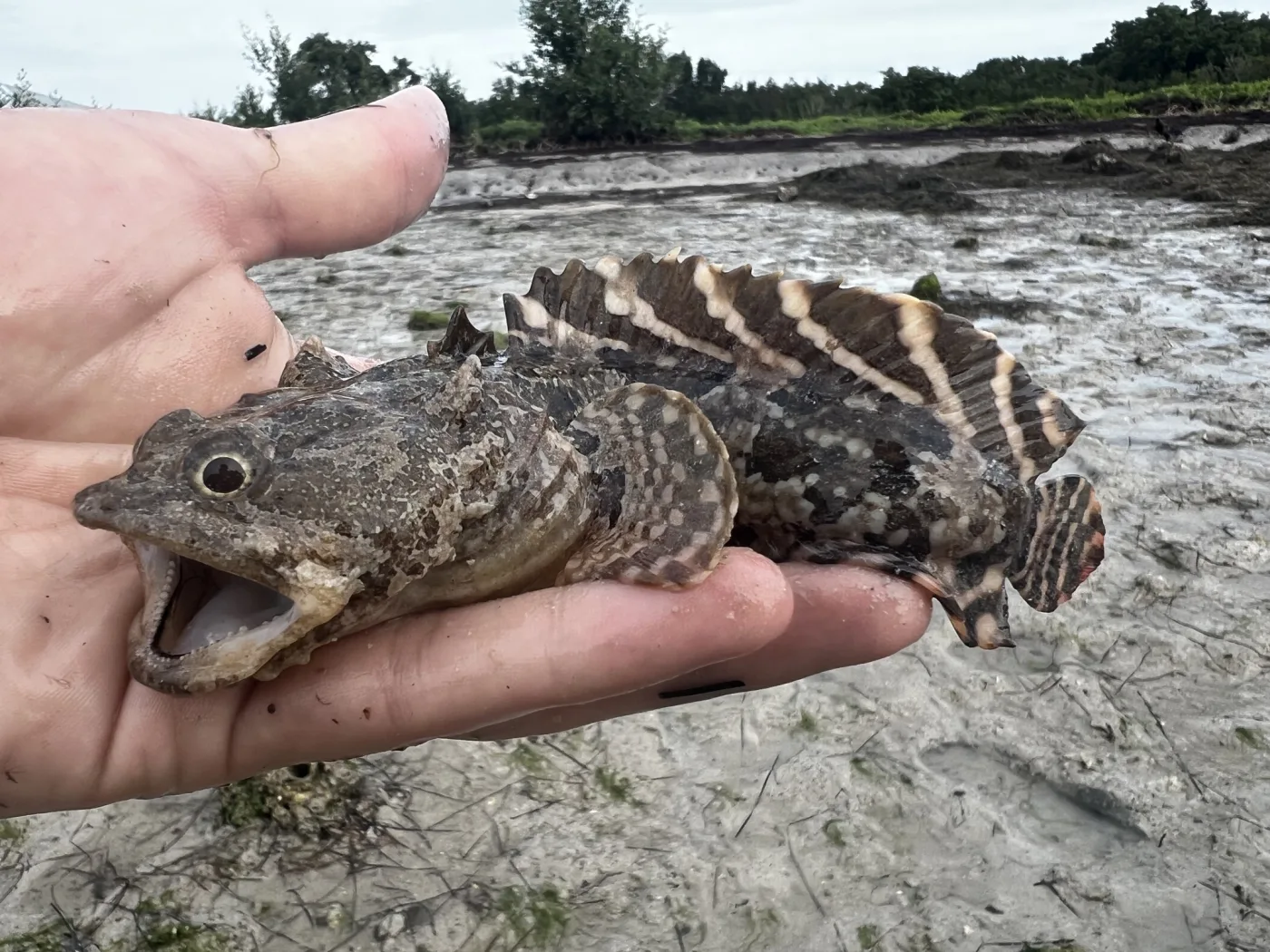
A toadfish is a chunky fish with a big, flat head and a huge mouth. Its eyes sit on top of its head. Little flaps of skin hang around its mouth like whiskers. Most are brown or tan with dark blotches, and a few are orange. Toadfish live in shallow water along the Atlantic coast of America. They hide under rocks, in oyster beds and even inside old cans and jars. A toadfish sits very still and waits. When a crab comes close, it opens its mouth and gulps it in. Dad toadfish build nests under rocks. Each dad hums a loud song, like a boat horn, to call a mom. She sticks her eggs to the roof of the nest and swims away. Then the dad guards the eggs and the babies. Toadfish are very tough fish, but they bite!
Water & care
Very hardy and undemanding once settled: it tolerates poorer water and wider swings than most marine fish, eats readily and needs feeding only every few days. Still, it is sensitive to ammonia and nitrite, so add it only to a cycled, mature tank. Give it a sand bed for digging and a cave or pipe of its own, keep only robust tankmates too big to swallow, and use strong filtration because it is a messy eater. Some imports refuse food at first and may need live foods. Oyster toadfish from the northern part of the range do better in cool water and may need a chiller. Handle it carefully: it bites hard, and its spines are sharp.
| Parameter | Keep it at | Where that sits on the usual reef range |
|---|---|---|
| Temperature | 68–78 °F | |
| Salinity (SG) | 1.020–1.025 | |
| pH | 8–8.4 | |
| Alkalinity | 8–12 dKH |
Ranges are combined from retailers: Aquatics Unlimited 68-82°F, SG 1.018-1.025, pH 8.1-8.4, 8-12 dKH; Saltwaterfish.com 72-78°F, SG 1.020-1.025, pH 7.8-8.4; That Pet Place 75-82°F, SG 1.020-1.024, pH 8.0-8.4. Top Shelf Aquatics advises matching temperature to where the fish came from, which often means a chiller for oyster toadfish from northern waters; Gulf toadfish from Florida take normal tropical temperatures. Both species tolerate brackish to full-strength seawater. No calcium, magnesium, nitrate or phosphate targets are published.
Feeding
DietCarnivore
Favorite foods
- Carnivore pellets
- Shrimp (live grass or ghost shrimp to start)
- Squid
- Krill and mysis shrimp
- Pieces of whole fish
A sit-and-wait predator with a slow metabolism: Aquatics Unlimited suggests feeding every few days, and Top Shelf Aquatics notes adults do well on a few meals a week. Many need live food at first, such as ghost or grass shrimp, then switch to frozen shrimp, krill, squid and chopped fish; Top Shelf uses carnivore pellets as a staple. Juveniles may ignore food that does not move, so drop it right in front of them. Avoid diets based on oily fish such as butterfish, which Top Shelf links to nutritional myopathy. Remove uneaten food promptly.
Tank & maintenance
- Minimum tank
- 75 gallons
- Aquascape
- A long, wide tank where floor area matters more than height, with a sand or fine gravel bed deep enough for digging and stable caves, overhangs or PVC pipes for each toadfish. Build rockwork on the tank bottom so digging cannot topple it.
- Lighting
- No special requirement; give it dark, shaded hiding places.
- Water flow
- Gentle to moderate (Saltwaterfish.com); it is a sedentary bottom fish.
Routine upkeep
Strong filtration and regular water changes to offset messy feeding, prompt removal of leftovers, and occasional checks that digging has not undermined the rockwork. Make sure the tank is fully cycled before adding one.
Temperament & tankmates
TemperamentAggressive
Saltwaterfish.com and Aquatics Unlimited list it as aggressive; Top Shelf Aquatics rates the oyster toadfish semi-aggressive. Most of the aggression is predation and defense of its den: it is generally calm toward large fish but eats anything it can swallow, and males are territorial around nest sites. Aquatics Unlimited says it does best alone.
Reef safeNo
It eats shrimps, crabs, hermit crabs, snails, clams and worms, swallows small fish, and digs in the sand, which can topple rock and corals. Every care sheet we found rates it not reef safe.
Good tankmates
- Robust fish of similar or larger size that do not need bottom shelter
- Large, calm fish-only tankmates such as large angelfish or tangs
- A species-only tank
Avoid
- Any fish small enough to swallow
- Shrimps, crabs, hermit crabs, snails and clams
- Reef tanks and loose rockwork
- Lobsters and other animals that pick at or bite it
- Other bottom-dwelling, cave-holding fish that compete for shelter
Help it thrive
- Add it only to a mature, cycled tank, because it is sensitive to ammonia and nitrite.
- Give it a sand bed and a cave or pipe of its own, with rocks set on the tank floor.
- Feed every few days, starting with live shrimp if needed, and avoid oily-fish diets.
- Keep it with fish too big to swallow, or on its own.
- Use a net or container carefully and keep fingers away from its mouth: it bites.
Common ailments
Nutritional myopathy (muscle damage from fatty diets)
- Signs
- Weakness, poor condition and loss of muscle in fish fed mostly on oily fish such as butterfish.
- Prevention
- Use carnivore pellets and lean seafood (squid, shrimp, mysis, white fish) as the staple, and keep oily fish to a minimum.
- Treatment
- Switch to a lean, varied diet; there is no specific cure for damage already done.
Ammonia and nitrite poisoning in new tanks
- Signs
- Rapid breathing, lethargy, refusing food and staying at the surface or in a corner, usually soon after being added to a new or overfed tank.
- Prevention
- Add it only to a fully cycled, mature tank with strong filtration, and do not overfeed.
- Treatment
- Test the water, make large water changes with matched water, and cut back feeding until ammonia and nitrite read zero.
Refusing food after shipping
- Signs
- A new toadfish ignores frozen foods, hides constantly and thins out. Store-held fish may already have gone a long time without eating.
- Prevention
- Ask whether the fish is eating before you buy, and give it a dark cave and calm tankmates.
- Treatment
- Offer live ghost or grass shrimp near its den, then move it on to frozen foods offered right in front of it. Top Shelf Aquatics notes adults can safely go up to a week without food, so give it time.
This is general hobby guidance, not veterinary advice. Quarantine new arrivals and treat in a separate tank whenever you can.
Risks of owning one
- Eats any fish small enough to swallow and almost all crustaceans and snails.
- Bites hard when handled, and has sharp dorsal and gill-cover spines.
- Digging can topple rockwork and corals.
- Northern oyster toadfish may need a chiller to stay healthy.
- Restricted in some states; it must never be released.
Breeding
DifficultyHard Captive-bredRare or wild-caught
Males dig out a nest under a rock, shell or debris and call females with a low 'boatwhistle' or foghorn note. A female sticks her large eggs (about one-fifth of an inch across in O. tau) to the roof of the nest and leaves. The male fertilizes, guards and cleans them; they hatch after about four weeks, and the young stay attached to the nest by their yolk before swimming out under his guard. Because the young are large and skip a floating larval stage, rearing is simpler than for most marine fish: FishBase notes O. tau has been reared in captivity, and a hobbyist on a fishkeeping forum reported keeping a breeding group of oyster toadfish in a 500-gallon tank. Practical Fishkeeping says the Gulf toadfish has not been bred in home aquariums because it is rarely kept.
- Keep several adults in a very large tank with rock, shell or oyster beds, and offer one cave or pipe per fish as a possible nest.
- Follow the wild season: oyster toadfish spawn from spring into summer (May to August, or April to October in Chesapeake Bay) and Gulf toadfish in February and March in western Florida, so seasonal temperature changes are probably needed.
- Listen for the male's boatwhistle call and watch for a female visiting his nest; she attaches her eggs to the nest roof and leaves.
- Leave the male to guard and clean the eggs, which hatch in about four weeks; the young stay stuck to the nest by their yolk at first.
- When the toadlets swim out, give them small live and frozen foods and keep larger fish away. There is no published hobby protocol for this stage.
Deep dive The science, history and family tree
The science
Opsanus Rafinesque, 1818 is a genus of toadfishes (Batrachoididae: Batrachoidinae) found only in the western Atlantic. WoRMS accepts five species: O. tau (oyster toadfish), O. beta (Gulf toadfish), O. pardus (leopard toadfish), O. dichrostomus (bicolor toadfish) and O. phobetron (scarecrow toadfish). Toadfishes have a robust, tapering body, a broad, flattened head with a wide mouth, eyes set high on the head, fleshy flaps on the cheeks and jaws, and sharp spines on the first dorsal fin and gill cover. O. tau ranges from Cape Cod to Florida and reaches 43 cm; O. beta lives from Florida and the Little Bahama Bank through the Gulf of Mexico and reaches about 33 cm. Both live in shallow inshore water over seagrass, oyster reefs, rock, jetties and debris, tolerate brackish and polluted water, and ambush crabs, other crustaceans, mollusks, worms and small fishes. Males nest under shelter and attract females with a 'boatwhistle' call made by very fast muscles on the swim bladder; the female attaches large, sticky eggs to the nest roof and leaves, and the male guards the eggs and young. Both common species are listed as Least Concern by the IUCN.
- Appearance
- Heavy-bodied and tapering, with a wide, flat head, a huge mouth with strong teeth, bulging eyes on top of the head and fleshy flaps ('whiskers') on the cheeks and jaws. The skin is scaleless and slimy. Oyster toadfish (O. tau) are yellowish to olive-brown with dark blotches or oblique bars and a pale belly. Gulf toadfish (O. beta) are mottled tan, white and brown, darker toward the rear, with dark brown bars on the tail and pectoral fins that are irregularly joined. Some Gulf toadfish are orange and are sold as 'orange toadfish'; a Florida live rock collector reports that orange fish are now rare, and toadfish can change color to match their surroundings, so the orange may not last. Telling the species apart needs a close look at the fin markings and the place of collection.
- Native range
- Western Atlantic only. O. tau: Cape Cod, Massachusetts (Wikipedia says Maine) south to Florida, straying to Miami in cold years; abundant in Chesapeake Bay. O. beta: Florida, the Little Bahama Bank and the Gulf of Mexico south to Campeche, Mexico; FishBase notes a range extension to Brazil. Aquarium fish are usually collected in Florida.
- Habitat
- Shallow, inshore coastal water (O. tau 0-5 m), in bays, lagoons, estuaries and along open shores, over seagrass beds, oyster reefs, rocky bottoms and rubble, around jetties, bridges, pilings and wrecks, and among litter. Small fish often live inside discarded jars and cans. They tolerate brackish water, polluted water and poor conditions, and O. tau can survive out of water for a long time. They hide by day under rocks or buried in sand up to the eyes.
- Size
- 17 in (43.2 cm). O. tau: 43.2 cm (17 in) total length and 2.2 kg (FishBase), rarely over 38 cm (15 in); the record is 48.8 cm (19.2 in). O. beta: 33 cm (13 in) maximum on FishBase, while Wikipedia gives a common size of 28-36 cm and 0.9-1.4 kg. Aquarium retailers list about 12 in (30 cm).
- Lifespan
- About 8 years for the oyster toadfish in the wild (Wikipedia; FishBase also uses 8 years as its maximum age), with maturity at 2-7 years. One retailer (Saltwaterfish.com) says 10-15 years in captivity, but gives no data.
- Conservation
- Least Concern. O. tau (2015) and O. beta (2018) are assessed Least Concern by the IUCN. Not evaluated by CITES. Anglers often treat them as nuisance 'trash fish'. Aquarium fish are wild-collected, many of them by Florida live rock collectors who find them in aquacultured live rock. That Pet Place lists sales restrictions for Alaska, California, Hawaii and Puerto Rico; check your local rules, and never release a toadfish into the wild
In the aquarium vs in the wild
In your aquarium
An odd, characterful sit-and-wait predator for fish-only or species tanks; it is also a long-standing laboratory animal for research on hearing, sound production and urea excretion.
On the reef
A top predator on oyster reefs and in seagrass beds, eating crabs and other bottom animals, and itself eaten by bottlenose dolphins, sharks and cormorants.
History
Carl Linnaeus described the oyster toadfish in 1766 as Gadus tau, placing it with the cods. Constantine Rafinesque named the genus Opsanus in 1818, with Opsanus cerapalus (now a synonym of O. tau) as its type species. George Brown Goode and Tarleton Bean described the Gulf and leopard toadfishes in 1880, Walters and Robins the scarecrow toadfish in 1961, and Bruce Collette the bicolor toadfish in 2001. Toadfishes are tough, easy to collect and easy to watch in shallow water, so they have become classic laboratory animals for studies of hearing, mating calls and the effects of human-made noise. The Gulf toadfish is a model for research on how fish switch from excreting ammonia to excreting urea, and in 1998 NASA flew oyster toadfish into space to study how the balance organs of the inner ear develop in microgravity; they developed much as they do on Earth.
Evolution & relatives
Toadfishes form the family Batrachoididae, the only family in the order Batrachoidiformes, with about 83 species in 21 genera and four subfamilies. The name comes from the Greek for frog, after their toad-like look. They are among the earliest-branching groups of spiny-finned fishes (percomorphs) and are thought to have split from their closest relatives in the Late Cretaceous. The oldest possible toadfish fossil, Bacchiaichthys, comes from Late Cretaceous rocks in Italy, and Opsanus itself is known from early to middle Miocene deposits of the Choptank Formation in Maryland. Opsanus belongs to the subfamily Batrachoidinae; its relatives include the midshipmen (Porichthyinae), which carry glowing spots called photophores, and the South American Thalassophryninae, whose hollow spines carry venom. On the site's tree, toadfish sit on a branch of their own, far from groupers, wrasses and tangs.
Family tree, from kingdom down
- Kingdom Animalia Animals Animals are living things made of many cells that must eat food to live. Fish, corals, crabs, snails and sea stars are all animals.
- Phylum Chordata Chordates Chordates have a stiff rod running down their back at some point in their lives. In fish and people, this rod is replaced by a backbone.
- Subphylum Vertebrata Vertebrates Vertebrates are animals with a backbone and a skull. Fish, frogs, birds and people are all vertebrates.
- Infraphylum Gnathostomata jawed vertebrates
- Parvphylum Osteichthyes bony fishes
- Gigaclass Actinopterygii ray-finned fishes
- Superclass Actinopteri
- Class Teleostei Teleost fishes Teleosts are bony fishes with thin, bendy fin rays and jaws that can push forward. Almost all of the fish in the world are teleosts.
- Order Batrachoidiformes Toadfishes This order has only one family, the toadfishes. They are chunky fish that sit on the bottom, and many males hum to call a mate.
- Family Batrachoididae Toadfishes Toadfishes have wide, flat heads and huge mouths, a bit like toads. The males make humming or whistling sounds to call females to their nests.
- Subfamily Batrachoidinae Typical toadfishes
- Genus Opsanus
See it on the Tree of Life Compare with another species
Closest relatives
- Opsanus tau Oyster Toadfish Species in this genus; the Atlantic coast toadfish
- Opsanus beta Gulf Toadfish Species in this genus; the usual 'orange toadfish' of the trade
- Opsanus pardus Leopard Toadfish Species in this genus
- Porichthyinae Midshipmen Another subfamily of the toadfish family
Fun facts
- The muscles a male oyster toadfish uses to 'sing' can contract up to 300 times a second, among the fastest muscles of any vertebrate.
- In 1998, NASA sent oyster toadfish into space to study how their balance organs develop without gravity.
- Gulf toadfish can go quiet when they hear bottlenose dolphins, whose diet is mostly fish that make sounds.
- Oyster toadfish eggs are about one-fifth of an inch across, the largest of any fish in Chesapeake Bay.
- Young toadfish sometimes make their homes inside old jars and cans.
Learn more
- WoRMS: Opsanus Rafinesque, 1818 marinespecies.org
- Chesapeake Bay Program: Oyster Toadfish chesapeakebay.net
- Practical Fishkeeping: The Gulf toadfish, Opsanus beta practicalfishkeeping.co.uk
- Wikipedia: Oyster toadfish en.wikipedia.org
Sources
- WoRMS taxon record 158781 (Opsanus) marinespecies.org
- FishBase species summary: Opsanus tau fishbase.se
- FishBase species summary: Opsanus beta fishbase.se
- Wikipedia: Oyster toadfish en.wikipedia.org
- Wikipedia: Gulf toadfish en.wikipedia.org
- Wikipedia: Batrachoididae en.wikipedia.org
- Top Shelf Aquatics: Atlantic Toadfish topshelfaquatics.com
- Aquatics Unlimited: Orange Toadfish, Opsanus beta aquaticsunlimited.com
Scientific names and classification follow the World Register of Marine Species (AphiaID 158781). Checked by our team. Last updated October 29, 2026.
Shop this species
Search the shop →