Invertebrates · Sea cucumber
Atlantic Sea Cucumber
Holothuria sp.
Also called Atlantic Cucumbers (Mixed Lot), Florida Sea Cucumber, Caribbean Sea Cucumber, Donkey Dung Sea Cucumber, Gray Sea Cucumber
- CareModerate
- Reef safeYes
- TemperamentPeacefulPeaceful; may poison tank if crushed or stressed
- Favorite foods
- Detritus in mature sand
- Microalgae and bacteria film
- Sinking pellets (supplement)
- Max size9.5 in (24.1 cm)
- Min tank75 gal
- Lifespan3-5+ years with proper care
- IUCN statusNot Evaluated
Quick answers
- How big does the Atlantic Sea Cucumber get?
- Up to 9.5 in (24.1 cm).
- What size tank does it need?
- At least 75 gallons.
- How hard is it to keep?
- Care level: Moderate.
- Is it reef safe?
- Yes. It does not eat or sting corals, and retailers list it as reef compatible.
- What does it eat?
- Detritus in mature sand
- Microalgae and bacteria film
- Sinking pellets (supplement)
- How long does it live?
- 3-5+ years with proper care (Top Shelf Aquatics); WetWebMedia notes many sea cucumber species are known to live 5-10 years.
- What are good tankmates?
- Peaceful reef fish that leave invertebrates alone
- Corals and anemones
- Snails, small hermit crabs and peaceful shrimp
- Other sand-bed fauna in large, mature systems
The 30-second version
A sea cucumber is a soft, slow animal shaped like a fat sausage. It is a cousin of starfish and sea urchins. These ones come from the warm, shallow seas near Florida and the Caribbean. They live on sand and in sea grass. A sea cucumber has no legs. It has lots of tiny tube feet on its belly. It crawls along and swallows sand. It eats the bits of old food and slime in the sand. Then it leaves clean sand behind in long strings. In a tank it needs lots of old sand, or it will slowly starve. Be careful. If a sea cucumber gets hurt or dies, it can let out a poison that can kill fish. So keep pumps covered, and never put one in a new tank.
Water & care
Its survival depends on the sand bed. It needs a mature tank with a wide, open bed of fine sand that has had time to build up detritus; new, small, bare-bottom or very clean tanks cannot feed it and it will slowly shrink and starve (Top Shelf, Saltcorner, ReefApp, TFH). Keep only one per tank so it does not run out of food. Water must stay clean and steady; it does not tolerate copper or high nitrate. Ratings vary from Easy (That Pet Place) through Intermediate (Saltcorner) to Expert Only (LiveAquaria), mostly because of the toxin risk.
| Parameter | Keep it at | Where that sits on the usual reef range |
|---|---|---|
| Temperature | 72–78 °F | |
| Salinity (SG) | 1.023–1.025 | |
| pH | 8.1–8.4 | |
| Alkalinity | 8–12 dKH |
Top Shelf and LiveAquaria give 72-78 F, dKH 8-12, pH 8.1-8.4 and SG 1.023-1.025; Saltcorner gives 72-83 F, pH 8.0-8.4 and SG 1.023-1.025. LiveAquaria warns it cannot tolerate high nitrate; keep stable reef parameters. No copper.
Feeding
DietDetritivore
Favorite foods
- Detritus in a mature sand bed
- Microalgae and bacterial film
- Sinking shrimp or algae pellets
- Fine powdered marine foods
It feeds itself by processing sand around the clock, so the sand bed is its food supply. If the tank is very clean, or the animal looks thin and shrunken, add small sinking foods that settle into the sand, such as sinking shrimp pellets (Saltcorner) or powdered or finely crushed marine foods (Top Shelf). Watch for sand trails and cast strings, which show it is finding food.
Tank & maintenance
- Minimum tank
- 75 gallons
- Aquascape
- A large, mature aquarium with a wide, open bed of fine sand (ReefApp: grains under 2 mm, at least 1 in deep) and some rockwork; no sharp substrate. Cover all pump intakes, overflows and heaters.
- Lighting
- No needs of its own; Saltcorner lists it as unaffected by light intensity.
- Water flow
- No firm guidance. Reef Builders says sea cucumbers seek out low-flow areas where detritus builds up; keep normal reef circulation with guarded pumps.
Routine upkeep
Check daily that it is visible or leaving sand trails, and that it is not near an intake. Keep pumps and overflows guarded and never vacuum the whole sand bed at once. Siphon out its sand casts occasionally. If it eviscerates, shrinks badly or dies, remove it at once and do a large water change.
Temperament & tankmates
TemperamentPeaceful
Rated peaceful by Top Shelf, Saltcorner, LiveAquaria and ReefApp. It ignores tankmates; the danger runs the other way, since fish or crabs that pick at it can make it release toxins.
Reef safeYes
It does not eat or sting corals, and retailers list it as reef compatible. The caution is its toxin: when badly stressed, injured, sucked into a pump or dead, it can release holothurin, which reeflex says rarely harms corals but usually kills fish. Saltcorner rates it coral safe but not fish or invertebrate safe. Cover every intake, overflow and powerhead before adding one.
Good tankmates
- Peaceful reef fish that leave invertebrates alone
- Corals and anemones
- Snails, small hermit crabs and peaceful shrimp
- Other sand-bed fauna in large, mature systems
Avoid
- Triggerfish, pufferfish, large angelfish and large wrasses
- Large crabs and aggressive shrimp
- Other sea cucumbers in all but very large tanks
- New, small or bare-bottom aquariums
- Uncovered pump intakes, overflows and powerheads
- Copper-treated systems
Help it thrive
- Only add it to a tank whose sand bed is at least several months old and wide open; it lives off what has built up in the sand.
- Guard every intake, overflow and powerhead before it goes in: being sucked into a pump is the most common way a cucumber poisons a tank.
- Acclimate slowly and move it underwater into its new home; do not pour the shipping water into the tank, as it may contain toxins.
- Keep one per aquarium unless the tank is very large, so it does not run out of food.
- Watch its body: it should stay plump and firm; a thin, shrinking cucumber needs extra sinking food or a bigger sand bed.
Common ailments
Starvation
- Signs
- Body slowly shrinks, becomes thin or limp; few sand trails or casts.
- Prevention
- Only keep it in large, mature tanks with deep, open fine sand; one per tank.
- Treatment
- Add sinking pellets or fine marine foods near it; move it to a larger, more mature system if it keeps shrinking.
Evisceration and toxin release
- Signs
- Sticky white threads (Cuvierian tubules) or internal organs expelled; fish gasping or dying soon after.
- Prevention
- Gentle handling, stable water, no harassing tankmates, guarded intakes.
- Treatment
- Remove the cucumber and expelled material at once (WetWebMedia warns you may have only minutes) and do large water changes; move fish if they show distress. Sea cucumbers can regrow lost organs if they survive.
Pump or overflow injury
- Signs
- Cucumber stuck to or pulled into an intake, torn skin.
- Prevention
- Foam guards or strainers on all intakes and overflows; mask heaters.
- Treatment
- Turn pumps off, free it gently without pulling hard, and watch fish for signs of toxin; remove the cucumber if it is badly torn.
Skin tears and lesions
- Signs
- Holes, sores, tears or oddly coloured patches in the body wall.
- Prevention
- Choose specimens with an intact skin and no sores; avoid sharp substrate and nipping tankmates.
- Treatment
- No proven treatment; keep water clean and remove the animal if it starts to disintegrate.
This is general hobby guidance, not veterinary advice. Quarantine new arrivals and treat in a separate tank whenever you can.
Risks of owning one
- Toxin risk: if stressed, injured, sucked into a pump or dead, Holothuria can release holothurin, a saponin toxin that usually kills fish though rarely harms corals.
- Holothurins can cause severe, burning pain on skin contact (reeflex); handle with gloves and keep it in water.
- Starves slowly in new, small or very clean tanks, and the decline is easy to miss.
- A mixed lot may include larger species (H. mexicana to about 20 in) that reeflex rates as not suitable for home aquariums.
- Copper and many medications cannot be used in a tank containing it.
- Wild-collected; Florida limits the commercial catch, and some Caribbean look-alikes are threatened by fishing.
Breeding
DifficultyVery hard Captive-bredRare or wild-caught
Sexes are separate and look alike; most release eggs and sperm into the water, and the larvae pass through auricularia and doliolaria stages before settling. LiveAquaria says it is extremely difficult to breed in an aquarium. In Belize, wild-collected H. mexicana, H. floridana and their hybrids spawned naturally in former shrimp ponds and produced pond-raised juveniles (Rogers 2018), and Reef Builders reports that H. floridana can be aquacultured, but captive-bred animals are not a regular trade item.
- Breeding is not practical in a home aquarium; it has been achieved only in ponds and hatcheries.
- Researchers hold groups of wild-collected adults in large outdoor ponds or tanks with natural sediment.
- Adults spawn naturally in the warm season (July-September in Belize), releasing eggs and sperm into the water.
- Larvae drift as plankton for weeks, feeding on microalgae and bacteria, before settling to the bottom as tiny juveniles.
- Juveniles grow on the sediment; low salinity (below 20 psu) kills them.
Deep dive The science, history and family tree
The science
Holothuria is the largest genus of sea cucumbers (Holothuroidea: Holothuriida: Holothuriidae); WoRMS recognizes about 163 species in 19 subgenera, found in coastal tropical and temperate waters. Supplier lots of 'Atlantic' or Florida sea cucumbers are wild-collected in Florida and the Caribbean, and the species named by Florida-stock retailers is the Florida sea cucumber, H. (Halodeima) floridana; other shallow western Atlantic species include the donkey dung sea cucumber H. mexicana and the gray sea cucumber H. grisea, both also in the subgenus Halodeima. Unrelated look-alikes that may turn up in mixed lots include the five-toothed sea cucumber Actinopyga agassizii (same family) and the three-rowed or chocolate chip sea cucumber Isostichopus badionotus (family Stichopodidae). H. floridana has an elongated, cylindrical body with tough, leathery skin covered in blunt conical bumps, mottled brown, fawn and white; it usually grows to about 20 cm (8 in), with a record of 51 cm. H. mexicana reaches about 50 cm and H. grisea about 30 cm, though around 14 cm is typical for H. grisea. All are deposit feeders: they crawl on rows of tube feet, sweep sand into the mouth with a ring of feeding tentacles, digest the detritus, microalgae and bacteria it carries, and leave strings of cleaned sand. Like other members of the family they can expel sticky Cuvierian tubules or eviscerate when stressed, releasing the saponin toxin holothurin, which is why retailers and hobby references warn that an injured or dying cucumber can kill fish. Because the exact species in a mixed lot is not stated, this profile covers the genus; check the animal you receive against the appearance notes.
- Appearance
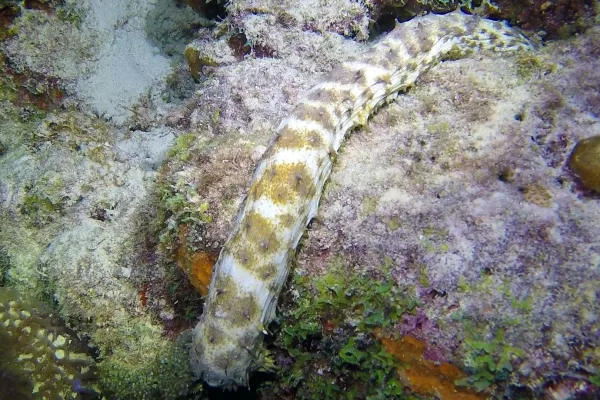
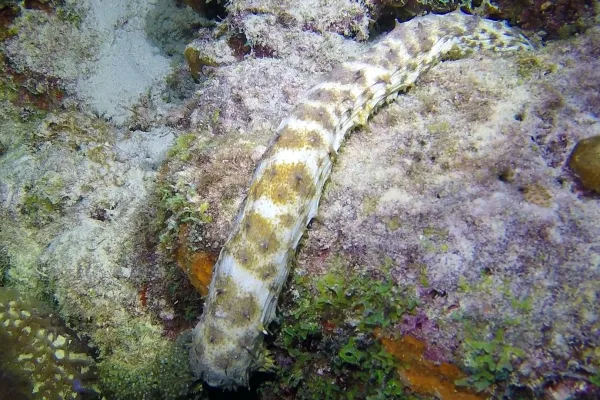
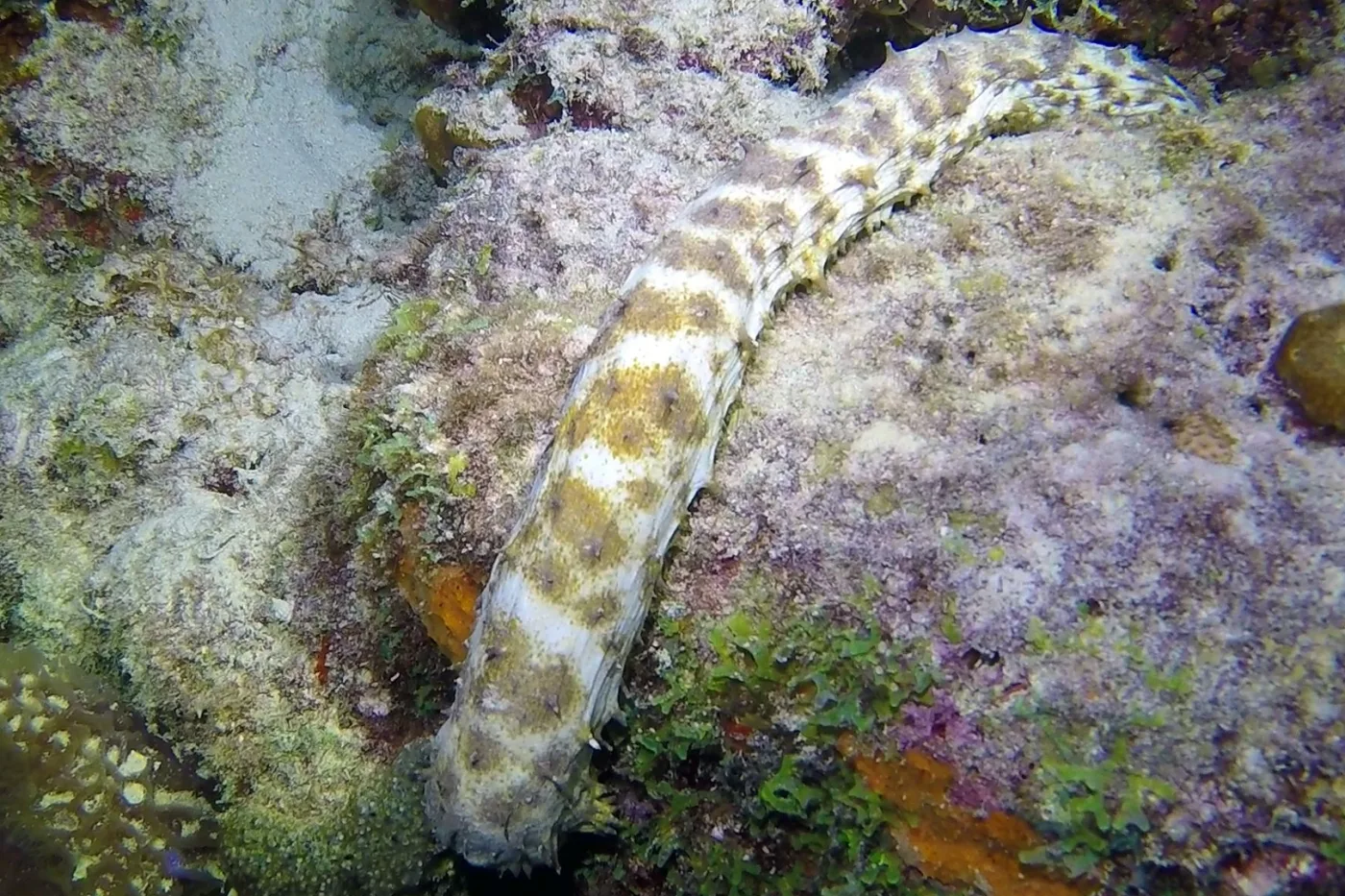
- Sausage-shaped, soft but tough-skinned animals with a ring of short feeding tentacles at one end and rows of tube feet on the flat underside. H. floridana is mottled brown, fawn and white with blunt conical bumps; Top Shelf Aquatics says the Florida/Caribbean animals it sells range from tan, brown, gray, olive and reddish to nearly black. H. mexicana is dull brown to black above with deep creases and a reddish, orange or pale underside crowded with tube feet; H. grisea is variable in colour and generally not gray despite its name. Look-alikes: Actinopyga agassizii is brown to yellow with five hard teeth around the anus; Isostichopus badionotus is light to dark brown with yellow to red spots on its podia.
- Native range
- Tropical western Atlantic: Florida, the Bahamas, the Gulf of Mexico and the Caribbean. H. mexicana reaches southern Brazil (and is reported from the Azores), and H. grisea ranges from Florida to southern Brazil and West Africa.
- Habitat
- Shallow sand flats, seagrass beds and mangrove margins. H. floridana lives just below the low-tide mark to about 5 m on sand and seagrass, and around mangroves; H. mexicana prefers calm sandy bottoms, seagrass and offshore reefs at 2-10 m (occasionally 20 m); H. grisea uses sand flats, seagrass beds and reefs and often buries in sand.
- Size
- 9.5 in (24.1 cm). Most sources give 8 in (20 cm) for H. floridana (That Pet Place, Mote, Florent's Guide; reeflex 7.9 in), with a record of 51 cm (20 in, SeaLifeBase and Mote). Other Holothuria that may be in a mixed lot grow larger: H. mexicana to about 20 in (WetWebMedia, reeflex 30-50 cm) and H. grisea to 30 cm. Generic Holothuria listings give 1 ft (LiveAquaria, ReefApp).
- Lifespan
- 3-5+ years with proper care (Top Shelf Aquatics); WetWebMedia notes many sea cucumber species are known to live 5-10 years.
- Conservation
- Not Evaluated. The genus as a whole is not assessed. H. floridana and H. mexicana are listed as Least Concern (SeaLifeBase, Wikipedia), while the look-alike Isostichopus badionotus is listed as Endangered because of fishing for the Asian food trade. Florida's small Keys fishery has historically supplied mainly the live aquarium trade; as demand for sea cucumbers as food in Asia grew, the FWC set a commercial limit of 200 sea cucumbers per trip and vessel per day from June 1, 2014. H. grisea is heavily and largely unregulated fished in northern Brazil
In the aquarium vs in the wild
In your aquarium
Sand-bed cleaner for large, mature reef tanks: it eats detritus, microalgae and bacteria from the sand and keeps the bed turned over.
On the reef
A deposit feeder on shallow sand and seagrass bottoms that recycles organic matter; a single sea cucumber can swallow more than 45 kg of sediment a year, and its burrowing and foraging aerate the sand.
History
Linnaeus named the genus Holothuria in 1767; its type species is the Mediterranean H. tubulosa. The Florida sea cucumber was described by Pourtales in 1851 as Cuvieria floridana, and Ives named several later synonyms in 1890. The toxin holothurin was originally isolated from the Caribbean five-toothed sea cucumber, Actinopyga agassizii; Chanley, Nigrelli and colleagues characterized holothurin A in 1959, giving aquarists the name for the danger these animals pose. Florida's small sea cucumber fishery in the Keys has historically supplied mainly the live aquarium trade; in 2014 growing demand for sea cucumbers as food in Asia led the FWC to cap commercial harvest at 200 per vessel per day. In 2023 Reef Builders promoted the Florida sea cucumber as a clean-up crew animal.
Evolution & relatives
Sea cucumbers are echinoderms, related to sea stars and sea urchins, but their skeleton is reduced to microscopic ossicles in the body wall. The earliest known sea cucumbers date from the Middle Ordovician, over 450 million years ago. Holothuria belongs to the family Holothuriidae in the order Holothuriida, together with Actinopyga, the five-toothed cucumbers; the Florida species H. floridana, H. mexicana and H. grisea are all placed in the subgenus Halodeima, and the tiger tail H. thomasi in Thymiosycia. The chocolate chip cucumber Isostichopus badionotus looks similar but belongs to a different family (Stichopodidae) and order (Synallactida). H. mexicana and H. floridana are close enough to hybridize in culture.
Family tree, from kingdom down
- Kingdom Animalia Animals Animals are living things made of many cells that must eat food to live. Fish, corals, crabs, snails and sea stars are all animals.
- Phylum Echinodermata Echinoderms Echinoderms are sea animals whose bodies are usually built in five matching parts. They move on hundreds of tiny tube feet, and many have spiny skin.
- Subphylum Echinozoa Sea urchins and sea cucumbers These echinoderms have no arms. Their bodies are shaped like a ball or a sausage, as in sea urchins and sea cucumbers.
- Class Holothuroidea sea cucumbers
- Subclass Actinopoda
- Order Holothuriida
- Family Holothuriidae
- Genus Holothuria
See it on the Tree of Life Compare with another species
Closest relatives
- Holothuria floridana Florida Sea Cucumber Same genus (subgenus Halodeima); the species retailers name for Florida stock
- Holothuria mexicana Donkey Dung Sea Cucumber Same genus (subgenus Halodeima); larger western Atlantic species, hybridizes with H. floridana
- Holothuria grisea Gray Sea Cucumber Same genus (subgenus Halodeima); Florida to Brazil and West Africa
- Holothuria thomasi Tiger Tail Sea Cucumber Same genus (subgenus Thymiosycia); Caribbean crevice dweller that stretches to 2 m
- Actinopyga agassizii Five-toothed Sea Cucumber Same family (Holothuriidae); source of the first holothurin isolated
- Isostichopus badionotus Chocolate Chip Sea Cucumber Different family (Stichopodidae); Caribbean look-alike, Endangered
Older scientific names: Halodeima, Ludwigothuria.
Fun facts
- A single sea cucumber can swallow more than 45 kg (99 lb) of sediment in a year, sifting out the food and leaving clean sand behind.
- When threatened, some sea cucumbers shoot out sticky white threads called Cuvierian tubules that tangle predators, then regrow them in weeks.
- Pearlfish live inside the back end of some sea cucumbers; the five-toothed sea cucumber has five hard 'teeth' around its anus that keep visitors out.
- The toxin holothurin was first discovered in a Caribbean sea cucumber, Actinopyga agassizii.
- Florida sea cucumbers and donkey dung sea cucumbers can interbreed, producing hybrids in culture ponds.
Learn more
- Reef Builders: Why Florida sea cucumbers are champions of cleanup crew reefbuilders.com
- Saltcorner: Florida Sea Cucumber (Holothuria floridana) saltcorner.com
- WetWebMedia: Sea Cucumbers, Not A Pretty Picture (Bob Fenner) wetwebmedia.com
- Mote Marine Laboratory: Florida sea cucumber mote.org
- WoRMS: Holothuria marinespecies.org
Sources
- WoRMS taxon record 123456 (Holothuria) marinespecies.org
- WoRMS taxon record 210900 (Holothuria floridana) marinespecies.org
- Top Shelf Aquatics: Caribbean Sea Cucumber topshelfaquatics.com
- That Pet Place: Florida Sea Cucumber thatpetplace.com
- LiveAquaria: Sea Cucumber EXPERT ONLY (Holothuria sp.) liveaquaria.com
- Saltcorner: Holothuria floridana saltcorner.com
- reeflex: Holothuria (Halodeima) floridana reeflex.net
- reeflex: Holothuria (Halodeima) mexicana reeflex.net
- ReefApp: Holothuria sp. reefapp.net
- Mote Marine Laboratory: Florida sea cucumber mote.org
- Florent's Guide to the Tropical Reefs: Florida Sea Cucumber reefguide.org
- SeaLifeBase: Holothuria floridana sealifebase.se
- WetWebMedia: Sea Cucumbers, Not A Pretty Picture, Parts II and IV wetwebmedia.com
- Reef Builders: Why Florida sea cucumbers are champions of cleanup crew reefbuilders.com
- TFH Magazine: Holothuria edulis tfhmagazine.com
- Wikipedia: Holothuria en.wikipedia.org
- Wikipedia: Holothuria floridana en.wikipedia.org
- Wikipedia: Holothuria mexicana en.wikipedia.org
- Wikipedia: Holothuria grisea en.wikipedia.org
- Wikipedia: Isostichopus badionotus en.wikipedia.org
- Wikipedia: Actinopyga agassizii en.wikipedia.org
- Wikipedia: Holothurin en.wikipedia.org
- Wikipedia: Sea cucumber en.wikipedia.org
- Niceville.com: Sea cucumber management changes adopted (FWC, April 2014) niceville.com
- NBC Miami: Limits proposed for sea cucumber harvests (2014) nbcmiami.com
- Rogers 2018, Culture of Holothuria mexicana, H. floridana and hybrids and Isostichopus badionotus in former shrimp ponds (GCFI 71) proceedings.gcfi.org
Care facts
The care facts on this guide and its product pages (care level, reef safety, temperament, size, tank, diet, flow, purpose, foods, acclimation and origin) combine 14 independent sources, checked October 25, 2026.
- Florida Sea Cucumber - Holothuria floridana - Small That Pet Place
- Caribbean Sea Cucumber Top Shelf Aquatics
- Holothuria floridana - Florida Sea Cucumber Saltcorner (Bob Goemans)
- Holothuria (Halodeima) floridana Meerwasser-Lexikon (reeflex.net)
- Sea Cucumber EXPERT ONLY (Holothuria sp.) LiveAquaria
- Holothuria sp. ReefApp
- Florida sea cucumber Mote Marine Laboratory & Aquarium
- Florida Sea Cucumber - Holothuria (Halodeima) floridana Florent's Guide to the Tropical Reefs
- Holothuria floridana, Florida sea cucumber SeaLifeBase
- Sea Cucumbers: Not A Pretty Picture (Parts I-IV) WetWebMedia (Bob Fenner)
- Why Florida Sea Cucumbers are Champions of Cleanup Crew Reef Builders (Taras Pleskun)
- Sea Cucumbers: Not A Pretty Picture, Part IV WetWebMedia (Bob Fenner)
- Sea cucumber management changes adopted Niceville.com (FWC news release)
- Culture of the Sea Cucumbers Holothuria mexicana, Holothuria floridana and Hybrids and Isostichopus badionotus in Former Shrimp Ponds: A Belize Case Study (Rogers 2018) Gulf and Caribbean Fisheries Institute
Scientific names and classification follow the World Register of Marine Species (AphiaID 123456). Last updated October 25, 2026.
Shop this species
Search the shop →