 Only 1 left
Fish · Grouper
Argus Grouper
Cephalopholis argus
Also called Peacock Grouper, Peacock Hind, Peacock Rockcod, Peacock Cod, Bluespotted Grouper, Blue Spotted Grouper, Celestial Grouper, Roi
Reviewed by admin on October 29, 2026 · Meet the team
- CareModerate
- Reef safeNo
- TemperamentAggressiveEats any fish or crustacean it can swallow
- Favorite foods
- Silversides
- Krill
- Shrimp and squid
- Max size23.6 in (60 cm)
- Min tank180 gal
- LifespanNo published lifespan data were found…
- IUCN statusLeast Concern
Quick answers
- How big does the Argus Grouper get?
- Up to 23.6 in (60 cm).
- What size tank does it need?
- At least 180 gallons.
- How hard is it to keep?
- Care level: Moderate.
- Is it reef safe?
- No. Corals are safe, but it eats small fish, shrimps and crabs; in Hawaii its diet is about 98% fish.
- What does it eat?
- Silversides
- Krill
- Shrimp and squid
- How long does it live?
- No published lifespan data were found for wild or captive fish.
- What are good tankmates?
- Large tangs
- Large angelfish
- Large triggerfish
- Other robust fish too big to be swallowed
The 30-second version
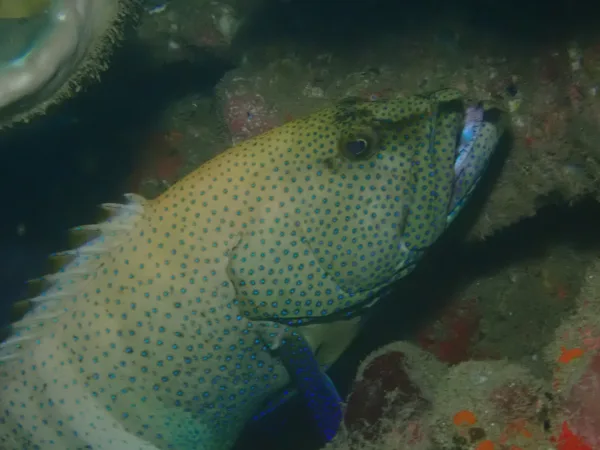
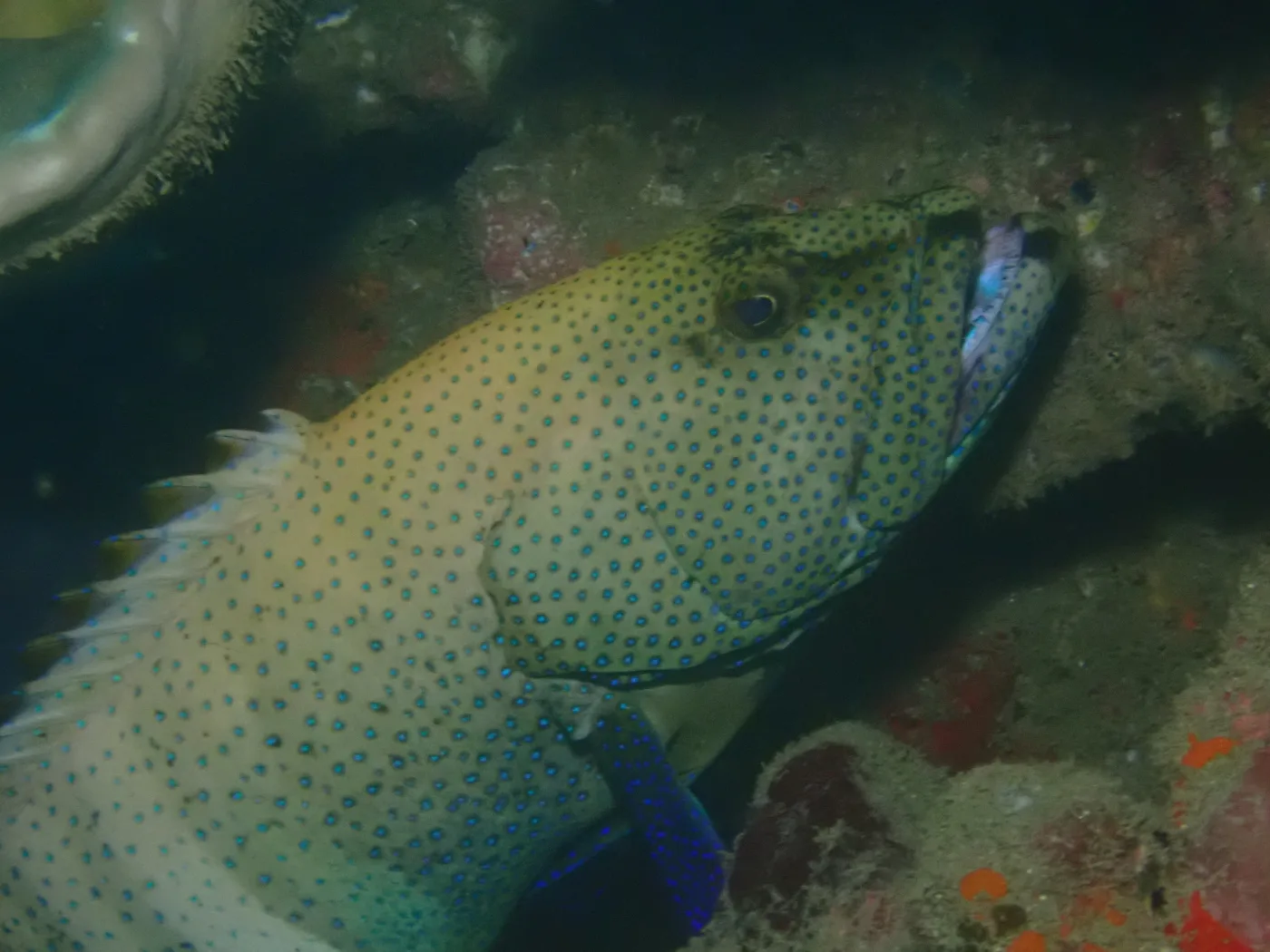
The argus grouper is a dark brown fish covered in hundreds of tiny blue dots. Each dot has a thin black ring around it, so it looks like a little eye. That is how the fish got its name. In an old Greek story, Argus was a giant with a hundred eyes. This grouper lives on shallow coral reefs in the Indian and Pacific Oceans. It hunts small fish. Sometimes it follows an octopus or an eel around the reef. When they scare a fish out of the rocks, the grouper grabs it. Long ago, people brought argus groupers to Hawaii to catch and eat. Now there are so many that they eat lots of Hawaii's own reef fish. In a home tank it needs lots of room. Any small fish or shrimp will be eaten.
Water & care
Hardy and an eager eater once settled, but it grows to about two feet and needs a large tank; Quality Marine recommends 180 gallons or more. It is secretive and hides until food appears, so give it caves and overhangs. Its heavy waste calls for oversized filtration and skimming. Feed meaty marine foods rather than freshwater feeder fish, keep only one grouper, and choose tankmates that are already too large to swallow.
| Parameter | Keep it at | Where that sits on the usual reef range |
|---|---|---|
| Temperature | 72–78 °F | |
| Salinity (SG) | 1.020–1.025 | |
| pH | 8.1–8.4 | |
| Alkalinity | 8–12 dKH |
Quality Marine gives 72-78°F, SG 1.020-1.025, pH 8.1-8.4 and 8-12 dKH. FishBase gives a wild temperature range of 24-28°C (75-82°F). No species-specific calcium, magnesium, nitrate or phosphate values are published; large water changes keep nitrate down.
Feeding
DietCarnivore
Favorite foods
- Silversides
- Krill
- Shrimp
- Squid
- Pieces of marine fish
Feed meaty, vitamin-enriched marine foods. Quality Marine says groupers have a low metabolism and adults need feeding only every other day; in the wild, Hawaiian fish eat about 0.8% of their body weight a day. If a new fish refuses food, offer live grass shrimp or enriched brine shrimp, then wean it onto frozen foods. Avoid relying on goldfish or other freshwater feeders.
Tank & maintenance
- Minimum tank
- 180 gallons
- Aquascape
- Solid rockwork with several caves and overhangs, and open space in front. It likes to perch on a rock or coral head where it can watch the tank.
- Lighting
- No special requirement; Quality Marine lists medium light.
- Water flow
- Moderate, with strong filtration. In the wild it lives on exposed, shallow reef fronts.
Routine upkeep
Regular large water changes, an oversized skimmer and filter, and prompt removal of uneaten food. Recheck which tankmates are safe as the grouper grows.
Temperament & tankmates
TemperamentAggressive
Quality Marine lists it as aggressive, mainly because it is a predator; it describes groupers as friendly toward larger fish but not toward anything that fits in their mouth. In the wild, males defend large territories and rival males fight. Keep one per tank and no other groupers.
Reef safeNo
Corals are safe, but it eats small fish, shrimps and crabs; in Hawaii its diet is about 98% fish. Quality Marine warns that groupers eat any fish or crustacean small enough to fit in their mouths. It is not suitable for reef tanks with small fish or a cleanup crew.
Good tankmates
- Large tangs
- Large angelfish
- Large triggerfish
- Other robust fish too big to be swallowed
Avoid
- Small fish of any kind, especially young surgeonfish and other small reef fish
- Shrimps, crabs and other crustaceans
- Another grouper
- Fish that will be small enough to eat once the grouper grows
Help it thrive
- Plan for a tank of about 180 gallons or more for an adult.
- Give it caves and a rock perch so it can hide and watch.
- Feed varied marine foods enriched with vitamins, about every other day for adults.
- Keep only one grouper, and add it after its tankmates are already large.
- Never release it: introduced argus groupers have damaged Hawaii's reef fish.
Common ailments
Marine ich (Cryptocaryon irritans)
- Signs
- White, salt-like spots on the skin, fins or gills, scratching, cloudy eyes, fast breathing, hiding and loss of appetite.
- Prevention
- Quarantine every new fish in a separate tank, and keep water quality stable.
- Treatment
- Treat in a hospital tank with copper, chloroquine phosphate or the tank-transfer method, following the product's directions. Leave the display fish-free for about 11 weeks, because the cyst stage can last up to 72 days.
Marine velvet (Amyloodinium ocellatum)
- Signs
- A fine dusty sheen on the skin, very rapid breathing, gasping near the surface, scratching and lethargy; badly infected fish can die within 12 to 48 hours.
- Prevention
- Strict quarantine of all new fish, and disinfect nets and buckets between tanks.
- Treatment
- Act immediately: a temperature- and pH-matched freshwater dip for quick relief, then copper or chloroquine phosphate in a hospital tank. Leave the display fallow.
Thiamine deficiency and disease from feeder fish
- Signs
- Neurological problems and early death in predators fed mostly on goldfish or rosy red minnows, which contain thiaminase; parasites, whitespot or velvet arriving with live feeders.
- Prevention
- Feed a varied diet of marine foods, using live foods only to start a fish that refuses to eat.
- Treatment
- Move to a varied, vitamin-enriched marine diet, and treat any disease in a hospital tank.
This is general hobby guidance, not veterinary advice. Quarantine new arrivals and treat in a separate tank whenever you can.
Risks of owning one
- Eats small fish, shrimps and crabs, including tankmates that later become small enough to swallow.
- Grows to about two feet and needs a tank of about 180 gallons or more.
- Produces heavy waste that strains filtration.
- An invasive species where introduced (Hawaii); it must never be released.
- All aquarium fish are wild-collected.
Breeding
DifficultyNot achieved Captive-bredRare or wild-caught
In the wild it lives in harems: in the Red Sea, a male defends 2-6 females in a territory up to about 2,000 square meters, each female defending part of it. The male visits daily, raising his dorsal fin, and the pair rubs flanks. In Micronesia, spawning is territorial and usually happens at dusk, with both fish darkening except for a white keyhole-shaped patch. Fishes of Australia notes that it can change sex. We found no record of captive breeding, and no captive-bred fish are sold.
Deep dive The science, history and family tree
The science
Cephalopholis argus is a medium-sized grouper (family Epinephelidae) of shallow Indo-Pacific reefs. The body is fusiform with a rounded tail; the dorsal fin has 9 spines and 15-17 soft rays and the anal fin 3 spines and 9 soft rays. It is dark brown, densely covered in small blue spots edged with black, often with five or six pale bars on the rear of the body and a pale chest. It reaches 60 cm total length, commonly 40 cm. The range extends from the Red Sea and Durban east to French Polynesia and the Pitcairn group, north to southern Japan and south to northern Australia and Lord Howe Island. It lives on coral reefs from tide pools to at least 40 m, especially exposed reef fronts at 1-10 m, while juveniles shelter in shallow coral thickets. Fish make up 75-95% of its diet. It hunts by lying on the bottom and surging forward, or by hovering, and often follows octopuses or moray eels to catch flushed prey. A dominant male shares a territory of up to 2,000 square meters with several females. Introduced to Hawaii in the 1950s, it has become the dominant reef predator there. The IUCN lists it as Least Concern.
- Appearance
- Chocolate to dark brown, peppered with hundreds of small iridescent blue spots, each ringed in black, over the head, body and fins; the fins look bluish. Larger fish often develop four to six pale vertical bars on the rear half of the body and a pale chest, and there is a creamy-white patch around the pectoral-fin base. Juveniles are dark brown with dense blue spots; Quality Marine notes light brown vertical bands in young fish and says adults may darken and lose some spots. Rival males can switch quickly between dark and pale-barred patterns, and courting fish darken except for a white keyhole-shaped patch in the middle of the body. The tail is rounded.
- Native range
- Indo-Pacific: the Red Sea and East Africa south to Durban, South Africa, east to French Polynesia and the Pitcairn group, north to the Ryukyu and Ogasawara (Bonin) Islands of Japan and south to northern Australia (Western Australia to Moreton Bay, Queensland, plus the Coral Sea, Cocos (Keeling) and Christmas Islands) and Lord Howe Island. Type locality: coast of Japan. Introduced to Hawaii in the 1950s to boost local fisheries, where it is now established and invasive.
- Habitat
- Coral reefs from tide pools to at least 40 m, preferring exposed reef fronts and the 1-10 m reef zone. Adults often sit on coral heads and retreat when startled. Juveniles live among dense coral in shallow, protected thickets. FishBase gives a water temperature range of 24-28°C (75-82°F).
- Size
- 23.6 in (60 cm). FishBase, Wikipedia and Fishes of Australia give 60 cm (23.6 in) total length as the maximum, with 40 cm (16 in) common. Quality Marine says a little over 24 in for aquarium purposes.
- Lifespan
- No published lifespan data were found for wild or captive fish.
- Conservation
- Least Concern. Assessed Least Concern by the IUCN (2017-2018); widespread and common. Not evaluated by CITES. Important to artisanal fisheries across the Indo-West Pacific and seen in Hong Kong live fish markets. In Hawaii, where it was introduced, it is a conservation problem: its population grew about fifteenfold after the 1980s and its biomass now exceeds that of all native reef-fish predators combined. Hawaiian fish often carry ciguatera toxin, so there is no official fishery, and spearfishing 'Roi Roundup' events are held to cull it. Never release an aquarium fish into the wild
In the aquarium vs in the wild
In your aquarium
An occasional display predator for large fish-only aquariums; Quality Marine says it is not often seen in the trade.
On the reef
A top reef predator that eats mainly small and newly settled fishes; important to artisanal fisheries, and an invasive predator in Hawaii.
History
Johann Gottlob Schneider described the species in 1801, in Bloch and Schneider's Systema Ichthyologiae, from the coast of Japan. The name refers to Argus, the hundred-eyed giant of Greek myth, because of its many eye-like spots. Several later names, such as Serranus myriaster Valenciennes, 1828, are now synonyms. In the 1950s the state of Hawaii introduced it to improve local fisheries. The plan backfired: the fish, known locally as roi, spread and became the dominant reef predator, a fishery never developed because Hawaiian roi often carry ciguatera, and ichthyologist Jack Randall has said its impact there exceeds that of fishing and aquarium collecting combined. Elsewhere it is an important food fish and an occasional aquarium fish.
Evolution & relatives
Groupers were long treated as a subfamily (Epinephelinae) of the sea basses (Serranidae); WoRMS and Eschmeyer's Catalog of Fishes now recognize them as their own family, Epinephelidae. Most groupers start life as females and can change sex later, and separate fixed sexes have evolved independently at least five times in the family. A 2022 study of complete mitochondrial genomes (Wang et al.) found that the hind genus Cephalopholis is not a natural group as currently defined: the argus grouper paired with the redmouth grouper (Aethaloperca rogaa), apart from the other hinds such as the miniatus grouper, which sit close to the lyretail groupers (Variola). WoRMS places groupers with the soapfishes and true sea basses in the suborder Percoidei of the order Perciformes. On the site's tree, the argus is a close cousin of the miniatus and lyretail groupers.
Family tree, from kingdom down
- Kingdom Animalia Animals Animals are living things made of many cells that must eat food to live. Fish, corals, crabs, snails and sea stars are all animals.
- Phylum Chordata Chordates Chordates have a stiff rod running down their back at some point in their lives. In fish and people, this rod is replaced by a backbone.
- Subphylum Vertebrata Vertebrates Vertebrates are animals with a backbone and a skull. Fish, frogs, birds and people are all vertebrates.
- Infraphylum Gnathostomata jawed vertebrates
- Parvphylum Osteichthyes bony fishes
- Gigaclass Actinopterygii ray-finned fishes
- Superclass Actinopteri
- Class Teleostei Teleost fishes Teleosts are bony fishes with thin, bendy fin rays and jaws that can push forward. Almost all of the fish in the world are teleosts.
- Order Perciformes Perch-like fishes These fish have sharp spines in the front part of the fin on their back. The name means 'perch-like', and this order holds perches, groupers and soapfishes.
- Suborder Percoidei
- Family Epinephelidae Groupers Groupers are big-mouthed hunting fish that swallow their food whole. Most start life as girls, and some turn into boys when they grow big.
- Genus Cephalopholis Hinds
- Species Cephalopholis argus
See it on the Tree of Life Compare with another species
Closest relatives
- Aethaloperca rogaa Redmouth Grouper Its closest relative in a 2022 mitogenome tree
- Cephalopholis miniata Miniatus Grouper Same genus, on a different branch in DNA studies
- Variola louti Lyretail Grouper Same family (Epinephelidae)
Older scientific names: Epinephelus argus, Cephalopholis guttata, Serranus guttatus, Serranus myriaster.
Fun facts
- It is named after Argus, a hundred-eyed giant from Greek myth, for its many eye-like blue spots.
- It follows octopuses and moray eels around the reef, grabbing the fish they scare out of hiding.
- Rival males settle disputes with 'color fights', flashing dark and pale bars until one gives up.
- On part of Hawaii's Kona coast, introduced argus groupers were estimated to eat about 8.2 million reef fish a year.
- Spearfishers on Maui hold 'Roi Roundup' tournaments to cull the introduced population.
Learn more
- FishBase: Cephalopholis argus, Peacock hind fishbase.se
- WoRMS: Cephalopholis argus Schneider, 1801 marinespecies.org
- Fishes of Australia: Peacock Rockcod fishesofaustralia.net.au
- Wikipedia: Peacock grouper en.wikipedia.org
Sources
- FishBase species summary: Cephalopholis argus fishbase.se
- WoRMS taxon record 218174 marinespecies.org
- Fishes of Australia: Cephalopholis argus fishesofaustralia.net.au
- Wikipedia: Peacock grouper en.wikipedia.org
- Wikipedia: Grouper (Epinephelidae) en.wikipedia.org
- Quality Marine: Blue Spotted Grouper qualitymarine.com
- Wang et al. 2022, Comparative analysis of four complete mitochondrial genomes of Epinephelidae (Genes) pmc.ncbi.nlm.nih.gov
- FishBase species summary: Aethaloperca rogaa, Redmouth grouper fishbase.se
Scientific names and classification follow the World Register of Marine Species (AphiaID 218174). Checked by our team. Last updated October 29, 2026.
Shop this species
Search the shop →
Only 1 left