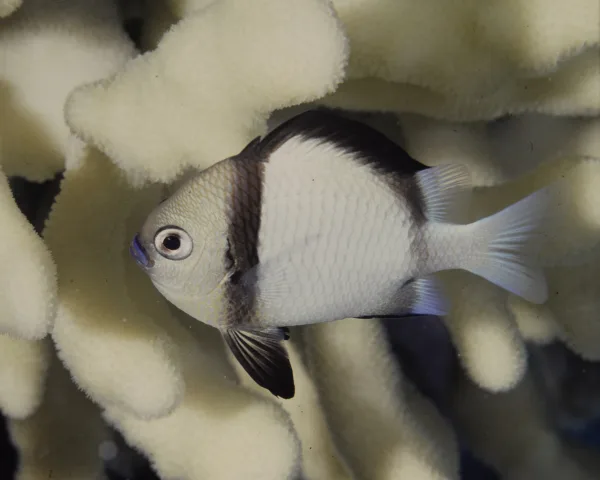
 Only 3 left
Fish · Damselfish
Two Stripe Damselfish
Dascyllus reticulatus
Also called Reticulate Dascyllus, Reticulated Damselfish, Twostripe Damselfish, 2 Stripe Damsel, Two-Stripe Damsel, Tongan Two-Stripe Damsel
Reviewed by admin on October 29, 2026 · Meet the team
- CareEasy
- Reef safeYes
- TemperamentAggressiveClaims the tank; attacks new fish and other damsels
- Favorite foods
- Frozen mysis shrimp
- Marine flakes and pellets
- Herbivore / algae foods
- Max size3.5 in (9 cm)
- Min tank30 gal
- LifespanNo published lifespan figure was found…
- IUCN statusLeast Concern
Quick answers
- How big does the Two Stripe Damselfish get?
- Up to 3.5 in (9 cm).
- What size tank does it need?
- At least 30 gallons.
- How hard is it to keep?
- Care level: Easy.
- Is it reef safe?
- Yes. No threat to corals or invertebrates (LiveAquaria, Reef Builders), which makes it a good candidate for a reef tank.
- What does it eat?
- Frozen mysis shrimp
- Marine flakes and pellets
- Herbivore / algae foods
- How long does it live?
- No published lifespan figure was found in the sources checked.
- What are good tankmates?
- Larger wrasses
- Angelfish
- Tangs
- Community-safe triggerfish
- Corals and clean-up crew invertebrates
The 30-second version
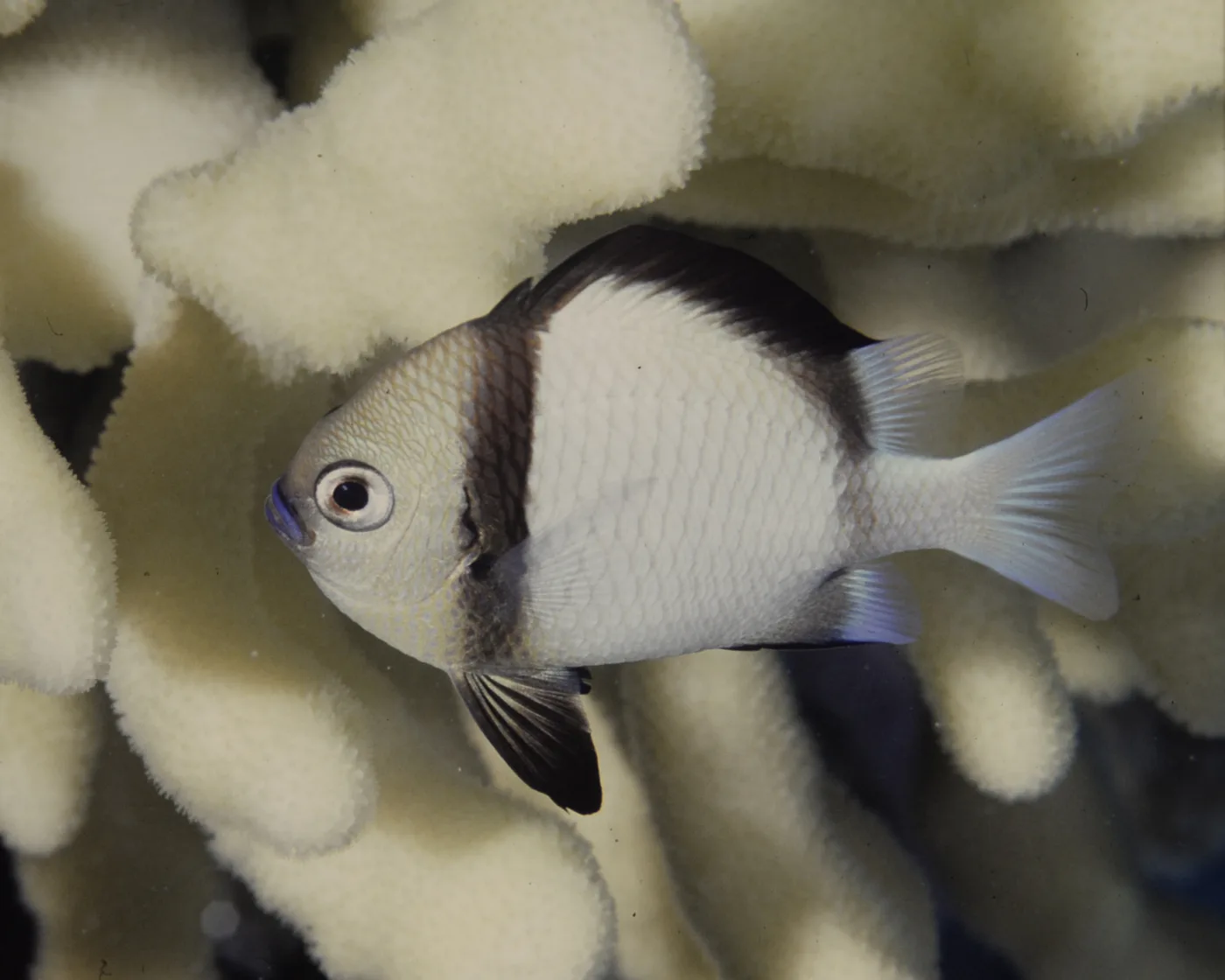
The two stripe damsel is a small gray fish with two dark stripes. One stripe is near its head, and one is near its tail. Its tail is a pretty blue green. Look close and you can see a net pattern on its scales. In the wild it lives in groups in branching coral. When it is scared, it zips down into the coral to hide. It eats tiny bits of food that float by. The dad cleans a spot on a rock for a nest. He guards the eggs and fans them. A young one is cute and calm. But a grown-up can be a big bully. It may claim the whole tank as its own, so pick tough tankmates for it.
Water & care
Hardy, and new arrivals usually start feeding right away, which is why it is often suggested for beginners. Its weak point is temperament: it is cute and peaceful as a juvenile but turns territorial and aggressive as it matures. In a 30-gallon tank it will usually claim the whole tank and drive other fish away, so either keep it as the only fish in a modest reef tank, or give it a much larger tank with big, assertive tankmates. Add it to an established, cycled tank.
| Parameter | Keep it at | Where that sits on the usual reef range |
|---|---|---|
| Temperature | 72–78 °F | |
| Salinity (SG) | 1.020–1.025 | |
| pH | 8.1–8.4 | |
| Alkalinity | 8–12 dKH |
LiveAquaria and Quality Marine agree on 72-78°F, SG 1.020-1.025, pH 8.1-8.4 and 8-12 dKH. No species-specific calcium, magnesium, nitrate or phosphate target; follow your corals' needs in a reef.
Feeding
DietOmnivore
Favorite foods
- Frozen mysis shrimp
- Small marine pellets
- Flake foods
- Spirulina and other algae-based foods
Feed several small meals a day of small meaty and algae-based foods, frozen and dry (Reef Builders). In the wild it picks small food from the water above its coral.
Tank & maintenance
- Minimum tank
- 30 gallons
- Aquascape
- Rockwork or branching coral with caves and crevices for shelter, plus open swimming space. In a small tank, plan for it to be the only fish.
- Lighting
- No special needs.
- Water flow
- Moderate.
Routine upkeep
Routine upkeep: regular partial water changes and normal testing. Quarantine new fish for 2-4 weeks. Watch for bullying whenever a new fish goes in.
Temperament & tankmates
TemperamentAggressive
LiveAquaria rates it Aggressive and Quality Marine Aggressive and Social. Adults are hostile to similar-sized fish, to other damsels and to their own kind, except for an established male-female pair, and they defend their space against every new addition. Suitable tankmates are large, assertive fish such as larger wrasses, angelfish, tangs and community-safe triggers, in a tank big enough for them.
Reef safeYes
No threat to corals or invertebrates (LiveAquaria, Reef Builders), which makes it a good candidate for a reef tank. Quality Marine notes it may pick at small bottom-dwelling crustaceans. It likes to shelter in branching corals.
Good tankmates
- Larger wrasses
- Angelfish
- Tangs
- Community-safe triggerfish
- Corals and clean-up crew invertebrates
Avoid
- Other damselfish
- Another two stripe damsel, unless an established pair
- Shy or docile fish such as gobies, firefish and dartfish
- Predators large enough to swallow it
Help it thrive
- Decide first: the only fish in a small reef tank, or one of several large, tough fish in a big tank.
- Add it last, after other fish have settled in.
- Give it a branching coral or rock cave to call home.
- Feed several small meals a day of meaty and algae-based foods.
Common ailments
Marine ich (Cryptocaryon irritans)
- Signs
- White, salt-grain spots on the body, fins or gills, scratching against rocks, cloudy eyes, faster breathing and loss of appetite.
- Prevention
- Quarantine all new fish, avoid temperature swings and keep stress low.
- Treatment
- Treat every fish in a hospital tank with copper or chloroquine phosphate, or use the tank-transfer method; none of these belong in a reef display. The cyst stage can last up to 72 days, so leave the display without fish for about 11 weeks.
Marine velvet (Amyloodinium ocellatum)
- Signs
- A fine, dusty sheen on the skin, very fast breathing, gasping at the surface, scratching and sudden deaths, sometimes within 12-48 hours.
- Prevention
- Strict quarantine, and separate nets and buckets for quarantine and display tanks.
- Treatment
- Act immediately: a temperature- and pH-matched freshwater dip for quick relief, then copper or chloroquine in a hospital tank, and a fishless fallow period for the display.
Fighting injuries
- Signs
- Torn fins, missing scales and constant hiding in the damsel's tankmates, or in a second two stripe damsel.
- Prevention
- Keep one per tank (or an established pair), add it last, and choose large, assertive tankmates.
- Treatment
- Separate the injured fish, keep the water very clean so wounds heal without infection, and rehome the aggressor if the bullying continues.
This is general hobby guidance, not veterinary advice. Quarantine new arrivals and treat in a separate tank whenever you can.
Risks of owning one
- Turns from a calm juvenile into a territorial adult that may claim the whole tank.
- Makes it hard to add new fish later, especially in small tanks.
- Wild-caught, so new fish can bring in ich or velvet; quarantine is essential.
- Its low price and hardiness tempt people to buy it as a first fish without planning for its temperament.
Breeding
DifficultyHard Captive-bredRare or wild-caught
Nest-spawning egg-layer. Pairs form for breeding; the male cleans a rock or coral surface, the female lays sticky eggs there, and the male guards and aerates them. No reports of larval rearing or captive-bred supply were found in the sources checked.
- Keep an established male-female pair in a large tank without egg-eating tankmates.
- Watch for the male cleaning a patch of rock or coral; spawning follows.
- Leave the male to guard the eggs until they hatch.
- Collect the larvae into a separate rearing tank with green water and rotifers, and expect heavy losses.
Deep dive The science, history and family tree
The science
Dascyllus reticulatus is a small, deep-bodied damselfish (Pomacentridae) that reaches about 9 cm total length. The body is pale grey to honey-brown, and dark scale edges form a fine net pattern that gives the species its name. Two dark bars cross the body, one just behind the gill cover and one toward the tail, and the head is greenish while the tail, anal fin and rear dorsal fin are tinted blue-green. It ranges from the Cocos-Keeling Islands in the eastern Indian Ocean to Samoa and the Line Islands, north to southern Japan and south to Rowley Shoals and Lord Howe Island, and is recorded from Tonga; it is absent from Hawaii and the Society Islands. Adults live on outer lagoon and seaward reefs at 1-50 m, schooling over branching coral heads, especially Pocillopora eydouxi, often in silty areas. Males clean a rock or coral surface for a nest, and the sticky eggs are guarded and aerated by the male. DNA studies show that northern and southern populations group with different relatives, so the species as defined today may not be a single natural unit. The IUCN lists it as Least Concern.
- Appearance
- Pale grey to honey-brown body with a fine dark crosshatch on the scales, two dark vertical bars (one behind the gill cover, one near the tail base), a greenish head, a dark edge to the dorsal fin, and a blue-green tinge on the tail, anal fin and rear dorsal fin. Quality Marine describes its fish as white with two black bars. Close relatives in the same group include the Cloudy Dascyllus (D. carneus) and the Marginate Dascyllus (D. marginatus). The Three Stripe (D. aruanus) and Four Stripe (D. melanurus) damsels are white with three or four black bars.
- Native range
- Eastern Indian Ocean to western Pacific: Cocos-Keeling Islands to Samoa and the Line Islands, north to southern Japan, south to Rowley Shoals and Lord Howe Island (FishBase). Recorded from Tonga (FishBase country checklist). Not found in the Hawaiian or Society islands or farther east.
- Habitat
- Outer lagoons and seaward reefs at 1-50 m. Schools over and shelters in branching coral heads, particularly Pocillopora eydouxi, often over silty areas.
- Size
- 3.5 in (9 cm). FishBase and Wikipedia give 9 cm TL; LiveAquaria and Reef Builders say about 3.5 in, Quality Marine almost 3 in.
- Lifespan
- No published lifespan figure was found in the sources checked.
- Conservation
- Least Concern. IUCN Least Concern (assessed 2021 per FishBase; Wikipedia gives 2022). Not listed by CITES. Collected for the aquarium trade; all fish sold appear to be wild-caught
In the aquarium vs in the wild
In your aquarium
A hardy, reef-safe damsel that suits a small reef tank as the only fish, or a large tank with robust tankmates.
On the reef
A plankton picker that schools over branching corals, especially Pocillopora, on outer lagoon and seaward reefs.
History
John Richardson described the species in 1846 as Heliases reticulatus; the name reticulatus means 'net-like', after the dark scale edges. Later names such as Dascyllus xanthosoma and Pomacentrus unifasciatus are now synonyms. It has long been sold as a hardy beginner fish, usually as the Two Stripe or Reticulated Damselfish, though Quality Marine notes it is only occasionally offered.
Evolution & relatives
Dascyllus is a genus of about a dozen damselfishes in three species complexes. The two stripe belongs to the reticulatus complex with the Cloudy (D. carneus), Marginate (D. marginatus) and Yellowtail (D. flavicaudus) dascyllus. Unlike the aruanus and trimaculatus complexes, this group does not form a single natural branch, and DNA places northern and southern populations of D. reticulatus with different relatives. The trimaculatus (domino) complex split from the reticulatus complex about 3.9 million years ago. Like most Dascyllus outside the domino group, it is thought to change sex from female to male.
Family tree, from kingdom down
- Kingdom Animalia Animals Animals are living things made of many cells that must eat food to live. Fish, corals, crabs, snails and sea stars are all animals.
- Phylum Chordata Chordates Chordates have a stiff rod running down their back at some point in their lives. In fish and people, this rod is replaced by a backbone.
- Subphylum Vertebrata Vertebrates Vertebrates are animals with a backbone and a skull. Fish, frogs, birds and people are all vertebrates.
- Infraphylum Gnathostomata jawed vertebrates
- Parvphylum Osteichthyes bony fishes
- Gigaclass Actinopterygii ray-finned fishes
- Superclass Actinopteri
- Class Teleostei Teleost fishes Teleosts are bony fishes with thin, bendy fin rays and jaws that can push forward. Almost all of the fish in the world are teleosts.
- Order Ovalentaria (unplaced) Unplaced ovalentarian fishes Ovalentaria is a big group of fish with spiny fins. Scientists found it by studying DNA, and most of its fish lay eggs that stay stuck to the bottom. 'Incertae sedis' means 'place not sure': scientists have not settled which order damselfishes, dottybacks and basslets belong in.
- Family Pomacentridae Damselfishes and clownfishes Damselfishes are small, often colorful reef fish that guard their homes. Clownfish and chromis are damselfishes.
- Genus Dascyllus humbugs and dominos
- Species Dascyllus reticulatus
See it on the Tree of Life Compare with another species
Closest relatives
- Dascyllus carneus Cloudy Dascyllus Same complex
- Dascyllus marginatus Marginate Dascyllus Same complex
- Dascyllus flavicaudus Yellowtail Dascyllus Same complex
- Dascyllus aruanus Three Stripe Damselfish Same genus; aruanus complex
Fun facts
- Its name, reticulatus, means 'net-like', after the fine dark net pattern on its scales.
- In the wild it is especially fond of one coral, Pocillopora eydouxi, which it uses as a shelter.
- It is found as deep as 50 m, more than twice as deep as the three stripe damsel.
- A juvenile looks harmless, but an adult will try to drive every other fish away from its patch.
Learn more
- FishBase: Dascyllus reticulatus (Reticulate dascyllus) fishbase.se
- Reef Builders: The Two-Stripe Damsel, hardiness and hostility in equal measure (Jeff Kurtz, 2015) reefbuilders.com
- LiveAquaria: Two Stripe Damselfish liveaquaria.com
Sources
- WoRMS: Dascyllus reticulatus (Richardson, 1846) marinespecies.org
- FishBase: Dascyllus reticulatus (Reticulate dascyllus) fishbase.se
- Wikipedia: Reticulate dascyllus en.wikipedia.org
- Wikipedia: Dascyllus en.wikipedia.org
- Reef Builders: The Two-Stripe Damsel, hardiness and hostility in equal measure (Jeff Kurtz, 2015) reefbuilders.com
- LiveAquaria: Two Stripe Damselfish liveaquaria.com
- Quality Marine: 2 Stripe Damselfish qualitymarine.com
- FishBase: Tonga country checklist (Pomacentridae) fishbase.se
Scientific names and classification follow the World Register of Marine Species (AphiaID 212844). Checked by our team. Last updated October 29, 2026.
Shop this species
Search the shop →
Only 3 left