 Sold out
Aquacultured
Corals · Soft coral
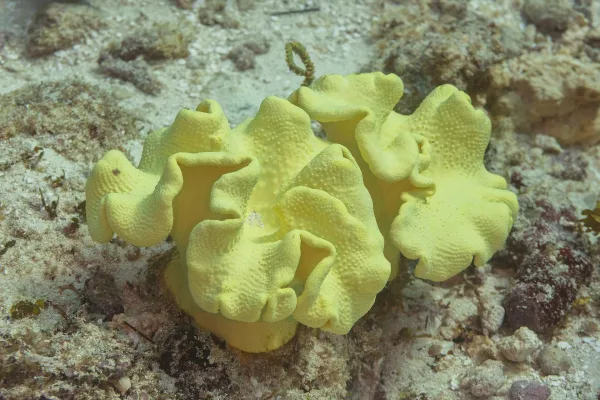
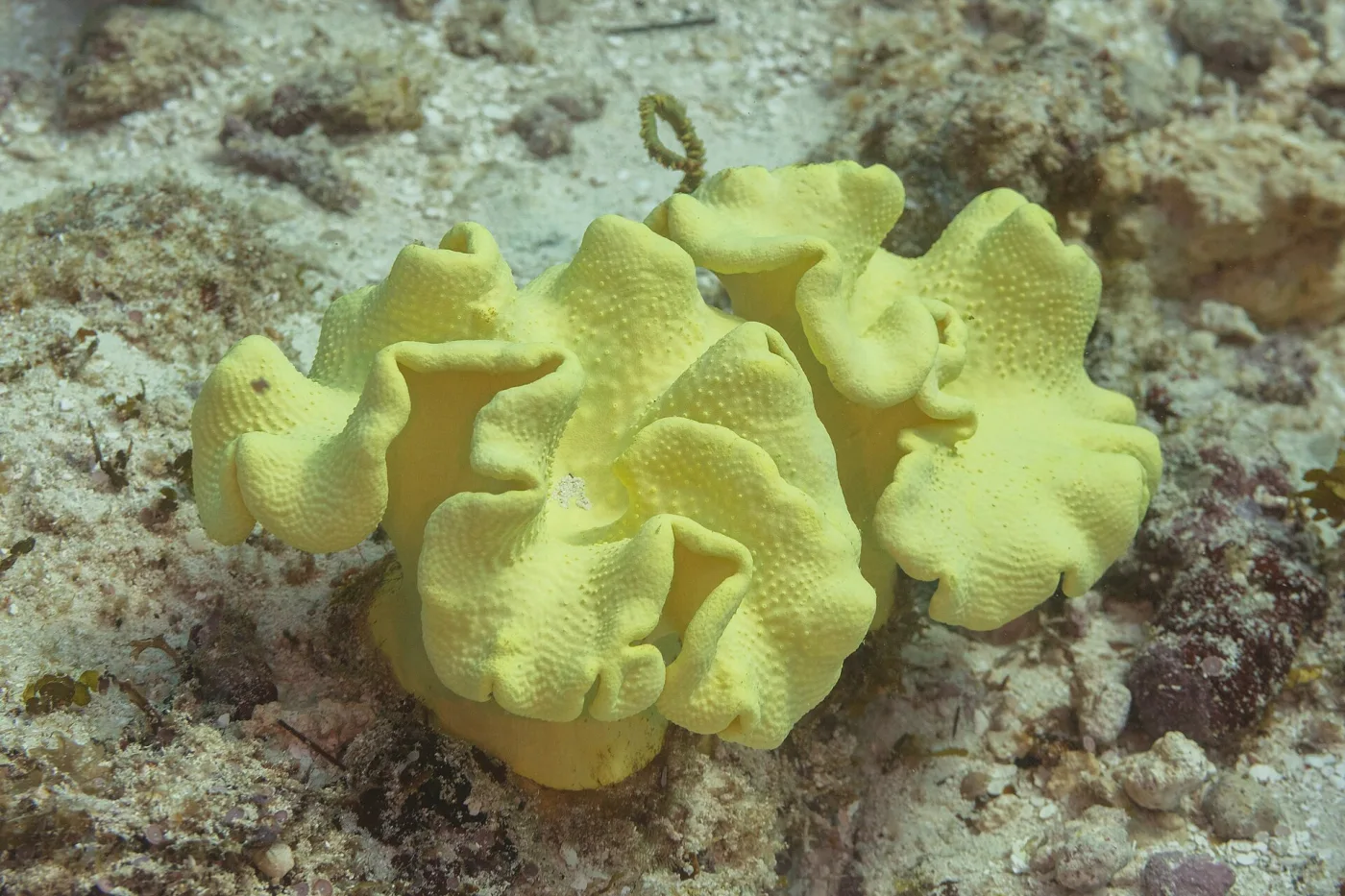
Toadstool Leather Coral
Sarcophyton sp.
Also called Toadstool, Mushroom leather coral, Leather coral, Sarcophyton, Trough coral, Long polyp toadstool, Skin coral
- CareEasy
- Reef safeWith caution
- TemperamentPeacefulReleases chemicals that irritate nearby corals
- Favorite foods
- Light (zooxanthellae)
- Phytoplankton / micro-plankton
- Baby brine shrimp
- Max size16 in (40.6 cm)
- Min tank30 gal
- LifespanLong-lived
- IUCN statusNot Evaluated
Quick answers
- How big does the Toadstool Leather Coral get?
- Up to 16 in (40.6 cm).
- What size tank does it need?
- At least 30 gallons.
- How hard is it to keep?
- Care level: Easy.
- Is it reef safe?
- With caution. It is harmless to fish and invertebrates, but Sarcophyton releases terpenoid compounds (cembranoid diterpenes such as sarcophytoxide and sarcophine) that can stunt or irritate nearby stony corals and some other soft corals, especially downstream; forum keepers report toadstools as among the more chemically active leathers.
- What does it eat?
- Light (zooxanthellae)
- Phytoplankton / micro-plankton
- Baby brine shrimp
- How long does it live?
- Long-lived; colonies keep growing for many years, and aquarium strains are maintained indefinitely by fragging.
- What are good tankmates?
- Other hardy soft corals such as mushrooms, star polyps and Kenya trees, with space between colonies
- LPS corals kept well apart and upstream
- Peaceful reef fish such as gobies, blennies, cardinalfish and tangs
- Cleanup crew snails, hermit crabs and cleaner shrimp
The 30-second version
A toadstool leather coral looks like a big mushroom. It has a smooth stalk with a wide, wavy cap on top. The cap is covered with tiny polyps. When they come out, the coral looks fuzzy, like a soft rug. Each polyp is a small animal with eight feathery arms. Tiny algae live inside the coral and turn light into food. The coral feels tough and bendy, like leather. That is how it got its name. Every few weeks it does something odd. It pulls in all its polyps and covers its cap with a shiny, waxy skin. After a few days it peels the skin off, a bit like a snake. This keeps it clean. The coral also lets out special chemicals that can hurt corals close by. So give it lots of space, and use a filter called carbon to clean the water.
Water & care
Hardy, forgiving and a classic beginner soft coral. Give it moderate light, moderate to strong indirect or alternating flow across the cap, and stable salinity and alkalinity. The two things beginners need to know: the regular shedding phase is normal, and the coral releases terpenoid chemicals, so it needs space and activated carbon in mixed reefs. Newly moved colonies often stay closed or droop for several days while they settle.
| Parameter | Keep it at | Where that sits on the usual reef range |
|---|---|---|
| Temperature | 74–80 °F | |
| Salinity (SG) | 1.023–1.026 | |
| pH | 8.1–8.4 | |
| Alkalinity | 8–12 dKH | |
| Calcium | 380–450 ppm | |
| Magnesium | 1,250–1,350 ppm | |
| Nitrate | 2–10 ppm | |
| Phosphate | 0.03–0.1 ppm |
Sources differ: LiveAquaria gives 72-78 F, 8-12 dKH and SG 1.023-1.025; Top Shelf gives 76-80 F (75-79 F in its text), 8-10 dKH, 380-450 ppm calcium, 1250-1350 ppm magnesium, nitrate 2-10 ppm and phosphate 0.03-0.1 ppm; a Gensou guide gives 77-81 F and 7.5-9 dKH and says it tolerates up to 15 ppm nitrate and 0.1 ppm phosphate. As a soft coral it uses little calcium or alkalinity; stability matters more than exact numbers.
Feeding
DietPhotosynthetic
Favorite foods
- Light (photosynthesis by its symbiotic algae)
- Phytoplankton and fine particulate foods
- Microplankton and rotifers
- Dissolved organic matter
Target feeding is not required; zooxanthellae supply most of its energy, and the polyps catch fine particles. Occasional broadcast feeding of phytoplankton, microplankton or a fine filter-feeder food is optional. Keep some nitrate and phosphate in the water; ultra-low nutrients can pale it, while very high nutrients feed film algae on the cap.
Tank & maintenance
- Minimum tank
- 30 gallons
- Aquascape
- Mount it securely on stable rock in the lower to middle rockwork, or on the sand bed, where the cap has room to spread in every direction. Leave 6-8 in (15-20 cm) to other corals and plan for the cap to double or triple in size.
- Lighting
- Moderate, roughly 100-200 PAR; it adapts to about 80-250 PAR. Acclimate over one to two weeks (Top Shelf ramps light up over about a week, Gensou over one to two weeks), since a sudden jump to intense light can bleach it. Plenty of blue light brings out green fluorescence in green strains.
- Water flow
- Moderate to strong, varied or indirect flow that keeps the cap clean and helps it shed. Avoid a constant direct blast, which keeps the polyps retracted and folds the cap.
Routine upkeep
Keep fresh activated carbon in the filter and replace it regularly, especially in mixed reefs. During a shed, let the flow carry the waxy film away, or gently baste it off once it is loose and siphon or net it out of the tank; do not peel it off by force. Baste detritus off the cap now and then, and prune or frag the colony if it starts to shade neighbours. Wear gloves when handling or cutting it.
Temperament & tankmates
TemperamentPeaceful
It has no sweeper tentacles; it competes chemically. LiveAquaria lists it as peaceful but needing space, and Top Shelf as peaceful to semi-aggressive. It can be stung by aggressive LPS placed close, and clownfish sometimes host in it and keep its polyps closed.
Reef safeWith caution
It is harmless to fish and invertebrates, but Sarcophyton releases terpenoid compounds (cembranoid diterpenes such as sarcophytoxide and sarcophine) that can stunt or irritate nearby stony corals and some other soft corals, especially downstream; forum keepers report toadstools as among the more chemically active leathers. Allow about 6-8 in (15-20 cm) to neighbours (Top Shelf), keep SPS upstream, run fresh activated carbon and do regular water changes. Our store lists it as reef safe; we rate it 'with caution' because of this chemistry.
Good tankmates
- Other hardy soft corals such as mushrooms, star polyps and Kenya trees, with space between colonies
- LPS corals kept well apart and upstream
- Peaceful reef fish such as gobies, blennies, cardinalfish and tangs
- Cleanup crew snails, hermit crabs and cleaner shrimp
Avoid
- SPS directly downstream or within a few inches
- Other leather corals crowded close by, since they compete chemically
- Coral-nipping butterflyfish and some large angelfish
- Clownfish that host in it, if they keep its polyps permanently closed
Help it thrive
- Expect it to close up and shed every few weeks; a shed lasting a few days to about a week is normal.
- Turn the flow up a little during a shed so the waxy skin peels off faster.
- Run fresh carbon and keep stony corals upstream to soak up its terpenoid chemicals.
- Give it space: leave 6-8 in around it and plan for a cap several times larger than the frag.
- Moderate light is enough; ramp up slowly to avoid bleaching.
- Leave a newly moved colony alone for a week or two; constant moving keeps it closed.
Common ailments
Prolonged shedding or staying closed
- Signs
- Polyps stay retracted for more than one to two weeks, the waxy film will not come off, or sheds happen very often.
- Prevention
- Stable salinity and alkalinity, adequate flow across the cap, and space from chemically competing corals.
- Treatment
- Test all parameters and correct swings slowly, increase flow over the cap, run fresh carbon, and look for irritation from neighbours, nipping fish, a hosting clownfish or pests. A short iodine (Lugol's) dip is sometimes suggested by vendors for persistent film.
Bleaching or fading colour
- Signs
- Cap turns pale or white; green strains lose fluorescence.
- Prevention
- Acclimate to strong light gradually and avoid nutrient levels near zero.
- Treatment
- Lower the light or move the colony lower, then raise light slowly; allow some nitrate and phosphate.
Stalk rot or tissue decay
- Signs
- Soft, slimy or discoloured patches on the stalk or cap, often after injury, poor flow or a parameter swing; tissue may slough off and smell bad.
- Prevention
- Good flow, stable water, careful handling and clean cuts when fragging.
- Treatment
- Cut away the affected tissue well into healthy flesh with a clean blade, increase flow and check water quality; some keepers dip the colony in an iodine coral dip. Remove dead tissue promptly.
Drooping or leaning
- Signs
- The stalk bends and the cap hangs over for days.
- Prevention
- Secure mounting, moderate indirect flow, and gradual light changes.
- Treatment
- Check for a direct blast of flow, a sudden light change or a parameter swing; it often recovers once the cause is fixed.
This is general hobby guidance, not veterinary advice. Quarantine new arrivals and treat in a separate tank whenever you can.
Risks of owning one
- It releases terpenoid compounds that can stunt or irritate nearby corals, especially SPS downstream, so mixed reefs need space, carbon and water changes.
- The waxy film it sheds can irritate other corals if it drifts onto them; siphon or net it out.
- It can grow far larger than the frag you buy and shade neighbouring corals.
- Sarcophyton contains bioactive and toxic compounds; wear gloves when handling or fragging it, keep cuts away from the tank and wash your hands afterwards.
Propagation & fragging
DifficultyEasy AquaculturedWidely available
Propagated asexually by cutting. A wedge cut from the edge of the cap, or a whole cap cut off the stalk, attaches to a new surface and grows into a new colony, and the mother colony heals within days. In the wild colonies are gonochoric broadcast spawners, which is not done in home aquaria.
- Wear gloves and eye protection, and work over a container of tank water.
- With a sharp, clean scalpel or razor blade, cut a wedge from the edge of the cap (or cut the whole cap off the stalk); avoid tearing the tissue.
- Hold the cutting against a frag plug or rubble with a rubber band, bridal-veil mesh or a toothpick through the tissue; glue sticks poorly to wet leather tissue.
- Keep the cutting in moderate light and gentle to moderate flow in a frag tank or low in the display.
- Expect it to stay closed for a few days; it usually attaches in about one to two weeks, after which the band can be removed.
- Leave the mother colony alone; the cut edge usually closes within days.
Deep dive The science, history and family tree
The science
Sarcophyton Lesson, 1834 is a genus of zooxanthellate soft corals (Octocorallia: Malacalcyonacea) and the type genus of the family Sarcophytidae, which also includes Lobophytum; both were long placed in Alcyoniidae until the 2022 phylogenomic revision of McFadden, van Ofwegen and Quattrini. WoRMS lists about 50 accepted species, which are hard to separate without examining their sclerites. Colonies are fleshy and mushroom-shaped: a sterile stalk supports a disc- or cup-shaped capitulum whose margin becomes folded or lobed as the colony grows, and S. glaucum can reach about 80 cm across. The polyps are dimorphic. Large, retractile autozooids with eight pinnate tentacles are spaced over the capitulum, and numerous small siphonozooids between them move water through the colony. Surface sclerites are typically clubs, with spindles in the interior and oval or cylindrical forms in the stalk. The genus ranges from the Red Sea and East Africa to the western Pacific, on reef flats, in lagoons and on upper reef slopes, often forming large stands. Species studied so far are gonochoric broadcast spawners; at Lizard Island, S. elegans has a 1:1 sex ratio, oocytes that take 19-24 months to mature, and most spawning after the November full moon during the mass coral spawning. Sarcophyton is a rich source of terpenoid secondary metabolites, especially cembranoid diterpenes. Sarcophine, from Red Sea S. glaucum, was described as a toxin in 1974, and sarcophytoxide deters predators and has been reported to depress photosynthesis in the symbionts of competing Acropora. The ovulid snail Ovula ovum still feeds on Sarcophyton and converts sarcophytoxide into a less toxic compound. Colonies periodically retract their polyps and slough a thin surface layer, which is thought to remove sediment and fouling organisms.
- Appearance
- A rubbery, mushroom-shaped colony: a smooth, pale stalk topped by a flat, cupped or wavy cap that folds more as it gets larger. With polyps open, the cap looks fuzzy; with them closed it is smooth and leathery, dotted with tiny pores. Colours are tan, cream, yellow or brown, and aquacultured strains include green, neon-green-polyp ('highlighter') and white or gold-polyp forms; long-polyp and short-polyp types are sold. During a shed the colony looks shrunken and shiny, as if covered in cling film. Look-alikes: Lobophytum (devil's hand leathers) has a lobed or finger-ridged surface rather than a smooth cap; Sinularia (finger and digitate leathers) branches into fingers and has no distinct cap; true mushroom corals (Discosoma, Rhodactis) are corallimorphs with no stalk and no eight-tentacled polyps.
- Native range
- Indo-West Pacific, from the Red Sea and East Africa to the western Pacific; S. glaucum is one of the most common soft corals in the Red Sea. Trade specimens come from Indonesia, Fiji and Tonga or, increasingly, from aquaculture and mariculture.
- Habitat
- Reef flats, lagoons and seaward slopes, mostly in shallow, well-lit water attached to hard substrate; intertidal and subtidal reef-flat stands of a single species are common. One species database gives a depth range of about 2-37 m. As zooxanthellate corals they depend on light, but S. glaucum has grown and survived well under low light in aquaculture trials.
- Size
- 16 in (40.6 cm). Wild Sarcophyton glaucum colonies grow up to about 80 cm (31 in) across (Wikipedia); another species database gives about 60 cm for the genus. In aquaria a mature cap commonly reaches 20 cm (8 in) or more, and old colonies can outgrow small tanks. Reproductive maturity in S. elegans starts at a stalk circumference of about 12-13 cm.
- Lifespan
- Long-lived; colonies keep growing for many years, and aquarium strains are maintained indefinitely by fragging. No reliable maximum age is published.
- Conservation
- Not Evaluated. No IUCN Red List assessment was found for the genus or for common species. Soft corals such as Sarcophyton are not CITES-listed. Sarcophyton is a prominent aquaculture and mariculture coral, and aquacultured pieces are widely available; buying them reduces wild collection
In the aquarium vs in the wild
In your aquarium
A hardy centerpiece soft coral that adds size and movement, often one of the first large corals in a reef, and an easy coral to frag and trade.
On the reef
A space-competing soft coral that can dominate reef flats and lagoons, using chemical defences against predators, fouling organisms and competing corals. It is food for specialist predators such as the egg cowry Ovula ovum, and it contributes to the annual mass spawning on the Great Barrier Reef.
History
René Primevère Lesson named Sarcophyton in 1834 in the zoology of a French voyage to the East Indies (1825-1829); the name means 'flesh plant'. Its common species S. glaucum was described by Quoy and Gaimard in 1833. In 1974 Israeli chemists isolated sarcophine from Red Sea S. glaucum as a new toxin, and Australian work in the 1980s on the Great Barrier Reef examined how soft-coral terpenes affect competing stony corals and how Ovula ovum detoxifies sarcophytoxide. Easy to keep and fast to frag, the toadstool became one of the most familiar leather corals in reef aquaria, where its shedding phase and chemical warfare are well known to hobbyists.
Evolution & relatives
Octocorals are one branch of the Anthozoa, and their history goes back hundreds of millions of years. Leather corals were traditionally lumped into the family Alcyoniidae. In 2022 McFadden, van Ofwegen and Quattrini used genome-scale data to reorganize octocorals into two orders and many new families. Sarcophyton now sits in Sarcophytidae with its close relative Lobophytum, within Malacalcyonacea, while the finger leathers (Sinularia) form a separate family and the familiar green star polyps sit in the other order, Scleralcyonacea. Studies of mitochondrial genes in S. glaucum have found several distinct clades, suggesting the 'species' as currently recognized may hide more diversity.
Family tree, from kingdom down
- Kingdom Animalia Animals Animals are living things made of many cells that must eat food to live. Fish, corals, crabs, snails and sea stars are all animals.
- Phylum Cnidaria Cnidarians Cnidarians are soft animals with tentacles. The tentacles have tiny stinging cells. Corals, sea anemones and jellyfish all belong here.
- Subphylum Anthozoa Corals and sea anemones These cnidarians spend their whole lives as polyps: a tube with a mouth ringed by tentacles. Unlike jellyfish, they never swim around as a bell-shaped medusa.
- Class Octocorallia Octocorals Each octocoral polyp has exactly eight feathery tentacles. Soft corals, sea fans and sea pens belong here.
- Order Malacalcyonacea Soft corals and sea fans This order holds most soft corals, such as leather corals and Kenya trees, plus many sea fans. Scientists named it in 2022 after studying octocoral DNA.
- Family Sarcophytidae Leather corals These soft corals feel tough and rubbery, like leather. They include toadstool and devil's hand leathers, and many make strong chemicals.
- Genus Sarcophyton
See it on the Tree of Life Compare with another species
Closest relatives
- Sarcophyton glaucum Toadstool leather coral Same genus; widespread species, source of sarcophine and a common aquaculture coral
- Sarcophyton elegans Toadstool leather coral Same genus; its spawning cycle was studied at Lizard Island
- Sarcophyton ehrenbergi Toadstool leather coral Same genus; diterpene-rich species used in AIMS competition experiments
- Lobophytum Devil's hand leather corals Same family (Sarcophytidae)
- Sinularia Finger leather corals Same order (Malacalcyonacea), different family (Sinulariidae)
- Ovula ovum Egg cowry Not a relative; a snail predator that eats Sarcophyton and detoxifies its terpenes
Older scientific names: Sarcophytum, Areocella.
Fun facts
- Every few weeks a toadstool pulls in its polyps and peels off a waxy skin, sometimes the whole cap's covering in one piece, to clean itself.
- Its chemical sarcophine was described as a new toxin in 1974, and other cembranoids from the same coral, such as sarcophytol A, are studied for tumor-inhibiting activity.
- It has two kinds of polyps: big feeding polyps with eight feathery arms and tiny pumping polyps that move water through the colony.
- The egg cowry, a white sea snail, eats toadstool corals and changes their poison into a weaker chemical in its gut.
- The name Sarcophyton means 'flesh plant'.
Learn more
- LiveAquaria: Toadstool Mushroom Leather Coral (Sarcophyton sp.) liveaquaria.com
- Top Shelf Aquatics: Green Long Polyp Toadstool Leather care topshelfaquatics.com
- Wikipedia: Sarcophyton glaucum en.wikipedia.org
- WoRMS: Sarcophyton Lesson, 1834 marinespecies.org
Sources
- WoRMS: Sarcophyton Lesson, 1834 marinespecies.org
- Wikipedia: Sarcophyton (coral) en.wikipedia.org
- Wikipedia: Sarcophyton glaucum en.wikipedia.org
- Hellstrom et al. 2010, reproduction of Sarcophyton elegans at Lizard Island (marineinfo.org) marineinfo.org
- Coll et al. 1983, Transformation of soft coral terpenes by Ovula ovum researchonline.jcu.edu.au
- AIMS dataset: Competition between alcyonacean and scleractinian corals at Britomart Reef researchdata.edu.au
- Bioactive hydroperoxyl cembranoids from the Red Sea soft coral Sarcophyton glaucum (Marine Drugs 2012) pmc.ncbi.nlm.nih.gov
- Subdiversion: Sarcophyton spp. subdiversion.es
- LiveAquaria: Toadstool Mushroom Leather Coral liveaquaria.com
- Top Shelf Aquatics: Green Long Polyp Toadstool Leather Coral topshelfaquatics.com
- Gensou: Toadstool Leather Coral care guide gensou.sg
- Gensou: Leather coral shedding cycle guide gensou.sg
- Reef Central: Toadstool toxin thread forums.reefcentral.com
Care facts
The care facts on this guide and its product pages (care level, reef safety, temperament, size, tank, diet, flow, purpose, foods, acclimation and origin) combine 10 independent sources, checked October 25, 2026.
- Toadstool Mushroom Leather Coral (Sarcophyton sp.) LiveAquaria
- Green Toadstool Leather Coral Top Shelf Aquatics
- Toadstool Coral Fishkeeper
- ORA Sarcophyton Toadstool Leather Coral Bulk Reef Supply (ORA product)
- Ultra Green Toadstool Leather SM Biota
- It Ain't Easy Bein Green (actually, it kinda is) Quality Marine
- Sarcophyton Leather Corals: Attractive, Toxic, and Tough as Nails Reef Builders (Jeff Kurtz)
- Toadstool Leather Coral Care Guide: Sarcophyton for Beginners Gensou
- Leather Coral 101: Care, Appearance & Types, Placement & More Light.fish (Queen City Corals)
- Cultured Toadstool Yellow Soft Coral Sarcophyton Sp Sims Tropical Fish
Scientific names and classification follow the World Register of Marine Species (AphiaID 205483). Last updated October 25, 2026.
Shop this species
Search the shop →Sold out right now. We restock weekly, so check back soon.
Sold out
Aquacultured