 Sold out
Invertebrates · Snail
Stocky Cerith Snail
Cerithium litteratum
Also called Stocky Cerith, Cerith Snail, True Cerith, Veränderliche Nadelschnecke
- CareEasy
- Reef safeYes
- TemperamentPeacefulPeaceful grazer; ignores corals, fish and inverts
- Favorite foods
- Film algae / diatoms
- Detritus / leftover food
- Algae wafers / nori
- Max size1.5 in (3.8 cm)
- Min tank20 gal
- LifespanNo formal data
- IUCN statusNot Evaluated
Quick answers
- How big does the Stocky Cerith Snail get?
- Up to 1.5 in (3.8 cm).
- What size tank does it need?
- At least 20 gallons.
- How hard is it to keep?
- Care level: Easy.
- Is it reef safe?
- Yes. Does not eat corals, clams or other sessile invertebrates.
- What does it eat?
- Film algae / diatoms
- Detritus / leftover food
- Algae wafers / nori
- How long does it live?
- No formal data.
- What are good tankmates?
- Peaceful reef fish that do not eat snails
- All reef corals
- Cleaner, peppermint and fire shrimp
- Other clean-up crew snails such as turbo, margarita and nassarius snails
The 30-second version
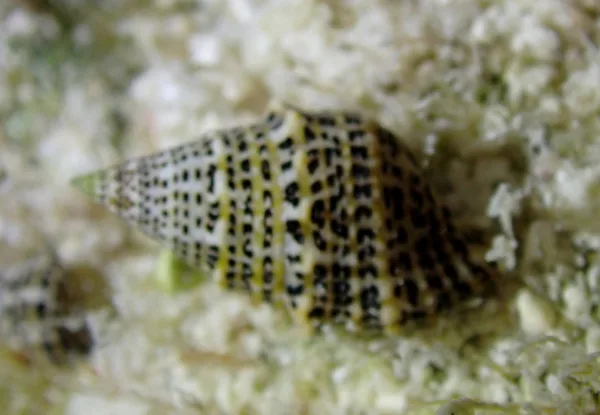
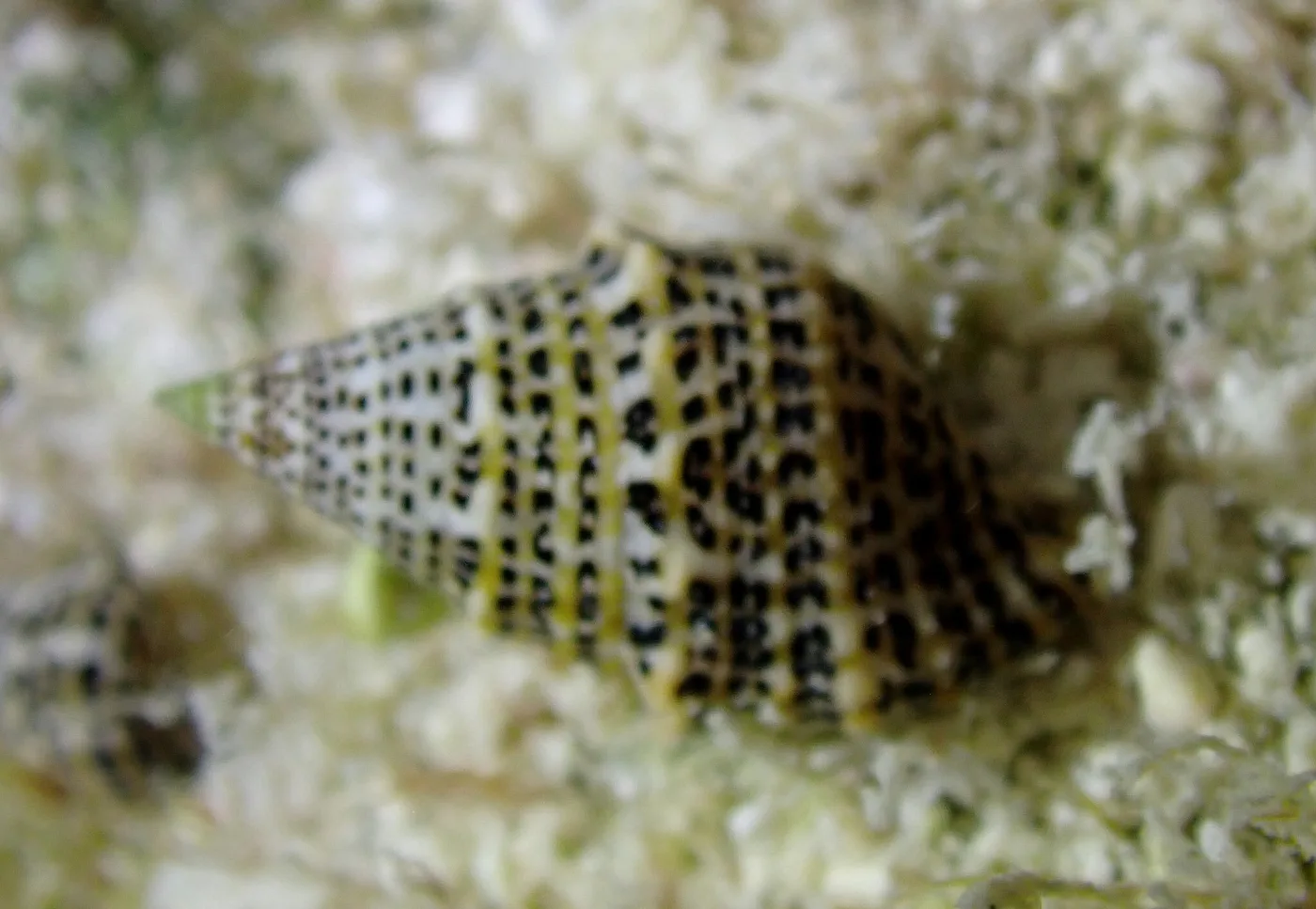
The stocky cerith is a small snail with a pointy shell shaped like a cone. The shell is white with rows of dark brown dots, a bit like dotted lines. It is about as long as the top part of your thumb. It lives in warm, shallow water around Florida and the Caribbean, on sand, in seagrass and on reefs. In a fish tank it is a tiny cleaner. It slides over the glass and rocks and eats the thin brown and green film of algae. It also digs through the sand and eats bits of old food and waste. That digging keeps the sand fresh. It is shy in the daytime and does most of its work at night. It never bothers fish or corals. Hermit crabs sometimes want its shell, so keep them apart.
Water & care
One of the hardiest clean-up crew snails, but only in an established tank with a sand bed, some film algae and leftover food. Drip-acclimate slowly (about 2 hours), because sudden salinity changes are a common cause of losses, and expect new snails to stay closed for up to a day. Keep copper and other invertebrate-unsafe medications out of the tank and keep nitrate moderate. In very clean or overstocked tanks, add an algae wafer or a little nori at night. Ceriths climb out of the water at night, so a lid helps.
| Parameter | Keep it at | Where that sits on the usual reef range |
|---|---|---|
| Temperature | 72–78 °F | |
| Salinity (SG) | 1.023–1.025 | |
| pH | 8.1–8.4 | |
| Alkalinity | 8–12 dKH | |
| Calcium | 400–450 ppm | |
| Magnesium | 1,300–1,450 ppm | |
| Nitrate | 0–20 ppm | |
| Phosphate | 0.01–0.1 ppm |
Temperature, salinity, pH and alkalinity are Quality Marine's cerith ranges; other retailers give 75-78 F (Bulk Reef Supply) and 74-80 F (BuildYourAquarium). Calcium, magnesium and phosphate follow Bulk Reef Supply's Stocky Cerith listing. BuildYourAquarium calls nitrate above 20 ppm dangerous, and several sources say ceriths are sensitive to high nitrate and copper. Avoid sudden salinity swings.
Feeding
DietOmnivore
Favorite foods
- Film algae and diatoms on glass, rock and sand
- Detritus and leftover fish food
- Cyanobacteria and hair algae (in small amounts)
- Sinking algae wafers or dried nori
Grazes and scavenges around the clock, mostly at night, on the glass near the sand line, on rock and through the top layer of sand. In a normally fed, established tank it needs no extra food. If the tank is new, very clean or holds many grazers, drop a small algae wafer or a piece of nori onto the sand after lights out. Stock modestly: sources range from about one per 5 gallons to fewer than one per 10 gallons, fewer if other grazers are present.
Tank & maintenance
- Minimum tank
- 20 gallons
- Aquascape
- An established tank (a few months old) with live rock and a fine sand bed; fine sand lets it burrow and forage, while coarse crushed coral or a bare bottom suits it poorly. A lid or tight top helps, because ceriths sometimes crawl above the waterline.
- Lighting
- Any reef or fish-only lighting; enough light to grow some film algae helps feed it.
- Water flow
- No source states a preference. It lives on sand and seagrass in shallow water, so normal reef flow is fine.
Routine upkeep
Little routine care. Check now and then that the snails are moving and grazing, flip any stuck on their backs, and remove dead snails (empty or smelly shells) quickly so they do not foul the water. When vacuuming the sand, stay shallow so buried snails are not sucked up. Add a wafer or nori if the glass stays spotless for days.
Temperament & tankmates
TemperamentPeaceful
Completely harmless to fish, corals and other invertebrates. It is more often the victim: hermit crabs may kill or evict it for its shell, and snail-eating fish pick it off.
Reef safeYes
Does not eat corals, clams or other sessile invertebrates. One hobby article mentions rare reports of ceriths nudging loose small frags while foraging, so glue frags down.
Good tankmates
- Peaceful reef fish that do not eat snails
- All reef corals
- Cleaner, peppermint and fire shrimp
- Other clean-up crew snails such as turbo, margarita and nassarius snails
Avoid
- Hermit crabs (may kill or evict it for its shell)
- Arrow crabs and other predatory crabs
- Triggerfish, puffers, medium to large wrasses and snowflake morays
- Copper-based medications
Help it thrive
- Add them to a tank that has been running for a few months and already grows some film algae.
- Drip-acclimate for about 2 hours and match salinity carefully; give them a day to open up.
- Provide a fine sand bed so they can burrow and forage.
- Keep hermit crabs and snail-eating fish out, and keep a lid on the tank.
- Feed an algae wafer or nori at night if the tank is very clean or heavily stocked with grazers.
Common ailments
Starvation
- Signs
- Snails stop moving for long periods, the body shrinks back into the shell, and losses mount once the tank looks very clean.
- Prevention
- Stock modestly and adjust numbers to tank age and bioload; supplement with algae wafers or nori in clean tanks.
- Treatment
- Place a wafer or nori near the snails at night and reduce grazer numbers if needed.
Acclimation and salinity shock
- Signs
- Snail stays closed, lies on its back or does not move for days after purchase.
- Prevention
- Drip-acclimate slowly and avoid sudden changes in salinity or other parameters.
- Treatment
- Set it upright on sand in stable water and leave it alone; new snails can take up to a day to open.
Copper and nitrate poisoning
- Signs
- Sudden deaths of several snails and other invertebrates after a medication was dosed, or a slow decline when nitrate is high.
- Prevention
- Never dose copper or invertebrate-unsafe medications in the display; keep nitrate below about 20 ppm.
- Treatment
- Move survivors to clean water, run activated carbon and do water changes.
Predation
- Signs
- Empty or broken shells, or a hermit crab suddenly wearing a cerith shell.
- Prevention
- Do not keep them with hermit crabs, arrow crabs, puffers, triggers or larger wrasses.
- Treatment
- Remove or rehome the predator.
Climbing out
- Signs
- Snails found dried out on the rim or outside an open-top tank, usually after a night.
- Prevention
- Use a lid or a tight-fitting top; ceriths are tidal and roam above the waterline at night.
- Treatment
- Return any that are still alive to the water at once.
This is general hobby guidance, not veterinary advice. Quarantine new arrivals and treat in a separate tank whenever you can.
Risks of owning one
- Starves in brand-new, very clean or overstocked tanks.
- Very sensitive to copper medications and sudden salinity changes.
- Lots are often mixed with other cerith species, so the snails you receive may not all be stocky ceriths.
- May crawl out of open-top aquariums.
- Dead snails buried in the sand can go unnoticed and add to the nutrient load.
Breeding
DifficultyVery hard Captive-bredRare or wild-caught
Sexes are separate. Ceriths lay eggs regularly in home aquariums, often on the glass, but the eggs are usually eaten by tank mates or removed by filtration. The young hatch as drifting larvae that spend several weeks in open water before settling, so very few reach adulthood in a display tank. No captive breeding of this species for the trade is known; captive-bred ceriths sold by ORA are a different, Marshall Islands species.
- Keep a group of well-fed adults in a mature tank.
- Look for egg masses on the glass and rock, mostly after nights of activity.
- Raising the drifting larvae would need a separate, filter-free larval tank and plankton food for several weeks; no hobby protocol for this species was found.
- Most eggs and larvae in a display are lost to fish, pumps and skimmers, so do not count on a self-sustaining population.
Deep dive The science, history and family tree
The science
Cerithium litteratum (Born, 1778), the stocky cerith, is a small marine snail in the family Cerithiidae (superfamily Cerithioidea, subclass Caenogastropoda). The shell is a blunt, turreted cone with many fine spiral threads and a row of about ten small knobs (tubercles) below each suture; the aperture is roundish. Ground colour is white to yellowish, with numerous dark brown spots arranged in spiral lines, although the pattern may be worn away on shells from very shallow water. Shells usually measure about 3 cm, with a recorded maximum of 3.4 cm in SeaLifeBase and the Bailey-Matthews Shell Museum and up to 5 cm in a Naturalis diving guide.
The species is common throughout the Caribbean and occurs in the western Atlantic from the southeastern United States and Florida through the Gulf of Mexico and Central America to Brazil, with records from Bermuda and an introduced, probably ship-borne record in the Aegean Sea. It is benthic and tropical, living from the intertidal zone to about 30 m in most habitats (records reach 88 m) in seagrass beds, intertidal pools, reef lagoons and sandy or muddy bottoms on reefs. It grazes algal films and detritus; a coral-recruitment experiment (Davies et al. 2013) treated it as an herbivorous grazer and found that it did not significantly harm young corals. Empty shells are reused by small hermit crabs, especially Calcinus tibicen, and live snails are eaten by the hogfish Lachnolaimus maximus. In the aquarium trade it is the cerith most often sold from the Caribbean, although stores usually label it only as Cerithium sp.
- Appearance
- A small, pointed, cone-shaped (turreted) shell, usually about 1 in and rarely over 1 1/4 in. The shell is white to cream with spiral rows of dark brown dots and a row of small knobs below each whorl join; algae or coralline crust often hides the pattern. The animal is usually seen gliding on the glass near the sand line or half buried in the sand. Look-alikes: other ceriths are often mixed into the same lots, especially the darker, slimmer Cerithium atratum (dark or Florida cerith), and Indo-Pacific ceriths such as C. caeruleum are also sold as 'cerith snails'; nassarius snails have a shorter, ribbed shell and live fully buried with a siphon showing.
- Native range
- Western Atlantic: southeastern United States (South Carolina) and Florida, the Gulf of Mexico, Bermuda, the Caribbean and Central America south to Brazil. Uncommon on Florida's southwest Gulf coast (Shell Museum records from Egmont Key and Sanibel) but common all over the Caribbean. An introduced record from the Aegean Sea is listed by WoRMS.
- Habitat
- Shallow, warm water from the intertidal zone to about 30 m (rarely deeper, to 88 m): seagrass beds, intertidal pools, reef lagoons and sandy or muddy patches on and around reefs, also on rock, rubble and algae. Often found in groups; many shell clusters on the bottom are actually small hermit crabs living in empty cerith shells.
- Size
- 1.5 in (3.8 cm). Maximum shell length 3.4 cm (SeaLifeBase, Bailey-Matthews Shell Museum); a Naturalis Caribbean diving guide gives up to 5 cm, usually 3 cm. Aquarium sources describe ceriths as about 1 in, with Quality Marine giving up to 1.75 in and That Pet Place up to 2 in. Trade sizes M/L are typically around 3/4-1 in.
- Lifespan
- No formal data. AlgaeBarn describes ceriths as long-lived and hardy for a marine snail when they have enough to eat.
- Conservation
- Not Evaluated. Not evaluated by the IUCN Red List and not listed by CITES or CMS (SeaLifeBase). Common and widespread in the Caribbean. Aquarium specimens are wild-collected; the only aquacultured ceriths in the trade (ORA) are a different Marshall Islands species
In the aquarium vs in the wild
In your aquarium
Clean-up crew: grazes film algae and diatoms on the glass and rock, scavenges detritus and leftover food, and stirs the top of the sand bed.
On the reef
A common grazer of shallow Caribbean seagrass beds, sand flats and reefs; its empty shells are an important home for small hermit crabs, and it is prey for molluscivorous fish such as the hogfish.
History
The Austrian naturalist Ignaz von Born described the species in 1778 as Murex litteratus in his catalogue of the imperial natural history collection in Vienna (Index rerum naturalium Musei Caesarei Vindobonensis). It was later moved to Cerithium, a genus named by Bruguière in 1789. Lamarck's Cerithium semiferrugineum (1822), Anton's C. angustum (1838) and Weisbord's C. litteratum playagrandensis (1962) are now treated as synonyms. A shell found in the Aegean Sea in 1978 is listed as an occasional, probably ship-borne introduction. In the reef hobby it became one of the standard clean-up crew snails; most specimens are collected in the Caribbean and Florida and sold simply as 'cerith snails' or Cerithium sp.
Evolution & relatives
Ceriths belong to the Caenogastropoda, one of the main branches of snails. Within it they form the family Cerithiidae in the superfamily Cerithioidea, and WoRMS currently places this superfamily in an order 'incertae sedis' (of uncertain position), which shows that its exact relationships are still unsettled. The genus Cerithium (Bruguière, 1789) occurs in tropical and temperate seas worldwide, with species in the Atlantic, the Mediterranean, East Africa and the Pacific. C. litteratum is one of several western Atlantic species; the dark cerith C. atratum and C. lutosum also live in Florida waters. No molecular study of the species was found.
Family tree, from kingdom down
- Kingdom Animalia Animals Animals are living things made of many cells that must eat food to live. Fish, corals, crabs, snails and sea stars are all animals.
- Phylum Mollusca Molluscs Molluscs are soft-bodied animals, and many of them grow a hard shell. Snails, clams and octopuses are all molluscs.
- Class Gastropoda Snails and slugs Gastropods crawl on one big, slimy foot. Most carry a single coiled shell, but sea slugs have lost theirs.
- Subclass Caenogastropoda
- Order Caenogastropoda (unplaced)
- Superfamily Cerithioidea ceriths, horn snails and kin
- Family Cerithiidae cerithids (ceriths)
- Subfamily Cerithiinae
- Genus Cerithium cerith snails
- Species Cerithium litteratum
See it on the Tree of Life Compare with another species
Closest relatives
- Cerithium atratum Dark cerith (Florida cerith) Same genus; western Atlantic, often shipped mixed with stocky ceriths (Cerithium floridanum is a synonym)
- Cerithium lutosum Same genus; western Atlantic cerith also recorded from southwest Florida
- Cerithium caeruleum Cerith snail Same genus; Indo-Pacific species also sold as a cerith snail
- Cerithium sp. ORA aquacultured cerith Same genus; Marshall Islands species maricultured by ORA and sold as captive-bred cerith snails
Older scientific names: Murex litteratus, Murex literatus, Cerithium semiferrugineum, Cerithium angustum, Cerithium litteratum playagrandensis.
Fun facts
- It was first described in 1778 as a murex (Murex litteratus) before being moved to the cerith genus Cerithium.
- Many 'cerith snails' crowding a reef flat are actually tiny hermit crabs, mostly Calcinus tibicen, living in empty cerith shells.
- The Caribbean hogfish eats stocky ceriths; a 1987 study found its snail prey is limited by how hard it can crush, not by how wide it can open its mouth.
- In a coral-recruitment experiment, 50 stocky ceriths shared a bin with baby corals without significantly harming them.
- Ceriths are tidal snails and will crawl out of the water at night, so they sometimes escape open-top tanks.
Learn more
- WoRMS: Cerithium litteratum (Born, 1778) marinespecies.org
- Bailey-Matthews National Shell Museum: Stocky Cerith shells.shellmuseum.org
- AlgaeBarn: Cerith Snails in the Reef Tank algaebarn.com
- Saltwater Aquarium Blog: Cerith Snails, MVP of the Clean Up Crew saltwateraquariumblog.com
Sources
- WoRMS: Cerithium litteratum taxon details, synonyms and original description marinespecies.org
- SeaLifeBase: Cerithium litteratum, Stocky cerith (size, depth, habitat, IUCN) sealifebase.se
- Bailey-Matthews National Shell Museum: Cerithium litteratum shells.shellmuseum.org
- Naturalis Caribbean diving guide: Stocky cerith caribbean-diving.linnaeus.naturalis.nl
- Wikipedia: Cerithium litteratum en.wikipedia.org
- Davies, Matz & Vize 2013, Effects of invertebrate herbivores on coral recruitment (PLOS ONE) journals.plos.org
- Reeflex: Cerithium litteratum reeflex.net
- Bulk Reef Supply: ECC Stocky Cerith Snails bulkreefsupply.com
- That Pet Place: Cerithium sp. (Stocky Cerith Snail) thatpetplace.com
- Quality Marine: Cerith Snail qualitymarine.com
- AlgaeBarn: Aquarium Cleaning Machines, Cerith Snails in the Reef Tank algaebarn.com
- Build Your Aquarium: Cerith Snail care buildyouraquarium.com
- Saltwater Aquarium Blog: Cerith Snails, MVP of the Clean Up Crew saltwateraquariumblog.com
- Fishkeeper: Cerith Snail fishkeeper.co.uk
- Live-Plants.com: Cerith Snail (mixed C. litteratum, C. floridanum, C. atratum) live-plants.com
- ORA: Cerith Snails (aquacultured Marshall Islands Cerith sp.) orafarm.com
Care facts
The care facts on this guide and its product pages (care level, reef safety, temperament, size, tank, diet, flow, purpose, foods, acclimation and origin) combine 18 independent sources, checked October 25, 2026.
- ECC Stocky Cerith Snails (Eye Catching Coral) Bulk Reef Supply / Eye Catching Coral
- Cerithium sp. (Stocky Cerith Snail) That Pet Place
- Cerithium litteratum Reeflex
- Cerith Snail Quality Marine
- Cerith Snail Care, Information, and Pictures Build Your Aquarium (BYA Editorial Staff)
- Cerith Snail (Cerithium spp.) Fishkeeper (Maidenhead Aquatics)
- Aquarium Cleaning Machines: Cerith Snails in the Reef Tank AlgaeBarn
- Cerith Snails: MVP of the Clean Up Crew Saltwater Aquarium Blog (Albert B Ulrich III)
- Cerith Snail Saltwaterfish.com
- What Are the Best Aquarium Cleanup Crews? Chewy (Hilary Jaffe, reviewed by Ivan Alfonso, DVM)
- Cerith Snail Live-Plants.com
- Cerith Snail Reeftopia
- Cerithium litteratum, Stocky cerith SeaLifeBase
- Stocky cerith Naturalis Biodiversity Center (Caribbean diving guide)
- Cerithium litteratum (Stocky Cerith) Bailey-Matthews National Shell Museum
- Stocky Cerith Snorkel St. John
- Ecological Complexity of Coral Recruitment Processes: Effects of Invertebrate Herbivores on Coral Recruitment and Growth Depends Upon Substratum Properties and Coral Species (Davies, Matz & Vize 2013) PLOS ONE
- Cerith Snails (Cerith sp.) ORA
Scientific names and classification follow the World Register of Marine Species (AphiaID 216687). Last updated October 25, 2026.
Shop this species
Search the shop →Sold out right now. We restock weekly, so check back soon.
Sold out