Invertebrates · Urchin
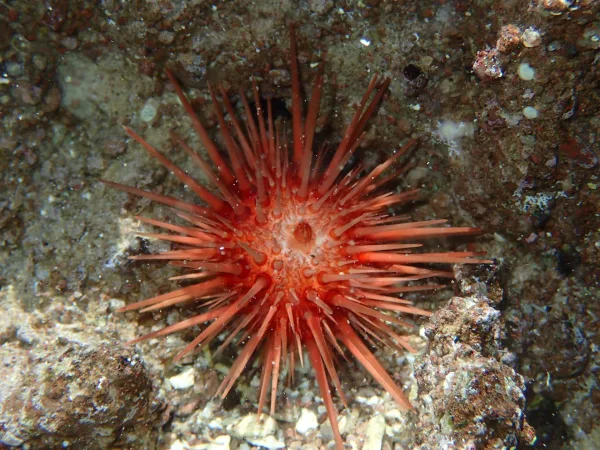
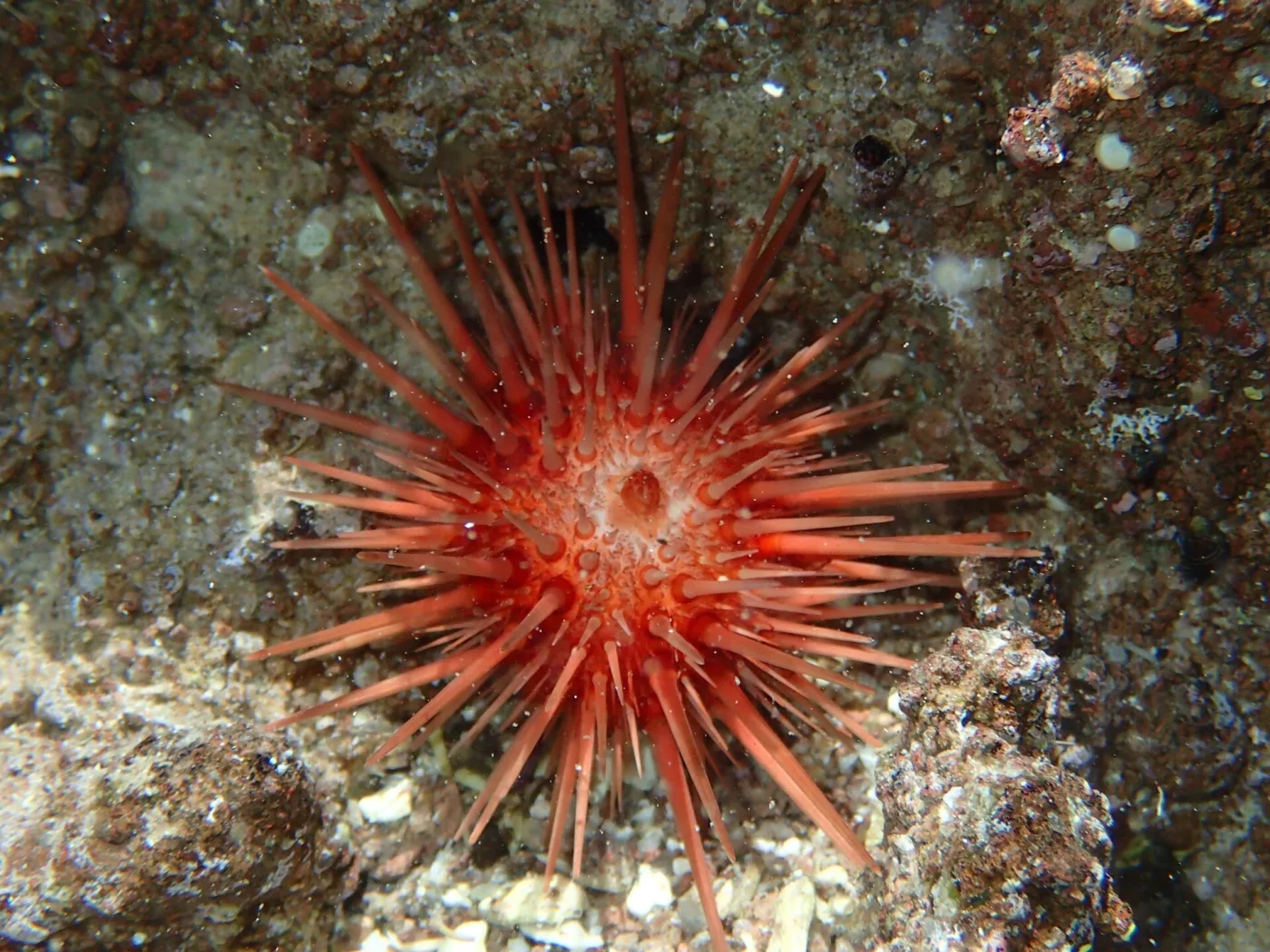
Rock Urchin
Echinometra lucunter
Also called Rock-boring Urchin, Red Rock Urchin, Atlantic Rock-boring Urchin, Rock Burrowing Urchin, Shortspine Urchin
- CareEasy
- Reef safeYes
- TemperamentPeacefulPeaceful; bulldozes loose frags and small rocks
- Favorite foods
- Film algae / microalgae
- Nori / dried seaweed
- Algae wafers / spirulina
- Max size3 in (7.6 cm)
- Min tank40 gal
- LifespanMore than 10 years in the wild after…
- IUCN statusNot Evaluated
Quick answers
- How big does the Rock Urchin get?
- Up to 3 in (7.6 cm).
- What size tank does it need?
- At least 40 gallons.
- How hard is it to keep?
- Care level: Easy.
- Is it reef safe?
- Yes. Most sellers call it reef safe (LiveAquaria, That Pet Place) because it does not deliberately eat corals, but it is a strong, bulldozing grazer: it knocks over loose frags and small rocks, can crush delicate corals by crawling over them, eats coralline algae (That Pet Place, Top Shelf Aquatics), and slowly erodes softer rock while making a burrow.
- What does it eat?
- Film algae / microalgae
- Nori / dried seaweed
- Algae wafers / spirulina
- How long does it live?
- More than 10 years in the wild after the first year, according to Animal Diversity Web (no detailed studies).
- What are good tankmates?
- Peaceful and semi-aggressive reef fish
- Snails, hermit crabs and other clean-up crew
- Cleaner and peppermint shrimp
- Corals that are firmly glued down
The 30-second version
The rock urchin is a small sea urchin from Florida and the Caribbean. Its body is shaped like a flat egg, not a ball. It is covered in short, thick, pointy spines. Most are dark red or brown, but some are almost black. It lives in very shallow water where waves crash on rocks. It uses its five little teeth to grind a round hole in the rock. In the day it hides in its hole. At night it comes out and scrapes algae off the rocks close by. It chases other rock urchins away from its hole. Tiny fish sometimes hide under it to stay safe. In a fish tank it eats algae. But it is strong and pushy, and it can knock over corals and small rocks.
Water & care
Hardy once settled, but it needs a mature tank with plenty of algae-covered live rock and rockwork that is glued or wedged so it cannot be pushed over. It is sensitive to copper-based medications, does not tolerate high nitrate, and drops its spines when water quality is poor (LiveAquaria). Top Shelf Aquatics rates it Moderate because it needs stable rockwork and enough algae; in a very clean tank add nori or algae wafers.
| Parameter | Keep it at | Where that sits on the usual reef range |
|---|---|---|
| Temperature | 72–78 °F | |
| Salinity (SG) | 1.023–1.025 | |
| pH | 8.1–8.4 | |
| Alkalinity | 8–12 dKH |
LiveAquaria and Quality Marine give 72-78 F, SG 1.023-1.025, pH 8.1-8.4 and 8-12 dKH; Top Shelf Aquatics gives 75-77 F, SG 1.024-1.026, pH 8.1-8.3 and 8-9 dKH. LiveAquaria warns it will not tolerate high nitrates but gives no number. Calcium, magnesium and phosphate are not species-specific: keep normal reef levels. No copper.
Feeding
DietHerbivore
Favorite foods
- Film algae and microalgae on rock
- Dried seaweed (nori)
- Algae wafers and spirulina-based foods
- Coralline algae and other encrusting algae
Grazes algae and biofilm off the rock, mostly at night. If the rock looks bare, clip a piece of nori or an algae sheet to a rock near its hiding place, or offer an algae wafer, a few times a week, and remove leftovers. In very clean tanks supplemental feeding is needed to prevent starvation (Top Shelf Aquatics).
Tank & maintenance
- Minimum tank
- 40 gallons
- Aquascape
- Mature live rock with lots of grazing surface and crevices to wedge into by day. Glue or pin rockwork and frags so it cannot topple them, and guard pump intakes and overflows.
- Lighting
- No needs of its own; light that grows film algae helps feed it. It hides from bright light during the day.
- Water flow
- Moderate in aquariums (Top Shelf Aquatics); in the wild it lives where waves are strong, so it copes well with strong flow.
Routine upkeep
Check that its spines stand up and that it moves at night; drooping or falling spines are an early warning of poor water. Re-glue anything it knocks loose, check rockwork stability now and then, and add nori when the rock runs short of algae.
Temperament & tankmates
TemperamentPeaceful
Harmless to fish and mobile invertebrates. In the wild it defends its burrow and nearby food against other rock urchins (ADW); in aquariums it is generally solitary but tolerates its own kind given space (LiveAquaria).
Reef safeYes
Most sellers call it reef safe (LiveAquaria, That Pet Place) because it does not deliberately eat corals, but it is a strong, bulldozing grazer: it knocks over loose frags and small rocks, can crush delicate corals by crawling over them, eats coralline algae (That Pet Place, Top Shelf Aquatics), and slowly erodes softer rock while making a burrow. In the wild dense groups cause considerable damage to reefs by boring (Wikipedia), and ReefLex and ADW list hydroid polyps, sponges or other sessile invertebrates among its foods. Glue frags down, keep rockwork stable and keep only one in a small reef.
Good tankmates
- Peaceful and semi-aggressive reef fish
- Snails, hermit crabs and other clean-up crew
- Cleaner and peppermint shrimp
- Corals that are firmly glued down
Avoid
- Triggerfish, large wrasses, pufferfish and porcupinefish that eat urchins
- Loose frags and unstable rockwork
- Tanks where coralline algae coverage matters to you
- Very new tanks with little algae
- Copper and other invertebrate-unsafe medications
Help it thrive
- Add it only to a mature tank with plenty of algae on the rock.
- Glue frags and secure rockwork before adding it; it pushes over loose pieces.
- Keep nitrate low and water quality stable; spine loss is the first sign of trouble.
- Never dose copper in its tank.
- Feed nori or algae wafers when the rock looks clean.
Common ailments
Spine loss
- Signs
- Spines droop or fall out in patches, the urchin stops moving and loses its grip.
- Prevention
- Slow acclimation, stable salinity and temperature, low nitrate and good water quality.
- Treatment
- Test and correct water quality and keep conditions stable; there is no medication. Remove it promptly if it dies.
Starvation
- Signs
- No grazing trails, constant wandering in daylight, thinning spines.
- Prevention
- Keep it in a mature tank with algae on the rock and do not overstock grazers.
- Treatment
- Offer nori, algae sheets or algae wafers next to it, at night if fish steal the food.
Copper and medication poisoning
- Signs
- Rapid spine loss and death after a medication was dosed.
- Prevention
- Never use copper-based treatments in a tank with urchins; treat fish in a hospital tank.
- Treatment
- Move it to clean water and remove the medication with activated carbon and water changes.
Pump and overflow injuries
- Signs
- Broken spines or damaged test after it climbs into a pump intake or overflow.
- Prevention
- Fit guards over intakes and overflows (Top Shelf Aquatics).
- Treatment
- Free it gently; minor spine damage regrows if water quality is good.
This is general hobby guidance, not veterinary advice. Quarantine new arrivals and treat in a separate tank whenever you can.
Risks of owning one
- Knocks over unglued frags and small rocks and can crush delicate corals.
- Grazes coralline algae along with nuisance algae.
- Slowly erodes softer rock while making its burrow.
- Starves in new or very clean tanks.
- Sharp spines break off in skin; ADW calls them venomous and says this urchin causes about half of marine-animal injuries in Brazil (LiveAquaria lists it as not venomous). Handle with gloves or a container.
- Copper and many fish medicines cannot be used in its tank.
Breeding
DifficultyHard Captive-bredRare or wild-caught
Sexes are separate and look alike. In the wild gonads ripen in spring and spawning, usually once and sometimes twice a year, takes place in summer, with males usually releasing sperm first, which seems to cue the females. Fertilisation is external; the larvae reach the four-armed pluteus stage after about two days and metamorphose about 19 days after fertilisation. Individuals mature at about 2 cm test diameter. Breeding is not practised in the hobby and no captive-bred animals are sold.
- Keep several mature adults (over about 2 cm across) together in a stable system.
- Spawning is seasonal (summer) and external; collect eggs and sperm when the urchins release them.
- Fertilise the eggs and rear the planktonic larvae in clean, gently moving seawater on cultured microalgae.
- Larvae develop through the four-armed pluteus stage (about day 2) and metamorphose into tiny urchins about 19 days after fertilisation.
- Grow juveniles on surfaces coated with algal film.
Deep dive The science, history and family tree
The science
Echinometra lucunter (Linnaeus, 1758) is a regular sea urchin of the family Echinometridae. Its test is elliptical rather than round, usually up to about 8 cm across, with records to 15 cm; it bears moderately short, thick, sharp spines with wide bases. Test colour ranges from black to deep brownish red, often redder on the upper surface, and the spines are usually black to reddish brown, sometimes with purple or green tones. It occurs in the western Atlantic from Bermuda and southern Florida through the Caribbean to Brazil, mostly at 2 m or less but recorded to about 45 m, and it is most abundant on rocky shores, tidal terraces and reef crests exposed to strong wave action. Using the five teeth of its Aristotle's lantern it grinds a hemispherical burrow into rock, shelters there by day and grazes at night on attached algae within a few centimetres of home, as well as drifting algae and seagrass; gut contents also include fragments of sessile invertebrates, so some authors call it omnivorous while others describe it as mainly herbivorous. It defends its burrow against other urchins of its own species but coexists with the closely related reef urchin, E. viridis. Sexes are separate and spawning, usually in summer, is external; the planktonic larvae metamorphose about 19 days after fertilisation, individuals mature at about 2 cm test diameter, and wild urchins are estimated to live more than 10 years. Dense populations erode reef rock, and small gobies, clingfish and crabs shelter among its spines.
- Appearance
- A small, oval (not round) urchin, usually 1-3 in across in the trade, with short, thick, sharp spines. Body black to deep reddish brown; spines usually dark red, reddish brown or black, sometimes purplish or greenish; some show a red patch at the top of the test. Look-alikes: the reef urchin (Echinometra viridis), also from Florida and the Caribbean, has longer, greenish spines with paler bases and dark, often violet tips; Indo-Pacific Echinometra mathaei is sold under the same 'rock-boring' and 'shortspine' names.
- Native range
- Western Atlantic: Bermuda, southern Florida and the Bahamas, throughout the Caribbean, and along the South American coast to Brazil.
- Habitat
- Very shallow rocky shores, tidal terraces, beach rock and reef crests, usually at 2 m or less (recorded to about 45 m), especially where waves are strong; also under rock slabs and broken coral and in seagrass. Each urchin sits in a burrow it grinds into the rock and grazes nearby at night. Often found in dense groups.
- Size
- 3 in (7.6 cm). Test (body) usually up to about 8 cm (3.1 in) across (Wikipedia, Naturalis); aquarium sellers give 3 in (LiveAquaria, That Pet Place) and up to 4 in for Echinometra in general (Quality Marine). Most adults are 4 cm or less, but SeaLifeBase, ADW and ReefLex record exceptional individuals of 15 cm (5.9 in). Spines add up to about 4 cm.
- Lifespan
- More than 10 years in the wild after the first year, according to Animal Diversity Web (no detailed studies). Top Shelf Aquatics gives 5-10 years in aquariums.
- Conservation
- Not Evaluated. Not evaluated by the IUCN Red List and not listed by CITES (SeaLifeBase, ADW). It is common through much of its range and its gonads are eaten by people. All aquarium specimens are wild-collected; no captive-bred supply is known
In the aquarium vs in the wild
In your aquarium
Inexpensive Florida and Caribbean clean-up-crew grazer for film algae and microalgae on rockwork; best in fish-only or sturdy reef tanks with secured corals.
On the reef
A nocturnal grazer of attached and drifting algae and seagrass on shallow rocky shores and reef crests; it bores burrows that reshape reef rock, keeps algal cover down, which can help sponges and other animals settle, and shelters small gobies, clingfish and crabs. It is eaten by triggerfish, porcupinefish, helmet shells, shorebirds and people.
History
Linnaeus described it in 1758 as Echinus lucunter; it was later moved to Echinometra, a genus created by Gray in 1825, and many later names such as Echinometra michelini, E. subangularis and Ellipsechinus lukunter are now synonyms (WoRMS). It is one of the most common shallow urchins of the Caribbean and has been studied for its rock boring, burrow defence and grouping behaviour; its gonads are eaten and have been used to monitor mercury pollution. In the aquarium trade it reaches stores from Florida collectors as the rock urchin, rock-boring or red rock urchin, and is also sold as the 'shortspine urchin (Echinometra sp.)'.
Evolution & relatives
Sea urchins (class Echinoidea) are echinoderms, related to sea stars, brittle stars and sea cucumbers. The rock urchin belongs to the order Camarodonta, which includes most familiar 'regular' urchins, and to the family Echinometridae (WoRMS). Its genus Echinometra has six species: E. lucunter and E. viridis in the western Atlantic and Caribbean, E. vanbrunti in the eastern Pacific off Mexico, E. insularis at Easter Island, and E. mathaei and E. oblonga in the Indo-Pacific. The two Atlantic species live side by side without competing for food or shelter (ADW).
Family tree, from kingdom down
- Kingdom Animalia Animals Animals are living things made of many cells that must eat food to live. Fish, corals, crabs, snails and sea stars are all animals.
- Phylum Echinodermata Echinoderms Echinoderms are sea animals whose bodies are usually built in five matching parts. They move on hundreds of tiny tube feet, and many have spiny skin.
- Subphylum Echinozoa Sea urchins and sea cucumbers These echinoderms have no arms. Their bodies are shaped like a ball or a sausage, as in sea urchins and sea cucumbers.
- Class Echinoidea Sea urchins Sea urchins have a round shell covered in spines. They chew food with five teeth set in a jaw called Aristotle's lantern.
- Subclass Euechinoidea
- Infraclass Carinacea
- Subterclass Echinacea
- Order Camarodonta Common sea urchins This order holds many of the round, spiny sea urchins people see most often, from rocky shores to reefs.
- Infraorder Echinidea
- Superfamily Odontophora
- Family Echinometridae
- Genus Echinometra
- Species Echinometra lucunter
See it on the Tree of Life Compare with another species
Closest relatives
- Echinometra viridis Reef urchin Same genus; Florida and Caribbean look-alike with longer, dark-tipped spines
- Echinometra mathaei Common urchin Same genus; Indo-Pacific, also sold as rock-boring or shortspine urchin
- Echinometra vanbrunti an Echinometra urchin Same genus; eastern Pacific (Mexico)
- Echinometra oblonga an Echinometra urchin Same genus; tropical Indo-Pacific and southern Africa
Older scientific names: Echinus lucunter, Cidaris lucunter, Ellipsechinus lukunter, Echinometra subangularis, Echinometra michelini.
Fun facts
- It grinds its own round hideout into solid rock with its five teeth, and enlarges it as it grows.
- It guards its burrow and pushes other rock urchins away.
- It can survive up to three hours out of water in direct sun, but water hotter than 38 C (100 F) kills it.
- Little gobies and clingfish hide among its spines for protection.
- Scientists measure mercury in its gonads to check for pollution.
Learn more
- Animal Diversity Web: Echinometra lucunter animaldiversity.org
- Wikipedia: Echinometra lucunter en.wikipedia.org
- Interactive Guide to Caribbean Diving: Rock-boring urchin caribbean-diving.linnaeus.naturalis.nl
- LiveAquaria: Shortspine Urchin care facts liveaquaria.com
Sources
- WoRMS: Echinometra lucunter taxon details marinespecies.org
- SeaLifeBase: Echinometra lucunter summary sealifebase.se
- Animal Diversity Web: Echinometra lucunter (J. Plazas) animaldiversity.org
- Wikipedia: Echinometra lucunter en.wikipedia.org
- Wikipedia: Echinometra (species list) en.wikipedia.org
- Wikipedia: Echinometra viridis en.wikipedia.org
- Interactive Guide to Caribbean Diving (Naturalis): Rock-boring urchin caribbean-diving.linnaeus.naturalis.nl
- Meerwasser-Lexikon (ReefLex): Echinometra lucunter en.reeflex.net
- Florent's Guide to the Caribbean Reefs: Atlantic Rock-Boring Urchin reefguide.org
- Wet Web Media: Sea Urchins part 4 (Echinometridae) wetwebmedia.com
- LiveAquaria: Shortspine Urchin (Echinometra sp.) liveaquaria.com
- That Pet Place: Rock Boring Urchin - Echinometra lucunter thatpetplace.com
- Top Shelf Aquatics: Rock-Boring Urchin topshelfaquatics.com
- Quality Marine: Shortspine Urchin (Echinometra sp.) qualitymarine.com
Care facts
The care facts on this guide and its product pages (care level, reef safety, temperament, size, tank, diet, flow, purpose, foods, acclimation and origin) combine 12 independent sources, checked October 25, 2026.
- Rock Boring Urchin - Echinometra lucunter That Pet Place
- Shortspine Urchin (Echinometra sp.) LiveAquaria
- Rock-Boring Urchin Top Shelf Aquatics
- Shortspine Urchin (Echinometra sp.) Quality Marine
- 3928 Echinometra lucunter (Rock-boring urchin) Meerwasser-Lexikon (ReefLex)
- Echinometra lucunter (Linnaeus, 1758) SeaLifeBase
- Echinometra lucunter (rock-boring urchin) Animal Diversity Web (University of Michigan)
- Rock-boring urchin, Echinometra lucunter Interactive Guide to Caribbean Diving (Naturalis Biodiversity Center)
- Atlantic Rock-Boring Urchin - Echinometra lucunter Florent's Guide to the Florida, Bahamas and Caribbean Reefs
- Some Spines Now! Sea Urchins, the Echinoids, Pt. 4 Wet Web Media (Bob Fenner)
- Echinometra lucunter Wikipedia
- LiveAquaria Step-by-Step Acclimation Guide LiveAquaria
Scientific names and classification follow the World Register of Marine Species (AphiaID 213380). Last updated October 25, 2026.
Shop this species
Search the shop →