 Sold out
Corals · LPS coral
Plate Coral
Fungia sp.
Also called Fungia plate coral, Disc coral, Mushroom coral, Fungus coral, Orange plate coral, Green plate coral, Short-tentacle plate coral
- CareEasy
- Reef safeYes
- TemperamentSemi-aggressiveMucus and night tentacles harm corals it touches
- Favorite foods
- Light (zooxanthellae)
- Mysis / brine shrimp
- Coral pellets / krill
- Max size12.5 in (31.8 cm)
- Min tank50 gal
- LifespanNo published captive lifespan
- IUCN statusLeast Concern
Quick answers
- How big does the Plate Coral get?
- Up to 12.5 in (31.8 cm).
- What size tank does it need?
- At least 50 gallons.
- How hard is it to keep?
- Care level: Easy.
- Is it reef safe?
- Yes. Safe with fish and invertebrates and kept in most reef tanks, but plate corals can harm other corals they touch: their mucus and night-time feeding or sweeper tentacles can damage neighbors.
- What does it eat?
- Light (zooxanthellae)
- Mysis / brine shrimp
- Coral pellets / krill
- How long does it live?
- No published captive lifespan.
- What are good tankmates?
- Other plate corals (they can usually touch)
- Peaceful reef fish
- Snails, hermit crabs and cleaner shrimp
- Corals placed on rockwork well above the sand
The 30-second version
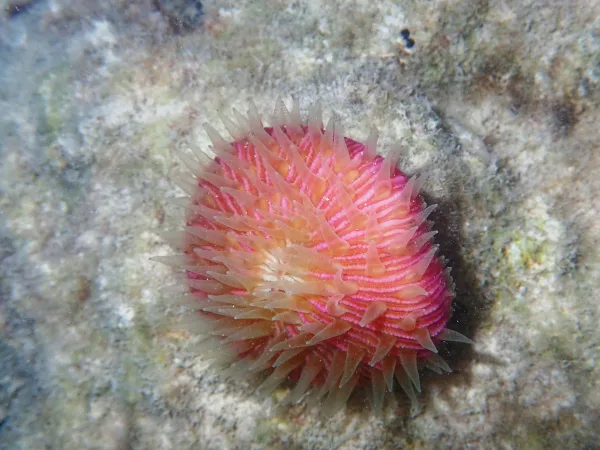
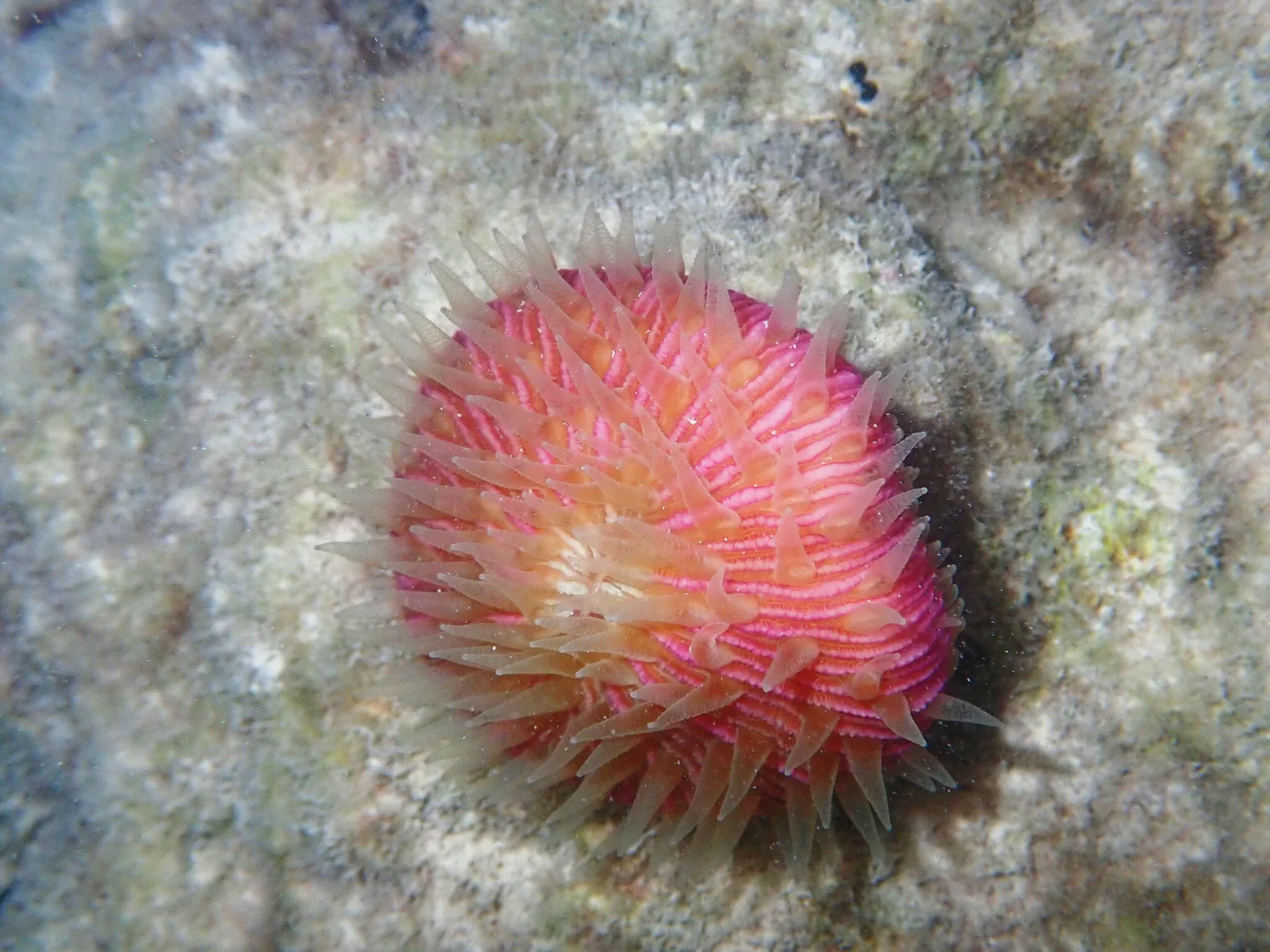
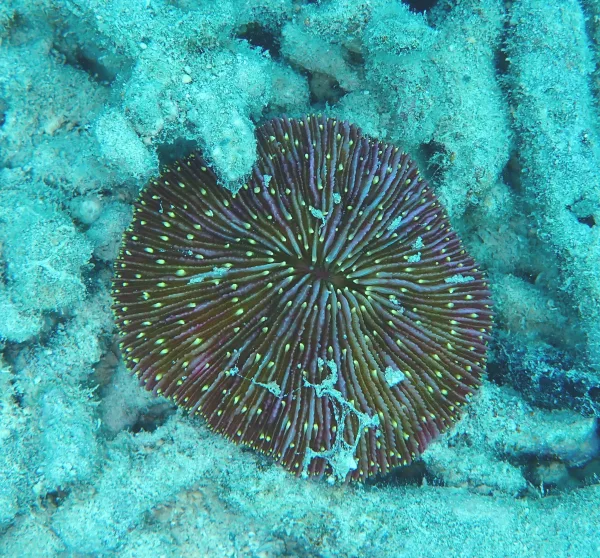
A plate coral looks like a round, flat plate or a mushroom cap lying on the sand. The whole plate is just one big polyp. It has one mouth in the middle and lots of ridges that run out to the edge like the spokes of a wheel. Tiny algae live inside it and make food from light. At night it puts out small tentacles to catch bits of food. A baby plate coral grows on a little stalk stuck to a rock. When it gets bigger, it breaks off and lies loose on the sand. It can puff up with water to slowly scoot along, dig itself out, or even flip back over. Plate corals come in green, pink, purple and orange. They are easy to keep, but keep other corals out of reach, because their slime and night tentacles can hurt them.
Water & care
LiveAquaria, Saltwater Aquarium Blog, AlgaeBarn, Frag Box, SeaScape and Tidal Gardens all rate plate corals easy, and a Colorado club article calls most of them fairly tolerant. The keys are placement on open sand, gradual light acclimation, space from other corals and stable water. Heliofungia (long-tentacle plate) is less hardy and is not covered by this rating.
| Parameter | Keep it at | Where that sits on the usual reef range |
|---|---|---|
| Temperature | 72–78 °F | |
| Salinity (SG) | 1.023–1.025 | |
| pH | 8.1–8.4 | |
| Alkalinity | 8–12 dKH |
Temperature, salinity, pH and alkalinity are Quality Marine's listed ranges for Fungia. No opened source gave plate-specific calcium, magnesium, nitrate or phosphate targets; follow normal LPS reef practice and keep levels stable. Tidal Gardens warns that moving a plate into a high-nitrate tank causes problems, and Quality Marine notes sensitivity to copper.
Feeding
DietPhotosynthetic
Favorite foods
- Light (photosynthesis by symbiotic algae)
- Mysis shrimp
- Brine shrimp
- Krill or chopped prawn
- Sinking coral or LPS pellets
Symbiotic algae supply much of its energy, and it also takes plankton, particles and dissolved organics from the water, so feeding is optional. Plates feed eagerly, though: place a piece of mysis, brine shrimp, krill or a coral pellet on the disc with a pipette once or twice a week, ideally in the evening when the tentacles are out, with the pumps turned down. Tidal Gardens feeds no more than three times a week.
Tank & maintenance
- Minimum tank
- 50 gallons
- Aquascape
- Place it directly on the sand bed (or fine rubble) in an open spot, not on rockwork, where it can fall, and never glue it down, since the underside is living tissue. Add it after corals above are secured so nothing drops on it. It may move a little by inflating. SeaScape suggests 50+ gallons; no other source gave a minimum tank size.
- Lighting
- Low to moderate, roughly 50-150 PAR on the sand (Tidal Gardens' medium band; Gensou suggests 80-150 PAR, Frag Box about 100). Gensou warns that above about 250 PAR can bleach plates; some sellers report better color under brighter light after a long acclimation.
- Water flow
- Low to moderate, indirect flow: enough to keep detritus off the disc without tumbling it. Tidal Gardens says they tolerate fairly strong periodic flow, and a Colorado club article says most types do well in most flow; long-tentacle plates prefer gentler flow.
Routine upkeep
Keep the sand around it clean and check that it has not been buried, flipped or pushed against another coral. Feed lightly once or twice a week if you choose to, watch the tissue for pale or dead patches, and keep up routine water changes and steady alkalinity and calcium dosing as for other stony corals.
Temperament & tankmates
TemperamentSemi-aggressive
Ratings vary from peaceful (Frag Box) to semi-aggressive (LiveAquaria, Saltwater Aquarium Blog) to aggressive (SeaScape). The harm is local: thick mucus, night-time tentacles and strong feeding behavior can damage corals within a few inches, but plate corals do not attack fish or mobile invertebrates.
Reef safeYes
Safe with fish and invertebrates and kept in most reef tanks, but plate corals can harm other corals they touch: their mucus and night-time feeding or sweeper tentacles can damage neighbors. Gensou suggests 10-15 cm (4-6 in) of clearance. Other plate corals generally tolerate touching each other.
Good tankmates
- Other plate corals (they can usually touch)
- Peaceful reef fish
- Snails, hermit crabs and cleaner shrimp
- Corals placed on rockwork well above the sand
Avoid
- Corals within about 4-6 in on the sand bed
- Sand-moving fish such as sleeper gobies that can bury or tip it
- Rockwork placement it can fall from
- Copper-based medications
Help it thrive
- Put it on the sand bed, never on rockwork and never glued down.
- Start it in the lowest light spot and raise the light over two to three weeks.
- Leave 4-6 in of open sand between it and other corals.
- Target-feed small meaty foods in the evening for faster growth and better color.
- Avoid sand-sifting gobies that can bury or tip it.
Common ailments
Tissue damage and infection
- Signs
- A dead or torn patch of tissue on the disc that spreads, often after a fall, a sting from a neighbor or rough handling.
- Prevention
- Sand-bed placement, space from other corals, no gluing, and gentle handling.
- Treatment
- Move it away from the cause, give it a coral dip (Frag Box uses Coral RX), and keep water stable while it heals.
Brown jelly
- Signs
- A brown, jelly-like film over part of the disc with fast tissue loss.
- Prevention
- Stable water, good flow over the sand bed, and quarantine of new corals.
- Treatment
- Siphon off the jelly and dip in Lugol's iodine (Gensou: about 5 drops per litre for 10-15 minutes), then return it to a clean area.
Bleaching
- Signs
- The disc turns pale or white after a move to stronger light or a temperature spike.
- Prevention
- Introduce at low light and raise intensity over two to three weeks; avoid PAR above about 250.
- Treatment
- Lower the light, stabilize temperature, and feed lightly while it recovers.
Burying or flipping
- Signs
- The disc is upside down or covered by sand moved by fish or snails, and the tissue shrinks.
- Prevention
- Keep sand-moving fish out and place it on a flat, open area.
- Treatment
- Turn it upright and clear the sand; most plates can also right themselves by inflating.
This is general hobby guidance, not veterinary advice. Quarantine new arrivals and treat in a separate tank whenever you can.
Risks of owning one
- Mucus and night tentacles can damage nearby corals.
- It can fall and tear its tissue if placed on rockwork.
- Copper medications can harm or kill it.
- Most plates are wild-collected, and trade names hide several genera, so the exact species and care can vary.
- Long-tentacle plates (Heliofungia) look similar but have a history of sudden death in captivity (Tidal Gardens).
Propagation & fragging
DifficultyHard AquaculturedRare or wild-caught
Plate corals cannot be fragged like branching corals. In the wild they spawn, releasing eggs and sperm through the mouth, and the larvae settle as small attached corals that later break free. New individuals also grow from broken fragments and daughter polyps budding from a damaged disc. Tidal Gardens notes that cost-effective aquaculture has not yet been shown, although a few captive-propagated plates are sold.
- Keep healthy plates on the sand with good feeding and stable water.
- If a disc is damaged, leave the pieces and the old skeleton in a calm spot; new polyps may bud from them.
- Let young polyps grow until they can be lifted off cleanly.
- Place each new plate on the sand bed in low light and raise the light gradually.
Deep dive The science, history and family tree
The science
Fungia Lamarck, 1801 is the type genus of the mushroom-coral family Fungiidae, zooxanthellate stony corals that are generally solitary and live unattached on the bottom as adults. Each individual is a single large polyp in a round or oval, slightly domed skeleton with a central mouth, sometimes slit-shaped, and strong radiating septa on the upper surface. In the type species, F. fungites, deep dentations on the septa make the upper surface rough, spines on the costae roughen the underside, and discs reach about 30 cm across. Young corals grow attached to hard substrate and later detach to live free; Fungia keeps a scar from this attachment, unlike the always free-living Cycloseris. Feeding tentacles are mostly extended at night, and the coral captures plankton and suspended particles and absorbs dissolved organic matter in addition to the food made by its symbiotic algae. Eggs and sperm are released through the mouth, and the planula larva settles to start the attached stage; new individuals also grow from broken pieces and daughter polyps. Fungiids can move by inflating their tissues, which lets them dig out of sand and turn themselves over. Fungia once held over 30 species, but after Hoeksema's 1989 revision and the 2011 molecular phylogeny of Gittenberger, Reijnen and Hoeksema, WoRMS accepts only F. fungites and F. puishani; most former Fungia now sit in Cycloseris, Danafungia, Lithophyllon, Lobactis, Pleuractis and other genera. In the aquarium trade, 'Fungia' and 'plate coral' are still used for most of these free-living discs, so this is a genus-level profile covering the trade group.
- Appearance
- A loose, round to oval disc, flat or slightly domed, with a central mouth and fine to coarse radiating ridges (septa) that may carry teeth; the polyp tissue covers the disc and short tentacles appear mainly at night or when food is present. Colors include green (often neon under blue light), pink, purple, red, blue, yellow, white and orange, often with a contrasting mouth or rim; some fluoresce under actinic light. Look-alikes: Cycloseris and Diaseris discs are usually smaller (5-10 cm) and domed with finer septa, and Reef Builders notes most orange 'Fungia' are really Cycloseris; pinwheel plates stay around 4 in; the long-tentacle plate coral (Heliofungia actiniformis) has long tentacles and is often mistaken for an anemone; tongue corals (Ctenactis, Herpolitha) are elongated with a central groove.
- Native range
- Indo-West Pacific: SeaLifeBase gives about 36°N to 31°S and 32°E to 137°W for F. fungites, including the Red Sea, the Great Barrier Reef and many Pacific islands. Trade plate corals come from Australia, Indonesia, Fiji, Tonga and Vietnam; this listing comes from a Miami wholesaler's Tongan shipment.
- Habitat
- Reef-associated at about 3-20 m, mainly on reef slopes and also on back reefs, reef flats and lagoons, often lying on sand, rubble or other sediment bottoms in fairly calm water.
- Size
- 12.5 in (31.8 cm). Single-polyp disc diameter. SeaLifeBase gives up to 30 cm for F. fungites, and several care guides quote about 1 ft. Gensou gives 15-25 cm for Fungia and 5-10 cm for Cycloseris, and Frag Box reports wild discs up to 18 in. Pinwheel types stay near 4 in.
- Lifespan
- No published captive lifespan. Each disc is one long-lived polyp, and Tidal Gardens reports discs growing to about 8 in across within a year in its system. Healthy specimens can last many years.
- Conservation
- Least Concern. The type species F. fungites is Least Concern on the IUCN Red List (SeaLifeBase gives a 2022 assessment). Status differs among the many former 'Fungia' now in other genera. F. fungites is listed on CITES Appendix II (SeaLifeBase), so wild-collected plates move under export permits. Tidal Gardens says most of its Fungia come from Australia and that cost-effective aquaculture has not been shown
In the aquarium vs in the wild
In your aquarium
A colorful, beginner-friendly display coral for the sand bed, often kept for its neon colors and lively feeding response.
On the reef
A free-living, solitary stony coral of reef slopes, flats and lagoons that adds calcium carbonate to the reef, catches plankton, and can move short distances across sand and rubble.
History
Lamarck named the genus Fungia in 1801, with Linnaeus's Madrepora fungites (1758) as the type species. Bert Hoeksema's 1989 monograph revised the taxonomy, phylogeny and biogeography of mushroom corals, and in 2011 Gittenberger, Reijnen and Hoeksema used DNA to reshape the family, which led WoRMS to move most former Fungia to separate genera; today only F. fungites and F. puishani remain. Hobbyists and wholesalers still sell most loose discs as 'Fungia' or 'plate coral'. Truly orange Fungia are rare: Reef Builders reported an orange F. klunzingeri offered for about $400 in 2011 and said most orange plates are Cycloseris.
Evolution & relatives
Fungiidae is a family of stony corals placed by WoRMS in the suborder Vacatina. Most of its 13-15 genera are solitary corals that become free-living as adults, but some are attached or colonial. The 2011 molecular phylogeny by Gittenberger, Reijnen and Hoeksema showed that the old genus Fungia was not a natural group, so its former subgenera, such as Danafungia, Lobactis, Pleuractis and Cycloseris, became genera of their own. Some fungiids, including Lithophyllon repanda and Ctenactis echinata, can change sex, which may respond to environmental or energy limits.
Family tree, from kingdom down
- Kingdom Animalia Animals Animals are living things made of many cells that must eat food to live. Fish, corals, crabs, snails and sea stars are all animals.
- Phylum Cnidaria Cnidarians Cnidarians are soft animals with tentacles. The tentacles have tiny stinging cells. Corals, sea anemones and jellyfish all belong here.
- Subphylum Anthozoa Corals and sea anemones These cnidarians spend their whole lives as polyps: a tube with a mouth ringed by tentacles. Unlike jellyfish, they never swim around as a bell-shaped medusa.
- Class Hexacorallia Hexacorals In this group the tentacles and body parts come in sixes or multiples of six. It includes stony corals, sea anemones, mushroom corals and zoanthids.
- Order Scleractinia Stony corals Stony corals build hard skeletons out of limestone under their soft polyps. Over many years, these skeletons pile up and make coral reefs.
- Suborder Vacatina Robust corals
- Family Fungiidae mushroom corals
- Genus Fungia
See it on the Tree of Life Compare with another species
Closest relatives
- Fungia fungites Common mushroom coral Type species of the genus
- Fungia puishani Same genus
- Cycloseris Disc coral Same family; small discs, including most orange 'plates'
- Danafungia scruposa Plate coral Same family; formerly Fungia
- Lobactis scutaria Plate coral Same family; formerly Fungia scutaria
- Pleuractis paumotensis Plate coral Same family; formerly Fungia
- Lithophyllon repanda Plate coral Same family; formerly Fungia repanda
- Heliofungia actiniformis Long-tentacle plate coral Same family; sold separately
- Herpolitha Tongue coral Same family
Older scientific names: Fungia scutaria (now Lobactis scutaria), Fungia repanda (now Lithophyllon repanda), Fungia concinna (now Lithophyllon concinna), Fungia granulosa (now Pleuractis granulosa), Fungia paumotensis (now Pleuractis paumotensis), Fungia horrida (now Danafungia horrida).
Fun facts
- Each plate is a single giant polyp, not a colony.
- Plate corals can inflate their tissue to crawl, dig out of sand and flip themselves right side up.
- Young plates grow on a stalk attached to rock, then break off and live loose on the sand.
- Fungia once held more than 30 species; WoRMS now accepts only two.
- Some relatives, such as Lithophyllon repanda, can change sex.
Learn more
- Tidal Gardens: How to care for your plate coral tidalgardens.com
- AlgaeBarn: Keeping Plate Corals algaebarn.com
- Saltwater Aquarium Blog: Plate coral care guide saltwateraquariumblog.com
- WoRMS: Fungia marinespecies.org
Sources
- WoRMS: Fungia Lamarck, 1801 marinespecies.org
- SeaLifeBase: Fungia fungites sealifebase.se
- Wikipedia: Fungia en.wikipedia.org
- Wikipedia: Fungiidae en.wikipedia.org
- LiveAquaria: Plate Coral, Pinwheel liveaquaria.com
- Quality Marine: Neon Green Plate Coral (Fungia sp.) qualitymarine.com
- Saltwater Aquarium Blog: Plate coral care guide saltwateraquariumblog.com
- AlgaeBarn: Keeping Plate Corals algaebarn.com
- Frag Box Corals: Plate Coral fragbox.ca
- SeaScape Studio: Fungia Plate Coral seascapestudio.net
- Gensou: Plate coral care guide (Fungia and Cycloseris) gensou.sg
- Tidal Gardens: How to care for your plate coral tidalgardens.com
- Tidal Gardens: Diablo Diaseris Plate (Fungia care and origin notes) tidalgardens.com
- Marine Aquarium Society of Colorado: Coral Spotlight, Plate Coral marinecolorado.org
- Reef Builders (2011): Orange Fungia plate coral reefbuilders.com
- Reef Builders (2014): Disc and plate coral olympics captured on time lapse reefbuilders.com
Care facts
The care facts on this guide and its product pages (care level, reef safety, temperament, size, tank, diet, flow, purpose, foods, acclimation and origin) combine 10 independent sources, checked October 25, 2026.
- Plate Coral, Pinwheel LiveAquaria
- Plate Coral Care Guide Saltwater Aquarium Blog
- Neon Green Plate Coral :: 52238 Quality Marine
- Plate Coral - Frag Box Corals Frag Box Corals
- Keeping Plate Corals AlgaeBarn (Kenneth Wingerter)
- Fungia Plate Coral (Fungia sp.) SeaScape Studio coral guide
- Plate Coral Care Guide: Fungia and Cycloseris Free-Living LPS Gensou (Singapore reef shop)
- How to care for your plate coral Tidal Gardens
- Coral Spotlight | Plate Coral Marine Aquarium Society of Colorado (club article by mikejrice, 2018)
- Fungia fungites, Common mushroom coral SeaLifeBase
Scientific names and classification follow the World Register of Marine Species (AphiaID 206375). Last updated October 25, 2026.
Shop this species
Search the shop →Sold out right now. We restock weekly, so check back soon.
Sold out
 Sold out