 Sold out
Invertebrates · Snail
Nerite Snail
Nerita sp.
Also called Saltwater Nerite, Marine Nerite, Caribbean Nerite, Checkered Nerite (N. tessellata), Antillean Nerite (N. fulgurans), Four-tooth Nerite (N. versicolor), Bleeding Tooth Nerite (N. peloronta)
- CareEasy
- Reef safeYes
- TemperamentPeacefulPeaceful grazer; small shell rarely topples rock
- Favorite foods
- Diatoms / film algae
- Cyanobacteria
- Nori or algae wafers
- Max size1 in (2.5 cm)
- Min tank10 gal
- LifespanNo figures for the Caribbean trade…
- IUCN statusNot Evaluated
Quick answers
- How big does the Nerite Snail get?
- Up to 1 in (2.5 cm).
- What size tank does it need?
- At least 10 gallons.
- How hard is it to keep?
- Care level: Easy.
- Is it reef safe?
- Yes. Reef safe.
- What does it eat?
- Diatoms / film algae
- Cyanobacteria
- Nori or algae wafers
- How long does it live?
- No figures for the Caribbean trade species.
- What are good tankmates?
- Peaceful reef fish
- Corals of all kinds
- Shrimp and small crabs
- Other clean-up crew snails such as turbo, trochus, cerith and nassarius snails
The 30-second version
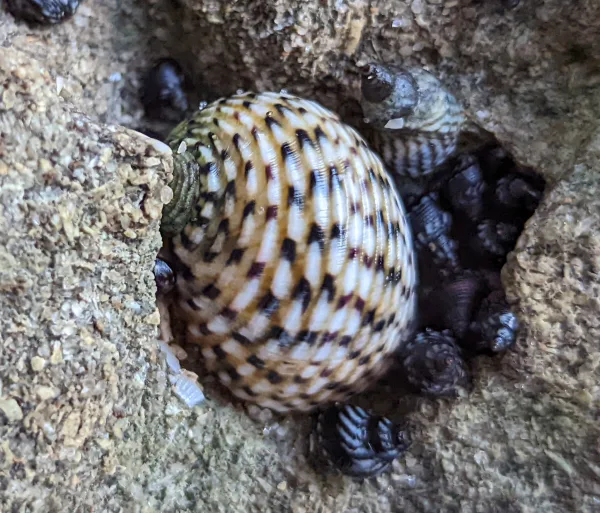
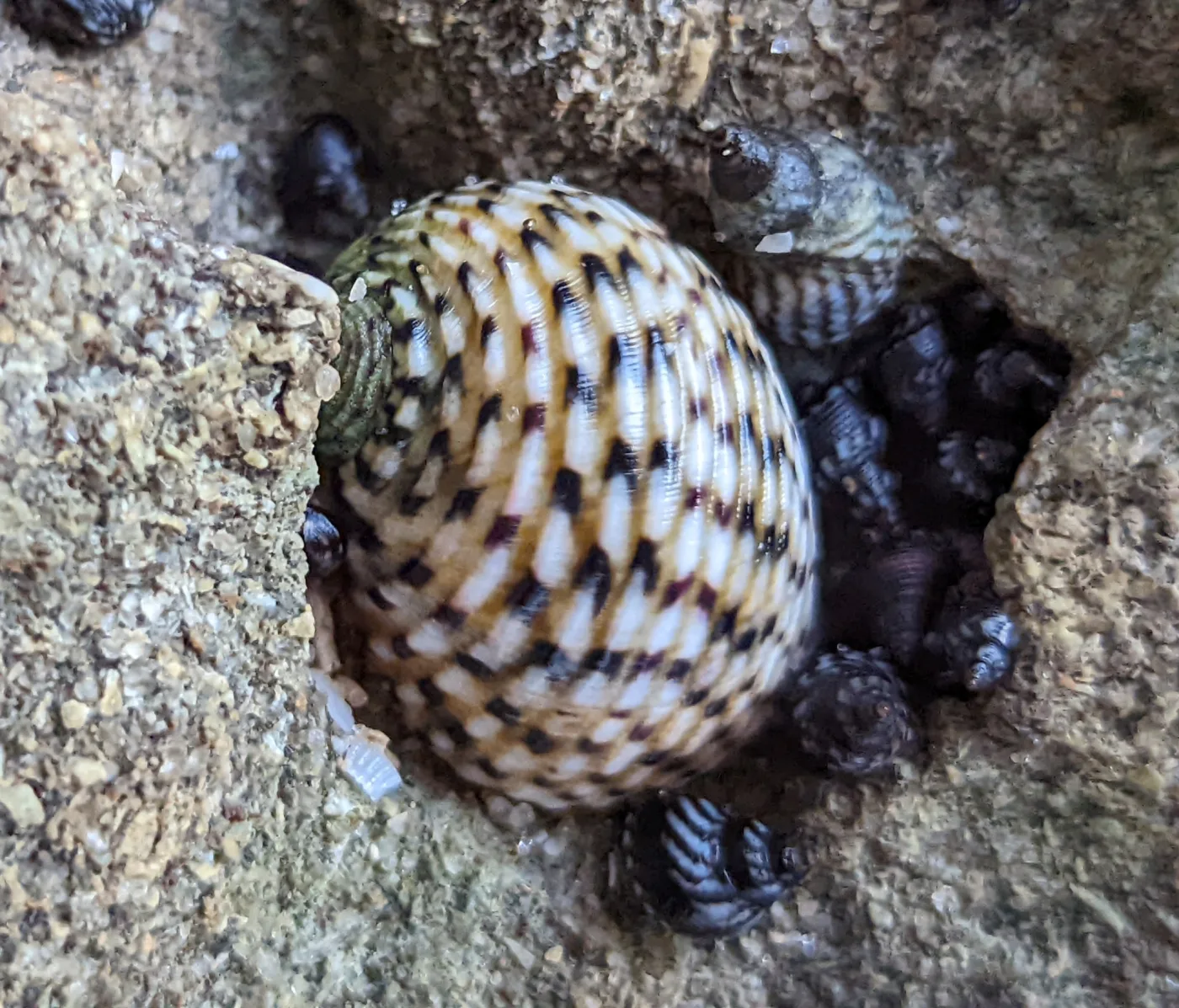
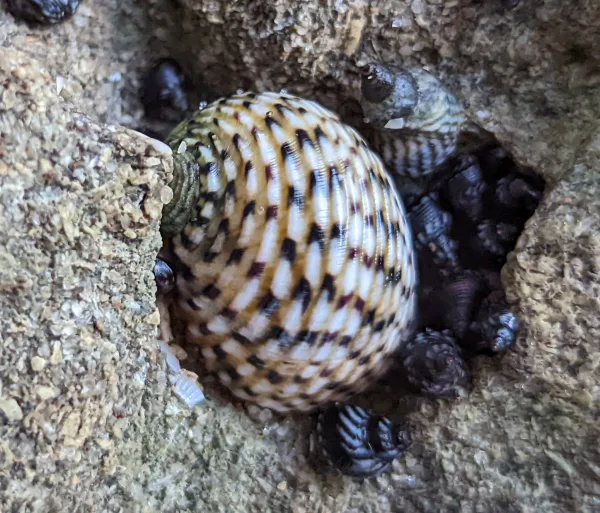
Nerite snails are small, round snails about the size of a coin. Their shells can be black and white like a checkerboard, or dark with stripes. In the wild they live on rocks at the edge of the sea in Florida and the Caribbean, where the tide comes in and goes out. In a fish tank they are little cleaners. They creep over rocks and glass and lick off thin brown and green films of algae with a tongue full of tiny teeth. They are gentle and never hurt fish or corals. Because they come from the shore, some like to climb out of the water, so the tank needs a lid. They also lay tiny white eggs that look like sesame seeds, but the babies almost never hatch in a tank.
Water & care
Easy and hardy in normal reef conditions (LiveAquaria, That Pet Place, Bulk Reef Supply, Aquatics Unlimited). Add them to an established tank with algae film on the rock and glass, and drip-acclimate over an hour or more. The main problem is escape: as shore snails, new nerites tend to climb out of the water for the first week or so, so use a lid or a tank with a thick rim, and put back any snail found out of the water. They are sensitive to copper medications and high nitrate. Feed dried seaweed or vegetable-based tablets if algae runs low.
| Parameter | Keep it at | Where that sits on the usual reef range |
|---|---|---|
| Temperature | 72–78 °F | |
| Salinity (SG) | 1.023–1.025 | |
| pH | 8.1–8.4 | |
| Alkalinity | 8–12 dKH |
LiveAquaria and Quality Marine both give 72-78 F, SG 1.023-1.025, pH 8.1-8.4 and 8-12 dKH, and LiveAquaria recommends calcium and trace-element supplements for shell growth. Nerites do not tolerate high nitrate or copper. No species-specific calcium, magnesium or phosphate targets were found; keep normal, stable reef levels. These are marine snails and die in freshwater.
Feeding
DietHerbivore
Favorite foods
- Diatoms and green film algae
- Cyanobacteria (including Lyngbya)
- Fine hair algae
- Dried seaweed (nori) or algae wafers
Grazes rock and glass for diatoms, film algae, fine hair algae and cyanobacteria, mostly at night. A tank with algae film feeds them on its own. If the glass and rock stay clean, offer sheet algae or vegetable-based tablets (Aquatics Unlimited, Quality Marine). Nerites need a steady food supply and do not breed in the tank, so plan to replace them as they die off (Top Shelf Aquatics).
Tank & maintenance
- Minimum tank
- 10 gallons
- Aquascape
- An established tank with live rock and plenty of surface to graze; algae film on the glass is a bonus. A tight lid, or a rim the snails cannot get past, is important, since new nerites often climb out. Reef Cleaners says they are not suitable for rimless aquariums.
- Lighting
- No needs of its own; enough light to grow film algae helps feed it.
- Water flow
- No care sheet states a flow preference. In the wild nerites live on intertidal rocks and in tide pools exposed to waves and tides, so normal reef flow suits them.
Routine upkeep
Check the lid and the tank rim for escapees during the first week or two, and return any found out of the water. Remove dead snails promptly. Scrape off the white sesame-seed egg capsules from the glass if they bother you; they do no harm and rarely hatch. Add nori or algae wafers when algae runs short.
Temperament & tankmates
TemperamentPeaceful
Completely peaceful toward fish, corals and other invertebrates. It is more likely to be the victim: snail-eating fish such as triggerfish, pufferfish and some wrasses may prey on it (Bulk Reef Supply).
Reef safeYes
Reef safe. Nerites graze algae films and leave corals, clams and other invertebrates alone, and their small, rounded shells rarely knock over rock or frags (LiveAquaria; Reef Cleaners calls them 100% reef safe). They also generally leave display macroalgae alone, but Reef Cleaners notes that Ulva is an exception.
Good tankmates
- Peaceful reef fish
- Corals of all kinds
- Shrimp and small crabs
- Other clean-up crew snails such as turbo, trochus, cerith and nassarius snails
Avoid
- Triggerfish, pufferfish and snail-eating wrasses
- Rimless or open-top tanks
- Freshwater or brackish tanks (these are marine snails)
- Copper-based medications
Help it thrive
- Use a lid or a tank with a thick rim: new nerites often try to climb out until they settle in, usually within about a week.
- Drip-acclimate for an hour or more and keep copper out of the tank.
- Add nerites to a tank that already has algae film, and feed sheet algae or vegetable tablets when the glass stays spotless.
- Buy marine Nerita, not freshwater or brackish Neritina; check the scientific name on the listing.
- Expect the white egg capsules on the glass; they are normal and almost never hatch in a tank.
Common ailments
Escape and drying out
- Signs
- Snails found above the waterline, under the lid or on the floor; a snail missing from the tank.
- Prevention
- Cover the tank or use a thick-rimmed tank; avoid splash-zone species such as N. peloronta and N. versicolor.
- Treatment
- Put the snail back in the tank; nerites can survive out of water for some time by holding water in the shell, and Sprung revived bleeding tooth nerites after more than a week out of water.
Starvation
- Signs
- Snails become inactive, stop moving over the glass and die after the tank has been very clean for a while.
- Prevention
- Stock to match the algae supply and add sheet algae or vegetable tablets when algae runs short.
- Treatment
- Place nori or an algae wafer next to the snails, or move some snails to another tank.
Copper or nitrate poisoning
- Signs
- Snails retract, fall off the glass and die after medication or when nitrate climbs.
- Prevention
- Never dose copper in a tank with invertebrates; keep nitrate low with water changes.
- Treatment
- Move survivors to clean, matched water; remove copper with carbon or resin and do water changes.
This is general hobby guidance, not veterinary advice. Quarantine new arrivals and treat in a separate tank whenever you can.
Risks of owning one
- New nerites often climb out of open or rimless tanks and can dry out.
- Starve once the algae is gone unless fed.
- Very sensitive to copper medications and high nitrate.
- Mixed lots may include splash-zone species (N. peloronta, N. versicolor) that keep crawling out.
- Lay many white egg capsules on glass and rock, which some keepers find unsightly.
Breeding
DifficultyNot achieved Captive-bredRare or wild-caught
Nerites have separate sexes and mate; the male passes sperm to the female, who stores it. Females lay many small white egg capsules, like sesame seeds, on glass and rock. In aquariums the eggs are laid freely but young snails almost never appear: Sprung suggests the planktonic larvae need special food, and egg capsules may need tidal exposure or salinity changes. He writes that captive rearing has not been worked out. Top Shelf Aquatics notes that they do not reproduce in reef tanks, so they never overpopulate.
- Keep several adults together; males and females cannot be told apart from outside.
- White egg capsules on the glass or rock show that they are mating; this is normal.
- No hobby or commercial method for raising the larvae is known; the young need plankton and may need brackish or tidal conditions.
- Plan to replace nerites with new wild-collected animals as they die.
Deep dive The science, history and family tree
The science
Nerita Linnaeus, 1758 is the type genus of the family Neritidae (subclass Neritimorpha), small to medium sea snails with a gill and a thick, calcareous operculum. The shell is broadly ovate to globular and low-spired. Species occur on tropical shores worldwide and live in the middle and upper intertidal zones, where they graze as gregarious herbivores. The 'Nerite Snails' sold as clean-up crew in the United States are Florida and Caribbean species collected from rocky shores and tide pools, and lots are often mixed. Bulk Reef Supply sells the checkered nerite, Nerita tessellata Gmelin, 1791, and the Florida supplier Reef Cleaners ships its nerite lots as N. tessellata plus N. fulgurans Gmelin, 1791. N. tessellata has a black shell with regular white checkers and reaches about 2-2.5 cm; N. fulgurans is dark with yellow and black shades, grooved, and reaches 37 mm. Two other common Caribbean species, the four-tooth nerite (N. versicolor) and the bleeding tooth (N. peloronta, the type species), live higher in the splash zone. Julian Sprung reports that they crawl out of aquariums, so they make poor tank snails.
Nerites feed mainly on diatom films, plus filamentous and film-forming cyanobacteria and fine green algae. Most Nerita are more active at night, and some gather in clusters by day to avoid drying out. Unlike turban snails, which release eggs and sperm into the water, nerites mate: the male has a penis and the female stores sperm. Females lay small white egg capsules that look like sesame seeds on rock and glass. In aquariums these eggs are laid freely, but young snails almost never appear.
- Appearance
- A small, rounded, low-spired shell with a wide, D-shaped opening and toothed inner lip, closed by a hard, chalky operculum. Trade animals are usually 1/2-1 in. The checkered nerite (N. tessellata) is black with neat white checkers, often crusted with pink coralline algae in tanks; N. fulgurans is darker and spirally grooved, with yellowish-black shades. XL lots may hold larger N. fulgurans. Look-alikes: freshwater and brackish Neritina/Vitta nerites (zebra, horned, olive nerites) are sold under the same name but are different animals, and at least one 'saltwater nerite' listing names Neritina natalensis instead; check that you are buying marine Nerita. The bleeding tooth nerite (N. peloronta) has a red stain around white 'teeth' in the opening.
- Native range
- Tropical seas worldwide for the genus. The trade species are western Atlantic: N. tessellata from Florida through the Gulf of Mexico, the West Indies and Central America to Brazil; N. fulgurans along Florida's Atlantic coast (north to St. Augustine) and south to Barbados. Some retailers also sell Indo-Pacific nerites under the same name.
- Habitat
- Intertidal rocky shores, tide pools and reef flats, from just above the waterline to about 3 m (SeaLifeBase gives 0-3 m for N. tessellata). Sprung notes that checkered nerites live lower on the rocks and in tide pools, with some individuals staying submerged and others often crawling out. N. fulgurans prefers brackish areas near mangroves and seagrass, protected from strong waves. N. versicolor and N. peloronta live in the splash zone above the tide line.
- Size
- 1 in (2.5 cm). Retailers give a 1 in maximum (LiveAquaria, Bulk Reef Supply, Quality Marine, Reef Cleaners); That Pet Place says they rarely exceed 1.5 in. N. tessellata reaches about 2-2.5 cm (Sprung; SeaLifeBase; Wikipedia), and Reef Cleaners lists 0.75 in for its checkered nerites. N. fulgurans reaches 37 mm (about 1.5 in), so XL lots may be larger than 1 in.
- Lifespan
- No figures for the Caribbean trade species. Sprung reports about 1 year in captivity for several small nerites (zebra, virgin and Hawaiian black nerites) and 3 years or more for larger Indo-Pacific Nerita species.
- Conservation
- Not Evaluated. N. tessellata is Not Evaluated on the IUCN Red List (SeaLifeBase). All trade animals are collected from wild shores; Bulk Reef Supply labels its nerites 'sustainably harvested'. No CITES listing or collection ban was found
In the aquarium vs in the wild
In your aquarium
Clean-up crew algae grazer, especially for diatoms, film algae and cyanobacteria on rock and glass.
On the reef
A herbivorous grazer of intertidal rocky shores and tide pools that crops diatom films, cyanobacteria and fine algae.
History
Linnaeus named the genus Nerita in 1758, with the bleeding tooth nerite, N. peloronta, as its type species. It is the type genus of the family Neritidae. The checkered nerite (N. tessellata), the Antillean nerite (N. fulgurans) and the four-tooth nerite (N. versicolor) were all described by Gmelin in 1791. In a 2003 article, Julian Sprung noted that nerites were less established than turban snails in the reef clean-up crew but were gaining fans. He sorted the Florida and Caribbean species by how often they climb out of water: the checkered nerite was the good choice, and the splash-zone species were not. Today nerites are a standard clean-up-crew item, sold in bulk packs of mixed Caribbean Nerita collected from Florida and the Caribbean.
Evolution & relatives
Nerites belong to the Neritimorpha, a group of about 2,000 living snail species with a rich fossil record going back to the Early Ordovician. Neritimorphs typically have calcified opercula, unlike most other snails. The group has moved from the sea into fresh water and onto land several times; terrestrial lifestyles evolved independently at least three times (helicinid land snails among them). Within the family Neritidae, Nerita holds the fully marine intertidal species, while genera such as Neritina, Vitta and Theodoxus include the brackish and freshwater nerites sold for freshwater tanks. The upper-shore life of species such as N. fulgurans and N. peloronta, which can survive long periods out of water, shows how neritids have edged toward life on land.
Family tree, from kingdom down
- Kingdom Animalia Animals Animals are living things made of many cells that must eat food to live. Fish, corals, crabs, snails and sea stars are all animals.
- Phylum Mollusca Molluscs Molluscs are soft-bodied animals, and many of them grow a hard shell. Snails, clams and octopuses are all molluscs.
- Class Gastropoda Snails and slugs Gastropods crawl on one big, slimy foot. Most carry a single coiled shell, but sea slugs have lost theirs.
- Subclass Neritimorpha
- Order Cycloneritida
- Superfamily Neritoidea
- Family Neritidae nerites
- Subfamily Neritinae
- Genus Nerita
See it on the Tree of Life Compare with another species
Closest relatives
- Nerita tessellata Checkered nerite Member species; the main Caribbean nerite in the trade
- Nerita fulgurans Antillean nerite Member species; shipped in Florida nerite lots, larger, prefers brackish shores
- Nerita versicolor Four-tooth nerite Member species; Caribbean splash zone, tends to crawl out
- Nerita peloronta Bleeding tooth nerite Member species and type species of the genus; unsuitable for most aquariums
- Puperita pupa Zebra nerite Same family (Neritidae); Caribbean tide-pool nerite
- Vitta virginea Virgin nerite Same family; brackish mudflats and seagrass, formerly Neritina virginea
Older scientific names: Nerita sp., Nerita tesselata.
Fun facts
- The 'blood' around the teeth of the bleeding tooth nerite is iron deposited in the shell.
- Bleeding tooth nerites that escaped from Julian Sprung's tank turned up more than a week later elsewhere in his house, and recovered when put back in saltwater.
- Nerite egg capsules look so much like sesame seeds that Sprung suggests calling them exactly that when visitors ask.
- Some checkered nerites from the same shore stay in the water while others keep climbing out; Sprung says the ones that stay in make the better aquarium snails.
- Their relatives, the neritimorphs, have a fossil record going back to the Early Ordovician.
Learn more
- Reefs.com: Nerites: Bleeding Tooth, Zebras, Checkers And More (Julian Sprung) reefs.com
- LiveAquaria: Nerite Snail liveaquaria.com
- Reef Cleaners: Nerite Snail reefcleaners.org
- WoRMS: Nerita Linnaeus, 1758 marinespecies.org
Sources
- WoRMS: Nerita Linnaeus, 1758 (via reefid taxonomy) marinespecies.org
- Reefs.com: Julian Sprung, Nerites: Bleeding Tooth, Zebras, Checkers And More (2003) reefs.com
- LiveAquaria: Nerite Snail (Nerita sp.) liveaquaria.com
- That Pet Place: Nerite Snail, Nerita sp. thatpetplace.com
- Bulk Reef Supply: ECC Nerite Snails (Nerita tessellata) bulkreefsupply.com
- Reef Cleaners: Nerite Snail (N. fulgurans and N. tessellata) reefcleaners.org
- Reef Cleaners: Checkered Nerite reefcleaners.org
- Aquatics Unlimited: Nerite Marine, Nerita sp. aquaticsunlimited.com
- Quality Marine: Nerite qualitymarine.com
- Top Shelf Aquatics: Clean Up Crew Reef Tank species guide topshelfaquatics.com
- SeaLifeBase: Nerita tessellata sealifebase.se
- Wikipedia: Nerita en.wikipedia.org
- Wikipedia: Nerita tessellata en.wikipedia.org
- Wikipedia: Nerita fulgurans en.wikipedia.org
- Wikipedia: Nerita peloronta en.wikipedia.org
- Wikipedia: Neritimorpha en.wikipedia.org
Care facts
The care facts on this guide and its product pages (care level, reef safety, temperament, size, tank, diet, flow, purpose, foods, acclimation and origin) combine 13 independent sources, checked October 25, 2026.
- Nerite Snail (Nerita sp.) LiveAquaria
- Nerite Snail - Nerita sp. - Small That Pet Place
- ECC Nerite Snails (Checkered Nerite, Nerita tessellata) Bulk Reef Supply / Eye Catching Coral
- SNAIL - NERITE MARINE Nerita sp. Aquatics Unlimited
- Nerite (Nerite sp.) Quality Marine
- Nerite Snail Reef Cleaners
- Nerites: Bleeding Tooth, Zebras, Checkers And More (Julian Sprung, 2003) Reefs.com (Advanced Aquarist archive)
- Nerita tessellata, Checkered nerite SeaLifeBase
- Nerita tessellata Wikipedia
- Nerita fulgurans Wikipedia
- Nerita Wikipedia
- Nerite Snails Fragbox
- Clean Up Crew Reef Tank: Complete Species Guide and Stocking Strategy Top Shelf Aquatics
Scientific names and classification follow the World Register of Marine Species (AphiaID 138254). Last updated October 25, 2026.
Shop this species
Search the shop →Sold out right now. We restock weekly, so check back soon.
Sold out
 Sold out