Invertebrates · Snail
Nassarius Snail
Phrontis vibex
Also called Bruised Nassa, Vibex Nassarius, Mottled Dog Whelk, Common Eastern Nassa, Nassa Mud Snail
- CareEasy
- Reef safeYes
- TemperamentPeacefulPeaceful scavenger; does not prey on tankmates
- Favorite foods
- Uneaten meaty food
- Carrion / dead animals
- Detritus
- Max size1 in (2.5 cm)
- Min tank20 gal
- LifespanCan live several years
- IUCN statusNot Evaluated
Quick answers
- How big does the Nassarius Snail get?
- Up to 1 in (2.5 cm).
- What size tank does it need?
- At least 20 gallons.
- How hard is it to keep?
- Care level: Easy.
- Is it reef safe?
- Yes. Ignores corals, clams, fish and algae.
- What does it eat?
- Uneaten meaty food
- Carrion / dead animals
- Detritus
- How long does it live?
- Can live several years (Animal Diversity Web); no formal data on captive lifespan were found.
- What are good tankmates?
- Reef corals of all kinds
- Peaceful fish that do not eat snails
- Cleaner, peppermint and fire shrimp
- Other clean-up crew snails such as turbo, trochus and cerith snails
The 30-second version
The nassarius snail is a small snail. It is about as long as your fingernail. It lives buried in the sand. It sticks up a long tube, like a snorkel. The tube lets it breathe and smell the water. When food lands in the tank, it smells it right away. Then it pops out of the sand and races to the food. It eats leftover food and dead animals, so it works like a tiny garbage truck. All that digging also stirs the sand. It does not eat algae, and it leaves corals and fish alone. In the wild it lives on sandy and muddy shores. It is found on the Atlantic coast of the Americas, from Cape Cod all the way to Brazil. Mother snails glue tiny egg cases onto rocks. Many mothers often lay their eggs in the same spot.
Water & care
One of the easiest clean-up crew animals, provided it has a sand bed and enough leftover food reaches the bottom. Give it at least 1-2 in of fine to medium sand, drip-acclimate (snails dislike sudden salinity changes) and keep copper out of the tank. In very clean, lightly fed tanks it can starve: if the snails stop appearing at feeding time, drop a small sinking pellet or a pinch of thawed frozen food onto the sand.
| Parameter | Keep it at | Where that sits on the usual reef range |
|---|---|---|
| Temperature | 72–78 °F | |
| Salinity (SG) | 1.023–1.025 | |
| pH | 8.1–8.4 | |
| Alkalinity | 8–12 dKH |
Ranges are LiveAquaria's care ranges for nassarius snails; other care guides give 70-80 F overall. A western Atlantic species that tolerates a fairly wide temperature range, but avoid sudden swings in salinity. Very sensitive to copper. Calcium, magnesium and nutrient targets are not species-specific, so they are left blank: keep normal reef levels, nitrate low, and ammonia and nitrite at zero.
Feeding
DietCarnivore
Favorite foods
- Leftover meaty frozen foods such as mysis and brine shrimp
- Sinking pellets
- Dead fish and invertebrates (carrion)
- Small pieces of fish, shrimp or clam dropped onto the sand
A scavenger that finds food by smell. It eats leftover food, decaying matter and carrion; it is not an algae eater. In a normally fed fish tank it lives on leftovers. If little food reaches the sand, target-feed a small sinking pellet or a pinch of thawed frozen food two or three times a week. Do not overfeed to 'feed the snails', and keep their numbers in line with how much food actually reaches the bottom.
Tank & maintenance
- Minimum tank
- 20 gallons
- Aquascape
- A sand bed at least 1-2 in deep of fine to medium-grain sand (deeper is better), with rockwork placed securely. Bare-bottom tanks are unsuitable because the snail needs to bury itself.
- Lighting
- Any; it has no lighting needs.
- Water flow
- Any normal reef flow; it lives under the sand.
Routine upkeep
Little routine care. Watch feeding time: healthy nassarius pop out of the sand within minutes of food entering the water, which doubles as a head count. Remove dead snails (empty or smelly shells) promptly. When siphoning the sand bed, stay shallow so you do not suck up buried snails.
Temperament & tankmates
TemperamentPeaceful
Harmless to tank mates. Large numbers may swarm a dead fish or snail, which can look alarming but is normal scavenging.
Reef safeYes
Ignores corals, clams, fish and algae. Its burrowing moves sand around but does not harm corals.
Good tankmates
- Reef corals of all kinds
- Peaceful fish that do not eat snails
- Cleaner, peppermint and fire shrimp
- Other clean-up crew snails such as turbo, trochus and cerith snails
Avoid
- Snail-eating fish such as triggerfish, puffers and larger wrasses
- Hermit crabs (may kill snails for their shells)
- Sand sifting starfish (Astropecten swallow small snails whole)
- Copper and other invertebrate-unsafe medications
Help it thrive
- Give them a real sand bed: they spend most of their life buried.
- Add them to a tank that is already being fed regularly; a new tank with no leftovers will starve them.
- Drip-acclimate slowly and keep salinity steady.
- Do not keep them with sand sifting starfish, hermit crabs or snail-eating fish.
- Count the snails that come up at feeding time now and then to catch losses early.
Common ailments
Starvation
- Signs
- Snails stop emerging at feeding time, wander on the sand surface during the day, or are found dead with empty shells.
- Prevention
- Match snail numbers to the amount of food reaching the sand; target-feed in lightly fed tanks.
- Treatment
- Feed small amounts of meaty food onto the sand and reduce the population if needed.
Acclimation and salinity shock
- Signs
- Snail stays retracted, will not bury itself, or lies with its foot hanging limp in the first days after purchase.
- Prevention
- Drip-acclimate and match salinity and temperature before release; avoid sudden top-off or water-change swings.
- Treatment
- Keep it in stable water and leave it undisturbed on the sand; there is no medication.
Copper and medication poisoning
- Signs
- Many snails and other invertebrates die suddenly after a medication was dosed.
- Prevention
- Never dose copper or invertebrate-unsafe medications in the display; treat fish in a hospital tank.
- Treatment
- Move survivors to clean water and remove the medication with activated carbon, resin and water changes.
Predation
- Signs
- Shells found empty or broken, or a hermit crab suddenly wearing a nassarius shell; snail numbers drop steadily.
- Prevention
- Do not house them with hermit crabs, sand sifting starfish or snail-eating fish.
- Treatment
- Remove or rehome the predator.
This is general hobby guidance, not veterinary advice. Quarantine new arrivals and treat in a separate tank whenever you can.
Risks of owning one
- Starves in very clean or lightly fed tanks.
- Easily killed by copper and other invertebrate-unsafe medications.
- Dead snails buried in the sand can go unnoticed and add to the nutrient load.
- Hard to keep with predators of small snails (hermit crabs, sand sifting starfish, many fish).
- Several different nassariid species are sold under the same name, including cooler-water ones that do poorly in reef tanks.
Breeding
DifficultyVery hard Captive-bredRare or wild-caught
Sexes are separate. Females attach small, flat, oval egg capsules (about 1.3-1.5 mm high) to hard surfaces such as rock and aquarium glass, often in communal clusters. The young hatch as swimming veliger larvae that must feed on phytoplankton in open water for weeks before settling (related Nassarius species take about 4-5 weeks in the lab). Egg capsules are often seen in aquariums, but the larvae are lost to pumps, skimmers and filter feeders, so a self-sustaining population is rare.
- Keep a group of well-fed adults in a mature tank with a sand bed.
- Look for clusters of tiny, flat, clear-to-white capsules on glass and rock; many capsules seen in tanks belong to other snails such as ceriths, so confirm the identity.
- Raising the veliger larvae would require a separate, filter-free larval tank and live phytoplankton for several weeks; no hobby protocol for this species was found.
- Juveniles that do settle stay buried and are rarely noticed until they are a few millimetres long.
Deep dive The science, history and family tree
The science
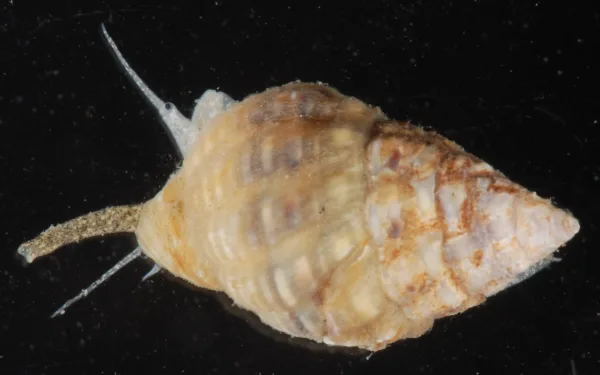
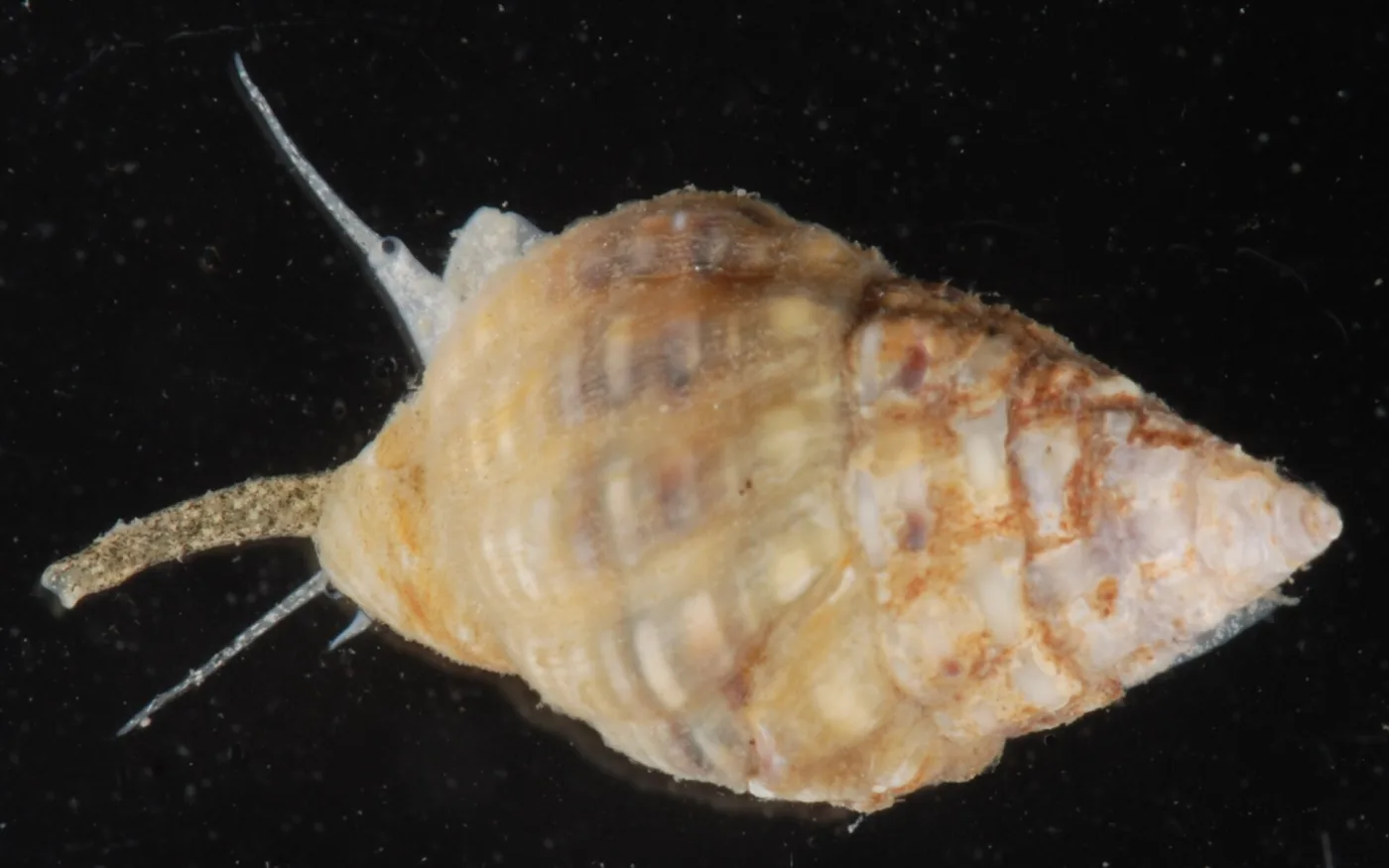
Phrontis vibex (Say, 1822), long known in the hobby as Nassarius vibex, is a small nassa mud snail (family Nassariidae) of the western Atlantic. The shell is solid and conical with a pointed, elevated spire; adults are usually about 1-1.5 cm long and reach roughly 2 cm. The whorls carry about a dozen strong axial ribs crossed by finer spiral threads, and the inner lip of the aperture bears a broad, thickened callus. Colour ranges from whitish or yellowish to light or dark brown, often with darker bands or blotches, which gives the name 'bruised nassa'. The animal has a long, mobile siphon and spends most of its time buried in sediment with only the siphon showing.
It ranges from Cape Cod south through Florida, the Gulf of Mexico and the West Indies to Brazil, living on intertidal and shallow subtidal sand and mud flats, creek banks and sheltered back bays. Like most nassariids it is a scavenger: it detects carrion by smell, moves up-current toward the scent and gathers in large numbers on dead fish and invertebrates; it also eats the eggs of sand-dwelling polychaete worms. Females attach small, flat, oval egg capsules about 1.3-1.5 mm high to hard surfaces, often spawning communally so that many capsules cluster together, and the young hatch as planktonic veliger larvae. A 2016 five-gene phylogeny of the family showed that the large genus Nassarius as traditionally defined was not a natural group, and this species was moved to Phrontis, a name formerly used as a subgenus of Nassarius.
- Appearance
- A small, pointed, cone-shaped shell, usually about 1/2 in and rarely over 3/4 in, with strong vertical ribs crossed by fine spiral lines and a thick, glossy callus around the opening. Colour is cream, yellowish, grey or brown, often with darker bands or smudges (the 'bruised' look). In the tank you usually see only the siphon sticking out of the sand like a snorkel until food arrives, when the snails surface and glide toward it. Look-alikes: several different nassariids are sold as 'Nassarius snails', including the larger Indo-Pacific 'Super Tongan' Nassarius distortus and the cooler-water eastern mud snail Ilyanassa obsoleta, which does poorly at reef temperatures; cerith snails have taller, narrower shells and graze rocks and glass rather than living buried in the sand.
- Native range
- Western Atlantic: Cape Cod (Massachusetts) south along the US East Coast to Florida, the Gulf of Mexico, the West Indies and Brazil. Type locality: New Jersey.
- Habitat
- Intertidal and very shallow subtidal sand and mud flats, creek banks, estuaries and sheltered back bays. Usually buried in the sediment with the siphon exposed, emerging to feed and moving up-current toward the smell of food. Gathers in numbers wherever carrion appears.
- Size
- 1 in (2.5 cm). Most adults are 1-1.5 cm (about 1/2 in). Maximum shell length about 2 cm per SeaLifeBase; the Bailey-Matthews Shell Museum gives 15 mm. LiveAquaria lists 1/2-1 in for nassarius snails in general.
- Lifespan
- Can live several years (Animal Diversity Web); no formal data on captive lifespan were found.
- Conservation
- Not Evaluated. No IUCN Red List, US federal or CITES listing (Animal Diversity Web). Common and widespread; aquarium animals are wild-collected from the western Atlantic
In the aquarium vs in the wild
In your aquarium
Sand-bed clean-up crew: eats leftover meaty food before it rots and keeps the top layer of sand turned over.
On the reef
A carrion scavenger of sand and mud flats that quickly cleans up dead fish and invertebrates, recycling nutrients, and also eats polychaete worm eggs.
History
The American naturalist Thomas Say described the species in 1822 as Nassa vibex, from New Jersey. It was later placed in Nassarius, the name under which it entered the aquarium trade, and in 2016 it was moved to Phrontis after a molecular revision of the family; Nassa fretensis Perkins, 1869 is among its synonyms. In the reef hobby it became a sand-bed staple, and Wikipedia notes it is considered nearly indispensable for keeping sand beds clean. Its relatives have an even longer history with people: beads made from shells of the South African Nassarius kraussianus at Blombos Cave are about 75,000 years old, among the oldest known ornaments.
Evolution & relatives
Nassariids belong to the Neogastropoda, the snail order that also contains whelks, cone snails and murexes, most of them predators; nassa snails became specialised scavengers that track carrion by smell with a long siphon. A 2016 study using three mitochondrial and two nuclear genes across 218 species estimated that the family arose about 120 million years ago, in the Early Cretaceous, in temperate Atlantic waters. It found that Atlantic and Indo-Pacific nassariids form separate clades that diversified independently, so Atlantic species like P. vibex and the Indo-Pacific 'Nassarius' of the trade are less closely related than their similar shells suggest. The same study showed that some snails once placed in the whelk family belong inside Nassariidae, including the freshwater assassin snail Anentome, which WoRMS now places in its own subfamily, Anentominae. P. vibex now sits in Phrontis alongside other American species such as P. alba and P. antillarum.
Family tree, from kingdom down
- Kingdom Animalia Animals Animals are living things made of many cells that must eat food to live. Fish, corals, crabs, snails and sea stars are all animals.
- Phylum Mollusca Molluscs Molluscs are soft-bodied animals, and many of them grow a hard shell. Snails, clams and octopuses are all molluscs.
- Class Gastropoda Snails and slugs Gastropods crawl on one big, slimy foot. Most carry a single coiled shell, but sea slugs have lost theirs.
- Subclass Caenogastropoda
- Order Neogastropoda Whelks, cone snails and kin These sea snails have a long tube, or siphon, that they use to smell the water. Many hunt other animals or eat dead ones.
- Superfamily Buccinoidea whelks
- Family Nassariidae Nassa snails Nassa snails are small sea snails that live in sand and mud. They sniff out dead animals with a long breathing tube and rush in to eat them.
- Subfamily Nassariinae Typical nassa snails
- Genus Phrontis American nassa snails Phrontis is a group of small nassa snails from the Americas. They live in sand and quickly find leftover food.
- Species Phrontis vibex
See it on the Tree of Life Compare with another species
Closest relatives
- Phrontis alba a western Atlantic nassa Same genus (Phrontis)
- Phrontis antillarum a Caribbean nassa Same genus (Phrontis)
- Ilyanassa obsoleta Eastern mud snail Same family; cooler-water Atlantic species often confused with it in the trade
- Nassarius distortus Necklace nassa (sold as Super Tongan Nassarius) Same family, separate Indo-Pacific clade; the larger 'Nassarius' common in the hobby
- Anentome helena Assassin snail Same family; a freshwater nassariid sold to control pest snails
Older scientific names: Nassarius vibex, Nassa vibex, Buccinum vibex, Nassa fretensis.
Fun facts
- Its siphon works like a snorkel and a nose at once: the water it draws in carries both oxygen and the scent of food.
- In the wild large numbers quickly gather on a dead fish; the Bailey-Matthews Shell Museum calls them 'little vultures'.
- Many females often lay their egg capsules in the same spot, a kind of group nursery.
- The freshwater assassin snail sold for pest-snail control is in the same family.
- Shells of a relative in the same family were strung as beads by people about 75,000 years ago.
Learn more
- WoRMS: Phrontis vibex (Say, 1822) marinespecies.org
- Bailey-Matthews National Shell Museum: The Bruised Nassa and its egg capsules shellmuseum.org
- LiveAquaria: Nassarius snails species spotlight liveaquaria.com
- Animal Diversity Web: Nassarius vibex animaldiversity.org
Sources
- WoRMS: Phrontis vibex taxon details and synonyms marinespecies.org
- Animal Diversity Web: Nassarius vibex animaldiversity.org
- SeaLifeBase: Phrontis vibex (max length 2.0 cm) sealifebase.se
- Bailey-Matthews National Shell Museum: The Bruised Nassa and its egg capsules shellmuseum.org
- LiveAquaria: Nassarius snails species spotlight liveaquaria.com
- Wikipedia: Nassarius en.wikipedia.org
- Wikipedia: Phrontis (gastropod) en.wikipedia.org
- Galindo et al. 2016, The phylogeny and systematics of the Nassariidae revisited (Mol. Phylogenet. Evol.) doi.org
Care facts
The care facts on this guide and its product pages (care level, reef safety, temperament, size, tank, diet, flow, purpose, foods, acclimation and origin) combine 15 independent sources, checked October 25, 2026.
- Phrontis vibex (Say, 1822) - WoRMS (REST API record) WoRMS
- Nassarius vibex - SeaLifeBase SeaLifeBase
- Nassarius Snail Top Shelf Aquatics
- Nassarius Snail - Nassarius sp. - Large That Pet Place
- Nassarius Snail Care Sheet: The Complete Guide Build Your Aquarium
- Nassarius snail Fishkeeper
- Nassarius Snail Reef Exclusive
- Nassarius Snail LiveAquaria
- Nassarius Snail Care Guide: The Marine Sand-Sifting Scavenger Gensou (Singapore)
- Nassarius Snail Reeftopia
- Nassarius Snail - Snails - Invertebrates Saltwaterfish.com
- Nassarius Black Snail - Nassarius Vibex Tropical Fish Plus
- Complete Nassarius Snail Care Guide: The Sand-Stirring Clean Up Crew Essential ReefBay
- Bruised Nassa (Nassarius vibex) Aquatic Community
- Nassarius Snail guide Aquarium Breeder
Scientific names and classification follow the World Register of Marine Species (AphiaID 877061). Last updated October 25, 2026.
Shop this species
Search the shop →