 Sold out
Aquacultured
Fish · Dragonet
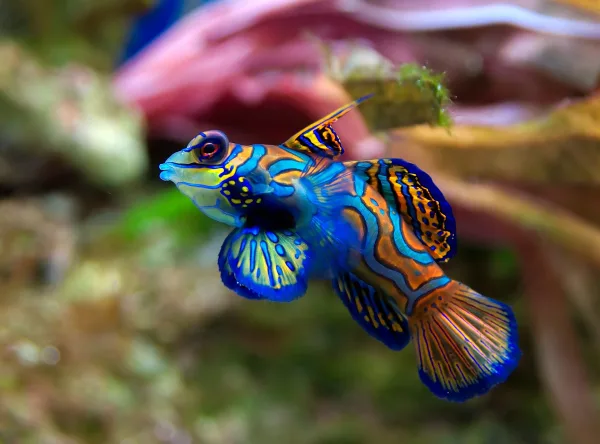
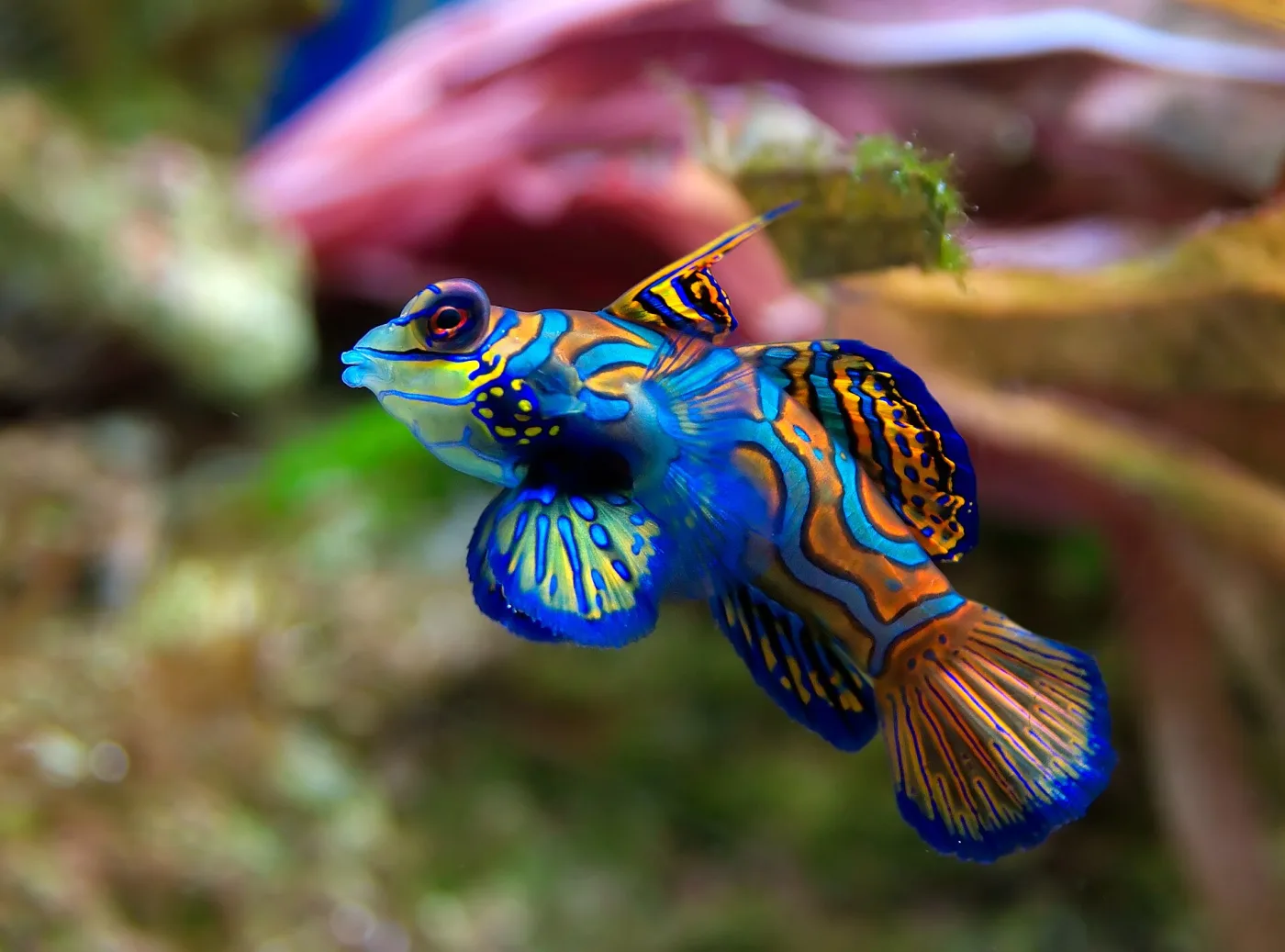
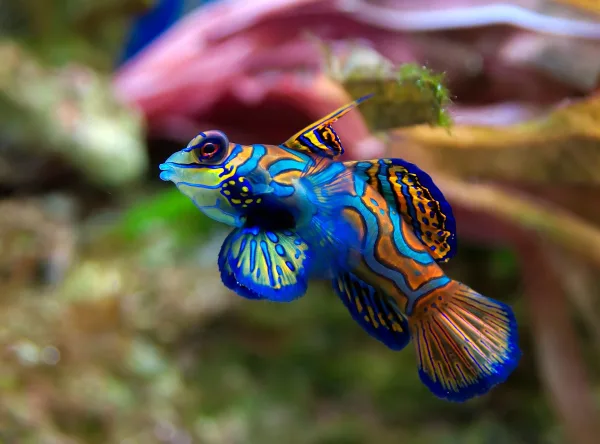
Mandarin Dragonet
Synchiropus splendidus
Also called Mandarinfish, Green Mandarin, Blue Mandarin, Mandarin Goby, Striped Mandarinfish, Psychedelic Mandarin, Striped Dragonet, Green Dragonet
- CareModerate
- Reef safeYes
- TemperamentPeacefulPeaceful; males fight other male mandarins
- Favorite foods
- Live copepods / amphipods
- Frozen mysis shrimp
- Enriched brine shrimp
- Max size3.5 in (8.9 cm)
- Min tank30 gal
- LifespanNo scientific data
- IUCN statusLeast Concern
Quick answers
- How big does the Mandarin Dragonet get?
- Up to 3.5 in (8.9 cm).
- What size tank does it need?
- At least 30 gallons.
- How hard is it to keep?
- Care level: Moderate.
- Is it reef safe?
- Yes. Completely safe with corals, clams and ornamental invertebrates.
- What does it eat?
- Live copepods / amphipods
- Frozen mysis shrimp
- Enriched brine shrimp
- How long does it live?
- No scientific data.
- What are good tankmates?
- Clownfish
- Firefish and dartfish
- Cardinalfish
- Royal gramma and other basslets
- Tangs (in larger tanks)
The 30-second version
The mandarin dragonet looks like someone painted it with swirls of blue, orange and green. Most blue animals are not really blue. They just bounce blue light back at you. This fish has real blue color in its skin, and only one other fish is known to do that. It has no scales. Instead it wears a coat of slime that smells bad and tastes awful, so most hunters leave it alone. People sometimes call it a goby, but it is not one. All day it scoots slowly over rocks. It pecks up tiny bugs called copepods, which are smaller than a grain of rice. That is the hard part about keeping one. Many mandarins will only eat these tiny live bugs. In a tank without enough of them, they can slowly starve. At sunset, a male and a female rise up together to let go of their eggs.
Water & care
Rated Expert because most mandarins in the trade are wild-caught and will eat little except live copepods and amphipods, so they slowly starve unless the tank holds a large, self-renewing pod population. That means a mature, rock-heavy tank (hobby guidance ranges from six months to over a year old), ideally with a fish-free refugium, regular reseeding with bottled live copepods, and no other pod-eating fish. Captive-bred, food-trained mandarins are much easier (closer to Moderate): they eat frozen foods and pellets, but they are slow, deliberate feeders that still need target-feeding and pods between meals. Check the belly before buying; a pinched belly means it is already starving. Keep one male per tank.
| Parameter | Keep it at | Where that sits on the usual reef range |
|---|---|---|
| Temperature | 75–80 °F | |
| Salinity (SG) | 1.020–1.026 | |
| pH | 8.1–8.4 | |
| Alkalinity | 8–12 dKH | |
| Nitrate | 0–20 ppm |
Bulk Reef Supply's care guide gives 75-80 °F, specific gravity 1.020-1.026, pH 7.7-8.5 and nitrate under 20 ppm; the pH range here is the usual reef target within that. The fish has no special calcium, magnesium or phosphate needs; set those for your corals. What matters most is a stable, mature system that can sustain copepods; never dose medications in the display, because they kill the pods it eats.
Feeding
DietCarnivore
Favorite foods
- Live copepods
- Live amphipods
- Frozen or live baby brine shrimp
- Fish roe (e.g. Nutramar Ova)
- Frozen mysis (some individuals)
- Small pellets such as New Life Spectrum (captive-bred fish)
- Cyclop-eeze
In the wild it pecks at tiny prey all day. Wild-caught fish often accept only live pods, so the tank itself must feed them. Captive-bred fish take frozen foods and small pellets: offer small amounts several times a day, in a feeding dish or by pipette near the rocks so faster fish cannot steal it, and keep reseeding live copepods. Watch the belly; it should look rounded, not pinched.
Tank & maintenance
- Minimum tank
- 30 gallons
- Aquascape
- Lots of mature live rock and rubble with crevices to forage over, plus a sand bed. A connected fish-free refugium with macroalgae (such as Chaetomorpha) breeds copepods and amphipods that wash into the display. Larger, rock-heavy systems support more pods; 30 gallons is the commonly cited minimum for one mandarin, and wild-caught fish are far safer in bigger, older systems.
- Lighting
- Any reef lighting. It is active by day and shelters in the rockwork at night.
- Water flow
- Moderate. It is a slow swimmer, so avoid blasting flow in its foraging areas, and cover pump and overflow intakes.
Routine upkeep
Check its body condition every day. Reseed live copepods every few weeks (more often in small tanks) or keep a productive refugium. Avoid over-cleaning rock and sand, which are pod habitat; siphon gently. Do normal partial water changes and keep conditions stable.
Temperament & tankmates
TemperamentPeaceful
Ignores other species. Males fight other males (from about 8 months old in captive-bred fish), so keep one male per tank; a male and female pair works. Females may attack smaller males when a pair is formed. Slow and timid, so it is easily outcompeted at feeding time rather than bullied outright.
Reef safeYes
Completely safe with corals, clams and ornamental invertebrates. The only reef issue is food: it eats the tank's copepods and amphipods, so it competes with other pod-eaters and can strip a small tank of pods.
Good tankmates
- Clownfish
- Firefish and dartfish
- Cardinalfish
- Royal gramma and other basslets
- Tangs (in larger tanks)
- Corals, clams, shrimp, snails and other reef invertebrates
Avoid
- Another male mandarin or spotted mandarin
- Other pod-eating fish in small tanks (scooter dragonets, other dragonets, pipefish, some small wrasses)
- Fast, aggressive feeders (dottybacks, damselfish, large wrasses) that take all the food
- Large predators that can swallow it
Help it thrive
- Buy captive-bred, food-trained mandarins whenever possible.
- Add it only to a mature tank with plenty of rock and a visible pod population; a refugium makes a big difference.
- Look for a rounded belly before buying and skip any fish with a pinched or sunken belly.
- Feed frozen foods in a feeding dish or by pipette so faster fish cannot steal them.
- Keep one male per tank and avoid other pod-hunting fish in small systems.
Common ailments
Starvation (wasting)
- Signs
- Pinched or sunken belly, thin body when seen from above, slower movement, lethargy.
- Prevention
- Captive-bred, food-trained fish; a mature, rock-heavy tank with a refugium; regular copepod reseeding; no competing pod-eaters.
- Treatment
- Act early: move it to a pod-rich system or refugium, add live copepods and amphipods, offer enriched live baby brine shrimp, and keep trying frozen foods. Advanced wasting is often fatal.
Marine ich (Cryptocaryon irritans) and gill parasites
- Signs
- White spots (fewer than on scaled fish), rapid breathing, scratching.
- Prevention
- Its thick slime makes it resistant but not immune; quarantine in a tank already stocked with live pods so it can eat.
- Treatment
- Treat in a separate hospital tank, never the reef. Hobbyists widely report that dragonets tolerate copper and formalin poorly, and chloroquine phosphate kills copepods, so get experienced advice before medicating and make sure it can still eat during treatment.
Fin damage from fighting males
- Signs
- Torn or nipped fins, one fish hiding, chasing over the rockwork.
- Prevention
- Keep only one male per tank (or a male-female pair).
- Treatment
- Separate the fish; nipped fins usually heal in clean water. Watch for bacterial infection.
This is general hobby guidance, not veterinary advice. Quarantine new arrivals and treat in a separate tank whenever you can.
Risks of owning one
- Starvation: wild-caught mandarins commonly starve slowly in tanks without a large, self-renewing pod population.
- Competition: other pod-eating fish can strip the tank of food.
- Its slime is foul-smelling and contains toxins to deter predators; move it with a cup or net and wash your hands afterward.
- Medicating the display kills the copepods it depends on, and dragonets are reported to tolerate copper and formalin poorly.
- Two males in one tank will fight.
- Buying wild-caught fish adds to collection pressure; captive-bred fish avoid this.
Breeding
DifficultyHard Captive-bredWidely available
Pairs spawn readily in aquaria at dusk, often within about 10 minutes of the lights going out and every one to three nights: the male displays, the pair rises together, and eggs and sperm are released into the water. The eggs are pelagic, colourless and about 1 mm across; one hobby report gives incubation of 1-2 days at about 80 °F, producing larvae about 1.5 mm long. The hard part is first food: in trials at James Cook University, larvae fed only rotifers had under 6% survival at 11-12 days, while co-feeding Parvocalanus crassirostris copepods at 1-2 per mL gave about 50%. ORA began breeding mandarins in 2009 and sold captive-bred, pellet-trained fish from 2010.
- Pick a large male and a noticeably smaller female and condition them well; females may attack small or similar-sized males.
- Run a 12-14 hour photoperiod with a dawn and dusk period; pairs spawn at or just after lights-out.
- Collect the floating eggs after spawning (an overflow egg trap or skimming the surface) and move them to a hatching container.
- Expect hatching in about 1-2 days at around 80 °F.
- Feed larvae copepod nauplii (Parvocalanus crassirostris) at 1 or more per mL from first feeding; rotifers alone give very poor survival.
- Wean settled juveniles onto baby brine shrimp, fish roe and fine frozen foods, then small pellets, as ORA does.
Deep dive The science, history and family tree
The science
Synchiropus splendidus is a small dragonet (Callionymidae) reaching about 7 cm total length. The body is fusiform, broad-headed and scaleless, with 4 dorsal spines and 8 soft dorsal rays and 6-8 soft anal rays; the large pelvic fins are used to walk over the bottom. Its colouration is a maze of blue, green and orange bands, with a greenish-blue face striped in blue and usually red eyes. The blue comes from pigment cells called cyanophores; with the spotted mandarin (S. picturatus) it is one of only two vertebrates known to have cellular blue pigment rather than structural blue. Males are larger than females and have an elongated first dorsal spine. The skin has two types of secretory cells, one making a thick mucus coat and one making toxins; the slime is foul-smelling and bitter and is thought to deter predators, which may make the bright colours a warning signal. The species occurs in the western Pacific from the Ryukyu Islands to Australia, in shallow, sheltered lagoons and inshore reefs at 1-18 m, usually over silty bottoms with coral and rubble, where small groups live spread over a small area. It forages continuously by day, picking harpacticoid copepods, gammarid amphipods, polychaete worms, small snails, ostracods and fish eggs from the substrate. At dusk males court females, and a pair rises together toward the surface to release pelagic eggs; males may spawn with several females in an evening. It is assessed as Least Concern by the IUCN and is widely collected for the aquarium trade.
- Appearance
- Small, round-bodied fish with a broad, flat head, red eyes, no scales, and a swirling maze of electric blue or green and orange bands. Males have a tall, spiky first dorsal fin and are larger. Colour forms in the trade: the usual green or 'blue' form; a 'red' form with red pelvic fins and red instead of orange; and rare all-red fish. Look-alikes: the spotted, target or psychedelic mandarin (Synchiropus picturatus) is grey-green covered in ringed spots; scooter dragonets (Neosynchiropus ocellatus, often sold as 'scooter blennies') are mottled and lack the blue and orange maze. Despite the name 'mandarin goby', it is not a goby.
- Native range
- Western Pacific: from the Ryukyu Islands (Japan) south through the Philippines and Indonesia to Australia. The type locality is Bungau, Sulu, Philippines.
- Habitat
- Shallow, protected lagoons and inshore reefs at 1-18 m, typically over silty bottoms among coral rubble and branching coral. Lives in small groups spread over a small area, foraging over rubble by day and sheltering in it at night. Courtship and spawning take place at sunset just above the rubble.
- Size
- 3.5 in (8.9 cm). FishBase gives 7 cm (2.8 in) total length; Wikipedia gives about 6 cm and Reef Builders about 2.5 in as typical. Some retailers quote up to 3-4 in, which is larger than recorded maxima. Males grow larger than females.
- Lifespan
- No scientific data. Wild-caught fish often starve within months in tanks without enough live food; well-fed fish in mature systems are reported by hobbyists to live many years, with estimates ranging from about 6 to over 10 years.
- Conservation
- Least Concern. IUCN Least Concern (assessed 2018). Not listed by CITES or CMS. Most aquarium mandarins are still wild-collected in the western Pacific, and a 2010 Reef Builders article on ORA's captive-bred release repeated claims of localised population problems from collection, without data. Captive-bred fish have been sold since 2010 and are the more sustainable choice
In the aquarium vs in the wild
In your aquarium
A showpiece fish for mature reef tanks, prized for its colour and 'walking' behaviour. It does no algae or pest control.
On the reef
A small predator of copepods, amphipods, worms and tiny snails in coral rubble, and part of the rubble food web; its floating eggs are eaten by cardinalfish and damselfish.
History
Albert W. Herre described the species in 1927 as Callionymus splendidus in the Philippine Journal of Science, from a specimen collected at Bungau in the Sulu Islands, Philippines; the holotype is presumed destroyed. It was later moved to Synchiropus, and some authors have placed it in Neosynchiropus or Pterosynchiropus; WoRMS and FishBase currently use Synchiropus splendidus, and some classifications keep Pterosynchiropus as a subgenus. The common name comes from its colours, which recall the robes of an Imperial Chinese mandarin. It has appeared on postage stamps from Laos (1987) and Micronesia (1993). In the aquarium hobby it has long been a famous 'beautiful but difficult' fish because of its live-food diet. Goda and Fujii described its blue pigment cells in 1995, and Sadovy, Randall and Rasotto studied its toxic skin secretions in 2005. ORA started breeding it in 2009 and sold the first captive-bred, pellet-trained fish in 2010, and researchers at James Cook University later showed that copepods are key to raising its larvae.
Evolution & relatives
Despite the nickname 'mandarin goby', the mandarin is a dragonet, not a goby. Dragonets (Callionymidae) and their deep-water cousins, the Draconettidae, form a small group of scaleless, bottom-living fishes. WoRMS lists them in their own order, Callionymiformes, while phylogenomic studies (for example Longo and colleagues, 2017) place them in an expanded Syngnathiformes alongside seahorses, pipefishes, goatfishes, flying gurnards and seamoths. On a tree of life the mandarin therefore sits far from gobies and firefish (Gobiiformes); the resemblance is convergence on a small, bottom-dwelling lifestyle. Within Synchiropus it belongs to the subgenus Pterosynchiropus with the spotted mandarin (S. picturatus) and S. occidentalis, and it shares its rare blue pigment cells with the spotted mandarin. Dragonet fossils are scarce: otoliths of Callionymus are known from the Middle Eocene, and Protonymus from the Middle Miocene of southern Russia is among the most primitive dragonet skeletons.
Family tree, from kingdom down
- Kingdom Animalia Animals Animals are living things made of many cells that must eat food to live. Fish, corals, crabs, snails and sea stars are all animals.
- Phylum Chordata Chordates Chordates have a stiff rod running down their back at some point in their lives. In fish and people, this rod is replaced by a backbone.
- Subphylum Vertebrata Vertebrates Vertebrates are animals with a backbone and a skull. Fish, frogs, birds and people are all vertebrates.
- Infraphylum Gnathostomata jawed vertebrates
- Parvphylum Osteichthyes bony fishes
- Gigaclass Actinopterygii ray-finned fishes
- Superclass Actinopteri
- Class Teleostei Teleost fishes Teleosts are bony fishes with thin, bendy fin rays and jaws that can push forward. Almost all of the fish in the world are teleosts.
- Order Callionymiformes Dragonets and kin Dragonets are small, bottom-living fish with big heads and no scales. Many are very colorful, like the mandarin.
- Family Callionymidae Dragonets Dragonets are small fish with big heads and slimy skin instead of scales. They hop along the bottom picking up tiny animals.
- Genus Synchiropus Synchiropus dragonets These dragonets are small and slow and pick tiny animals off rocks and sand. The bright mandarin dragonet belongs here.
- Species Synchiropus splendidus
See it on the Tree of Life Compare with another species
Closest relatives
- Synchiropus picturatus Spotted Mandarin Same genus and subgenus (Pterosynchiropus); the only other fish known with blue pigment cells
- Synchiropus stellatus Starry Dragonet Same genus; Indian Ocean species
- Neosynchiropus ocellatus Ocellated Dragonet (Scooter Dragonet) Same family (Callionymidae); FishBase still lists it as Synchiropus ocellatus
- Callionymus lyra Common Dragonet Same family; northeast Atlantic species
Older scientific names: Pterosynchiropus splendidus, Neosynchiropus splendidus, Callionymus splendidus.
Fun facts
- It is one of only two vertebrates known to make blue with pigment cells (cyanophores); the other is its cousin the spotted mandarin.
- It has no scales. Its slimy, foul-smelling coat contains toxins that make predators think twice.
- Its name comes from the brightly coloured silk robes of Imperial Chinese officials, the mandarins.
- It is not a goby: DNA studies put dragonets closer to seahorses and pipefishes than to gobies.
- Divers in Lembeh Strait, Indonesia, watch mandarins spawn at sunset using red lights, because white light makes them abort the ritual.
- Laos (1987) and Micronesia (1993) have both put it on postage stamps.
Learn more
- FishBase: Synchiropus splendidus fishbase.se
- WoRMS taxon record marinespecies.org
- Wikipedia: Synchiropus splendidus en.wikipedia.org
- Reef Builders: Green mandarinfish overview reefbuilders.com
- TFH Magazine: Breeding Mandarins (Wittenrich) tfhmagazine.com
Sources
- FishBase: Synchiropus splendidus summary fishbase.se
- WoRMS: Synchiropus splendidus (Herre, 1927) marinespecies.org
- Wikipedia: Synchiropus splendidus en.wikipedia.org
- Wikipedia: Callionymidae en.wikipedia.org
- Australian Geographic: Beware of the beautiful but poisonous mandarinfish australiangeographic.com.au
- LiveAquaria: Green Mandarin liveaquaria.com
- Bulk Reef Supply: How to care for mandarin dragonets bulkreefsupply.com
- Reef Builders: Green mandarinfish overview (2013) reefbuilders.com
- Reef Builders: ORA releasing captive-bred mandarins (2010) reefbuilders.com
- Reef Builders: Watch mandarin dragonets spawning in the wild (2017) reefbuilders.com
- ORA: Blue Mandarin (captive-bred) orafarm.com
- TFH Magazine: Breeding Mandarins (Wittenrich) tfhmagazine.com
- Breeder's Registry spawning report SYNSPL-010299 breedersregistry.org
- Zeng et al. 2018, copepods as live feed for green mandarin larvae (Aquaculture 491) researchonline.jcu.edu.au
- Shao & Zeng 2020, larval green mandarin feeding (Aquaculture 520) researchonline.jcu.edu.au
Care facts
The care facts on this guide and its product pages (care level, reef safety, temperament, size, tank, diet, flow, purpose, foods, acclimation and origin) combine 13 independent sources, checked October 25, 2026.
- Synchiropus splendidus summary FishBase
- Mandarin Goby New England Aquarium
- How to Care for Mandarin Dragonets Bulk Reef Supply
- ORA Blue Mandarin Dragonet Bulk Reef Supply (ORA captive-bred product)
- Green Mandarin Dragonet Care Guide Top Shelf Aquatics
- Mandarin - Blue/Green (Captive Bred) Dr. Reef's Quarantined Fish
- Mandarin Dragonet Care Guide - Synchiropus splendidus Reef Archive
- Mandarin Fish [Dragonet Care, Tank Mates, & Tank Size] Fishkeeping World
- Mandarin Goby (Synchiropus splendidus) Aquarium Source
- Mandarin Goby Aquariadise (Alison Page)
- How to look after dragonets / mandarin fish OATA
- Mandarin Dragonet Care Guide: Feeding, Copepods and Tank Requirements Gensou Premium Aquascaping
- Mandarin Dragonet AlgaeBarn
Scientific names and classification follow the World Register of Marine Species (AphiaID 273264). Last updated October 25, 2026.
Shop this species
Search the shop →Sold out right now. We restock weekly, so check back soon.
Sold out
Aquacultured
 Sold out