 Sold out
Invertebrates · Starfish
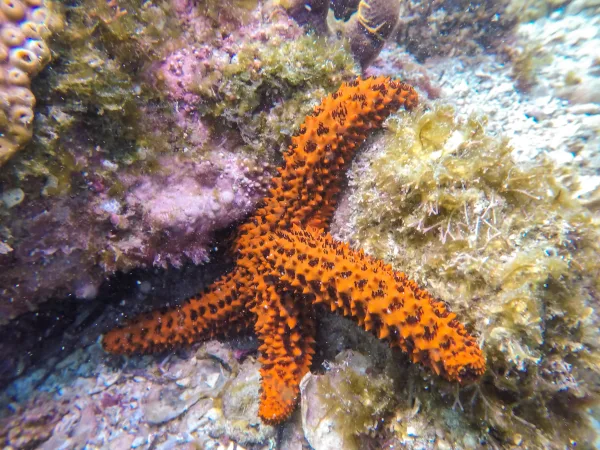
Knobby Starfish
Echinaster (Othilia) echinophorus
Also called Knobby Red Starfish, Orange Knobby Star, Caribbean Knobby Sea Star, Red Thorny Starfish, Red Thorny Sea Star, Red Knob Sea Star, Thorny Sea Star, Florida Knobby Starfish
- CareModerate
- Reef safeWith caution
- TemperamentPeacefulIgnores fish; eats sponges and may eat clams
- Favorite foods
- Sponges (natural diet)
- Meaty foods: shrimp, krill
- Algae film and detritus
- Max size3 in (7.6 cm)
- Min tank55 gal
- LifespanUnknown
- IUCN statusNot Evaluated
Quick answers
- How big does the Knobby Starfish get?
- Up to 3 in (7.6 cm).
- What size tank does it need?
- At least 55 gallons.
- How hard is it to keep?
- Care level: Moderate.
- Is it reef safe?
- With caution. Ratings disagree: That Pet Place says reef safe, KP Aquatics says not reef safe, and Wet Web Media reports it as reef safe but short lived.
- What does it eat?
- Sponges (natural diet)
- Meaty foods: shrimp, krill
- Algae film and detritus
- How long does it live?
- Unknown.
- What are good tankmates?
- Peaceful fish
- Mature reef or fish-only tanks with lots of live rock
- Most corals, with observation
The 30-second version
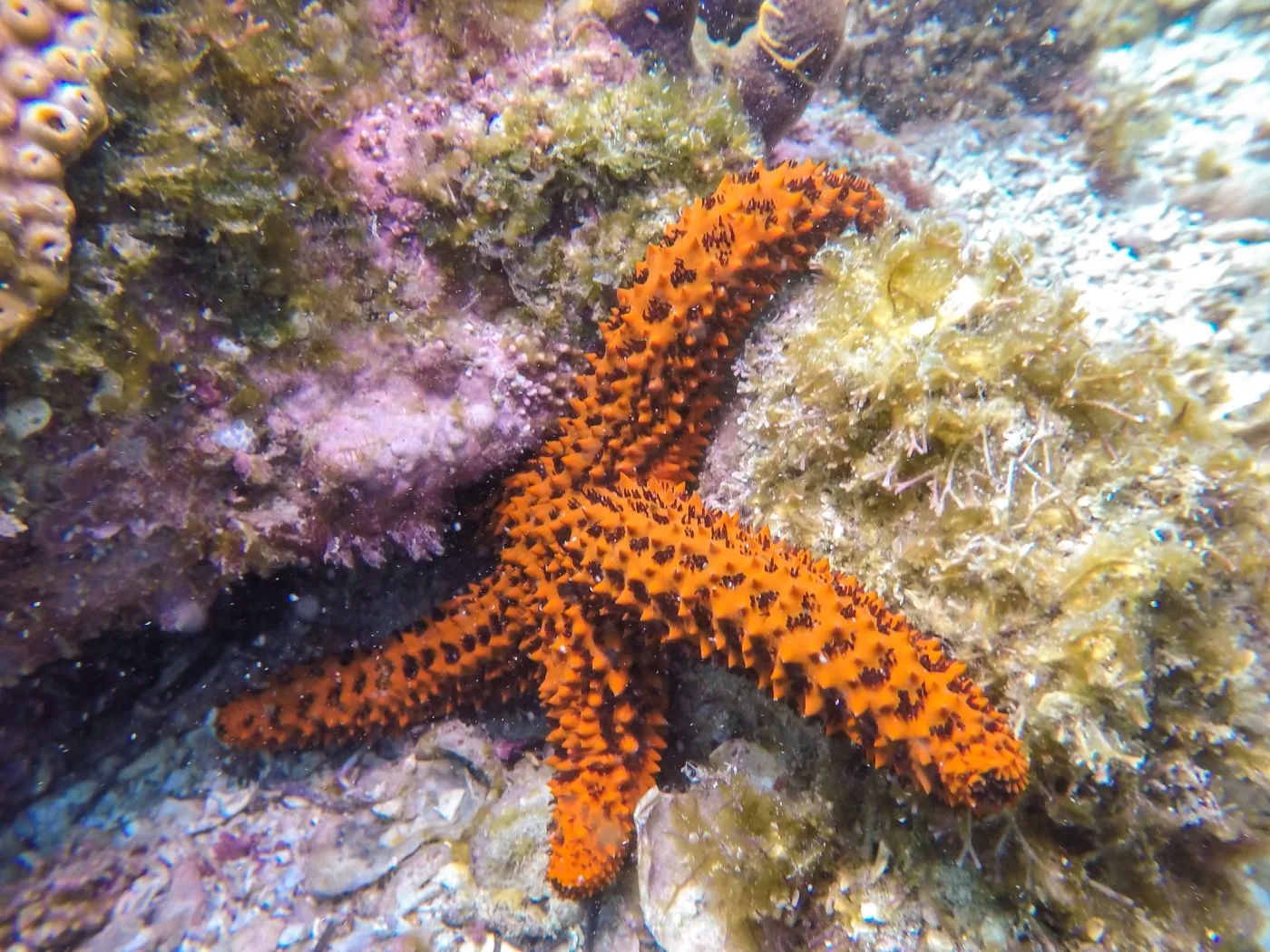
The knobby starfish is a small sea star. It is bright red or orange. It has five fat arms with round tips. Rows of little bumps run along the top of each arm. That is why people call it knobby. It grows to about the size of a big cookie. It lives in warm seas near Florida, the islands of the Caribbean and South America. It crawls over rocks, reefs and the roots of mangrove trees. Its main food in the wild is sponges. A sponge is a soft animal that sticks to rocks. A fish tank has few sponges, so this star can go hungry. It may also eat a clam or a small crab. It needs a big tank that has been set up for a long time. Move it into a new tank very slowly.
Water & care
Sellers rate it from easy (Quality Marine, Whitecorals) to moderate (That Pet Place, Meerwasser-Lexikon, Salty Underground), but Wet Web Media's crew report a poor survival rate in captivity, most likely because its natural food is sponges. Give it a large, mature tank with plenty of live rock that is 'not too clean' (Whitecorals) and offer small meaty foods; keepers report that it accepts meaty food in captivity. It is very sensitive to quick changes in salinity, temperature and pH and to copper medications.
| Parameter | Keep it at | Where that sits on the usual reef range |
|---|---|---|
| Temperature | 75–82 °F | |
| Salinity (SG) | 1.023–1.025 | |
| pH | 8.1–8.4 | |
| Alkalinity | 8–12 dKH |
That Pet Place gives 75-82 F, SG 1.022-1.026 and pH 8.0-8.4; Quality Marine gives 72-78 F, SG 1.023-1.025, pH 8.1-8.4 and 8-12 dKH; Meerwasser-Lexikon gives 26-28 C (79-82 F). Stability matters more than the exact numbers: starfish cannot adjust to quick changes, so match new water closely at every water change. Calcium, magnesium and nutrients are not species-specific and are left blank. No copper.
Feeding
DietOmnivore
Favorite foods
- Sponges (natural diet)
- Small meaty foods such as shrimp or krill
- Algae film and detritus on live rock
In the wild it eats sponges, which most aquariums cannot supply. Let it graze on mature live rock, and offer a small piece of thawed shrimp, krill or other meaty seafood next to one arm about once a week, as a KP Aquatics customer reports doing. Salty Underground notes that small specimens graze algae and larger ones accept krill. Keep an eye on its body: thinning arms and a softer body suggest it is not finding enough food.
Tank & maintenance
- Minimum tank
- 55 gallons
- Aquascape
- Mature live rock with plenty of grazing surface, ideally with natural sponge growth. Whitecorals advises a tank as large as possible, well established and not too clean; Meerwasser-Lexikon recommends at least 240 litres (63 gal) and Whitecorals 300 litres (79 gal), while US sellers say 30 gallons.
- Lighting
- No needs of its own.
- Water flow
- No source gives a flow preference; in the wild it lives on reefs, rubble, hard bottoms and mangrove roots.
Routine upkeep
Check daily that it is moving and its arms are full, and check its condition weekly. Keep salinity steady with daily top-off and match temperature and salinity at water changes. Target-feed a small meaty item about once a week, and never dose copper in its tank.
Temperament & tankmates
TemperamentPeaceful
Peaceful toward fish (That Pet Place: aggressiveness low, community safe; Quality Marine: social). Its only 'aggression' is predation on sponges and, at times, clams, crabs or small urchins.
Reef safeWith caution
Ratings disagree: That Pet Place says reef safe, KP Aquatics says not reef safe, and Wet Web Media reports it as reef safe but short lived. No page we opened reports it eating corals, but its natural prey is sponges, and keepers report it eating a crab, a small urchin and possibly a clam. Keep it away from ornamental sponges, clams and other small sessile or slow invertebrates, and watch it closely in a reef.
Good tankmates
- Peaceful fish
- Mature reef or fish-only tanks with lots of live rock
- Most corals, with observation
Avoid
- Ornamental sponges
- Clams
- Small crabs and urchins
- New or unstable tanks
- Copper-treated systems
Help it thrive
- Add it only to a large, mature tank with plenty of live rock.
- Acclimate very slowly and keep salinity, temperature and pH steady.
- Offer a small piece of shrimp or krill near an arm about once a week.
- Keep it away from ornamental sponges and clams.
- Confirm the species before buying: several different stars are sold as 'knobby starfish'.
Common ailments
Starvation
- Signs
- Arms become thin and soft, the body shrinks and the star moves less, over weeks to months.
- Prevention
- A large, mature tank with plenty of live rock and weekly meaty food.
- Treatment
- Target-feed small meaty foods next to it; if it keeps declining, move it to a larger, more mature system.
Acclimation and water-change shock
- Signs
- Limp body, curled arms and no movement after arrival or after a large water change.
- Prevention
- Very slow acclimation, and new water matched closely to the tank water (That Pet Place).
- Treatment
- Keep it in stable water and avoid further handling; there is no medication.
Copper poisoning
- Signs
- Weakness, loss of grip and tissue breakdown after a tank was medicated.
- Prevention
- Never use copper-based medications in a tank with starfish (Salty Underground, Quality Marine); treat fish in a separate tank.
- Treatment
- Move the star to clean, matched water and remove copper from the display with carbon or resin and water changes.
This is general hobby guidance, not veterinary advice. Quarantine new arrivals and treat in a separate tank whenever you can.
Risks of owning one
- May eat ornamental sponges, clams, small crabs or urchins.
- Poor survival record in captivity; it may slowly starve.
- Copper and many fish medicines cannot be used in its tank.
- The trade name 'knobby starfish' covers several different stars, so care sheets may describe the wrong animal.
Breeding
DifficultyNot achieved Captive-bredRare or wild-caught
Not bred in aquariums, and not available captive-bred (Meerwasser-Lexikon); all trade specimens are wild-collected. In Florida it spawns in late spring and early summer. As summarized on Wikipedia from Atwood (1973), it produces two kinds of eggs, dark planktonic ones and bright orange ones that sink; the sinking eggs develop into modified brachiolaria larvae that attach with a sucker and have two pairs of tube feet by day seven.
- No captive breeding protocol exists for this species.
- All specimens in the trade are wild-collected.
Deep dive The science, history and family tree
The science
Echinaster (Othilia) echinophorus (Lamarck, 1816) is a small western Atlantic sea star of the family Echinasteridae (order Spinulosida). It has a small central disc and five spatulate arms that taper very little, end in rounded tips and are oval in cross-section. The upper surface carries one or two rows of blunt, conical spines along each arm, with more spines on the sides and underside, and the colour is usually red or orange. Most references give a diameter of up to about 7 cm; one retailer quotes about 10 cm. It ranges from Florida, the Bahamas and the Gulf of Mexico through the Caribbean to Venezuela and northern Brazil. Published depth ranges differ: 24-73 m (Wikipedia, Meerwasser-Lexikon) and 0-55 m (SeaLifeBase, which records it on sandy, algae-covered sediment, in mangroves and on hard bottoms); it also occurs on reefs, rock and coral rubble.
It is a sponge predator. In feeding assays with stars from the Bahamas, Waddell and Pawlik (2000) found that it ate the tissue of several mangrove and reef sponges and that only a few sponge extracts deterred it; it is reported to avoid the red tree sponge, Haliclona compressa. In Florida it spawns in late spring and early summer, and its larval development was described by Atwood (1973). A crude extract of its tissue showed activity against the Leishmania parasite in laboratory tests (García Parra et al. 2010). NatureServe ranks it G3G4 (vulnerable to apparently secure).
- Appearance
- A small, stiff, bright red to orange star with five fairly fat, round-tipped arms and one or two rows of blunt, knob-like spines along the top of each arm. Look-alikes: Florida's Echinaster sentus and E. spinulosus (sold as small-spined or common sea stars) are also orange-red but have smaller spines; the red knob starfish (Protoreaster linckii) has a thick gray body with red knobs joined by red lines and grows to about a foot; the chocolate chip or horned star (Protoreaster nodosus), sold dried as 'knobby starfish' in the curio trade, is a large Indo-Pacific star; and the Bahama or cushion star (Oreaster reticulatus) is a big, thick star that may not be harvested or sold in Florida (FWC).
- Native range
- Tropical western Atlantic: Florida, the Gulf of Mexico, the Bahamas, Cuba, Jamaica, Belize, Nicaragua and the wider Caribbean, south to Venezuela and northern Brazil. Aquarium specimens are imported from the Caribbean, for example Haiti (KP Aquatics).
- Habitat
- Reefs, rock, coral rubble, hard bottoms, sandy algae-covered sediment and mangroves, at depths quoted as 0-55 m (SeaLifeBase) or 24-73 m (Wikipedia, Meerwasser-Lexikon), in water of about 26-28 C. It feeds on sponges growing on mangrove roots and reefs.
- Size
- 3 in (7.6 cm). Wikipedia and Meerwasser-Lexikon give a diameter of up to 7 cm (2.8 in), Whitecorals about 10 cm and That Pet Place 3 in. Quality Marine's 12 in and Salty Underground's 8 in (for a 'Florida Knobby Starfish' with no scientific name) look like generic or misapplied figures.
- Lifespan
- Unknown. Wet Web Media's crew describe a poor survival rate in captivity and call it short lived; no figures are published.
- Conservation
- Not Evaluated. Not evaluated by the IUCN Red List and not CITES-listed (SeaLifeBase, Meerwasser-Lexikon). NatureServe ranks it G3G4, rounded to G3 (vulnerable), last reviewed in 2014. All trade specimens are wild-collected
In the aquarium vs in the wild
In your aquarium
A colorful display star for mature reef or fish-only tanks; it grazes some film and detritus but is not a clean-up crew animal.
On the reef
A sponge predator on Caribbean reefs, rubble and mangrove roots. Feeding assays show it eats many mangrove and reef sponges, and scientists use it to test which sponge chemicals deter predators.
History
Jean-Baptiste de Lamarck described the species in 1816 in the genus Asterias; the parentheses around his name show that it was later moved, and WoRMS now places it in Echinaster, subgenus Othilia. Older names include Asterias echinophora, Asterias spinosa, Stellonia spinosa and Echinaster crassispina. David G. Atwood described its larval development in 1973, Waddell and Pawlik used it in 2000 to test how Caribbean sponges defend themselves against sea stars, and in 2010 García Parra and colleagues reported that a crude extract of the star was active against Leishmania. In the aquarium trade it arrives from the Caribbean (for example Haiti) under names such as red thorny star, red knob sea star and knobby red starfish; Wet Web Media answered an identification question about a 'red thorny/knobby star' in 2007. The name 'knobby starfish' is also used for unrelated Indo-Pacific stars, especially Protoreaster nodosus in the dried-curio trade, which causes confusion.
Evolution & relatives
Sea stars (Asteroidea) are echinoderms, related to sea urchins, brittle stars and sea cucumbers. WoRMS places Echinaster in the family Echinasteridae, order Spinulosida, superorder Spinulosacea, and puts this species in the subgenus Othilia together with Florida's Echinaster sentus. The big 'knobby' stars that share its trade name, Protoreaster and Oreaster, belong to a different order (Valvatida, family Oreasteridae), so the resemblance is only skin deep. Waddell and Pawlik (2000) found that E. echinophorus and E. sentus ranked reef sponges in the same order of preference, a sign that the sponge diet is shared within the genus.
Family tree, from kingdom down
- Kingdom Animalia Animals Animals are living things made of many cells that must eat food to live. Fish, corals, crabs, snails and sea stars are all animals.
- Phylum Echinodermata Echinoderms Echinoderms are sea animals whose bodies are usually built in five matching parts. They move on hundreds of tiny tube feet, and many have spiny skin.
- Subphylum Asterozoa Sea stars and brittle stars These echinoderms have star-shaped bodies with arms spreading out from the middle. The group includes sea stars and brittle stars.
- Class Asteroidea Sea stars Sea stars, or starfish, usually have five arms joined to a central disc. Most can grow back an arm they lose.
- Subclass Ambuloasteroidea
- Infraclass Neoasteroidea
- Superorder Spinulosacea
- Order Spinulosida
- Family Echinasteridae
- Genus Echinaster
- Subgenus Echinaster (Othilia)
- Species Echinaster (Othilia) echinophorus
See it on the Tree of Life Compare with another species
Closest relatives
- Echinaster (Othilia) sentus Florida common or small-spined sea star Same subgenus; Florida look-alike that also eats sponges
- Echinaster spinulosus Small-spined sea star Same genus; sold with E. sentus as 'Echinaster spinulosus/sentus'
- Echinaster luzonicus Luzon star Same genus; Indo-Pacific aquarium species
- Protoreaster nodosus Chocolate chip or horned sea star Different order (Valvatida); shares the 'knobby starfish' name in the curio trade
- Protoreaster linckii Red knob starfish Different order (Valvatida); sold as 'red knobby starfish'
- Oreaster reticulatus Bahama or cushion sea star Different order (Valvatida); Caribbean, protected in Florida
Older scientific names: Echinaster echinophorus, Asterias echinophora, Asterias spinosa, Echinaster (Othilia) crassispina, Stellonia spinosa.
Fun facts
- Its main food is sponges, animals packed with tiny glassy spikes that many predators avoid.
- Chemicals from one sponge that put off fish and hermit crabs do not stop this star from eating it.
- It lays two kinds of eggs: dark ones that drift and bright orange ones that sink.
- An extract from its body worked against the Leishmania parasite in lab tests.
- At least four different starfish are sold as 'knobby', so the scientific name matters.
Learn more
- Wikipedia: Orange knobby star en.wikipedia.org
- Meerwasser-Lexikon: Echinaster (Othilia) echinophorus (German) meerwasser-lexikon.de
- Wet Web Media: Sea star compatibility FAQs wetwebmedia.com
- WoRMS: Echinaster (Othilia) echinophorus marinespecies.org
Sources
- WoRMS taxon record 178748 (via reefid taxonomy) marinespecies.org
- Wikipedia: Orange knobby star (morphology, range, depth, diet, reproduction) en.wikipedia.org
- Meerwasser-Lexikon: Echinaster (Othilia) echinophorus meerwasser-lexikon.de
- SeaLifeBase: Echinaster echinophorus sealifebase.se
- Waddell & Pawlik 2000, Defenses of Caribbean sponges against invertebrate predators II (MEPS 195: 133-144), abstract int-res.com
- Wet Web Media: Sea star compatibility FAQs wetwebmedia.com
- That Pet Place: Red Thorny Starfish thatpetplace.com
- Whitecorals: Caribbean Knobby Sea Star whitecorals.com
- Quality Marine: Red Knob Sea Star (Echinaster echinophorus) qualitymarine.com
- KP Aquatics: Knobby Red Starfish kpaquatics.com
- Salty Underground: Florida Knobby Starfish saltyunderground.com
- NatureServe Explorer: Echinaster echinophorus (Thorny Sea Star) explorer.natureserve.org
- FWC: Bahama Seastar, prohibited species myfwc.com
- LiveAquaria: Red Knob Sea Star (Protoreaster linckii, look-alike) liveaquaria.com
Care facts
The care facts on this guide and its product pages (care level, reef safety, temperament, size, tank, diet, flow, purpose, foods, acclimation and origin) combine 9 independent sources, checked October 25, 2026.
- Red Thorny Starfish - Echinaster echinophorus That Pet Place
- Red Knob Sea Star (Echinaster echinophorus), item 59029 Quality Marine
- Echinaster echinophorus - Caribbean Knobby Sea Star Whitecorals
- Echinaster (Othilia) echinophorus - Dornenseestern Meerwasser-Lexikon
- Knobby Red Starfish KP Aquatics
- Sea Star Compatibility FAQs (incl. 'Red Thorny/Knobby Star (Echinaster echinophorus) Best Left in the Ocean', 2007, and 'Orange Knobby Starfish', 2012) Wet Web Media (Bob Fenner and crew)
- Waddell & Pawlik 2000. Defenses of Caribbean sponges against invertebrate predators. II. Assays with sea stars. Mar Ecol Prog Ser 195: 133-144 Inter-Research (Marine Ecology Progress Series)
- Florida Knobby Starfish Salty Underground
- Echinaster echinophorus, Caribbean sea star SeaLifeBase
Scientific names and classification follow the World Register of Marine Species (AphiaID 178748). Last updated October 25, 2026.
Shop this species
Search the shop →Sold out right now. We restock weekly, so check back soon.
Sold out
 Sold out