 Only 2 left
Invertebrates · Snail
Horse Conch
Triplofusus giganteus
Also called Florida Horse Conch, Giant Horse Conch, Horse Conch Snail
- CareExpert
- Reef safeNo
- TemperamentSemi-aggressivePredator: eats snails, hermit crabs, even its own kind
- Favorite foods
- Live snails (whelks, tulips)
- Clams / bivalves
- Meaty foods
- Max size24 in (60 cm)
- Min tank200 gal
- LifespanShell growth analysis
- IUCN statusNot Evaluated
Quick answers
- How big does the Horse Conch get?
- Up to 24 in (60 cm).
- What size tank does it need?
- At least 200 gallons.
- How hard is it to keep?
- Care level: Expert.
- Is it reef safe?
- No. No source reports it eating corals, but it hunts the animals a reef tank depends on: snails, clams and other bivalves, and (in captivity) small hermit crabs.
- What does it eat?
- Live snails (whelks, tulips)
- Clams / bivalves
- Meaty foods
- How long does it live?
- Shell growth analysis (Herbert et al.
- What are good tankmates?
- A species-only tank
- Fish-only systems with fish too big and fast for it to catch
- Other large predatory animals that do not eat snails
The 30-second version
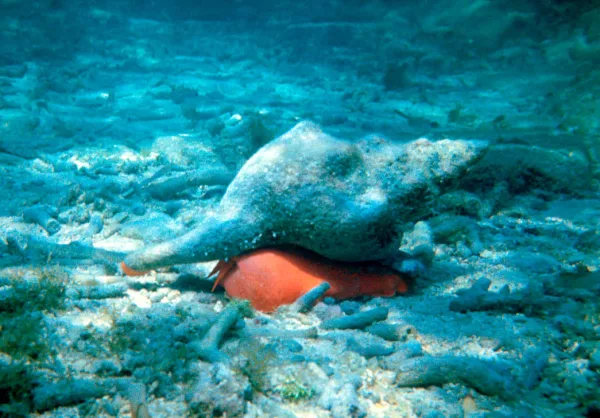
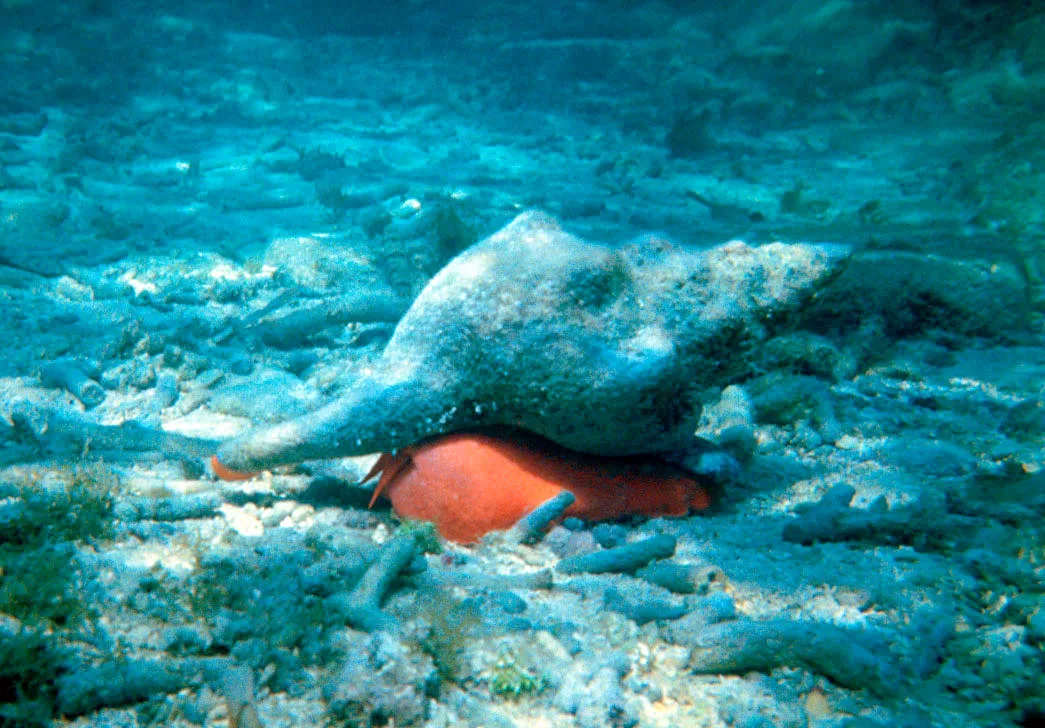
The horse conch is one of the biggest snails in the world. A grown-up shell can be about two feet long, longer than your arm from elbow to fingertips. It lives in warm, shallow water along the coast of the southern United States and Mexico, on sand and in sea grass. Baby horse conchs have bright orange shells, and the soft body stays orange-red its whole life. The horse conch is a hunter. It creeps up on other snails, wraps them in its big orange foot and eats them. It also eats clams, and in tanks it has eaten small hermit crabs. That makes it a bad pick for a tank full of clean-up snails, because it would eat them. A horse conch grows slowly and can live more than ten years. Florida chose it as its state shell.
Water & care
Not a beginner animal and, according to the Meerwasser-Lexikon, not really suited to aquariums at all. The main problems are size and food: a juvenile grows into a 1-2 ft predator, and one retailer lists a 200-gallon minimum and recommends a species-only or fish-only tank. It must be fed: in the wild it eats other large snails and bivalves, and a retailer lists other snails and meaty foods. Without enough food it can starve or turn cannibal. No species-specific acclimation advice was found; acclimate it slowly as you would other marine snails, and give it open sand to roam and dig in.
No species-specific water parameters were found from a retailer or care guide. The Meerwasser-Lexikon lists 25 C (77 F). It is a subtropical to tropical animal (SeaLifeBase: 35 N to 17 N) of shallow flats and coastal lagoons that also enters brackish water, so in nature it sees seasonal temperature and salinity swings; in an aquarium, stable marine conditions are the safe choice.
Feeding
DietCarnivore
Favorite foods
- Live snails (lightning whelks, tulip snails and other large snails)
- Clams, pen shells and other bivalves
- Small hermit crabs
- Meaty foods offered by hand (retailer listing)
In the wild it eats mainly other large snails, plus pen shells and other bivalves (FWC says mostly bivalves; Gulf Specimen says it ignores clams, so individuals or regions may differ). A retailer lists 'other snails, meaty foods' as its captive diet, and hobbyists report juveniles taking chunks of fish or shrimp and occasionally pellets, but feeding studies are lacking. Plan on a steady supply of live snails or bivalves and offer meaty food near the snail; a hungry horse conch will eat its tankmates and may starve once they are gone.
Tank & maintenance
- Minimum tank
- 200 gallons
- Aquascape
- Large open sand areas, ideally with a sand bed deep enough for it to bury in, since in the wild it lies buried in sandy sediment or forages in seagrass. Rockwork should be stable and leave plenty of open floor; a 2 ft adult is heavy.
- Lighting
- Any; it has no light requirements of its own.
- Water flow
- No source gives a flow preference. In the wild it lives on sheltered shallow sand, mud and seagrass flats and coastal lagoons.
Routine upkeep
Check daily that it is eating and keep a supply of prey or meaty food; remove uneaten meaty food so it does not foul the water. Count the other snails and hermits: losses are a sign it is hunting. Plan the upgrade path early, because a juvenile bought at 3 inches keeps growing for years.
Temperament & tankmates
TemperamentSemi-aggressive
Not territorial or aggressive toward fish, but a predator of invertebrates: it smothers snails under its foot, has been seen eating hermit crabs in captivity, and will eat other horse conchs when food is short (Dietl 2003; CORAL Magazine). One retailer simply lists its temperament as 'Predatory'.
Reef safeNo
No source reports it eating corals, but it hunts the animals a reef tank depends on: snails, clams and other bivalves, and (in captivity) small hermit crabs. A retailer rates it not reef safe and recommends a species-only or fish-only aquarium; it will wipe out a clean-up crew.
Good tankmates
- A species-only tank
- Fish-only systems with fish too big and fast for it to catch
- Other large predatory animals that do not eat snails
Avoid
- Snails of any kind, including clean-up crew snails, whelks and tulip snails
- Clams, scallops and other bivalves
- Hermit crabs
- Other horse conchs
- Small or slow bottom-dwelling invertebrates
Help it thrive
- Keep it in its own tank or a fish-only system; never in a reef with a clean-up crew.
- Budget for a very large tank: one retailer lists 200 gallons for an adult.
- Feed it reliably with live snails or bivalves and meaty foods; a hungry horse conch turns on its tankmates and its own kind.
- Give it open sand to roam and bury in.
- Buy legally collected animals and avoid large adult females, which matter most for wild populations.
Common ailments
Starvation
- Signs
- Snail stops moving around, stays buried or retracted for long periods and loses weight in the foot after the tank's snails are gone.
- Prevention
- Provide live snails or bivalves and offer meaty foods regularly from the start.
- Treatment
- Offer live prey or meaty food right beside the snail; move it to a tank where it can be fed easily.
Cannibalism and predation of tankmates
- Signs
- Empty shells of snails or hermit crabs, or one horse conch attacking another.
- Prevention
- Keep one horse conch per tank and do not house it with snails or hermit crabs you want to keep.
- Treatment
- Separate the animals and increase feeding.
Outgrowing the tank
- Signs
- Snail bulldozes rock and decor, has little room to move, and the prey it needs overwhelms the filtration.
- Prevention
- Plan for its adult size before buying a juvenile.
- Treatment
- Rehome it to a much larger system or a public aquarium; do not release it into the wild.
This is general hobby guidance, not veterinary advice. Quarantine new arrivals and treat in a separate tank whenever you can.
Risks of owning one
- Eats snails, clams and hermit crabs, so it destroys a clean-up crew.
- Grows to about 2 ft and over 5 kg; few home aquariums can hold an adult.
- Needs a steady supply of live or meaty food; can starve or turn cannibal.
- Wild-caught from heavily harvested Florida and Gulf populations; local harvest rules vary.
- Little published aquarium husbandry; the Meerwasser-Lexikon rates it unsuitable for aquariums.
Breeding
DifficultyVery hard Captive-bredRare or wild-caught
Lays egg capsules rather than broadcast spawning (SeaLifeBase lists it as a non-broadcast spawner without a trochophore larva). Females attach clusters of fan-shaped capsules, each about an inch long, to hard surfaces; a spawning may produce up to about 400 capsules with around 70 embryos each, and juveniles hatch from the capsules. Females mature late, at roughly 6-7 years and a shell length of about 20-25 cm, and spawn infrequently. No captive breeding for the trade is known.
- Spawning needs mature adults, which takes about 6-7 years and a shell length of 20-25 cm or more.
- Females attach clusters of fan-shaped egg capsules to rock, shells or other hard surfaces.
- Embryos develop inside the capsules and hatch as juveniles; SeaLifeBase lists no trochophore larval stage.
- No hobby or commercial protocol for raising the young was found.
Deep dive The science, history and family tree
The science
Triplofusus giganteus (Kiener, 1840), the Florida horse conch, is a very large predatory sea snail in the family Fasciolariidae (tulip and spindle shells). Despite the name it is not a true conch (family Strombidae). Kiener described it as Fasciolaria gigantea; it was later placed in Pleuroploca and moved to Triplofusus in 1953. Some authors used the older name Fasciolaria (or Triplofusus) papillosa(us) Sowerby, 1825, but its type specimen is lost and WoRMS treats papillosus as a synonym of giganteus. The shell is a tall, spindle-shaped spire of up to ten whorls; juveniles are bright orange, while adults are greyish-white to salmon-orange under a darker outer layer. The soft parts are bright orange-red. It is the largest gastropod in US waters: shells reach about 60 cm (the record is 604.8 mm), although overharvesting means recent surveys rarely find shells over about 34-40 cm.
It ranges from North Carolina around Florida and the Gulf of Mexico to the Yucatan Peninsula, on sand, mud and seagrass flats and in coastal lagoons from the low intertidal zone usually to around 6 m, with records to 100-200 m. It is an apex predator of other large snails, mainly lightning whelks, tulip shells and queen conchs, plus pen shells and other bivalves; it traps prey under its muscular foot. Cannibalism is rare and mostly happens when food is scarce. Shell growth studies (Herbert et al. 2022) suggest a maximum age of about 16 years, with females maturing late, at roughly 6-7 years. Females lay clusters of fan-shaped capsules, up to about 400 per spawning with around 70 embryos each, and the young develop inside the capsules rather than as free-swimming larvae. It is commercially harvested in Florida for the curio and aquarium trades.
- Appearance
- A tall, spindle-shaped shell with a pointed spire of up to ten whorls, usually knobbed on the shoulders (a knobless form occurs in southwest Florida). Young animals, the size usually sold for aquariums, have a bright orange shell; it fades to greyish-white or salmon-orange under a darker outer layer as the snail grows, and the inside of the shell is pink. The large foot is brick-red to bright orange, and the shell is often crusted with worms, barnacles and bryozoans. Look-alikes: tulip snails (Fasciolaria) are smaller relatives in the same subfamily, and true conchs such as the fighting conch (family Strombidae) are unrelated; check the scientific name, because a horse conch will eat other snails.
- Native range
- Western Atlantic: North Carolina south along the Atlantic coast of Florida, around the Gulf of Mexico and south to Mexico's Yucatan Peninsula. Found throughout Florida marine waters. Its range may once have extended further north on the Atlantic coast.
- Habitat
- Sand, mud and seagrass flats, coastal lagoons and tidal flats from the low intertidal zone to the shallow subtidal, commonly around 6 m (20 ft); records go to about 100 m (Wikipedia) or 200 m (SeaLifeBase). It forages in seagrass beds or lies buried in sandy sediment (FWC), and SeaLifeBase notes it also enters brackish water. Large shells studied by Herbert et al. (2022) came from subtidal reef areas in the Florida Keys.
- Size
- 24 in (60 cm). Shell length up to about 60 cm (24 in); the record shell measures 604.8 mm (Wikipedia, Herbert et al. 2022) and SeaLifeBase lists 60.9 cm. Weight can exceed 5 kg (11 lb). Because of heavy harvest, recent surveys rarely find shells over 34-40 cm (13-16 in). Aquarium specimens are shipped small (Gulf Specimen); the store sells a 3-inch size and a large size, but even a 3-inch juvenile will keep growing for years.
- Lifespan
- Shell growth analysis (Herbert et al. 2022) predicts a maximum age of only about 16 years; National Geographic reports a typical 7-10 years and Reef Smart Guides 8-10 years or longer. An older figure of 20-30 years (National Marine Sanctuary Foundation) predates that study. No aquarium lifespan data were found.
- Conservation
- Not Evaluated. Not evaluated by the IUCN (SeaLifeBase). Florida's reported commercial harvest fell from 14,511 animals in 1996 to 67 in 2020 (FWC data via National Geographic), and researchers warn that the Gulf population could be nearing collapse. It is still harvested along most of the coast for the curio and aquarium trades; commercial harvest in Florida requires a Saltwater Products License (FWC), and a few local governments led by Sanibel Island ban or limit live shelling. Because females mature late and spawn infrequently, Herbert et al. (2022) recommend minimum size limits so each animal can spawn at least once
In the aquarium vs in the wild
In your aquarium
Display animal for species-only or fish-only tanks: a striking orange predator, not a clean-up crew snail.
On the reef
An apex predator of seagrass and sand flats that eats other large predatory snails such as lightning whelks and tulip snails, as well as bivalves.
History
Described by the French naturalist Louis Charles Kiener in 1840 as Fasciolaria gigantea; it was later moved to Pleuroploca and in 1953 to Triplofusus. The name Fasciolaria papillosa Sowerby, 1825 was also applied to it, but the type specimen is lost and its identity is uncertain, so WoRMS keeps giganteus as the accepted name. The species has long been used by people: Classic Maya artisans made paint and ink containers and trumpets from the shells, and the Calusa and Tequesta of Florida made tools and drinking cups from them. Florida made it the state seashell in 1969. Its diet featured in R. T. Paine's 1963 study of the trophic relationships of eight predatory snails living together, and a 2022 PLoS ONE study (Herbert et al.) used growth lines and isotopes in its shell to show it lives shorter and matures later than previously thought.
Evolution & relatives
The horse conch is a neogastropod, the group of mostly predatory snails that includes whelks and cone snails, and belongs to the whelk superfamily Buccinoidea. Within it, the family Fasciolariidae (tulip and spindle shells) contains medium to large snails with tall spires; the large species feed mostly on other gastropods and bivalves, while smaller ones eat more polychaete worms. It was long placed in Pleuroploca, a genus of very large predatory snails named for the Indo-Pacific P. trapezium, before being moved to Triplofusus, which also contains the much smaller eastern Pacific prince horse conch, T. princeps. Its closest familiar neighbours on Florida's flats are the tulip snails (Fasciolaria), which share its subfamily and are among its prey.
Family tree, from kingdom down
- Kingdom Animalia Animals Animals are living things made of many cells that must eat food to live. Fish, corals, crabs, snails and sea stars are all animals.
- Phylum Mollusca Molluscs Molluscs are soft-bodied animals, and many of them grow a hard shell. Snails, clams and octopuses are all molluscs.
- Class Gastropoda Snails and slugs Gastropods crawl on one big, slimy foot. Most carry a single coiled shell, but sea slugs have lost theirs.
- Subclass Caenogastropoda
- Order Neogastropoda Whelks, cone snails and kin These sea snails have a long tube, or siphon, that they use to smell the water. Many hunt other animals or eat dead ones.
- Superfamily Buccinoidea whelks
- Family Fasciolariidae spindle shells and tulip shells
- Subfamily Fasciolariinae
- Genus Triplofusus horse conchs
- Species Triplofusus giganteus
See it on the Tree of Life Compare with another species
Closest relatives
- Triplofusus princeps Prince horse conch Same genus; eastern Pacific, much smaller (about 13 cm per the Meerwasser-Lexikon)
- Fasciolaria tulipa True tulip Same subfamily (Fasciolariinae); western Atlantic tulip snail that horse conchs prey on
- Sinistrofulgur sinistrum Lightning whelk Different family (Busyconidae); one of the horse conch's main prey
- Aliger gigas Queen conch Unrelated true conch (family Strombidae); listed among its prey
Older scientific names: Pleuroploca gigantea, Fasciolaria gigantea, Triplofusus papillosus, Fasciolaria papillosa, Fasciolaria reevei.
Fun facts
- It is the largest snail in US waters and Florida's state seashell; the record shell is just over 60 cm (about 2 ft) long.
- Despite its name it is not a true conch (family Strombidae) but a giant member of the tulip and spindle shell family, and it even eats queen conchs.
- It kills by wrapping prey in its big orange-red foot and smothering it.
- Young horse conchs have bright orange shells that fade to grey, white or salmon as they grow.
- Shell growth lines show the record-sized snail was only about 16 years old.
- The Maya used horse conch shells as trumpets and paint containers.
Learn more
- WoRMS: Triplofusus giganteus (Kiener, 1840) marinespecies.org
- Florida Museum: Horse Conch floridamuseum.ufl.edu
- National Geographic: One of the world's biggest sea snails at risk of extinction nationalgeographic.com
- Herbert et al. 2022, Age and growth of the Florida Horse Conch (PLoS ONE) pmc.ncbi.nlm.nih.gov
Sources
- WoRMS: Triplofusus giganteus taxon details (papillosus as synonym) marinespecies.org
- Wikipedia: Triplofusus giganteus en.wikipedia.org
- SeaLifeBase: Triplofusus giganteus sealifebase.se
- Herbert et al. 2022, PLoS ONE 17(4): e0265095 pmc.ncbi.nlm.nih.gov
- Florida Museum of Natural History: Horse Conch floridamuseum.ufl.edu
- FWC: Sea snails myfwc.com
- FWC: Florida horse conch marine life code myfwc.com
- National Geographic: One of the world's biggest sea snails at risk of extinction (2022) nationalgeographic.com
- UF College of Journalism: Cynthia Barnett article on horse conch extinction risk jou.ufl.edu
- My Saltwater Fish Store: Horse Conch Snail (care facts) mysaltwaterfishstore.com
- Meerwasser-Lexikon: Triplofusus giganteus reeflex.net
- Meerwasser-Lexikon: Triplofusus princeps reeflex.net
- Gulf Specimen Marine Lab: Horse Conch gulfspecimen.org
- Bailey-Matthews National Shell Museum: Triplofusus giganteus shells.shellmuseum.org
- CORAL Magazine: Conch vs Hermit Crabs (2013) coralmagazine.com
- Reef Smart Guides: Horse Conch reefsmartguides.com
- National Marine Sanctuary Foundation: Sea Wonder: Horse Conch marinesanctuary.org
- Cretaceous Atlas: Fasciolariidae cretaceousatlas.org
- Wikipedia: Pleuroploca en.wikipedia.org
- Wikipedia: Fasciolaria tulipa en.wikipedia.org
Care facts
The care facts on this guide and its product pages (care level, reef safety, temperament, size, tank, diet, flow, purpose, foods, acclimation and origin) combine 13 independent sources, checked October 25, 2026.
- Horse Conch Snail My Saltwater Fish Store (vendor: Foxy Saltwater Tropicals)
- Triplofusus giganteus Florida horse conch, Gigant horse conch Meerwasser-Lexikon (reeflex.net)
- Triplofusus giganteus Wikipedia
- Triplofusus giganteus, Horse conch SeaLifeBase
- Horse Conch Florida Museum of Natural History
- Sea Snails Florida Fish and Wildlife Conservation Commission (FWC)
- Horse Conch Gulf Specimen Marine Lab
- One of the world's biggest sea snails at risk of extinction National Geographic (Cynthia Barnett, 2022-04-06)
- Triplofusus giganteus (Family Fasciolariidae) Bailey-Matthews National Shell Museum
- Age and growth of one of the world's largest carnivorous gastropods, the Florida Horse Conch, Triplofusus giganteus (Kiener, 1840), a target of unregulated, intense harvest PLoS ONE 17(4): e0265095 (Herbert et al. 2022)
- CORAL Featured Video - Conch vs Hermit Crabs CORAL Magazine (2013-04-25)
- Sea Wonder: Horse Conch National Marine Sanctuary Foundation
- Florida Horse Conch (marine life code) FWC
Scientific names and classification follow the World Register of Marine Species (AphiaID 420051). Last updated October 25, 2026.
Shop this species
Search the shop →
Only 2 left