 Only 2 left
Fish · Grouper
Clown Grouper
Pogonoperca punctata
Also called Spotted Soapfish, Bearded Soapfish, Leaflip Grouper, Leaflip Soapfish, Snowflake Soapfish, Spotted Soapfish Grouper
Reviewed by admin on October 29, 2026 · Meet the team
- CareModerate
- Reef safeNo
- TemperamentSemi-aggressiveEats small fish and crustaceans; toxic slime
- Favorite foods
- Silversides
- Krill
- Shrimp and squid
- Max size13.8 in (35 cm)
- Min tank125 gal
- LifespanNo published lifespan data were found…
- IUCN statusLeast Concern
Quick answers
- How big does the Clown Grouper get?
- Up to 13.8 in (35 cm).
- What size tank does it need?
- At least 125 gallons.
- How hard is it to keep?
- Care level: Moderate.
- Is it reef safe?
- No. It ignores corals, but it eats crustaceans and small fish, and LiveAquaria warns that it 'may eat tank mates as well as crustaceans'.
- What does it eat?
- Silversides
- Krill
- Shrimp and squid
- How long does it live?
- No published lifespan data were found for wild or captive fish.
- What are good tankmates?
- Lionfish and other calm predators of similar size
- Large, peaceful fish too big to be swallowed
The 30-second version
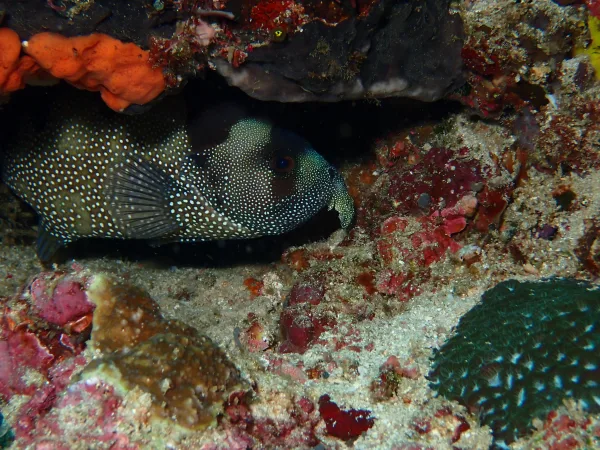
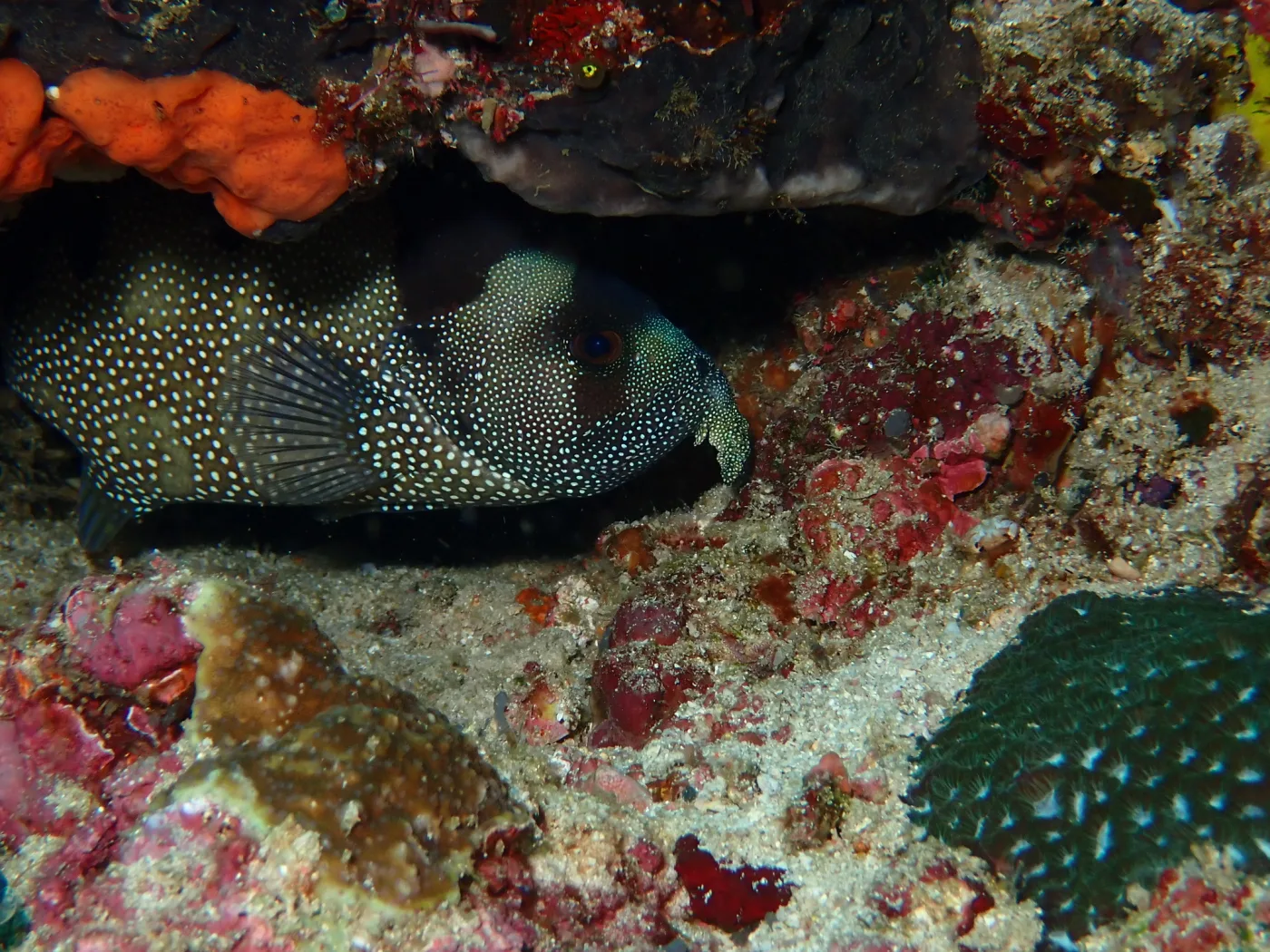
The clown grouper is a gray-brown fish covered in little white dots, like snowflakes. It has a black stripe through each eye and four dark patches on its back. A small flap of skin hangs from its chin, a bit like a beard. Even with its name, it is not a real grouper. It belongs to a family called soapfish. Its skin makes a slimy poison. When the fish is scared or hurt, it can let out more of it. The poison helps stop bigger fish from eating it. In a home tank, the poison can harm the other fish too. The clown grouper hides by day and hunts at night. It eats crabs, shrimp and small fish. It needs a big tank, strong filters and tank mates too big to swallow.
Water & care
Hardy and usually an easy feeder on meaty foods, but its toxic skin secretion sets it apart from true groupers. A soapfish that is badly stressed, chased, netted roughly or left to die and decay in the tank can release enough toxin to harm or kill its tankmates, which is why LiveAquaria rates it 'Expert Only'. Keep it in a large, well-filtered tank (100-125 gallons or more) with plenty of caves, avoid tankmates that harass it, move it in a container rather than a net where possible, and remove it at once if it dies. It is secretive and may only come out at feeding time.
| Parameter | Keep it at | Where that sits on the usual reef range |
|---|---|---|
| Temperature | 72–78 °F | |
| Salinity (SG) | 1.020–1.025 | |
| pH | 8.1–8.4 | |
| Alkalinity | 8–12 dKH |
LiveAquaria and Quality Marine agree on 72-78°F, SG 1.020-1.025, pH 8.1-8.4 and 8-12 dKH. No species-specific calcium, magnesium, nitrate or phosphate values are published. Strong filtration and regular water changes keep up with a heavy-feeding predator.
Feeding
DietCarnivore
Favorite foods
- Silversides
- Krill
- Mysis shrimp (for small fish)
- Squid
- Shrimp
Offer meaty foods such as silversides, krill, shrimp and squid. Quality Marine says these fish have a low metabolism and need feeding only every other day. Hobbyists report starting reluctant fish on live foods, then dropping silversides in front of them, after which they take most meaty frozen foods. Avoid relying on goldfish or other freshwater feeders.
Tank & maintenance
- Minimum tank
- 125 gallons
- Aquascape
- Plenty of rockwork with caves and crevices to hide in, and a clear view of the front so it can watch for food. Keep it uncrowded so it is not chased.
- Lighting
- No special requirement; Quality Marine lists medium light. It is most active at dusk and night.
- Water flow
- Moderate; in the wild it lives on slopes with moderate currents.
Routine upkeep
Regular water changes and generous filtration, prompt removal of uneaten food, and a daily check that the fish is present and healthy, so a dead soapfish never stays in the tank. Plan any catching carefully, with as little chasing as possible.
Temperament & tankmates
TemperamentSemi-aggressive
LiveAquaria's temperament rating is 'Moderate' (its overview calls it aggressive) and Quality Marine lists it as aggressive. In practice it is a patient ambush predator rather than a bully: Quality Marine describes groupers as friendly toward fish too large to eat, and hobbyists report keeping it with lionfish and similar fish. Anything that fits in its mouth will be eaten, and it may try to swallow prey that is barely too large. Avoid aggressive, nippy tankmates such as triggerfish, which stress it and could trigger toxin release.
Reef safeNo
It ignores corals, but it eats crustaceans and small fish, and LiveAquaria warns that it 'may eat tank mates as well as crustaceans'. LiveAquaria rates it reef compatible 'with caution'. Shrimps, crabs, small fish and the cleanup crew are all at risk, and the toxin risk is harder to manage in a crowded reef tank, so the store's rating of No is kept.
Good tankmates
- Lionfish and other calm predators of similar size
- Large, peaceful fish too big to be swallowed
Avoid
- Small fish such as gobies, firefish and clownfish
- Shrimps, crabs and other crustaceans
- Triggerfish and other aggressive or nippy fish that harass it
- Another grouper or soapfish
Help it thrive
- Give it a large tank (125 gallons or more) with many caves, and keep tankmates calm.
- Feed meaty marine foods every other day or so, starting with live foods if it refuses frozen ones.
- Choose tankmates too big to swallow, and skip triggerfish and other harassers.
- Catch it with a container rather than a chase with a net, to keep stress and toxin release low.
- Count it at every feeding and remove it at once if it dies.
Common ailments
Toxin release (grammistin) after stress or death
- Signs
- Heavy slime on the soapfish, cloudy or soapy-looking water, and tankmates breathing fast, hiding or dying after the soapfish was chased, injured, netted or died.
- Prevention
- Avoid harassing tankmates, catch it calmly in a container, ship and acclimate it gently, and check daily that it is alive.
- Treatment
- Remove a dead or dying soapfish immediately and make a large water change. Move stressed tankmates to clean water if they are struggling.
Marine ich (Cryptocaryon irritans)
- Signs
- White, salt-like spots on the body, fins or gills, scratching, cloudy eyes, fast breathing, hiding and loss of appetite.
- Prevention
- Quarantine new fish in a separate tank, and keep water stable.
- Treatment
- Treat in a hospital tank with copper, chloroquine phosphate or the tank-transfer method, following the product's directions. Keep the display fish-free for about 11 weeks, because the cyst stage can last up to 72 days.
Marine velvet (Amyloodinium ocellatum)
- Signs
- A fine dusty coating on the skin, very rapid breathing, gasping near the surface and lethargy; heavily infected fish can die within 12 to 48 hours.
- Prevention
- Strict quarantine, and disinfect nets and buckets between tanks.
- Treatment
- Act immediately with copper or chloroquine phosphate in a hospital tank, and leave the display fallow.
This is general hobby guidance, not veterinary advice. Quarantine new arrivals and treat in a separate tank whenever you can.
Risks of owning one
- Its skin toxin, released under stress or after death, can harm or kill other fish in the tank.
- Eats small fish, shrimps and crabs, and may try to swallow fish that are almost too big.
- Grows to about 14 inches and needs a large, well-filtered tank.
- Secretive by day, so a sick or dead fish can go unnoticed.
- All aquarium fish are wild-collected.
Breeding
DifficultyNot achieved Captive-bredRare or wild-caught
Little is known about its reproduction in the wild; FishBase, Wikipedia and Fishes of Australia give no details. We found no record of captive breeding, and no captive-bred fish are sold.
Deep dive The science, history and family tree
The science
Pogonoperca punctata is a soapfish (family Grammistidae), a group once treated as part of the groupers but now ranked as a separate family; the aquarium trade sells it as the clown or leaflip grouper. The dorsal fin has 7 spines and 12-13 soft rays and the anal fin 3 spines and 8 soft rays. Adults are brown to gray with dense small white spots, a black bar through the eye, four black saddles along the back, a fleshy flap of skin on the chin and clear fins; juveniles are dark brown with large white spots. It reaches 35 cm total length. It ranges from the Comoros and eastern Indonesia east to the Line, Marquesas and Society Islands, north to southern Japan and south to New Caledonia. It is cryptic and reef-associated at 10-216 m: adults usually live below 20 m around large coral heads on slopes with moderate currents, juveniles in shallow lagoons and protected bays. It hunts benthic crustaceans and small fishes, mainly at night. Its skin secretes grammistins, peptide toxins that are hemolytic and toxic to fish; Shiomi and colleagues (2001) isolated and sequenced six from this species. The IUCN lists it as Least Concern.
- Appearance
- Gray to brown body with a dense pattern of small white spots, a black bar running down through the eye, four black saddle-shaped blotches along the top of the back (Quality Marine describes them as triangles) and clear fins. A skin flap on the lower jaw gives it the names 'leaflip' and 'bearded'. Juveniles are dark brown with a few large white spots; as the fish grows, smaller spots fill in between them and the pattern becomes finer. LiveAquaria describes the effect as a silvery-brown body with white spotting and black 'tiger stripes' along the back. No other common aquarium fish has this combination of spots, saddles and chin flap.
- Native range
- Indo-West and central Pacific: the Comoros and eastern Indonesia east to the Line, Marquesas and Society Islands, north to southern Japan and south to New Caledonia; in Australian waters at Evans Shoal (Northern Territory), Christmas Island and the Cocos (Keeling) Islands. FishBase notes a recent record from southern Natal, South Africa. Type locality: Vanikoro Island, Santa Cruz Islands (Solomon Islands).
- Habitat
- Reef-associated and cryptic, from 10 to 216 m (usually 10-150 m). Adults are usually found deeper than 20 m on outer reef slopes, around large coral heads on slopes with moderate currents. Juveniles live in shallower, sheltered lagoons and bays. FishBase describes it as sporadic and habitat-specific.
- Size
- 13.8 in (35 cm). FishBase, Wikipedia and Fishes of Australia give 35 cm (13.8 in) total length as the maximum. LiveAquaria lists 14 in and Quality Marine a little over 14 in. LiveAquaria sells it in sizes from 1.5 to 7 in.
- Lifespan
- No published lifespan data were found for wild or captive fish.
- Conservation
- Least Concern. Assessed Least Concern by the IUCN (2015-2016). Not evaluated by CITES. FishBase rates its vulnerability to fishing as low; it is taken only in minor fisheries and occasionally appears in fish markets. Aquarium fish are wild-collected
In the aquarium vs in the wild
In your aquarium
An unusual, strikingly patterned predator for large fish-only aquariums, kept by hobbyists who can manage its toxin risk.
On the reef
A nocturnal ambush predator of crustaceans and small fishes around coral heads on reef slopes, protected from predators by its toxic skin.
History
Achille Valenciennes described the species in 1830 as Grammistes punctatus, in the Histoire Naturelle des Poissons, from Vanikoro in the Santa Cruz Islands. Albert Günther created the genus Pogonoperca in 1859, and Pogonoperca reticulata Bliss, 1883 is a later synonym. Soapfishes were long treated as tribes of the grouper subfamily, which is why the trade still calls this fish a grouper; Eschmeyer's Catalog of Fishes and WoRMS now place them in their own family, Grammistidae. In 2001, Kazuo Shiomi and colleagues at the Tokyo University of Fisheries isolated six peptide toxins, grammistins Pp 1, 2a, 2b, 3, 4a and 4b, from its skin secretion and showed they are simple peptides, not the unusual amine compounds earlier proposed. LiveAquaria sells it as the 'Leaflip Grouper (Expert Only)'.
Evolution & relatives
Soapfishes were once placed in the sea bass family Serranidae as tribes (Grammistini and Diploprionini) of the grouper subfamily Epinephelinae. Eschmeyer's Catalog of Fishes now ranks the soapfishes as separate families, and WoRMS places Pogonoperca in Grammistidae, with genera including Grammistes, Pogonoperca, Pseudogramma, Rypticus and Suttonia. WoRMS places the soapfishes, the groupers (Epinephelidae) and the true sea basses in the suborder Percoidei of the order Perciformes, with the perches. Grammistins are known from more than one soapfish: two of this species' grammistins are identical to each other and closely match grammistin Gs 2 from the goldenstriped soapfish (Grammistes sexlineatus), while the other four resemble no known toxin. On the site's tree, the clown grouper sits next to the groupers but on its own branch.
Family tree, from kingdom down
- Kingdom Animalia Animals Animals are living things made of many cells that must eat food to live. Fish, corals, crabs, snails and sea stars are all animals.
- Phylum Chordata Chordates Chordates have a stiff rod running down their back at some point in their lives. In fish and people, this rod is replaced by a backbone.
- Subphylum Vertebrata Vertebrates Vertebrates are animals with a backbone and a skull. Fish, frogs, birds and people are all vertebrates.
- Infraphylum Gnathostomata jawed vertebrates
- Parvphylum Osteichthyes bony fishes
- Gigaclass Actinopterygii ray-finned fishes
- Superclass Actinopteri
- Class Teleostei Teleost fishes Teleosts are bony fishes with thin, bendy fin rays and jaws that can push forward. Almost all of the fish in the world are teleosts.
- Order Perciformes Perch-like fishes These fish have sharp spines in the front part of the fin on their back. The name means 'perch-like', and this order holds perches, groupers and soapfishes.
- Suborder Percoidei
- Family Grammistidae Soapfishes Soapfishes are cousins of the groupers with slimy, poisonous skin. The slime helps keep other fish from eating them.
- Genus Pogonoperca
- Species Pogonoperca punctata
See it on the Tree of Life Compare with another species
Closest relatives
- Pogonoperca ocellata Indian Soapfish Same genus; the only other Pogonoperca species, from the Indian Ocean to Indonesia and Vietnam
- Grammistes sexlineatus Goldenstriped Soapfish Same family; has a closely matching grammistin toxin
- Rypticus Soapfishes Same family (Grammistidae)
- Epinephelidae Groupers Neighboring family in the same suborder; soapfishes were once classified inside it
Older scientific names: Grammistes punctatus, Pogonoperca reticulata.
Fun facts
- It is not a true grouper but a soapfish; some soapfishes release a skin toxin that looks like soap.
- Scientists have found six different peptide toxins, called grammistins, in its skin slime.
- The flap of skin on its chin is why it is also called the leaflip grouper and the bearded soapfish.
- Young fish live in shallow lagoons, while adults usually stay deeper than 20 m.
- Its toxic slime helps protect it from predators.
Learn more
- FishBase: Pogonoperca punctata, Bearded soapfish fishbase.se
- WoRMS: Pogonoperca punctata (Valenciennes, 1830) marinespecies.org
- Fishes of Australia: Spotted Soapfish fishesofaustralia.net.au
- Wikipedia: Spotted soapfish en.wikipedia.org
Sources
- FishBase species summary: Pogonoperca punctata fishbase.se
- WoRMS taxon record 218270 marinespecies.org
- Fishes of Australia: Pogonoperca punctata fishesofaustralia.net.au
- Wikipedia: Spotted soapfish en.wikipedia.org
- Wikipedia: Soapfish (Grammistidae) en.wikipedia.org
- LiveAquaria: Leaflip Grouper (Expert Only) liveaquaria.com
- Quality Marine: Spotted Soapfish Grouper qualitymarine.com
- Shiomi et al. 2001, Primary and secondary structures of grammistins (Fisheries Science) jstage.jst.go.jp
Scientific names and classification follow the World Register of Marine Species (AphiaID 218270). Checked by our team. Last updated October 29, 2026.
Shop this species
Search the shop →
Only 2 left