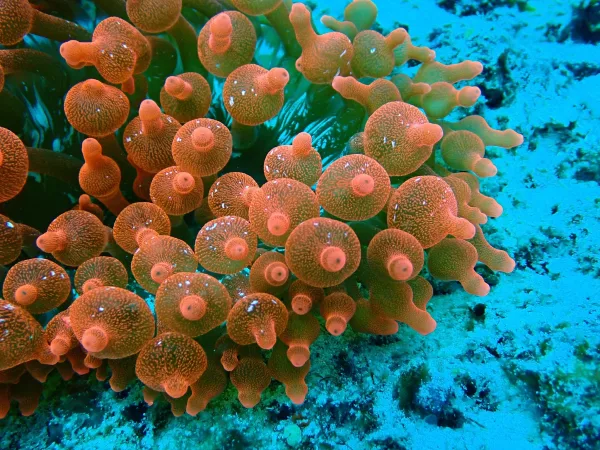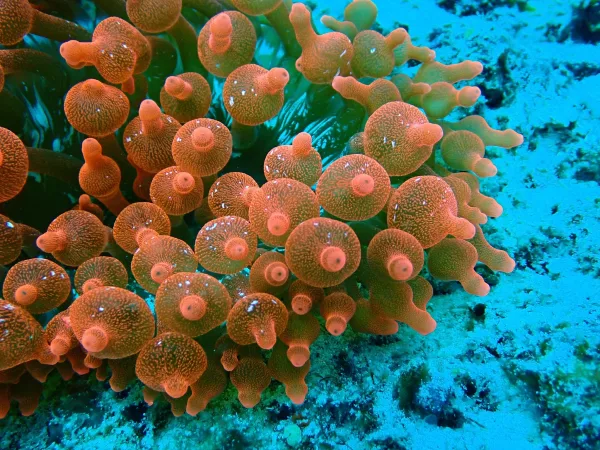
Anemones · Clownfish host anemone
Bubble Tip Anemone
Entacmaea quadricolor
Also called BTA, Rose Bubble Tip Anemone, Rose BTA, Rose anemone, Bulb-tentacle sea anemone, Bulb-tip anemone, Four-colored anemone, Maroon anemone
- CareModerate
- Reef safeWith caution
- TemperamentAggressiveStings nearby corals and wanders the tank
- Favorite foods
- Light (zooxanthellae)
- Mysis shrimp
- Chopped fish / shrimp
- Max size12 in (30.5 cm)
- Min tank40 gal
- LifespanNot well documented
- IUCN statusNot Evaluated
Quick answers
- How big does the Bubble Tip Anemone get?
- Up to 12 in (30.5 cm).
- What size tank does it need?
- At least 40 gallons.
- How hard is it to keep?
- Care level: Moderate.
- Is it reef safe?
- With caution. It will sting any coral or other anemone its tentacles touch, and because it can move you cannot fully control where it ends up.
- What does it eat?
- Light (zooxanthellae)
- Mysis shrimp
- Chopped fish / shrimp
- How long does it live?
- Not well documented.
- What are good tankmates?
- Clownfish that host it in the wild: clarkii, tomato (A. frenatus), cinnamon (A. melanopus), Red Sea (A. bicinctus) and maroon clownfish
- Captive-bred ocellaris and percula clownfish, which often adopt it in aquariums
- Anemone shrimp (Ancylocaris brevicarpalis, formerly Periclimenes brevicarpalis) and cleaner shrimp
- Peaceful reef fish large or quick enough to avoid its tentacles
- Corals placed well out of reach of its tentacles
The 30-second version
The bubble tip anemone is a soft, squishy animal that looks like a flower. Its arms are called tentacles. Many of them end in a little round bubble. It is related to corals and jellyfish. Its tentacles can sting small animals that bump into them. But clownfish are special. A slimy coat keeps them safe, so they snuggle right into the tentacles to hide. In return, they chase away fish that would nibble the anemone. They also drop bits of food into it. Tiny algae live inside the anemone and make food from light, so it needs a bright tank. A bubble tip can slowly walk on its sticky foot to find a spot it likes. So pumps must be covered. Sometimes it even splits into two anemones!
Water & care
The easiest and most popular host anemone, especially captive-split clones, which are much hardier than wild imports. It still needs an established, stable reef (at least about six months old), strong light, crevices for its foot, guarded pump intakes and overflows, and stable reef-level water quality. Expect it to wander until it finds a spot it likes; constant wandering signals a problem with light, flow or water quality. Never buy a pale, white or translucent (bleached) anemone, or one with a gaping mouth or torn foot.
| Parameter | Keep it at | Where that sits on the usual reef range |
|---|---|---|
| Temperature | 75–80 °F | |
| Salinity (SG) | 1.025–1.026 | |
| pH | 8.1–8.4 | |
| Alkalinity | 8–12 dKH | |
| Calcium | 380–450 ppm | |
| Magnesium | 1,250–1,400 ppm | |
| Nitrate | 1–20 ppm | |
| Phosphate | 0.01–0.1 ppm |
Keep it in natural-seawater-level reef conditions and, above all, stable ones. LiveAquaria lists 72-78 F and SG 1.020-1.025, but in a reef tank standard reef targets are better. Calcium and magnesium matter for the tank's corals more than for the anemone. Captive bubble tips seem relatively tolerant of nitrate. Avoid heat spikes, which cause bleaching. Ammonia and nitrite must be zero.
Feeding
DietPhotosynthetic carnivore
Favorite foods
- Light (photosynthesis by its symbiotic algae)
- Mysis shrimp
- Chopped silversides or other marine fish
- Chopped shrimp or squid
- Food scraps passed on by its clownfish
Most of its energy comes from its zooxanthellae, but it grows and splits better with regular meaty food. Target-feed small, mouth-sized pieces of mysis, chopped silverside, shrimp or squid about 1-3 times a week (some keepers offer a morsel every two to three days), using tongs or a baster with pumps briefly turned down. A hosting clownfish will also feed it. Do not feed whole large fish or overfeed: uneaten or regurgitated food fouls the water.
Tank & maintenance
- Minimum tank
- 40 gallons
- Aquascape
- A mature reef at least six months old with stable rockwork that offers deep holes or crevices where it can anchor its foot and retract. Place it, and let it settle, before positioning corals nearby. Larger tanks are easier: about 75 gallons or more if you keep several. Fit foam or mesh guards on all pump intakes and overflow slots before adding it.
- Lighting
- Strong reef lighting, roughly 150-350 PAR where it settles; sources differ (about 150-200 PAR to 250-350 PAR). Blue-heavy light shows off fluorescent colors. Too little light makes it stretch, wander and eventually bleach; acclimate a new anemone gradually.
- Water flow
- Moderate, turbulent flow that gently moves the tentacles; avoid strong direct jets. More flow is better than too little, but every intake must be guarded.
Routine upkeep
Check daily that it is open, attached and not near a pump; clean pump guards often because they clog and cut flow. Target-feed a few times a week, do regular water changes (10-15% weekly is a common routine), and test water regularly. Watch for splits and rehome extra clones before they crowd corals.
Temperament & tankmates
TemperamentAggressive
Not aggressive in behavior, but its tentacles sting neighbors, and it wages stinging and chemical warfare with other anemone species. Keep corals at least a few inches beyond the fully extended tentacles. Clownfish hosting it often become territorial and may bite tankmates and hands.
Reef safeWith caution
It will sting any coral or other anemone its tentacles touch, and because it can move you cannot fully control where it ends up. Small, slow or sleeping fish and shrimp that blunder into it may be stung and eaten. It is kept in many reef tanks successfully if corals are placed out of its reach and pumps are guarded.
Good tankmates
- Clownfish that host it in the wild: clarkii, tomato (A. frenatus), cinnamon (A. melanopus), Red Sea (A. bicinctus) and maroon clownfish
- Captive-bred ocellaris and percula clownfish, which often adopt it in aquariums
- Anemone shrimp (Ancylocaris brevicarpalis, formerly Periclimenes brevicarpalis) and cleaner shrimp
- Peaceful reef fish large or quick enough to avoid its tentacles
- Corals placed well out of reach of its tentacles
Avoid
- Other anemone species such as carpet (Stichodactyla), magnificent and sebae (Radianthus, formerly Heteractis) anemones in the same tank
- Corals within reach of its fully extended tentacles
- Unguarded powerheads, pump intakes and overflow slots
- Angelfish, butterflyfish and other fish that pick at anemones
- Very small, slow or bottom-sleeping fish that may be stung
Help it thrive
- Buy a captive-split clone rather than a wild one; they are hardier and do not deplete reefs.
- Add it only to a stable tank that has been running at least six months.
- Guard every pump intake and overflow before it goes in.
- Give it a deep hole or crevice in bright light and then leave it alone; moving it repeatedly stresses it.
- Feed small meaty foods a couple of times a week, especially if it has no clownfish.
- Keep corals out of reach of its extended tentacles, and place the anemone before the corals.
Common ailments
Bleaching
- Signs
- The anemone turns pale, white or translucent as it loses its symbiotic algae, often after poor acclimation, too little light, a heat spike or shipping stress. Bleached anemones slowly starve.
- Prevention
- Do not buy pale or translucent specimens, acclimate carefully, provide strong stable lighting and avoid temperature spikes.
- Treatment
- Correct lighting and temperature gradually (do not blast it with sudden high light), keep water pristine and target-feed small meaty foods regularly while it regains its algae, which can take weeks to months.
Wandering and failure to settle
- Signs
- It keeps moving around the tank, climbs toward the light, hides behind rock or refuses to attach for days or weeks.
- Prevention
- Add it only to a mature, stable tank with good light, moderate flow and suitable crevices; some movement in the first weeks is normal.
- Treatment
- Test water and check light and flow; turn off or guard pumps while it is on the move and avoid repeatedly relocating it.
Pump and overflow injuries
- Signs
- Torn tissue, a shredded anemone in a powerhead or overflow, sudden cloudy water and a spike in ammonia or nitrate.
- Prevention
- Fit foam or mesh guards on every intake and overflow and clean them regularly.
- Treatment
- Switch off the pump, remove the anemone and any loose pieces, do a large water change and run activated carbon. A partly torn anemone can survive and heal (cut halves usually survive in aquaculture), so keep it in clean water and good light.
Shrinking, gaping mouth and decline
- Signs
- It stays shrunken for days, the mouth gapes open or is everted, tentacles stay retracted, or tissue starts to look ragged or melt; short deflations to expel waste are normal.
- Prevention
- Stable water quality, appropriate feeding and lighting, and minimal handling.
- Treatment
- Test water and do a water change, check temperature and salinity, and stop feeding until it recovers. If it begins to disintegrate, remove it quickly; a dying anemone fouls the water fast.
This is general hobby guidance, not veterinary advice. Quarantine new arrivals and treat in a separate tank whenever you can.
Risks of owning one
- It can wander into powerheads or overflows; a shredded anemone fouls the water quickly and can harm the whole tank.
- It stings corals and other anemones it moves next to, and you cannot fully control where it settles.
- Small, slow or sleeping fish and shrimp can be stung and eaten.
- Clownfish that host it often become territorial and may nip tankmates and the keeper's hands.
- Its sting is mild for most people, but sensitive skin can react; wear gloves and keep hands away from your eyes after handling.
- Healthy anemones split, so you may need to rehome extra clones.
- Wild-collected specimens are often stressed or bleached and their collection depletes host anemones on reefs.
Propagation & fragging
DifficultyModerate AquaculturedWidely available
In aquariums it reproduces asexually by longitudinal fission: the anemone stretches in opposite directions and tears into two genetically identical clones, often within about a day. Healthy, well-fed anemones in stable tanks split on their own; occasional stress may also trigger splitting, and some keepers credit iodine dosing, though many tanks produce clones without it. Aquaculture researchers have also propagated it by cutting, with about 89-94% of halves surviving. It also reproduces sexually (separate sexes, broadcast spawning): researchers have settled larvae from wild-collected spawners in outdoor flow-through aquaria, but rearing larvae is not practical in home aquariums.
- Keep the anemone healthy: mature stable tank, strong light, steady parameters and regular small meaty feedings.
- Let it split naturally; when it starts stretching apart, do not disturb it. The split usually completes within about a day.
- Watch both clones as they settle and keep pumps guarded, because new clones often wander.
- Rehome or trade extra clones before they crowd corals; many local stores accept them.
- Manual cutting is for experienced keepers only: with the anemone attached to a small rock, cut cleanly through the mouth and foot with a sharp sterile blade, keep the halves in clean, well-lit water with good flow, feed lightly, and expect a new mouth to form over several weeks (up to about 8 weeks). Some hobbyists report poor results, so natural splitting is preferred.
Deep dive The science, history and family tree
The science
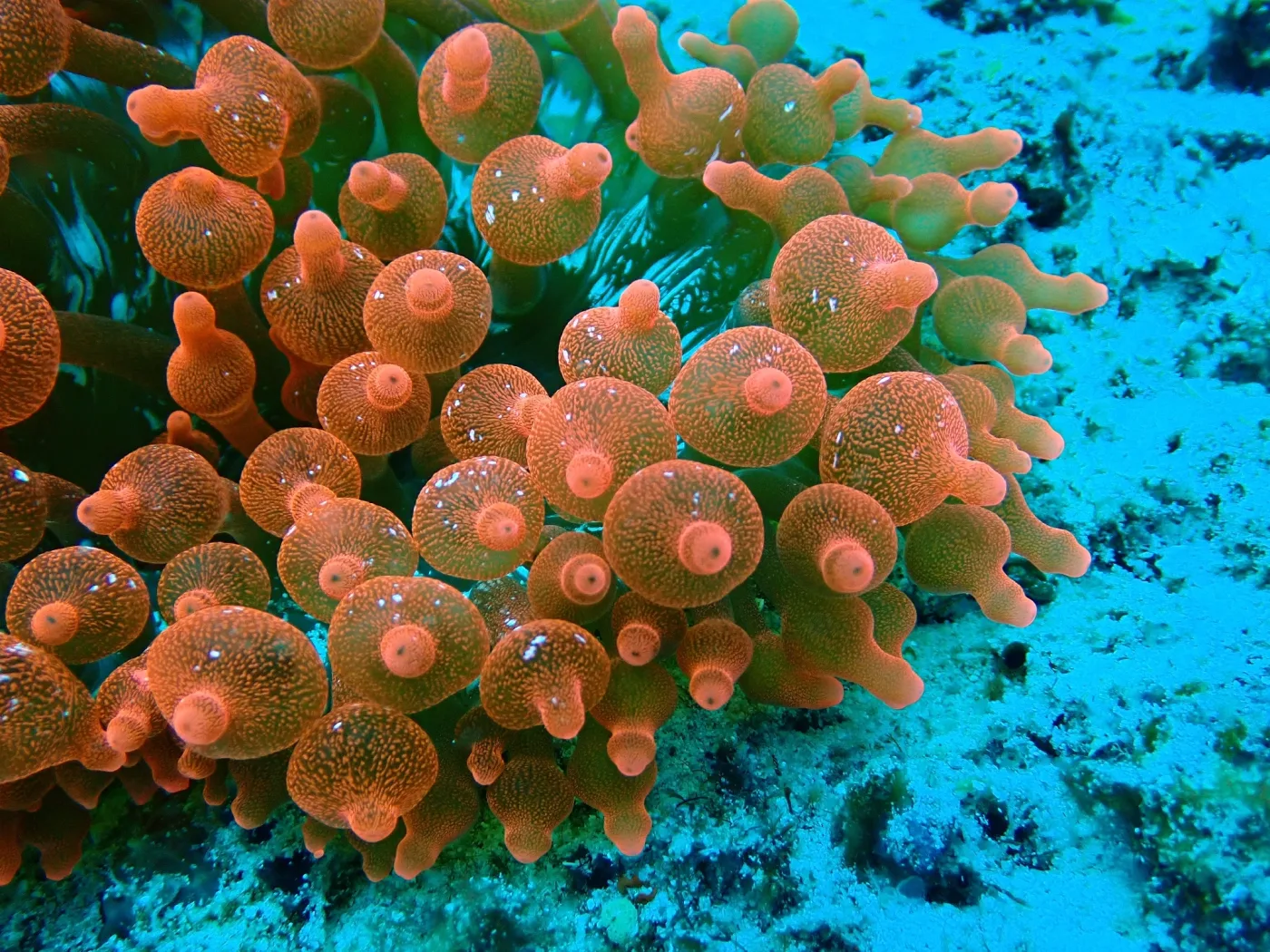
Entacmaea quadricolor (Leuckart in Rüppell & Leuckart, 1828) is a large zooxanthellate sea anemone of the family Actiniidae. Its oral disc carries numerous tentacles that, in many individuals, swell into a bulb just below the tip, the feature behind its common names; bulb development varies with light, flow, clownfish hosting and other factors, and tentacles may instead be long and stringy. The column is often brownish to maroon, and the disc and tentacles range from green or tan to red, rose and orange. The species occurs throughout the tropical Indo-West Pacific, including the Red Sea, typically at 2-25 m, with its pedal disc anchored deep in holes and crevices so it can retract when disturbed. Two growth forms are recognized: smaller individuals forming clonal aggregations in bright shallow water, and large solitary individuals up to about 40 cm across in deeper, dimmer water. Most of its energy comes from symbiotic dinoflagellates, supplemented by prey and particles captured with its stinging tentacles and by scraps from resident fish. It hosts about 14 anemonefish species, roughly half of all clownfishes, including Amphiprion clarkii, A. frenatus, A. melanopus, A. bicinctus and the maroon clownfish, as well as anemone shrimps and juvenile damselfish. Sexes are separate; in eastern Australia it broadcast-spawns between January and April, and larvae begin settling about 5 days after spawning, peaking around day 10. It also reproduces asexually by longitudinal fission. Genomic work suggests the nominal species is a complex of at least five cryptic species that diversified within the last five million years.
- Appearance
- A rounded anemone usually 10-30 cm (4-12 in) across in aquariums, with a smooth, often reddish-brown to maroon column hidden in the rock and a disc of many tentacles that may end in bulbous 'bubbles' just below a slightly paler tip. Bubbles come and go; healthy anemones sometimes show long, stringy tentacles instead. Rose and red morphs are pink to deep red throughout; others are green, tan, orange ('sunburst') or multicolored ('rainbow'), and many fluoresce under blue light. Look-alikes: the corkscrew or long tentacle anemone (Radianthus doreensis, formerly Macrodactyla doreensis) buries its foot in sand and has long tapering tentacles; the sebae anemone (Radianthus crispa, formerly Heteractis crispa) has long, pointed tentacles; carpet anemones (Stichodactyla) have a broad flat disc covered in short tentacles; the pest Aiptasia is small, brown and has thin, translucent tentacles.
- Native range
- Tropical Indo-West Pacific including the Red Sea: from the Red Sea, Gulf of Oman and East Africa across the Indian Ocean (including the Seychelles) to Southeast Asia, Japan, Australia, New Guinea, Micronesia and Melanesia.
- Habitat
- Coral reefs at about 2-25 m, with the pedal disc wedged deep in a hole or crevice so the anemone can withdraw. Smaller anemones form dense clonal fields in bright shallow water, while large solitary individuals live deeper in dimmer water. It is usually occupied by one or more pairs of clownfish and may also shelter anemone shrimps and juvenile three-spot dascyllus.
- Size
- 12 in (30.5 cm). Large solitary wild individuals reach about 40 cm (16 in) across; shallow clonal individuals are much smaller (oral disc around 5 cm). In aquariums most stay 4-8 in (10-20 cm) and rarely exceed 12 in (30 cm); bright light keeps them compact, while poor light makes them stretch.
- Lifespan
- Not well documented. Sea anemones can be long-lived, and because bubble tips clone themselves by splitting, a captive line can be kept going for decades; the 'Sherman Rose' line, for example, traces back to a single anemone that entered a hobbyist's tank in 2000.
- Conservation
- Not Evaluated. Not assessed on the IUCN Red List and not listed under CITES. Host anemones are heavily collected for the aquarium trade (in the Philippines fishers can earn up to 13 times more for an anemone than for an anemonefish), and collection has reduced host anemone abundance in parts of their range. Warming seas cause anemone bleaching, which also harms resident clownfish. Captive-split bubble tips are widely available and are the responsible choice; our Rose BTA is aquacultured
In the aquarium vs in the wild
In your aquarium
The classic host anemone for clownfish, kept as a living centerpiece so clownfish can show natural hosting behavior. Captive-split color strains (rose, red, sunburst, rainbow, green) are widely bred, traded and shared between hobbyists.
On the reef
A host for about half of all clownfish species plus anemone shrimps and juvenile damselfish, providing them protection from predators while gaining food scraps, cleaning and defense against anemone-eating fish. Shallow clonal fields form important clownfish habitat on many Indo-Pacific reefs.
History
Friedrich Sigismund Leuckart described the species in 1828 as Actinia (Entacmaea) quadricolor in Eduard Rüppell's atlas of his travels in northern Africa, from Red Sea material; the name means 'four-colored'. Because its shape and color vary so much, it was re-described many times over the following century, and WoRMS lists names such as Physobrachia douglasi, Entacmaea ramsayi and several Gyrostoma species as synonyms. WoRMS places it in Actiniidae, although genomic studies recover Entacmaea as a lineage of its own within the superfamily Actinioidea. Keeping clownfish with a host anemone was long considered a recipe for failure in the hobby, but captive splitting made hardy clones common. Colored lines such as the 'Sherman Rose', traced to a single anemone that entered a hobbyist's tank in 2000 in Oregon and spread through Reef Central splits to Sherman, Texas, helped make captive clones the norm. Research by Anna Scott and Peter Harrison in Australia in the 2000s described its spawning cycle and larval settlement, and later showed that cut anemones survive well, supporting aquaculture as an alternative to wild collection.
Evolution & relatives
Sea anemones (order Actiniaria) are hexacorals like stony corals but are soft-bodied, mostly solitary polyps with no skeleton. Entacmaea sits in the Actiniidae, a large family of 'typical' anemones that also includes the beadlet anemone (Actinia) and the Caribbean condy anemone (Condylactis). Hosting clownfish evolved at least three separate times among sea anemones (Titus et al. 2019), and genomic work resolves the ten host species into three clades that do not share recent ancestors: Stichodactylina (carpet anemones and the magnificent anemone, Radianthus magnifica), Heteractina (Heteractis aurora and the sebae, corkscrew and R. malu anemones) and Entacmaea (De Jode et al.). The bubble tip's partnership with clownfish is therefore an independent, convergent evolution rather than an inheritance from a shared host ancestor. Its only congener is Entacmaea medusivora, a jellyfish-eating anemone described from a marine lake in Palau. Genomic data suggest that 'E. quadricolor' is really a complex of at least five cryptic species that diverged within the last ~5 million years, and that clownfishes tell them apart: some lineages host the generalist A. clarkii while others host the specialist A. frenatus (Chiodo et al. 2024, preprint). On the AquaFrenzy tree it shares Anthozoa and Hexacorallia with the corals but branches off at the order level (Actiniaria vs Scleractinia).
Family tree, from kingdom down
- Kingdom Animalia Animals Animals are living things made of many cells that must eat food to live. Fish, corals, crabs, snails and sea stars are all animals.
- Phylum Cnidaria Cnidarians Cnidarians are soft animals with tentacles. The tentacles have tiny stinging cells. Corals, sea anemones and jellyfish all belong here.
- Subphylum Anthozoa Corals and sea anemones These cnidarians spend their whole lives as polyps: a tube with a mouth ringed by tentacles. Unlike jellyfish, they never swim around as a bell-shaped medusa.
- Class Hexacorallia Hexacorals In this group the tentacles and body parts come in sixes or multiples of six. It includes stony corals, sea anemones, mushroom corals and zoanthids.
- Order Actiniaria Sea anemones Sea anemones are single, soft polyps with no skeleton. They catch food with stinging tentacles, and some give clownfish a home.
- Suborder Enthemonae
- Superfamily Actinioidea
- Family Actiniidae Actiniid sea anemones This is the biggest family of sea anemones. Many have sticky bumps on their column, and the bubble-tip anemone belongs here.
- Genus Entacmaea Bubble-tip anemones These sea anemones often have tentacles with bubble-shaped tips. Clownfish like to live in them.
- Species Entacmaea quadricolor
See it on the Tree of Life Compare with another species
Closest relatives
- Entacmaea medusivora Jellyfish-eating anemone Same genus; the only other Entacmaea species, from Palau
- Condylactis gigantea Condy anemone Same family Actiniidae; a Caribbean anemone common in the hobby
- Actinia equina Beadlet anemone Same family Actiniidae
- Radianthus magnifica Magnificent sea anemone Another clownfish host (formerly Heteractis magnifica) in family Stichodactylidae; hosting evolved independently
- Stichodactyla gigantea Giant carpet anemone Another clownfish host in a different family; hosting evolved independently
Older scientific names: Actinia quadricolor, Physobrachia douglasi, Physobrachia ramsayi, Entacmaea ramsayi, Gyrostoma helianthus.
Fun facts
- Its species name quadricolor means 'four-colored'.
- It hosts about 14 clownfish species, roughly half of all clownfish, more than almost any other anemone.
- It can split itself into two complete anemones in about a day.
- Its larvae can survive in the plankton for up to 59 days, but settlement peaks about 10 days after spawning.
- In one wild Australian population, females were significantly more common than males.
- Scientists now think the bubble tip is really at least five look-alike species, and clownfish seem to know which is which.
Learn more
- Wikipedia: Bubble-tip anemone en.wikipedia.org
- Reef Builders: The indomitable Red Bubble Tip Anemone (2023) reefbuilders.com
- Scott et al. 2014, Asexual propagation of anemonefish host anemones (PLoS ONE) pmc.ncbi.nlm.nih.gov
- WoRMS: Entacmaea quadricolor marinespecies.org
Sources
- WoRMS: Entacmaea quadricolor marinespecies.org
- Wikipedia: Bubble-tip anemone en.wikipedia.org
- Florent's Guide to the Tropical Reefs: Entacmaea quadricolor reefguide.org
- LiveAquaria: Green Bubble Tip Anemone liveaquaria.com
- Top Shelf Aquatics: Bubble Tip Anemone Care Guide topshelfaquatics.com
- Reef Builders: Bubble-tip anemone care and propagation (2013) reefbuilders.com
- Reef Builders: The indomitable Red Bubble Tip Anemone (2023) reefbuilders.com
- Scott et al. 2014, Asexual propagation of anemonefish host anemones (PLoS ONE) pmc.ncbi.nlm.nih.gov
- Scott & Harrison 2008, Larval settlement and juvenile development (Marine Biology) marineinfo.org
- Scott & Harrison 2009, Gametogenic and reproductive cycles of Entacmaea quadricolor (Marine Biology) marineinfo.org
- Titus et al. 2019, Phylogenetic relationships among the clownfish-hosting sea anemones (bioRxiv) biorxiv.org
- De Jode et al., Phylogenomics reveals coincident divergence between giant host sea anemones and the clownfish adaptive radiation (NSF PAR manuscript) par.nsf.gov
- Chiodo et al. 2024, Nemo knows: clownfishes differentiate cryptic host species (bioRxiv) biorxiv.org
- MelevsReef: Sherman Rose bubble tip anemone melevsreef.com
Care facts
The care facts on this guide and its product pages (care level, reef safety, temperament, size, tank, diet, flow, purpose, foods, acclimation and origin) combine 9 independent sources, checked October 25, 2026.
- Rose Bubble Tip Anemone - LiveAquaria LiveAquaria
- Bubble Tip Anemone: Your Complete Care Guide Aquariadise
- Bubble Anemone-Entacmaea quadricolor Fishkeeper (UK)
- Bubble-Tip Anemone Care Guide Reef Chasers
- Snowflake Bulb Anemone :: 50095 Quality Marine
- ORA Acid Wash Rose Bubble Tip Anemone - Bulk Reef Supply Bulk Reef Supply (ORA product)
- Bubble tip anemone care guide: facts, & clownfish pairing Saltwater Aquarium Blog (Albert B Ulrich III)
- Green Bubble Tip Anemone LiveAquaria
- Nexus Burst Bubble Tip Anemone Tidal Gardens
Scientific names and classification follow the World Register of Marine Species (AphiaID 289898). Last updated October 25, 2026.
Shop this species
Search the shop →