 Only 3 left
Fish · Pipefish
Bluestripe Pipefish
Doryrhamphus excisus
Also called Blue-striped Pipefish, Blue-and-orange Cleaner Pipefish, Fantail Pipefish, Pacific Bluestripe Pipefish, Black-sided Pipefish
Reviewed by admin on October 29, 2026 · Meet the team
- CareExpert
- Reef safeYes
- TemperamentPeacefulPeaceful; males fight each other
- Favorite foods
- Live copepods
- Small mysis shrimp
- Fish roe (Nutramar Ova)
- Max size2.8 in (7 cm)
- Min tank30 gal
- LifespanNot documented
- IUCN statusLeast Concern
Quick answers
- How big does the Bluestripe Pipefish get?
- Up to 2.8 in (7 cm).
- What size tank does it need?
- At least 30 gallons.
- How hard is it to keep?
- Care level: Expert.
- Is it reef safe?
- Yes. Harmless to corals and invertebrates.
- What does it eat?
- Live copepods
- Small mysis shrimp
- Fish roe (Nutramar Ova)
- How long does it live?
- Not documented; no published lifespan for aquarium or wild fish was found.
- What are good tankmates?
- Small, calm fish that feed slowly
- Its own species as a male-female pair
- Peaceful reef tanks without anemones
The 30-second version
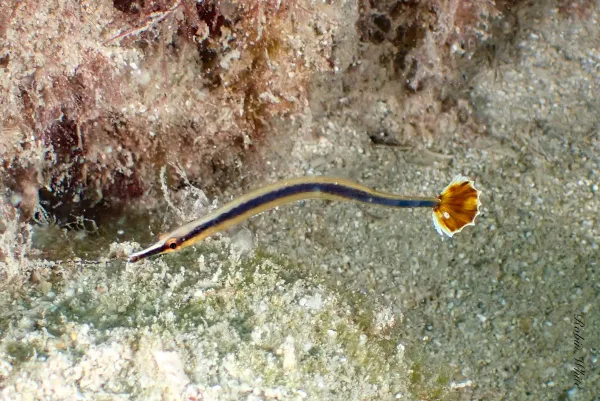
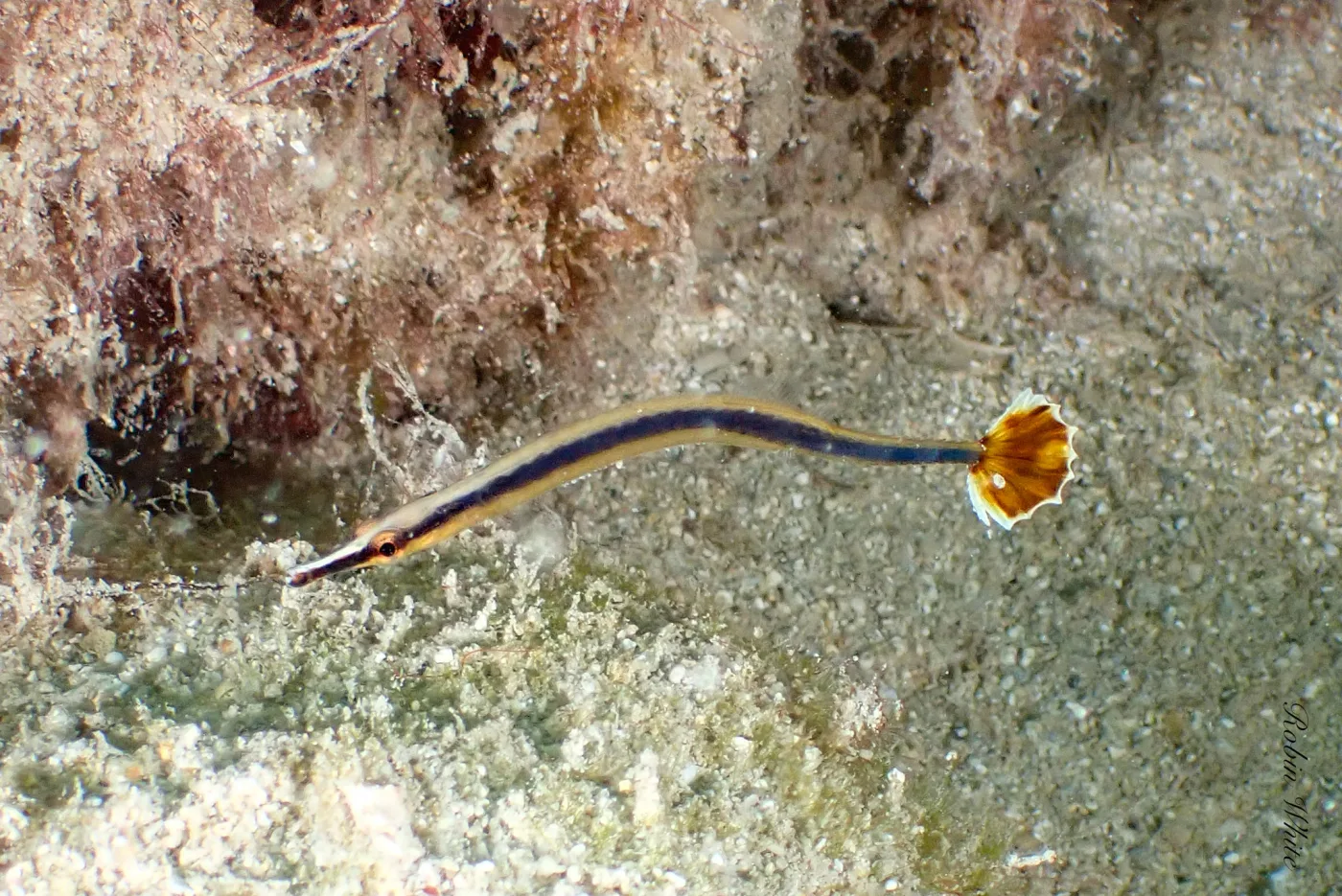
The bluestripe pipefish is a tiny cousin of the seahorse. It is thin like a piece of string and shorter than your finger. Its body is orange, with a bright blue stripe down each side. Its tail opens like a little fan. It lives on reefs from Africa all the way to the coast of the Americas. It hides in cracks and caves in the rock. Pairs bob up and down near the door of their cave. This tells bigger fish to come and get cleaned. Then the pipefish picks tiny pests off their skin, even off moray eels! Just like a seahorse, the dad carries the eggs on his belly until the babies are born. In a tank it needs calm friends and lots of tiny food.
Water & care
Hardy for a pipefish but demanding because of its small size and special needs (LiveAquaria). It must have a steady supply of very small foods, such as copepods, small mysis and Nutramar Ova (fish roe), and should be target fed so that faster fish do not take everything. A mature tank with plenty of live rock and natural pods helps between meals. Keep it in a calm tank of 30 gallons or more with caves and overhangs, only with small, peaceful tankmates, and with one male per tank: a mated pair or one male with several females.
| Parameter | Keep it at | Where that sits on the usual reef range |
|---|---|---|
| Temperature | 72–78 °F | |
| Salinity (SG) | 1.020–1.025 | |
| pH | 8.1–8.4 | |
| Alkalinity | 8–12 dKH |
LiveAquaria's ranges. No species-specific calcium, magnesium or nutrient values are published; in a reef, follow the corals' targets.
Feeding
DietCarnivore
Favorite foods
- Live copepods
- Small mysis shrimp
- Nutramar Ova (fish roe)
- Frozen brine shrimp
- Zooplankton
Use foods small enough for its tube-like snout, which takes in prey with a rapid rush of water. LiveAquaria recommends copepods, small mysis and Nutramar Ova; hobbyists also report feeding frozen brine shrimp and mysis. A mature tank with a healthy copepod population gives it something to hunt between meals.
Tank & maintenance
- Minimum tank
- 30 gallons
- Aquascape
- Mature live rock with caves, crevices and overhangs, and shaded spots where it can stay during the day. Calm areas near cave entrances where a pair can hover.
- Lighting
- No special requirement; it often stays in shaded areas during the day.
- Water flow
- Low to moderate, with calm spots near caves; like other syngnathids it is a slow swimmer that hovers in place.
Routine upkeep
Check at every feeding that it is eating, and keep copepod populations up (for example by not adding other pod-eaters). Avoid adding fast, greedy feeders later. Routine partial water changes.
Temperament & tankmates
TemperamentPeaceful
Peaceful toward other fish, especially when kept in pairs. Males are territorial and will not tolerate each other (LiveAquaria), and two males may fight (Wikipedia). Keep a mated pair or one male with several females.
Reef safeYes
Harmless to corals and invertebrates. LiveAquaria lists it 'With caution' because the reef can hurt the pipefish: stinging anemones, large corals and large invertebrates can injure or eat it. Keep it in a reef without anemones or large stinging corals.
Good tankmates
- Small, calm fish that feed slowly
- Its own species as a male-female pair
- Peaceful reef tanks without anemones
Avoid
- Another male bluestripe pipefish
- Stinging anemones
- Large corals that can sting
- Large invertebrates
- Fast, aggressive feeders that take all the food
Help it thrive
- Buy a known pair, or one male with females; never two males.
- Add it to a mature tank with plenty of live rock and copepods.
- Offer copepods, small mysis and fish roe, and make sure it gets its share.
- Skip stinging anemones and large stinging corals.
- Keep tankmates small and calm.
Common ailments
Starvation
- Signs
- A thin body, slow movement and a fish that no longer hunts at feeding time.
- Prevention
- Offer very small foods (copepods, small mysis, fish roe) every day, target-feed, and keep it away from fast, greedy tankmates.
- Treatment
- Move it to a quiet, mature tank with live copepods, and target-feed small foods until it fills out.
Stings from anemones and corals
- Signs
- Damaged skin or tail, a fish stuck to or avoiding an anemone, or a missing fish in a tank with anemones or large corals.
- Prevention
- Do not keep it with stinging anemones, large stinging corals or large invertebrates.
- Treatment
- Move the fish to a hospital tank with very clean water and no stinging animals, and keep it fed while it recovers.
Fighting between males
- Signs
- Chasing, nipping and one fish hiding or losing condition.
- Prevention
- Keep only one male, either as a mated pair or with several females.
- Treatment
- Separate the males and keep the weaker one in a calm tank with plenty of small food.
This is general hobby guidance, not veterinary advice. Quarantine new arrivals and treat in a separate tank whenever you can.
Risks of owning one
- Starves easily if food is too big or tankmates outcompete it.
- Can be stung or eaten by anemones, large corals and large invertebrates.
- Two males will fight.
- Very small and secretive; it spends much of the day hidden in caves.
Breeding
DifficultyVery hard Captive-bredRare or wild-caught
Monogamous pairs. During mating the female places her eggs in the male's semi-exposed pouch on the abdomen, which has skin flaps along its sides, and he broods 80-150 eggs of 1.0-1.2 mm until the young are born; the pouch lining supplies the eggs with oxygen and nutrients. Newborn young look like small adults and drift in the plankton at 8-13 mm before settling at about 17-19 mm, when they develop adult stripes (Fishes of Australia). Wikipedia reports that it has bred in aquariums (citing Tristan Lougher's What Fish?), but no reliable larval-rearing method was found and no captive-bred fish are sold.
- Start with a mated pair.
- Condition them with copepods, small mysis and fish roe in a calm, mature tank.
- Watch the male's belly: males start brooding at about 31-33 mm.
- At birth, move the young to a rearing tank with tiny live foods such as copepods; no proven method has been published.
Deep dive The science, history and family tree
The science
Doryrhamphus excisus is a small flagtail pipefish (family Syngnathidae) and the type species of its genus, reaching about 7 cm total length. The body is slender and eel-like, with 17-19 trunk rings and 13-17 tail rings, orange to orange-yellow with a broad blue stripe along each side that continues onto the head. The caudal fin is large, rounded and fan-like, dark with orange or reddish-brown markings and white upper and lower edges. The dorsal fin has 21-29 soft rays and the anal fin 4. The species ranges from the Persian Gulf and East Africa across the Indo-Pacific to the Pacific coast of the Americas, at about 2-50 m on lagoon and seaward reefs, always in or near crevices, caves and ledges. It eats small planktonic crustaceans and removes parasites from other fishes at cleaning stations. Pairs are monogamous, and the male broods 80-150 eggs in a semi-exposed pouch on his abdomen. The IUCN lists it as Least Concern.
- Appearance
- Slender orange to orange-yellow body with a broad dark blue stripe along each side that runs onto the head, and a large, round, fan-shaped tail that is mostly dark inside, marked with orange or reddish-brown blotches and an orange spot, with white upper and lower edges. Males have bumps or hooks on the upper snout and fleshy flaps on the sides of the snout, while females have a smooth snout; mature males also show a flattened brood area on the belly. Look-alikes: other flagtail pipefishes such as Janss' pipefish (D. janssi) and the Negros pipefish (D. negrosensis); most species in the genus have a blue line on the body and a contrasting, white-edged tail.
- Native range
- Indo-Pacific and tropical eastern Pacific: from the Persian Gulf and East Africa east to the Pacific coast of Central and South America. In Australia it occurs north of Clerke Reef (Western Australia) and along the length of the Great Barrier Reef. Type locality: Massawa, Eritrea (Red Sea). WoRMS now ranks two former subspecies, D. abbreviatus and D. paulus (Revillagigedo Islands, Mexico), as separate species.
- Habitat
- Coastal to outer reefs: lagoons, reef flats, slopes, walls, channels and coral gutters, at about 2-50 m (mostly 5-45 m), and also tide pools. It stays in or near crevices, caves and ledges and retreats into them when threatened. Pairs keep a home range but do not defend an exclusive territory, and they set up cleaning stations near cave and crevice entrances.
- Size
- 2.8 in (7 cm). FishBase, Wikipedia and Fishes of Australia give 7 cm (2.8 in) total length; LiveAquaria says 3 in. Males start brooding at about 31-33 mm.
- Lifespan
- Not documented; no published lifespan for aquarium or wild fish was found.
- Conservation
- Least Concern. Assessed Least Concern by the IUCN (Pollom 2016). Not listed by CITES. Collected for the aquarium trade and also sold for Traditional Chinese Medicine; it is a listed marine species under Australia's EPBC Act 1999
In the aquarium vs in the wild
In your aquarium
A small, colorful oddity for calm, mature reef tanks.
On the reef
A cleaner that runs cleaning stations at cave and crevice mouths, removing parasites from fishes such as moray eels, and a predator of tiny planktonic crustaceans.
History
Johann Jakob Kaup described the bluestripe pipefish in 1856 from Massawa in the Red Sea, and it is the type species of his genus Doryrhamphus, from the Greek dory (lance) and rhamphos (beak). Later names for the same fish, such as Doryrhamphus melanopleura (Bleeker), are synonyms. Two subspecies were added later, D. e. paulus (Fritzsche, 1980) and D. e. abbreviatus (Dawson, 1981); WoRMS now ranks both as full species. In the hobby, LiveAquaria describes it as the smallest reef pipefish available.
Evolution & relatives
Doryrhamphus is one of two genera called flagtail pipefishes: small reef dwellers of the Indian and Pacific Oceans, mostly under 8.5 cm, most with a blue body line and a white-edged tail. WoRMS places the genus in Nerophinae, the trunk-brooding lineage of the family Syngnathidae, while seahorses and seadragons belong to the tail-brooding Syngnathinae; the two lineages are thought to have split in the Paleocene. Syngnathids share fused jaws, a long snout, bony armor plates and no pelvic fins; their common ancestor was probably pouchless, and brood pouches evolved several times. The oldest fossil syngnathids come from the Paleocene of Egypt and the Eocene of Monte Bolca in Italy. The order Syngnathiformes, with about 290 living species, also includes trumpetfishes, cornetfishes, ghost pipefishes, shrimpfishes and seamoths; its oldest known member, Gasteroramphosus, is from the Late Cretaceous of Italy.
Family tree, from kingdom down
- Kingdom Animalia Animals Animals are living things made of many cells that must eat food to live. Fish, corals, crabs, snails and sea stars are all animals.
- Phylum Chordata Chordates Chordates have a stiff rod running down their back at some point in their lives. In fish and people, this rod is replaced by a backbone.
- Subphylum Vertebrata Vertebrates Vertebrates are animals with a backbone and a skull. Fish, frogs, birds and people are all vertebrates.
- Infraphylum Gnathostomata jawed vertebrates
- Parvphylum Osteichthyes bony fishes
- Gigaclass Actinopterygii ray-finned fishes
- Superclass Actinopteri
- Class Teleostei Teleost fishes Teleosts are bony fishes with thin, bendy fin rays and jaws that can push forward. Almost all of the fish in the world are teleosts.
- Order Syngnathiformes Pipefishes, seahorses and kin These skinny fish have small, tube-shaped mouths and bony rings around their bodies. In many of them, the dads carry the eggs.
- Family Syngnathidae Pipefishes and seahorses Pipefishes and seahorses have long snouts, armor plates and no belly fins. The males carry the eggs until the babies are born.
- Subfamily Nerophinae Trunk-brooding pipefishes
- Genus Doryrhamphus Flagtail pipefishes
- Species Doryrhamphus excisus
See it on the Tree of Life Compare with another species
Closest relatives
- Doryrhamphus janssi Janss' Pipefish Same genus; the only species in the genus over 8.5 cm
- Doryrhamphus negrosensis Negros Pipefish Same genus
- Doryrhamphus bicarinatus Narrowstripe Pipefish Same genus
- Hippocampus Seahorses Same family (Syngnathidae), tail-brooding subfamily Syngnathinae
Older scientific names: Doryrhamphus melanopleura, Doryrhamphus excisus excisus.
Fun facts
- The dad gets pregnant: the female puts her eggs in a pouch on his belly.
- Pairs bob and sway at cave mouths to advertise their cleaning service, and they even clean moray eels.
- Its babies look like tiny adults when born, but drift in the plankton before settling on the reef.
- Its range stretches from the Persian Gulf to the Pacific coast of the Americas.
- The genus name Doryrhamphus means 'lance beak'.
Learn more
- FishBase: Doryrhamphus excisus, Bluestripe pipefish fishbase.se
- Fishes of Australia: Bluestripe Pipefish fishesofaustralia.net.au
- LiveAquaria: Bluestripe Pipefish liveaquaria.com
- Wikipedia: Doryrhamphus excisus en.wikipedia.org
Sources
- FishBase species summary: Doryrhamphus excisus fishbase.se
- WoRMS: Doryrhamphus excisus Kaup, 1856 marinespecies.org
- Wikipedia: Doryrhamphus excisus en.wikipedia.org
- Wikipedia: Doryrhamphus en.wikipedia.org
- Wikipedia: Syngnathidae en.wikipedia.org
- Wikipedia: Syngnathiformes en.wikipedia.org
- Fishes of Australia: Doryrhamphus excisus fishesofaustralia.net.au
- LiveAquaria: Bluestripe Pipefish liveaquaria.com
Scientific names and classification follow the World Register of Marine Species (AphiaID 218002). Checked by our team. Last updated October 29, 2026.
Shop this species
Search the shop →
Only 3 left