 Only 1 left
Fish · Butterflyfish
Bluespot Butterflyfish
Chaetodon plebeius
Also called Bluespot Butterfly, Blue Spot Butterflyfish, Blueblotch Butterflyfish, Blue-dash Butterflyfish, Grey-blotched Butterflyfish, Coral Butterflyfish, Two-spot Coralfish
Reviewed by admin on October 29, 2026 · Meet the team
- CareExpert
- Reef safeNo
- TemperamentPeacefulPeaceful; coral eaters may guard a feeding spot
- Favorite foods
- Mysis shrimp
- Enriched brine shrimp
- Spirulina / marine algae
- Max size6 in (15 cm)
- Min tank90 gal
- LifespanNot documented
- IUCN statusLeast Concern
Quick answers
- How big does the Bluespot Butterflyfish get?
- Up to 6 in (15 cm).
- What size tank does it need?
- At least 90 gallons.
- How hard is it to keep?
- Care level: Expert.
- Is it reef safe?
- No. Not reef safe.
- What does it eat?
- Mysis shrimp
- Enriched brine shrimp
- Spirulina / marine algae
- How long does it live?
- Not documented: no published longevity figure for this species was found.
- What are good tankmates?
- Tangs
- Angelfish that are not too aggressive
- Peaceful, slow-feeding community fish
- Different-looking butterflyfish added at the same time in a large tank
The 30-second version
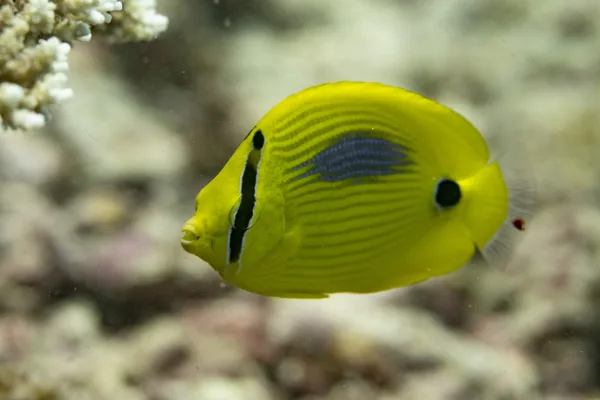
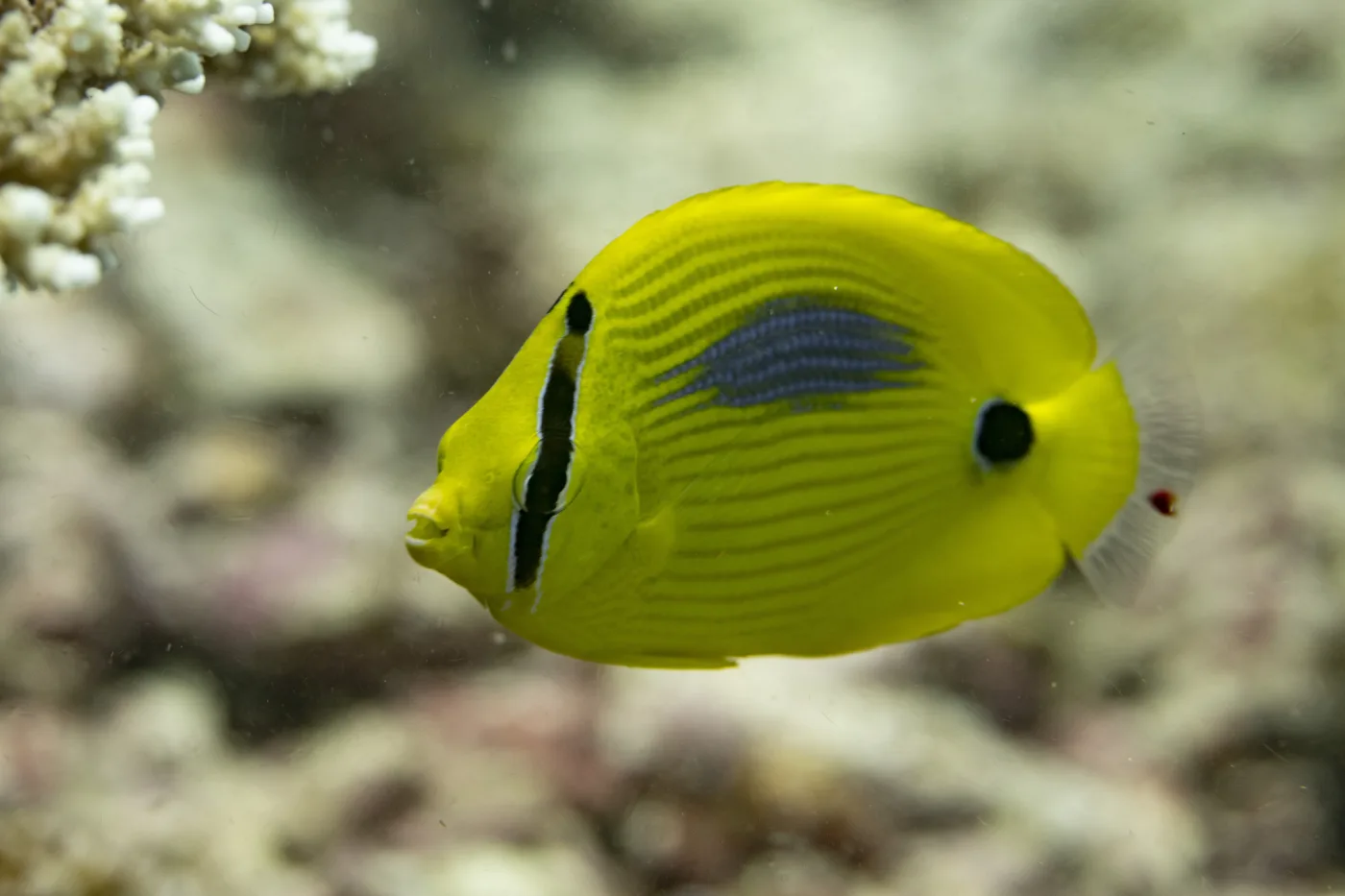
The bluespot butterflyfish is a small, flat fish. It is bright yellow. On each side it has a long patch of shiny blue. A black stripe runs over each eye. A black spot sits near its tail. Babies are all yellow. They get the blue patch when they grow up. It lives on coral reefs near Australia, Japan and Fiji. Grown-ups eat almost nothing but coral. They pick tiny coral animals called polyps off the reef. A baby picks its own coral home and eats from it. Babies also help other fish. They pick tiny pests off their skin. In a tank, this fish is hard to keep. It may not eat normal fish food at all. It needs an expert keeper, a big tank and lots of small meals.
Water & care
A coral specialist that only suits experienced keepers. Adults in the wild eat almost nothing but live coral polyps, and Quality Marine rates it Difficult. LiveAquaria describes it as hardier than many butterflyfish, so some individuals do adapt, but only buy one that is already eating frozen foods in front of you. Keep it in a large, mature fish-only tank with plenty of rock, calm tankmates and several small meals a day, and quarantine it carefully.
| Parameter | Keep it at | Where that sits on the usual reef range |
|---|---|---|
| Temperature | 72–78 °F | |
| Salinity (SG) | 1.020–1.025 | |
| pH | 8.1–8.4 | |
| Alkalinity | 8–12 dKH |
LiveAquaria and Quality Marine agree on 72-78°F, SG 1.020-1.025, pH 8.1-8.4 and 8-12 dKH. The general OATA butterflyfish care sheet suggests nitrate no higher than 50 mg/L. No species-specific calcium, magnesium or phosphate needs are published.
Feeding
DietCarnivore
Favorite foods
- Live coral polyps (in the wild)
- Mysis shrimp
- Vitamin-enriched brine shrimp
- Frozen marine foods
- Spirulina and marine algae
In the wild adults are obligate coral eaters, so the hard part is getting a fish onto aquarium foods. LiveAquaria suggests a varied diet of vitamin-enriched brine shrimp, mysis, spirulina, marine algae and frozen marine foods two to three times a day; Quality Marine lists live foods and several meals a day. Feed only what it eats within a few minutes (OATA), and watch its belly closely in the first weeks.
Tank & maintenance
- Minimum tank
- 90 gallons
- Aquascape
- A large, mature tank with plenty of live rock for grazing and shelter, and open swimming room. A lid is recommended, because butterflyfish can jump.
- Lighting
- No special requirement; Quality Marine lists medium lighting.
- Water flow
- Medium flow (LiveAquaria).
Routine upkeep
Regular partial water changes (OATA suggests 25% a week) and weekly water tests. Feed several small meals a day and keep a close eye on body condition, since a coral specialist that is not eating enough loses weight quickly.
Temperament & tankmates
TemperamentPeaceful
Peaceful toward most fish (LiveAquaria). Quality Marine notes it can become territorial in a tank that is too small, and coral-feeding butterflyfish in general are territorial around a favored coral head. Keep one, or a pair, and avoid similar yellow butterflyfish in small tanks.
Reef safeNo
Not reef safe. It is an obligate coral eater in the wild, feeding mainly on Pocillopora and Acropora polyps, and LiveAquaria warns that it may nip soft corals, stony corals, tube worms, ornamental shrimp and anemones.
Good tankmates
- Tangs
- Angelfish that are not too aggressive
- Peaceful, slow-feeding community fish
- Different-looking butterflyfish added at the same time in a large tank
Avoid
- All stony and soft corals, especially Pocillopora and Acropora
- Anemones, tube worms and ornamental shrimp
- Fast, aggressive feeders that take its food
- Similar yellow butterflyfish in a small tank
Help it thrive
- Only buy a fish that is already eating frozen foods in the store.
- Watch its belly closely in the first weeks and act fast if it stops eating.
- Offer varied meaty foods and algae two to three or more times a day.
- Keep it in a mature fish-only tank of 90 gallons or more without corals.
- Quarantine it in a calm tank where it does not have to compete for food.
Common ailments
Starvation from refusing prepared foods
- Signs
- The fish picks at rock but ignores frozen and dry foods, hides, and develops a pinched belly and sunken back.
- Prevention
- Buy only a fish seen eating frozen foods, and give it a mature tank with peaceful tankmates and several meals a day.
- Treatment
- Offer live foods and a wide variety of fresh and frozen meaty foods several times a day; fresh clam or mussel on the half shell is a common trigger for butterflyfish. If it still will not eat, return it or move it to a calmer system quickly.
Marine ich (Cryptocaryon irritans)
- Signs
- White, salt-like spots on the body, fins or gills, scratching, rapid breathing, cloudy eyes, hiding and loss of appetite.
- Prevention
- Quarantine every new fish in a separate tank before adding it to the display, keep water stable and feed well.
- Treatment
- Treat in a hospital tank with copper, a quinine-based drug such as chloroquine phosphate, or the tank-transfer method, never in a tank with invertebrates. Leave the display without fish for about 11 weeks, because the cyst stage can last up to 72 days.
Marine velvet (Amyloodinium ocellatum)
- Signs
- Rapid breathing, scratching, jerky swimming, crowding near the surface, lethargy and sometimes a dusty sheen on the skin. Heavy infections can kill within 12 to 48 hours.
- Prevention
- Strict quarantine of all new fish, and disinfect nets and buckets between tanks.
- Treatment
- Act at once: a temperature- and pH-matched freshwater dip for short-term relief, then copper or chloroquine in a hospital tank. Leave the display fallow with no fish.
This is general hobby guidance, not veterinary advice. Quarantine new arrivals and treat in a separate tank whenever you can.
Risks of owning one
- An obligate coral eater in the wild; many individuals never accept aquarium foods.
- Eats corals, anemones, tube worms and ornamental shrimp.
- Loses condition quickly if it is outcompeted at feeding time.
- Wild-caught only; no captive-bred supply was found.
Breeding
DifficultyNot achieved Captive-bredRare or wild-caught
Monogamous; forms distinct pairs during breeding (FishBase). Like other butterflyfish it is a pelagic spawner: floating eggs drift in the plankton, and the young pass through a tholichthys stage covered in bony plates before settling onto a live coral colony. No captive rearing of this species was found in the sources checked.
- Pairs form on their own in the wild; there is no published method for pairing aquarium fish.
- Spawning would release floating eggs into the water column, which would need to be collected from the overflow.
- Rearing has not been documented, and settling juveniles in the wild need live coral to feed on.
Deep dive The science, history and family tree
The science
Chaetodon plebeius is a butterflyfish (family Chaetodontidae) of the western Pacific and eastern Indian Ocean. Adults are bright yellow with a large, horizontally elongated blue blotch on the upper flank, a blue-edged black bar through the eye and a blue-edged black spot on the caudal peduncle; juveniles lack the blue blotch. Maximum total length is about 15 cm. It ranges from the Andaman Sea and Vietnam east to Fiji and Tonga, north to southern Japan and south to Australia, but is largely absent from Indonesia except northern Papua. It lives in coral habitats from shallow coastal lagoons to outer reef slopes at about 1-14 m, alone or in pairs. Adults are obligate corallivores, feeding mainly on the polyps of Pocillopora and also Acropora, with a little filamentous algae, and the species depends on live coral for both food and recruitment. Small juveniles usually feed from a single host colony and have been recorded cleaning ectoparasites from other fishes. It is placed in the subgenus Tetrachaetodon, of which it appears to be the most basal living member. The IUCN lists it as Least Concern.
- Appearance
- Bright yellow body and fins with a long, iridescent blue blotch on the upper side, fine horizontal lines on the flanks, a black bar through the eye edged in bluish white, and a black spot edged in bluish white on the tail base that looks like a false eye. Juveniles are intensely yellow and lack the blue blotch; Quality Marine notes that the white border around the tail spot also develops with age. The sexes look alike.
- Native range
- Western Pacific and eastern Indian Ocean: from the Andaman Sea and Vietnam east to Fiji and Tonga, north to southern Japan and south to Australia; largely absent from Indonesia except northern Papua. In Australia it occurs from Rottnest Island north to the Dampier Archipelago in Western Australia, and from the northern Great Barrier Reef south to Arrawarra near Coffs Harbour in New South Wales, plus Coral Sea reefs, Middleton and Elizabeth Reefs and Lord Howe Island. Type locality: 'South Seas'.
- Habitat
- Coral reef habitats from shallow coastal and lagoon areas to outer reef slopes, at about 1-14 m (FishBase gives to 10 m). Solitary or in pairs. It relies on live corals for food and for settlement of its young: small juveniles live on, and feed from, a single host coral colony.
- Size
- 6 in (15 cm). FishBase, Fishes of Australia and the Australian Museum give 15 cm (about 6 in) total length as the maximum; LiveAquaria and Quality Marine also list 6 in.
- Lifespan
- Not documented: no published longevity figure for this species was found. OATA notes that butterflyfish can live for many years in a mature tank with good water quality, but advises avoiding coral-polyp eaters because their diet is hard to meet in aquariums.
- Conservation
- Least Concern. Assessed Least Concern by the IUCN (Myers and Pratchett, 2010); FishBase lists CITES as not evaluated and rates its fishing vulnerability as low. Because it depends on live coral for food and recruitment, it is vulnerable to coral bleaching and reef decline; Bellwood et al. (2010) note that coral-feeding butterflyfish lineages are especially vulnerable to global coral decline. Aquarium fish are wild-collected; no captive-bred supply was found
In the aquarium vs in the wild
In your aquarium
A striking yellow-and-blue display fish for experienced keepers with a large fish-only aquarium.
On the reef
A specialist coral predator of shallow Pacific reefs, feeding on Pocillopora and Acropora polyps; juveniles also act as part-time cleaners of other fish.
History
Georges Cuvier described the species in 1831 in Histoire Naturelle des Poissons, with the type locality given only as the 'South Seas' (Mers du Sud). Later names for the same fish, Chaetodon cordiformis Thiollière, 1857 and Megaprotodon maculiceps Ogilby, 1910, are now synonyms, and some older works place it in the genus Megaprotodon. Quality Marine describes it as uncommon in the aquarium trade, and its coral diet has kept it a fish for specialists.
Evolution & relatives
Butterflyfishes (Chaetodontidae) are a family of about 129 species in 12 genera. Molecular studies suggest they shared a common ancestor with the scats and the marine angelfishes in the Early Eocene, about 54 million years ago, and WoRMS places the family in the order Acanthuriformes with tangs and angelfish. Bellwood and colleagues (2010) found that butterflyfishes moved onto coral reefs in the Miocene, followed by rapid diversification in Chaetodon, and that coral feeding evolved at least five separate times between about 15.7 and 3 million years ago; of the 41 reef fishes known to feed mainly on corals, 61% are butterflyfishes. The bluespot belongs to the subgenus Tetrachaetodon, butterflyfishes with angular yellow bodies, black eye stripes and one differently colored patch, and appears to be its most basal living species. If Chaetodon is split into several genera, this group would go to Megaprotodon.
Family tree, from kingdom down
- Kingdom Animalia Animals Animals are living things made of many cells that must eat food to live. Fish, corals, crabs, snails and sea stars are all animals.
- Phylum Chordata Chordates Chordates have a stiff rod running down their back at some point in their lives. In fish and people, this rod is replaced by a backbone.
- Subphylum Vertebrata Vertebrates Vertebrates are animals with a backbone and a skull. Fish, frogs, birds and people are all vertebrates.
- Infraphylum Gnathostomata jawed vertebrates
- Parvphylum Osteichthyes bony fishes
- Gigaclass Actinopterygii ray-finned fishes
- Superclass Actinopteri
- Class Teleostei Teleost fishes Teleosts are bony fishes with thin, bendy fin rays and jaws that can push forward. Almost all of the fish in the world are teleosts.
- Order Acanthuriformes Surgeonfishes, angelfishes and kin This order of fishes includes surgeonfishes, marine angelfishes and rabbitfishes. Many have deep, flat bodies and graze on reefs.
- Family Chaetodontidae Butterflyfishes Butterflyfishes are flat, colorful reef fish with small, pointy mouths. Many have a dark stripe over each eye, and lots of them eat coral.
- Genus Chaetodon
- Species Chaetodon plebeius
See it on the Tree of Life Compare with another species
Closest relatives
- Chaetodon speculum Ovalspot Butterflyfish Same subgenus (Tetrachaetodon)
- Chaetodon bennetti Bennett's Butterflyfish Same subgenus (Tetrachaetodon)
- Chaetodon zanzibarensis Zanzibar Butterflyfish Same subgenus (Tetrachaetodon)
- Chaetodon trifascialis Chevron Butterflyfish Same subgenus group (Megaprotodon)
Older scientific names: Megaprotodon plebeius, Chaetodon cordiformis.
Fun facts
- Young bluespots work as cleaner fish, picking parasites off other reef fish.
- In one study, 38 of 43 small juveniles fed only from a single coral colony, their own 'home' coral.
- Heavy feeding by juveniles reduced the tissue of their host corals by up to about half (53.4%).
- Juveniles are plain yellow; the blue blotch that gives the fish its name appears as it grows.
- It is largely absent from Indonesia, except northern Papua, even though its range reaches all around it.
Learn more
- FishBase: Chaetodon plebeius, Blueblotch butterflyfish fishbase.se
- WoRMS: Chaetodon plebeius Cuvier, 1831 marinespecies.org
- Fishes of Australia: Bluespot Butterflyfish fishesofaustralia.net.au
- Bellwood et al. 2010, Evolutionary history of the butterflyfishes researchonline.jcu.edu.au
Sources
- FishBase species summary: Chaetodon plebeius fishbase.se
- Wikipedia: Blueblotch butterflyfish en.wikipedia.org
- Fishes of Australia: Chaetodon plebeius fishesofaustralia.net.au
- Australian Museum: Bluespot Butterflyfish australian.museum
- LiveAquaria: Blue Spot Butterflyfish liveaquaria.com
- Quality Marine: Blueblotch Butterflyfish qualitymarine.com
- Cole and Pratchett 2011, Effects of juvenile coral-feeding butterflyfishes on host corals researchonline.jcu.edu.au
- OATA: How to look after butterfly fish ornamentalfish.org
Scientific names and classification follow the World Register of Marine Species (AphiaID 273354). Checked by our team. Last updated October 29, 2026.
Shop this species
Search the shop →
Only 1 left