 Sold out
Invertebrates · Hermit crab
Blue Leg Hermit Crab
Clibanarius tricolor
Also called Blue-legged hermit crab, Blueleg reef hermit, Tricolor hermit crab, Three-colored hermit crab, Dwarf blue leg hermit, Blue-knee hermit, Equal-handed hermit crab
- CareEasy
- Reef safeYes
- TemperamentPeacefulFights snails and other hermits for shells
- Favorite foods
- Hair and film algae
- Leftover food / detritus
- Dried seaweed / nori
- Max size1 in (2.5 cm)
- Min tank20 gal
- LifespanOften about 1-2 years in aquariums
- IUCN statusNot Evaluated
Quick answers
- How big does the Blue Leg Hermit Crab get?
- Up to 1 in (2.5 cm).
- What size tank does it need?
- At least 20 gallons.
- How hard is it to keep?
- Care level: Easy.
- Is it reef safe?
- Yes. It does not eat healthy corals, though climbing crabs can knock over loose frags and make polyps close temporarily.
- What does it eat?
- Hair and film algae
- Leftover food / detritus
- Dried seaweed / nori
- How long does it live?
- Often about 1-2 years in aquariums (TFH, Mexican Crabs).
- What are good tankmates?
- Peaceful reef fish such as clownfish, gobies, blennies and cardinalfish
- Corals of all kinds, if frags are glued down
- Other blue leg hermits in groups, with plenty of spare shells
- Larger snails such as big turbo or Mexican turbo snails, with spare shells available
The 30-second version
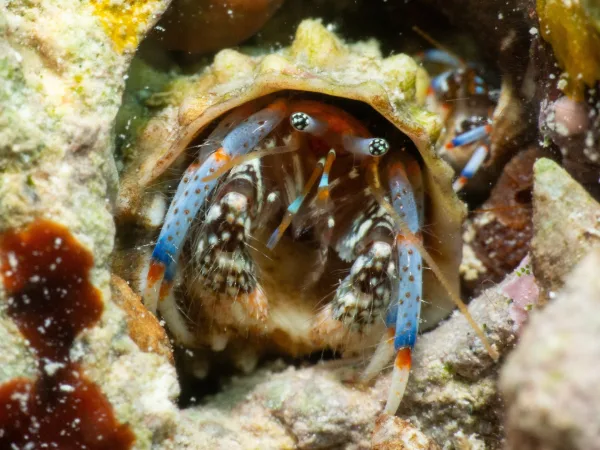
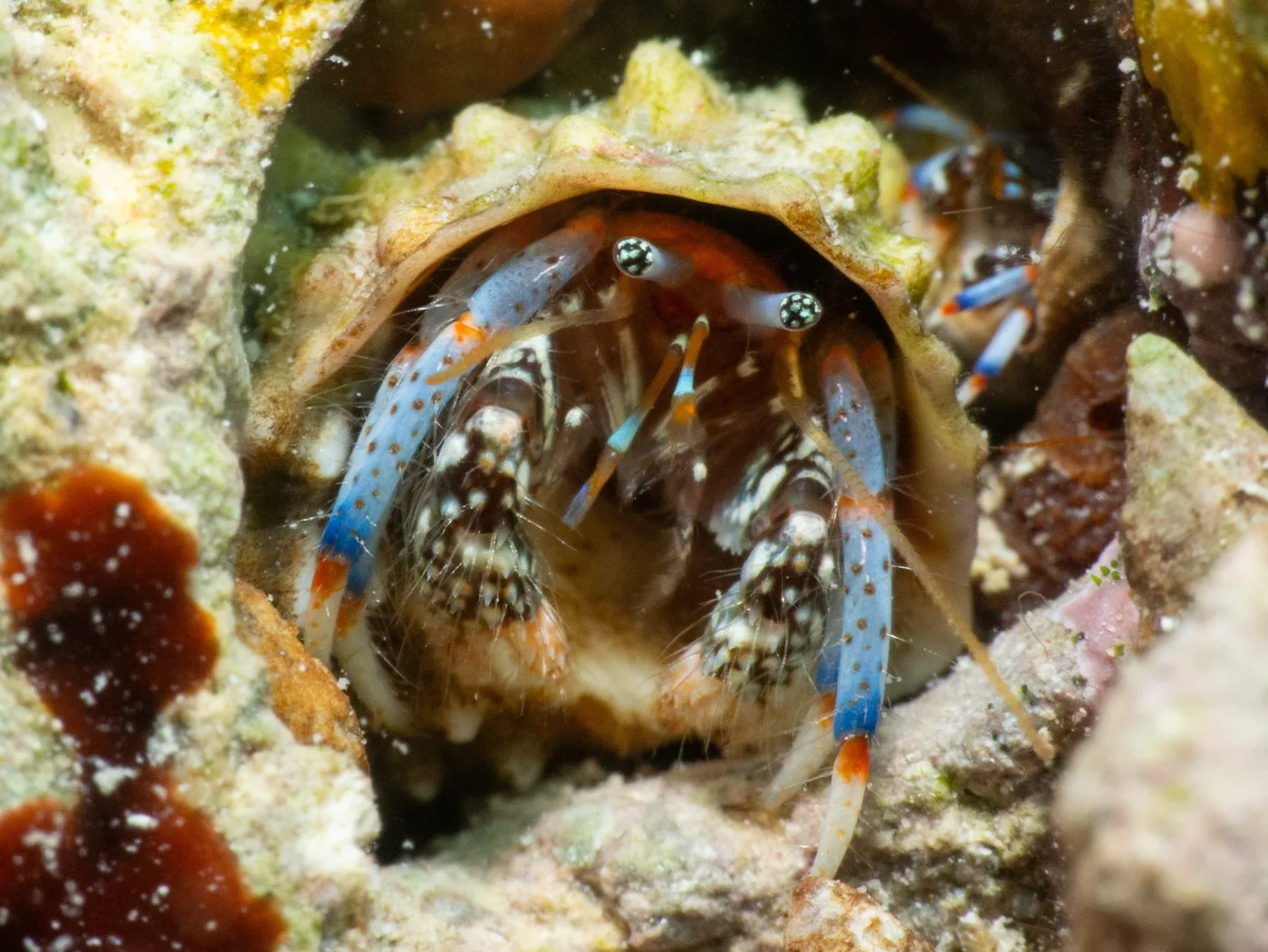
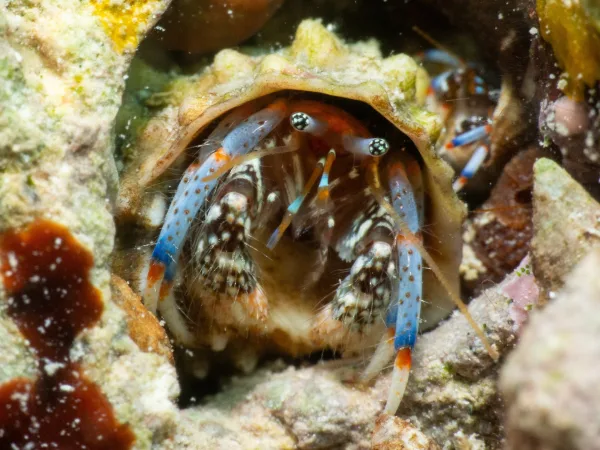
The blue leg hermit crab is a tiny crab with bright blue legs. Each leg has red or orange bands, and its feelers are orange. It is only about as long as your thumbnail. A hermit crab has a soft, curly tail end, so it tucks it inside an empty snail shell. It carries the shell around like a house. As it grows, it needs a bigger shell. Hermit crabs fight over shells. One crab may flip another one over and shake it out of its house! Some crabs even kill a live snail to take its shell. That is why reefers put lots of empty shells in the tank. In the wild, these crabs live in warm, shallow water in Florida and the Caribbean. In a tank, they climb all over the rocks and eat algae, gunk and bits of leftover food.
Water & care
Very hardy and a staple of reef cleanup crews. It needs a cycled tank with some algae and detritus to eat, stable salinity, copper-free water, and, above all, a supply of empty shells slightly larger than the ones the crabs wear. In a brand-new, spotless tank it may starve; supplement with dried seaweed or an algae wafer if algae runs out. Acclimate slowly, as for any invertebrate.
| Parameter | Keep it at | Where that sits on the usual reef range |
|---|---|---|
| Temperature | 72–82 °F | |
| Salinity (SG) | 1.023–1.025 | |
| pH | 8.1–8.4 | |
| Alkalinity | 8–12 dKH | |
| Calcium | 380–430 ppm |
LiveAquaria gives 72-78 F, dKH 8-12, pH 8.1-8.4 and SG 1.020-1.025; TFH gives 75-82 F, pH 8.1-8.2, SG 1.023-1.025, calcium 380-430 ppm and alkalinity 2.5 meq/L (about 7 dKH). It tolerates a range of conditions; keep normal, stable reef parameters for your corals. Magnesium and nutrient targets are not species-specific, so they are left blank. Sensitive to copper; keep ammonia and nitrite at zero.
Feeding
DietOmnivore
Favorite foods
- Film algae, hair algae and cyanobacteria
- Detritus and leftover fish food
- Dried seaweed (nori) and algae wafers
- Dead animals and sinking pellets
Mostly forages on its own. If the tank is very clean, add a small piece of dried seaweed or an algae wafer a couple of times a week so the crabs do not starve or turn on snails. Do not overfeed; leftovers foul the water.
Tank & maintenance
- Minimum tank
- 20 gallons
- Aquascape
- Live rock with plenty of crevices and a sand bed. Keep a handful of empty snail shells (cerith-type and turbo-type) in a range of sizes slightly larger than the crabs' current shells, and add bigger ones as they grow. Glue down frags so they are not knocked over.
- Lighting
- No special needs; it is most active at dusk and at night.
- Water flow
- Any normal reef flow.
Routine upkeep
Check the shell supply every month or two and add larger empty shells as the crabs grow. Watch for empty shells or missing snails and add food if algae has run out. Leave apparent 'dead' crabs alone for a day or two: a molted exoskeleton looks like a dead crab, and molting crabs hide for days. Remove genuinely dead crabs promptly.
Temperament & tankmates
TemperamentPeaceful
Peaceful toward fish and corals (LiveAquaria lists it as peaceful), but it attacks other hermit crabs and sometimes snails to take their shells, and freshly molted crabs are especially at risk. One reference calls it aggressive for this reason. It loses shell fights to larger hermits such as Calcinus.
Reef safeYes
It does not eat healthy corals, though climbing crabs can knock over loose frags and make polyps close temporarily. The real risk is to snails and other hermits: blue legs fight over shells and may kill and eat live snails, especially small turbo, Trochus, Cerith and Nassarius snails, when they need a bigger shell or are hungry. Provide plenty of spare empty shells and enough food to reduce losses.
Good tankmates
- Peaceful reef fish such as clownfish, gobies, blennies and cardinalfish
- Corals of all kinds, if frags are glued down
- Other blue leg hermits in groups, with plenty of spare shells
- Larger snails such as big turbo or Mexican turbo snails, with spare shells available
Avoid
- Small or expensive snails in tanks without spare shells
- Wrasses, triggerfish, puffers and hawkfish that eat small crustaceans
- Large predatory crabs and larger aggressive hermits
- Copper-based medications in the display
Help it thrive
- Always keep spare empty shells, slightly larger than the ones your crabs wear, to reduce shell fights and snail killings.
- Do not add a large group to a new, spotless tank; add a few once algae and detritus have appeared.
- Supplement with dried seaweed or algae wafers if they start roaming the glass constantly.
- Keep copper and copper medications out of the display.
- Glue frags down so climbing crabs cannot topple them.
- If snails keep turning up empty, check whether the crabs are killing them or just scavenging snails that died of other causes.
Common ailments
Failed or stressful molt
- Signs
- The crab stays out of its shell, is limp or cannot shed fully; or dies soon after a molt.
- Prevention
- Stable salinity, normal calcium, alkalinity and iodine levels, and safe hiding places and shells.
- Treatment
- Leave it undisturbed; check salinity and calcium. Make sure spare shells are available so a freshly molted crab can rehouse quickly.
Starvation
- Signs
- Crabs roam the glass constantly, attack snails or each other more often, and numbers slowly decline.
- Prevention
- Stock only as many as the tank's algae and detritus can support.
- Treatment
- Add dried seaweed, algae wafers or sinking pellets a few times a week, and do not add more crabs.
Shell fights and evictions
- Signs
- Crabs flipping each other, empty shells, or a crab out of its shell or dead.
- Prevention
- Plenty of empty shells in several sizes, with openings similar to the crabs' current shells.
- Treatment
- Add more and larger shells straight away; move a bullied, shell-less crab to a container with spare shells until it rehouses.
Copper or medication poisoning
- Signs
- Crabs stop moving, come out of their shells, or die after a treatment.
- Prevention
- Never use copper or invertebrate-unsafe medications in a tank with crabs; treat fish in a separate tank.
- Treatment
- Move the crabs to clean water, run carbon and do large water changes.
This is general hobby guidance, not veterinary advice. Quarantine new arrivals and treat in a separate tank whenever you can.
Risks of owning one
- It may kill and eat live snails, and fight other hermits, to get a better shell or when hungry.
- Climbing crabs can knock over unglued frags and disturb polyps.
- In a new or very clean tank it may starve without supplemental food.
- Wild harvest is very large; buy only as many as your tank can support.
Breeding
DifficultyNot achieved Captive-bredRare or wild-caught
Not bred in aquariums. In the wild, males and females mate after the female molts, and the female carries a clutch of a few hundred embryos under her abdomen until they hatch as planktonic larvae. The larval development of C. tricolor has not been described; related Clibanarius species pass through several zoeal stages and a megalopa before settling and finding a first shell.
- Females in home tanks sometimes carry eggs; they are tucked under the abdomen inside the shell.
- Hatched larvae are tiny plankton and are normally eaten by fish or removed by filtration.
- No reliable aquarium rearing method has been published, so all trade stock is wild-collected.
Deep dive The science, history and family tree
The science
Clibanarius tricolor (Gibbes, 1850) is a small hermit crab (Anomura: Paguroidea: Diogenidae) of the tropical western Atlantic, recorded from Bermuda, Florida, the Bahamas, the Gulf of Mexico and throughout the Caribbean. It was described as Pagurus tricolor; Clibanarius hebes Verrill, 1908 and C. brachyops Bouvier, 1918 are junior synonyms. Like other Clibanarius it has chelipeds of nearly equal size, unlike the strongly enlarged left claw of many diogenids. The walking legs are blue with red to orange bands at the joints, and the antennae are orange. Individuals are small: mean shield lengths in Florida Keys populations were about 2.2-2.6 mm in males and 1.8-2.2 mm in females, and overall size reaches about 2 cm. The species lives in the low intertidal and shallow subtidal, mostly above 3 m, on rock, rubble, sand and seagrass. It forms dense aggregations that rest by day and forage together from dusk through the night, and individuals tend to stay with the same group. It grazes algal films and cyanobacteria and scavenges detritus and carrion. Gastropod shells are a limiting resource; in the Florida Keys, Cerithium shells were the main or only type used. Crabs fight over shells by flipping a rival and repeatedly shaking its shell until it is evicted; in Curaçao, smaller crabs rarely beat larger ones, and freshly molted crabs were attacked more often and lost more often. In laboratory fights C. tricolor beat C. antillensis but lost to Calcinus tibicen. Females brood embryos under the abdomen, with mean fecundity of about 180-610 embryos per female across Florida Keys sites. It has been called the most heavily traded marine invertebrate in the western Atlantic, with about 2.4 million taken in Florida in 2007.
- Appearance
- A tiny hermit crab in a borrowed snail shell, usually a slender, pointed cerith or similar shell. The walking legs are bright blue with red or orange bands at the joints, the antennae are orange, and the two claws are about the same size. Look-alikes: the Mexican red-leg hermit (Clibanarius digueti, eastern Pacific) has red legs; the scarlet reef hermit (Paguristes cadenati) is solid red with yellow eyestalks; Calcinus hermits such as the orangeclaw hermit (Calcinus tibicen) have one claw clearly larger than the other; the zebra and electric blue hermits sold from the Indo-Pacific belong to other genera.
- Native range
- Tropical western Atlantic: Bermuda, Florida (especially the Florida Keys), the Bahamas, the Gulf of Mexico (including the Mexican Atlantic coast and Yucatan) and throughout the Caribbean Sea, roughly 33 N to 7 N (SeaLifeBase). Aquarium stock is wild-collected, largely in Florida.
- Habitat
- Rocky intertidal and shallow subtidal zones, usually 0-3 m (rarely deeper; one source gives up to 7 m), on hard bottom, rubble, sand and seagrass, often in clear water near rock and coral. It gathers in dense groups in very shallow water (about 30 cm) and in tide pools at low tide, with small daily home ranges.
- Size
- 1 in (2.5 cm). Wikipedia and Florent's Reef Guide give about 2 cm (0.8 in); LiveAquaria and TFH give 1 in (2.5 cm), which includes legs and shell. Shield length (the hard front plate) averages only about 2-2.6 mm in Florida Keys males and 1.8-2.2 mm in females. Males grow larger than females. Animals are sold at about 1/4-3/4 in.
- Lifespan
- Often about 1-2 years in aquariums (TFH, Mexican Crabs). Wild lifespan is unknown; a 30-year wild figure quoted by one magazine could not be confirmed.
- Conservation
- Not Evaluated. Not evaluated by the IUCN Red List and not CITES-listed. It is abundant and widespread, but it is one of the most heavily harvested aquarium invertebrates: Florida's licensed marine-life fishery took about 2.4 million in 2007 (Baeza & Behringer 2017). All trade stock is wild-collected; it has not been bred in captivity
In the aquarium vs in the wild
In your aquarium
A cleanup-crew staple that grazes film algae, hair algae and cyanobacteria, eats leftover food and detritus, and stirs the top of the sand bed; usually sold in packs.
On the reef
A grazer and scavenger in shallow, hard-bottom and seagrass habitats, where large aggregations crop algal films and recycle detritus. It is prey for fish and other predators and competes with other hermit crabs for gastropod shells.
History
Lewis R. Gibbes described the species as Pagurus tricolor in 1850 in his account of the carcinological collections of the United States. Verrill's Clibanarius hebes (1908) and Bouvier's C. brachyops (1918) were later recognized as the same species. Its group-living and shell fighting were studied in Curaçao by Hazlett in the 1960s and in competition experiments in the 1970s. With the rise of reef aquariums and the idea of a working 'cleanup crew', the blue leg hermit became one of the most popular invertebrates in the hobby, supplied mostly by the Florida marine-life fishery.
Evolution & relatives
Hermit crabs belong to the Anomura, the decapod group that also contains squat lobsters, porcelain crabs and king crabs; king crabs are thought to have evolved from hermit crab ancestors and lost the shell-dwelling habit. Hermit crabs evolved a soft, twisted abdomen that fits into the coiled shells of snails. Fossils show hermit crabs were already diverse in Late Jurassic (Oxfordian) sponge reefs of Poland, about 160 million years ago, where early members of the family Diogenidae lived alongside other early hermit crab families (Fraaije et al. 2012). Clibanarius is a large, mostly shallow-water and intertidal genus with dozens of species around the tropics.
Family tree, from kingdom down
- Kingdom Animalia Animals Animals are living things made of many cells that must eat food to live. Fish, corals, crabs, snails and sea stars are all animals.
- Phylum Arthropoda Arthropods Arthropods have jointed legs and a hard outer shell called an exoskeleton. To grow, they must crawl out of the old shell, which is called molting.
- Subphylum Crustacea Crustaceans Crustaceans are arthropods with a hard shell and two pairs of feelers. Most live in water, like crabs, shrimps and lobsters.
- Superclass Multicrustacea
- Class Malacostraca Malacostracans This big class of crustaceans includes crabs, shrimps, lobsters and krill. Their bodies are built from about the same number of segments.
- Subclass Eumalacostraca
- Superorder Eucarida
- Order Decapoda Decapods Decapod means 'ten feet'. Crabs, shrimps, lobsters and hermit crabs all have ten legs, counting their claws.
- Suborder Pleocyemata Egg-carrying decapods
- Infraorder Anomura anomurans (hermit crabs and kin)
- Superfamily Paguroidea hermit crabs
- Family Diogenidae Left-handed hermit crabs In many of these hermit crabs, the left claw is bigger than the right. They live in empty snail shells.
- Genus Clibanarius Clibanarius hermit crabs These hermit crabs have two claws of about the same size. Most live in shallow, warm water near the shore.
- Species Clibanarius tricolor
See it on the Tree of Life Compare with another species
Closest relatives
- Clibanarius digueti Mexican red-leg hermit crab Same genus; eastern Pacific species also sold for cleanup crews
- Clibanarius antillensis (no common name) Same genus; western Atlantic species that loses shell fights to C. tricolor
- Calcinus tibicen Orangeclaw hermit crab Same family (Diogenidae); a larger Caribbean hermit that wins shell fights against C. tricolor
- Paguristes cadenati Scarlet reef hermit crab Same family (Diogenidae); another popular Caribbean cleanup-crew hermit
- Cerithium Cerith snails Not a relative; the snails whose empty shells it uses most in the Florida Keys
Older scientific names: Pagurus tricolor, Clibanarius hebes, Clibanarius brachyops.
Fun facts
- To steal a shell, a blue leg flips its rival over, spins it and shakes the shell up and down until the other crab falls out.
- Wild groups rest together by day and set off at dusk, all heading the same way like grazing cattle, then return to their spot before dawn.
- Unlike many of its 'left-handed' relatives, the blue leg hermit has two claws of about the same size.
- Florida collectors took about 2.4 million of these tiny crabs in a single year for aquariums.
- A freshly shed skin looks exactly like a dead crab, so many keepers have 'buried' a crab that was alive and well.
Learn more
- Wikipedia: Clibanarius tricolor en.wikipedia.org
- TFH Magazine: Clibanarius tricolor tfhmagazine.com
- Baeza & Behringer 2017, reproduction of the blue-legged hermit crab (PeerJ) pmc.ncbi.nlm.nih.gov
- WoRMS: Clibanarius tricolor marinespecies.org
Sources
- WoRMS: Clibanarius tricolor (Gibbes, 1850) marinespecies.org
- Wikipedia: Clibanarius tricolor en.wikipedia.org
- SeaLifeBase: Clibanarius tricolor sealifebase.se
- Baeza & Behringer 2017, PeerJ: Small-scale spatial variation in reproductive parameters of Clibanarius tricolor pmc.ncbi.nlm.nih.gov
- Hazlett 1966, Social behavior of the Paguridae and Diogenidae of Curacao repository.naturalis.nl
- Bach, Hazlett & Rittschof 1976, shell competition in Clibanarius tricolor scholars.duke.edu
- Florent's Guide to the Tropical Reefs: Blue-legged hermit crab reefguide.org
- Mexican Crabs: Blue-leg hermit crab mexican-crabs.org
- TFH Magazine: Clibanarius tricolor tfhmagazine.com
- LiveAquaria: Dwarf Blue Leg Hermit Crab liveaquaria.com
- Fraaije et al. 2012, New Late Jurassic symmetrical hermit crabs from the southern Polish Uplands (Acta Palaeontologica Polonica) app.pan.pl
- FishProfiles: Clibanarius tricolor fishprofiles.com
Care facts
The care facts on this guide and its product pages (care level, reef safety, temperament, size, tank, diet, flow, purpose, foods, acclimation and origin) combine 12 independent sources, checked October 25, 2026.
- Clibanarius tricolor Tropical Fish Hobbyist Magazine
- blue leg hermit crab Reef Exclusive
- Blue Leg Hermit Crab saltwater fish care guide Top Shelf Aquatics
- Dwarf Blue Leg Hermit Crab, Tiny LiveAquaria
- Invertebrate reference: Blue Leg Hermit Crab SeaScape Studio
- Dwarf Blue Leg Hermit Crab Quality Marine
- CRAB – HERMIT BLUE LEG Clibanarius tricolor Aquatics Unlimited
- Blue Eyed Hermit Crab Clibanarius Tricolor Sims Tropical Fish (UK)
- True Orange Legged Hermit Crab Clibanarius Tricolor Sims Tropical Fish
- Dwarf Blue Leg Hermit Crab - Crabs - Invertebrates Saltwaterfish.com
- Blue Leg Hermit Crab - Detailed Guide: Care, Diet, and Breeding Aquarium Breeder
- Blue Leg Hermit Crab Sustainable Aquatics
Scientific names and classification follow the World Register of Marine Species (AphiaID 367527). Last updated October 25, 2026.
Shop this species
Search the shop →Sold out right now. We restock weekly, so check back soon.
Sold out
 Sold out