 Sold out
Aquacultured
Corals · SPS coral
Birdsnest Coral
Seriatopora sp.
Also called Bird's nest coral, Purple Birdsnest, Pink Birdsnest, Green Birdsnest, Thin birdsnest coral (S. hystrix), Bird of Paradise coral (S. guttata), Needle coral, Finger coral, Bush coral
- CareModerate
- Reef safeYes
- TemperamentPeacefulPeaceful; easily damaged by neighbors' sweepers
- Favorite foods
- Light (zooxanthellae)
- Fine particulate foods
- Zooplankton / rotifers
- Max size15 in (38.1 cm)
- LifespanIn the wild S
- IUCN statusVulnerable
Quick answers
- How big does the Birdsnest Coral get?
- Up to 15 in (38.1 cm).
- How hard is it to keep?
- Care level: Moderate.
- Is it reef safe?
- Yes. A reef coral that harms nothing but neighbors its branches touch.
- What does it eat?
- Light (zooxanthellae)
- Fine particulate foods
- Zooplankton / rotifers
- How long does it live?
- In the wild S.
- What are good tankmates?
- Montipora, Acropora, Stylophora and other SPS (with spacing)
- Clownfish, gobies, blennies, cardinalfish and other reef-safe fish
- Tangs and rabbitfish for algae control
- Snails, hermit crabs and cleaner shrimp
- Small symbiotic crabs that may live in its branches
The 30-second version
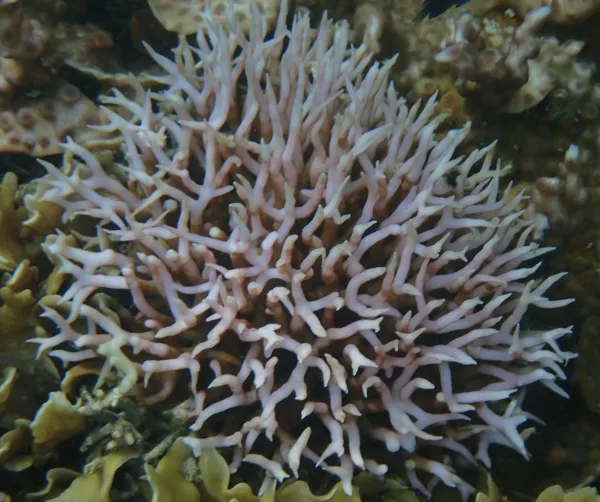
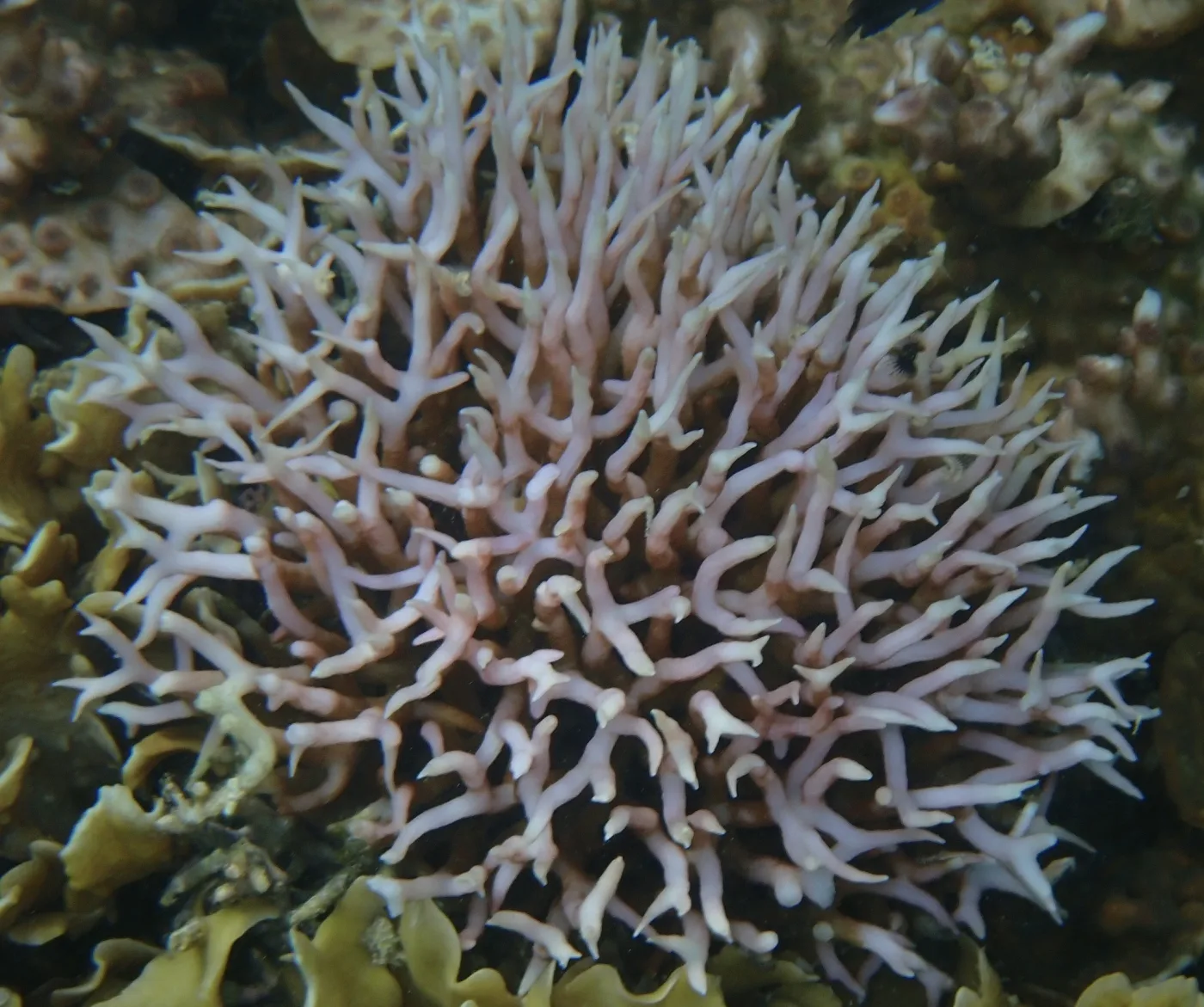
Birdsnest coral looks like a messy little nest made of thin, pointy sticks. Each stick is a branch of stony skeleton. Rows of tiny animals called polyps live along it. Tiny algae inside the coral use light to make food, so it needs a bright tank. It grows fast and comes in pink, purple, green and cream. The branches are thin and break easily. But a broken piece can grow into a whole new nest. In the sea, little crabs and shrimp hide between the branches. Some crabs even get the coral to grow a tiny room around them! Birdsnest corals like clean, steady water. If the water gets too hot or changes too fast, they can lose their color fast. So keepers watch them closely.
Water & care
Hardier and more forgiving than Acropora and one of the easiest SPS to grow and frag, but it is still a stony coral that needs a mature, stable reef, steady alkalinity and calcium, good flow and appropriate light. Lighting needs vary even within a species: some colonies bleach under bright light while others brown out when kept low, so start a new piece low and move it up stepwise while watching its color. It is sensitive to temperature spikes (S. hystrix readily bleaches after several days at more than about 0.5-1 C above its normal summer maximum) and to air exposure, and it can suffer rapid tissue necrosis. Pink morphs pale in ultra-low-nutrient tanks.
| Parameter | Keep it at | Where that sits on the usual reef range |
|---|---|---|
| Temperature | 75–80 °F | |
| Salinity (SG) | 1.025–1.026 | |
| pH | 8.1–8.4 | |
| Alkalinity | 7.5–10 dKH | |
| Calcium | 380–450 ppm | |
| Magnesium | 1,250–1,400 ppm | |
| Nitrate | 1–10 ppm | |
| Phosphate | 0.02–0.08 ppm |
Stability matters most. Avoid heat spikes: S. hystrix readily bleaches after several days at more than about 0.5-1 C (1-2 F) above its normal summer maximum (Mayfield et al. 2011), so keep temperature under about 82 F and use a chiller or fans if your room heats up. Fatherree recommends alkalinity anywhere from 7 to 12 dKH as long as it is stable; sharp alkalinity swings are linked to tissue necrosis. Ultra-low nutrients can bleach pink strains within weeks. Ammonia and nitrite must be zero.
Feeding
DietPhotosynthetic
Favorite foods
- Light (photosynthesis by its symbiotic algae)
- Dissolved organics
- Fine zooplankton and microplankton
No target feeding is required; it relies on photosynthesis plus fine plankton and dissolved organics in the water. Occasional broadcast feeding of fine plankton is fine, but do not overfeed the tank to 'feed the coral'. Pink strains need some nitrate and phosphate present to keep color.
Tank & maintenance
- Aquascape
- Any stable SPS-capable reef. Glue a frag with as little glue or epoxy as possible to a plug or rock in the middle to upper rockwork, where flow passes through the branches and the bush has room to expand on all sides.
- Lighting
- Medium to high, about 150-300 PAR depending on the colony (pink morphs often color best around 180-220 PAR and fade above about 300; green morphs tolerate 250-300). Start new pieces low or around 150 PAR for a week and raise light stepwise, watching for paling.
- Water flow
- Moderate to high, turbulent and indirect so the branches flex slightly; detritus collecting in the branches means flow is too low, and a strong direct laminar jet can snap the thin branches.
Routine upkeep
Test alkalinity, calcium and magnesium weekly and dose to keep up with growth. Watch daily for paling or tissue peeling from the base, keep powerheads clean so flow stays consistent, and frag the bush before it touches neighbors or becomes too dense for water to pass through.
Temperament & tankmates
TemperamentPeaceful
Weakly aggressive at most. Give it a few inches of clearance from other corals and keep it well away from strongly stinging corals such as Euphyllia, chalices and acans, which will damage it.
Reef safeYes
A reef coral that harms nothing but neighbors its branches touch. It has only short sweeper tentacles and loses fights with most LPS and soft corals; as the bush grows it can shade corals below it.
Good tankmates
- Montipora, Acropora, Stylophora and other SPS (with spacing)
- Clownfish, gobies, blennies, cardinalfish and other reef-safe fish
- Tangs and rabbitfish for algae control
- Snails, hermit crabs and cleaner shrimp
- Small symbiotic crabs that may live in its branches
Avoid
- Butterflyfish and coral-nipping angelfish
- Parrotfish and triggerfish that chew coral
- Euphyllia, chalices, acans and other strongly stinging corals within reach
- Direct high-velocity flow that snaps branches
Help it thrive
- Keep it submerged: birdsnest often dies after being exposed to air during rescaping, so move it underwater or keep air exposure to a few minutes at most.
- Use the smallest possible blob of glue or epoxy; birdsnest is poor at encrusting down over its base.
- Start new pieces low and move them up stepwise, watching color, because light needs vary from colony to colony.
- Guard against heat: a few hot days can bleach it.
- Give it turbulent, indirect flow so the branches sway slightly but never whip.
- Frag a few healthy tips as a backup; if a colony starts to strip, those backups can save the strain.
Common ailments
Rapid and slow tissue necrosis (RTN and STN)
- Signs
- Tissue peeling away to white skeleton, either slowly from the base (STN) or over large parts of the colony within about 24 hours (RTN).
- Prevention
- Keep alkalinity, temperature and salinity stable, provide good flow, and avoid sudden chemistry crashes or shocks.
- Treatment
- Act fast: frag healthy branch tips well away from the receding edge, dip and remount them, then find and correct the cause. Remove dead skeleton before it fouls with algae.
Bleaching (heat or light)
- Signs
- Branches turn pale or white, often the upper part of the colony first, after a heat spike or a move to brighter light.
- Prevention
- Keep temperature steady (under about 82 F), acclimate new pieces to light gradually, and keep some nutrients present for pink strains.
- Treatment
- Lower the coral or reduce light, correct temperature, and keep conditions stable; colonies moved lower often recolor over a few weeks.
Polyp bail-out and air-exposure losses
- Signs
- Polyps detach and drift away, leaving bare branches or patches, often after air exposure, shipping or other stress; small colonies may die after a short time out of water.
- Prevention
- Keep the coral submerged during rescaping, handle gently, and avoid sudden changes.
- Treatment
- Return it to stable conditions and good flow; frag any healthy tissue. Lost polyps rarely regrow on bare branches.
Base dieback at the attachment point
- Signs
- Tissue dies back next to the glue or epoxy, exposing skeleton at the narrow base, which becomes a weak point as the colony grows.
- Prevention
- Use minimal glue and mount the frag firmly so it does not rock.
- Treatment
- Keep the area clean of algae; if the base is very weak, frag the upper branches and remount them.
This is general hobby guidance, not veterinary advice. Quarantine new arrivals and treat in a separate tank whenever you can.
Risks of owning one
- It can die quickly: a heat spike, alkalinity swing or chemistry crash can trigger tissue necrosis that strips a colony within a day.
- Branches are very brittle and break during shipping, cleaning or rock work, and the needle-sharp tips of S. hystrix can prick fingers.
- Exposure to air during rescaping kills it more readily than many other stony corals.
- It consumes calcium and alkalinity as it grows, so you will need to test and dose.
- Color names are trade labels: a 'purple birdsnest' may be any of several Seriatopora species or even a Stylophora.
Propagation & fragging
DifficultyEasy AquaculturedWidely available
Propagated by fragging: any branch snapped from a healthy colony grows into a new bush, and a mature colony can yield dozens of frags a year. In the wild S. hystrix is hermaphroditic and broods larvae internally (and can also release new colonies by polyp bail-out), but these are not used for aquarium propagation. Nearly all aquarium birdsnest is aquacultured.
- Choose a healthy, well-colored colony and keep it underwater while you work as far as possible.
- With sharp wire or bone cutters, snap off a branch 2-3 cm (about 1 in) from the tip.
- Dip the frag briefly in a reef coral dip and rinse it in tank water.
- Glue it to a plug with a small amount of cyanoacrylate gel; less glue helps it encrust.
- Place it in moderate light and good flow; it should heal and attach in about 7-10 days.
- Move it gradually to its final spot and watch its color as you increase light.
Deep dive The science, history and family tree
The science
Seriatopora Lamarck, 1816 is a genus of zooxanthellate stony corals in the family Pocilloporidae, alongside Pocillopora and Stylophora. WoRMS currently accepts nine species; S. hystrix (thin birdsnest) is by far the most common in the aquarium trade, followed by S. caliendrum (sometimes called green birdsnest coral) and S. guttata, sold as 'Bird of Paradise'. Colonies are compact to open bushes of fine branches that often fuse (anastomose). The key diagnostic feature is the arrangement of the small corallites, which sit flush with the branch surface, in neat rows along the branches. S. hystrix has slender branches tapering to sharp points and is usually pink, less often cream, blue or green, while S. caliendrum has thicker, non-tapering, blunt branches and hooded corallites that recall Stylophora. Polyps of S. hystrix extend mainly at night, whereas S. caliendrum often extends tentacles by day. Branches are thicker and shorter in shallow, wave-exposed water and finer in sheltered or deeper sites. The genus ranges from the Red Sea and East Africa across the Indian Ocean and Indo-Pacific to the central Pacific, on reef flats, fore-reef slopes and lagoons, mostly at about 3-15 m (S. caliendrum to about 25 m). S. hystrix is a fast-growing, short-lived pioneer that often recolonizes disturbed reef first; it is hermaphroditic and broods larvae that can settle within about a day, passing its symbiotic algae on to them. Its branches shelter gall crabs and other symbiotic crustaceans. S. hystrix and S. caliendrum are assessed as Vulnerable on the IUCN Red List, and all species are listed on CITES Appendix II.
- Appearance
- A dense, rounded bush of thin, cylindrical branches that criss-cross and fuse, looking like a tangled bird's nest. Look closely at a branch and you will see the tiny polyp openings lined up in neat rows running along its length, the feature that identifies the genus. S. hystrix (the usual pink, purple or cream birdsnest) has thin branches with needle-sharp tips; S. caliendrum (cream or brown in the wild, sometimes called 'green birdsnest') and S. guttata ('Bird of Paradise', often bright green) have thicker branches with blunt, rounded tips; sellers label green birdsnest variously as S. caliendrum, S. guttata or S. hystrix. Colors in the trade include pink, purple, lavender, green, orange, yellow and cream, sometimes with differently colored polyps. Look-alikes: Stylophora (thicker, blunt branches; polyps not in rows) and Pocillopora (knobbly verrucae on the branches). Color names such as 'purple birdsnest' do not identify the species; the purple Stylophora sold as 'Milka' is a different genus.
- Native range
- Red Sea and East Africa (including Madagascar) across the Indian Ocean to Southeast Asia, tropical Australia, Japan, the South China Sea and central Pacific island groups. All species occur in the central tropical West Pacific; S. hystrix and S. caliendrum range west to the Red Sea.
- Habitat
- Shallow reef flats (including intertidal flats), sheltered lagoons and upper to fore-reef slopes, mostly 3-15 m and to about 25 m for S. caliendrum. Colonies can form extensive stands. The branches host gall crabs (females induce the coral to grow a chamber around them) and other symbiotic crabs and shrimps.
- Size
- 15 in (38.1 cm). Wild S. hystrix colonies can reach about 1 m (39 in) across, with individual branches up to about 15 cm (6 in) long. In aquariums colonies grow roughly 3-5 cm (1-2 in) per year under stable conditions and are usually fragged long before they reach large sizes.
- Lifespan
- In the wild S. hystrix is a short-lived 'weedy' coral with high growth and turnover. In aquariums colonies live for years in stable conditions, and clonal strains are kept indefinitely by fragging; colonies can die quickly from heat spikes or tissue necrosis.
- Conservation
- Vulnerable. Genus-level profile: the genus itself is not assessed. S. hystrix (the main aquarium species) and S. caliendrum are each listed as Vulnerable (S. hystrix under criteria A3ce, assessed 2023); other species vary or have not been checked here. All stony corals are on CITES Appendix II. S. hystrix is collected for the aquarium trade (about 15,000 pieces exported worldwide in 2005), but most birdsnest sold today, including our Purple Birdsnest, is aquacultured
In the aquarium vs in the wild
In your aquarium
Ornamental SPS coral grown for its fine, colorful branching shape in the middle to upper reef. Fast growth and easy fragging make it a staple of aquaculture and frag swaps and a common early SPS for reefers.
On the reef
A fast-growing pioneer coral that is often the first stony coral to recolonize disturbed reef. Its dense branches shelter gall crabs, which live as filter feeders in chambers the coral grows around them and do not feed on their host, as well as other symbiotic crabs and shrimps.
History
Jean-Baptiste Lamarck named the genus Seriatopora in 1816 in his Histoire naturelle des animaux sans vertebres. Hemprich and Ehrenberg described S. caliendrum from the Red Sea in 1834, and James Dwight Dana described S. hystrix in 1846 from material collected by the U.S. Exploring Expedition, with Fiji as the type locality. Veron's Corals of the World (2000) recognized six species; WoRMS now accepts nine, with more than 20 older names left as uncertain. In the reef hobby, birdsnest corals became popular as colorful, fast-growing, relatively forgiving SPS, and James Fatherree's widely read husbandry article (2015) describes S. hystrix as the most common species in the trade, with S. caliendrum second. About 15,000 wild pieces of S. hystrix were exported in 2005, but aquacultured pink, purple, green and 'Bird of Paradise' strains now dominate the market.
Evolution & relatives
Seriatopora is one of a handful of genera in the family Pocilloporidae, together with Pocillopora, Stylophora and (per WoRMS) Madracis. Molecular studies place Pocilloporidae among the 'robust' corals, which WoRMS ranks as suborder Vacatina, so birdsnest corals are only distantly related to Montipora and Acropora (the 'complex' corals, suborder Refertina) despite looking like typical branching SPS; fine branching evolved separately in the two lineages. Within the family, Seriatopora is most similar to Stylophora: S. caliendrum has Stylophora-like hooded corallites and robust colonies can be confused with slender Stylophora, and the two genera share an unusual duplicated mitochondrial tRNA gene (trnW), while pocilloporids carry a distinctive atp8 gene first found in Seriatopora (Chen et al. 2008). Species boundaries inside the genus are blurry: Corals of the World treats both S. hystrix and S. caliendrum as species complexes. On the AquaFrenzy tree birdsnest sits on the pocilloporid branch next to Stylophora and Pocillopora, separated from the Montipora and Acropora branch at the deep split between robust and complex corals.
Family tree, from kingdom down
- Kingdom Animalia Animals Animals are living things made of many cells that must eat food to live. Fish, corals, crabs, snails and sea stars are all animals.
- Phylum Cnidaria Cnidarians Cnidarians are soft animals with tentacles. The tentacles have tiny stinging cells. Corals, sea anemones and jellyfish all belong here.
- Subphylum Anthozoa Corals and sea anemones These cnidarians spend their whole lives as polyps: a tube with a mouth ringed by tentacles. Unlike jellyfish, they never swim around as a bell-shaped medusa.
- Class Hexacorallia Hexacorals In this group the tentacles and body parts come in sixes or multiples of six. It includes stony corals, sea anemones, mushroom corals and zoanthids.
- Order Scleractinia Stony corals Stony corals build hard skeletons out of limestone under their soft polyps. Over many years, these skeletons pile up and make coral reefs.
- Suborder Vacatina Robust corals
- Family Pocilloporidae Pocilloporid corals These stony corals usually grow as branching bushes with small polyps. Birdsnest and cauliflower corals belong here.
- Genus Seriatopora
See it on the Tree of Life Compare with another species
Closest relatives
- Seriatopora hystrix Thin birdsnest coral Species in this genus; the usual pink or purple birdsnest of the trade
- Seriatopora caliendrum Green birdsnest coral Species in this genus; thicker, blunt-tipped branches
- Seriatopora guttata Bird of Paradise coral Species in this genus; thick blunt branches, often bright green
- Stylophora Stylophora (cat's paw coral) Same family Pocilloporidae; most similar genus, sharing a duplicated mitochondrial gene
- Pocillopora Cauliflower coral Same family Pocilloporidae
- Madracis Madracis corals Placed in Pocilloporidae by WoRMS
Older scientific names: Seriatopora sp., Seriatopora guttatus, Seriatopora angulata.
Fun facts
- The polyp openings run in neat rows along each branch, a feature that tells you it is a Seriatopora even when the color and shape fool you.
- Female gall crabs settle on the branches and make the coral grow a little chamber around them, where they spend their lives filter-feeding; in one Madagascar survey more than a third of Seriatopora colonies had them.
- When stressed, birdsnest can 'bail out': its polyps let go of the skeleton and drift away, and in one lab study about 5% of them settled and started new colonies.
- S. hystrix broods its babies inside its polyps and the larvae can settle within about 24 hours, so new colonies often grow right next to their parents.
- It is often the first stony coral to move back onto a reef after a storm or other disturbance.
Learn more
- Reefs.com: The Bird's Nest Corals, Species of the Genus Seriatopora (James W. Fatherree) reefs.com
- Corals of the World: Seriatopora hystrix factsheet coralsoftheworld.org
- Wikipedia: Seriatopora hystrix en.wikipedia.org
- WoRMS: Seriatopora Lamarck, 1816 marinespecies.org
Sources
- WoRMS: Seriatopora Lamarck, 1816 marinespecies.org
- Wikipedia: Seriatopora en.wikipedia.org
- Wikipedia: Seriatopora hystrix en.wikipedia.org
- Wikipedia: Seriatopora caliendrum en.wikipedia.org
- Corals of the World: Seriatopora hystrix factsheet coralsoftheworld.org
- Corals of the World: Seriatopora caliendrum factsheet coralsoftheworld.org
- Reefs.com: The Bird's Nest Corals, Species of the Genus Seriatopora (Fatherree 2015) reefs.com
- Mayfield et al. 2011, Elevated temperature and Seriatopora hystrix (PLoS ONE) pmc.ncbi.nlm.nih.gov
- Chen et al. 2008, Unique mitogenomic features in the scleractinian family Pocilloporidae (Marine Biotechnology) marineinfo.org
- Terrana et al. 2016, Seriatopora corals infested by the gall crab Hapalocarcinus marsupialis (Symbiosis) marineinfo.org
- Bulk Reef Supply: ORA Pink Birdsnest Coral bulkreefsupply.com
- Gensou: Birdsnest Coral Seriatopora Care gensou.sg
- Tidal Gardens: Bird's Nest Corals (Seriatopora) tidalgardens.com
Care facts
The care facts on this guide and its product pages (care level, reef safety, temperament, size, tank, diet, flow, purpose, foods, acclimation and origin) combine 17 independent sources, checked October 25, 2026.
- Seriatopora hystrix, Thin birdsnest coral SeaLifeBase
- 576 Seriatopora hystrix Reeflex
- Bird's nest coral Saltwater Aquarium Blog
- Bird's Nest Coral (Seriatopora hystrix) Aquarium Source
- Birdsnest Coral LiveAquaria
- Pink Birdsnest Coral Top Shelf Aquatics
- ORA Ponape Birdsnest Coral Bulk Reef Supply (ORA product)
- SERIATOPORA ("Birds Nest") CARE OVERVIEW Reef Chasers
- Birdsnest Coral Seriatopora Care: Pink and Green Varieties Gensou (Singapore retailer blog)
- Purple Cactus Birdsnest Frag Box
- Pink Birdsnest / Purple Polyp Green Birdsnest Biota
- Beginner SPS coral: Seriatopora birds nest Reef Builders
- ORA Pink Birdsnest Coral Bulk Reef Supply
- ORA Green Birdsnest Coral Bulk Reef Supply
- ORA Hyacinth Birdsnest AlgaeBarn
- ORA Bird of Paradise Birdsnest Coral Top Shelf Aquatics
- Aquacultured Pink Thick Branch Birdsnest Coral LiveAquaria
Scientific names and classification follow the World Register of Marine Species (AphiaID 205121). Last updated October 25, 2026.
Shop this species
Search the shop →Sold out right now. We restock weekly, so check back soon.
Sold out
Aquacultured