 Sold out
Invertebrates · Snail
Banded Trochus Snail
Trochus sp.
Also called Banded Trochus, Redstripe Trochus Snail, Trochus Snail, Turban Snail, Top Shell, Banded Top Snail
- CareEasy
- Reef safeYes
- TemperamentPeacefulPeaceful grazer; may knock over unglued frags
- Favorite foods
- Film algae and diatoms
- Cyanobacteria (red slime)
- Nori / algae wafers
- Max size2 in (5.1 cm)
- Min tank20 gal
- LifespanAt least 2-3 years in aquariums with…
- IUCN statusNot Evaluated
Quick answers
- How big does the Banded Trochus Snail get?
- Up to 2 in (5.1 cm).
- What size tank does it need?
- At least 20 gallons.
- How hard is it to keep?
- Care level: Easy.
- Is it reef safe?
- Yes. Does not eat corals, clams or other invertebrates.
- What does it eat?
- Film algae and diatoms
- Cyanobacteria (red slime)
- Nori / algae wafers
- How long does it live?
- At least 2-3 years in aquariums with good care (Aquarium Breeder).
- What are good tankmates?
- Peaceful reef fish that leave invertebrates alone
- Cleaner and other reef-safe shrimp
- Other clean-up crew such as cerith, nassarius and turbo snails and conchs
- Corals that are glued down
The 30-second version
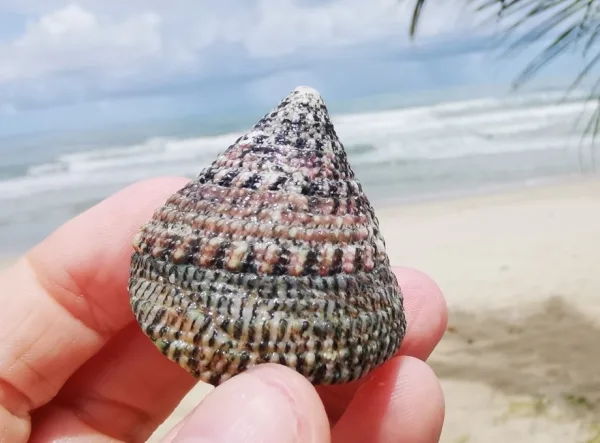
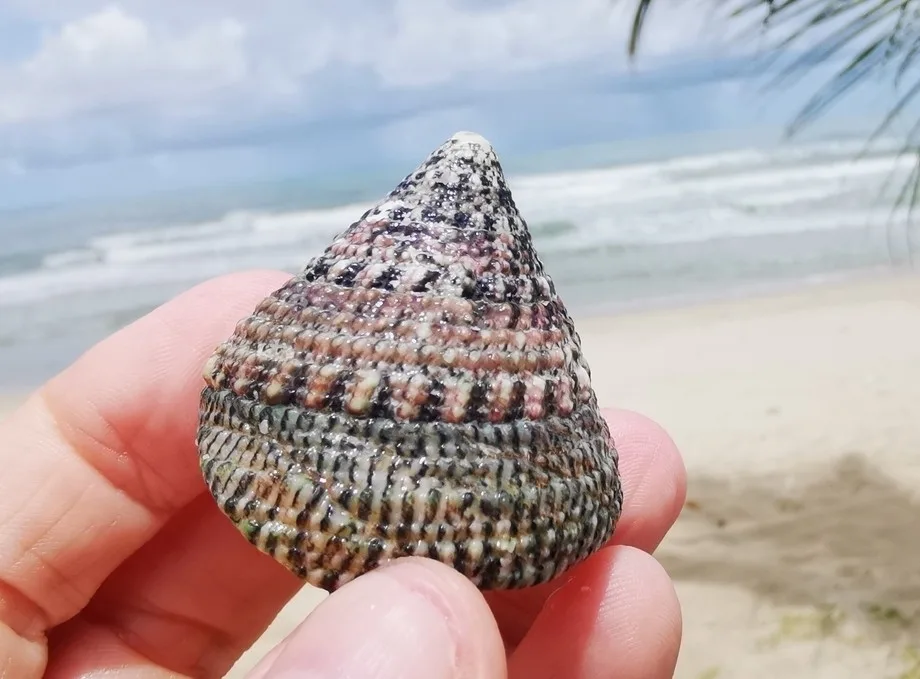
The banded trochus is a small snail with a shell shaped like a pointy party hat. The shell is pale gray with red or purple stripes, and the snail's foot is black on top. It comes from warm, shallow reefs on the far side of the world, around Indonesia. In a fish tank it works as a cleaner. It slides over rocks and glass and scrapes off thin films of algae with a tongue full of tiny teeth. Many of these snails do most of their work at night. If one falls on its back, it can usually flip itself over, which many other snails cannot do. It is gentle and never bothers fish or corals. When the tank gets very clean, it needs a little dried seaweed so it does not go hungry.
Water & care
One of the easiest clean-up snails, as long as the tank is established and has algae to graze. Drip-acclimate slowly over 1-2 hours; trochus react badly to salinity swings and may stay sealed in the shell for hours or even days after being added, which is usually normal. Keep copper out of the tank and nitrate low. When the glass and rock stay clean, feed nori, sheet algae or algae wafers, preferably in the evening. Keep calcium and alkalinity in reef range for shell growth.
| Parameter | Keep it at | Where that sits on the usual reef range |
|---|---|---|
| Temperature | 72–78 °F | |
| Salinity (SG) | 1.023–1.025 | |
| pH | 8.1–8.4 | |
| Alkalinity | 8–12 dKH | |
| Nitrate | 0–20 ppm |
LiveAquaria and Quality Marine give 72-78 F, SG 1.023-1.025, pH 8.1-8.4 and 8-12 dKH; Top Shelf Aquatics gives 75-79 F and SG 1.024-1.026, and Bulk Reef Supply 75-80 F, pH 7.7-8.5 and nitrate below 20 ppm. Sellers advise calcium and trace-element supplementation for shell growth but give no ppm targets; keep normal reef levels. Sensitive to high nitrate and to copper.
Feeding
DietHerbivore
Favorite foods
- Film algae on glass and rock
- Diatoms
- Cyanobacteria (red slime)
- Dried seaweed (nori) and algae wafers
Grazes algae, diatoms and cyanobacteria from rock, substrate and glass, mostly at night. It is a strong film-algae and diatom eater but only picks at hair algae, so pair it with turbos if hair algae is the problem. Stocking advice varies widely (one per 2-3 gallons at LiveAquaria, about one adult per 10 gallons in hobby guides); start low and add more only if algae persists. When natural algae runs out, drop in a piece of nori, sheet algae or an algae wafer once or twice a week.
Tank & maintenance
- Minimum tank
- 20 gallons
- Aquascape
- An established tank with plenty of live rock to graze and crevices to hide in. Glue down frags. Sand is fine, but trochus prefer rock; move any snail that sits on the sand for a long time back onto the rock.
- Lighting
- Any reef or fish-only lighting (low to high); enough light to grow some film algae helps keep it fed.
- Water flow
- Few sources mention flow; one care sheet recommends moderate to strong flow.
Routine upkeep
Check the snails every week or two: put back on the rock any that are stuck on the sand or lying still for days, and remove any that smell, because a dead snail fouls the water quickly. Keep calcium, alkalinity and pH steady for shell growth, feed nori or algae wafers when the tank is very clean, and keep spare empty shells around if you also keep hermit crabs.
Temperament & tankmates
TemperamentPeaceful
Completely peaceful toward fish, corals and other invertebrates. It is more often the victim: hungry hermit crabs may kill it for its shell, and puffers, triggers, many wrasses and some larger hawkfish, crabs and dottybacks may flip, peck at or eat snails.
Reef safeYes
Does not eat corals, clams or other invertebrates. The only risk is mechanical: a grazing snail can knock over frags that are not glued down.
Good tankmates
- Peaceful reef fish that leave invertebrates alone
- Cleaner and other reef-safe shrimp
- Other clean-up crew such as cerith, nassarius and turbo snails and conchs
- Corals that are glued down
Avoid
- Hermit crabs in large numbers (may kill it for its shell)
- Puffers, triggerfish and snail-eating wrasses
- Large predatory crabs
- Copper-based medications
Help it thrive
- Add trochus to a mature tank that already grows film algae, a few at a time.
- Drip-acclimate for 1-2 hours and don't pour shipping water into the display.
- Feed nori or an algae wafer in the evening once the glass stays spotless for days.
- Never dose copper in a tank with snails; treat fish in a separate tank.
- Give hermit crabs spare shells, or skip hermits, so they leave the trochus alone.
Common ailments
Starvation
- Signs
- Snails slow down, stop climbing and die off one by one after the tank starts to look very clean.
- Prevention
- Stock modestly and add them only to established tanks with algae growth; feed nori or algae wafers when algae runs short.
- Treatment
- Place nori or an algae wafer near the snails in the evening and reduce the number of grazers.
Acclimation shock
- Signs
- Snail stays sealed in its shell or falls off the rock for several days after purchase and does not grip surfaces.
- Prevention
- Drip-acclimate slowly (1-2 hours) and match salinity and temperature closely.
- Treatment
- Set it on rock near algae in stable water and wait; a closed snail that does not smell is usually alive.
Copper and medication poisoning
- Signs
- Sudden deaths of snails and other invertebrates after a medication was dosed.
- Prevention
- Never use copper or other invertebrate-toxic medications in the display.
- Treatment
- Move survivors to clean water; remove copper with activated carbon or a copper-removing resin and water changes.
Predation and shell theft
- Signs
- Empty shells, shells occupied by hermit crabs, or snails found flipped and half-eaten.
- Prevention
- Keep hermit crabs few and provide spare shells; avoid snail-eating fish and large crabs.
- Treatment
- Remove or rehome the predator; no treatment for the snail.
This is general hobby guidance, not veterinary advice. Quarantine new arrivals and treat in a separate tank whenever you can.
Risks of owning one
- Overstocking leads to starvation, and dead snails can cause an ammonia spike.
- Very sensitive to copper medications and to sudden salinity changes.
- Can knock over unglued frags while grazing.
- The trade name is loose: lots sold as 'trochus' can be different species of different size.
Breeding
DifficultyModerate Captive-bredRare or wild-caught
Broadcast spawner with separate sexes that look identical. Spawning often follows a change in lighting or water conditions and shows as a cloudy white release of eggs and sperm. The larvae drift for about 3-7 days, then settle on rock and grow into small snails; LiveAquaria says they reach maturity in a few months, while hobby guides say juveniles take about a year to reach adult size and longer to mature. Many hobbyists see baby trochus appear in established tanks without any effort, but most larvae are lost to filtration and filter feeders. No captive-bred banded trochus are sold; ORA's aquacultured 'trochus' is Rochia nilotica.
- Keep several healthy adults together in a mature tank; males and females look the same.
- Spawning usually happens without help and briefly clouds the water; this is harmless.
- To raise more young, collect larvae or move rock with settled juveniles to a refugium or fishless tank with algae-coated surfaces and no strong mechanical filtration.
- Feed juveniles on natural film algae; they grow slowly over months.
Deep dive The science, history and family tree
The science
Trochus Linnaeus, 1758 is the type genus of the top snails (family Trochidae, subfamily Trochinae). Species have large, thick, solid shells with a broadly conical spire, a flat to convex base and an angled periphery; the columella carries a strong fold ending in a blunt tooth, and the inside of the shell is lined with thick, iridescent nacre. Like other trochids they close the aperture with a thin, horny, circular, many-whorled operculum rather than the chalky trapdoor of turban snails. Wikipedia lists about 35 living species, mostly from the tropical Indo-West Pacific.
The 'Banded Trochus' of the aquarium trade is sold as Trochus sp. and is not identified to species on most listings. Sellers describe a pale gray, top- or pyramid-shaped shell with a sharp spire, a flattened base, about eight to ten whorls and maroon, reddish or purplish bands, on a black foot with an off-white underside, usually 1/2-1 in at sale. Individual sellers attach Trochus radiatus or Trochus histrio to it; T. radiatus, the radiate top shell, has a 17-40 mm shell striped with crimson flames and lives on intertidal boulders from Madagascar to the western Pacific. Trochus snails graze algal films, diatoms and cyanobacteria from rock, usually in shallow water near reefs. Sexes are separate but look alike, and spawning is external: eggs and sperm are shed into the water and the larvae drift for a few days before settling. Trade animals are imported from Indonesia and other parts of Southeast Asia and Melanesia.
- Appearance
- A cone- or pyramid-shaped shell with a sharp point and a flat base, pale gray to cream with maroon, red or purple stripes or flames running down the whorls; trade animals are about 1/2-1 in. The foot is black on top with an off-white or tan underside. In the tank the shell is often fuzzy with algae, which hides the colors. Look-alikes: Tectus snails (taller, plainer cones that cannot right themselves), ORA's aquacultured 'Trochus snail' (Rochia nilotica, a different genus that grows much larger), turbo and Astraea snails (round or flat-coned shells with a chalky trapdoor), and the tiny 'mini trochus' (Collonista spp.).
- Native range
- Indo-West Pacific. Trade 'banded trochus' are listed as coming from Indonesia (LiveAquaria, Meerwasser-Lexikon), and the importer Quality Marine offers them from Melanesia, South Asia and Eastern Asia. Hobby guides describe the genus as found across the tropical Indo-Pacific from the Indian Ocean to northern Australia; Trochus radiatus, one species sold under the name, ranges from Madagascar to the western Pacific. One seller also gives Nicaragua as an origin, which suggests some lots may be other snails.
- Habitat
- Rocky shores, boulders and reef flats from the intertidal zone to about 20 m, near coral reefs, where the snails graze algal films and short algal turf on hard surfaces (Aquarium Breeder; Wikipedia for T. radiatus). They prefer rock to sand and tend to hide in crevices or under rocks by day.
- Size
- 2 in (5.1 cm). Retail care sheets for the banded trochus (LiveAquaria, Quality Marine, Aquatics Unlimited) give a maximum of 1 in; sale size is 1/2-1 in. Genus-level guides quote 1-3 in (Saltwater Aquarium Blog, Aquarium Breeder) and Meerwasser-Lexikon up to 8 cm, because some Trochus species grow larger; T. radiatus shells are 17-40 mm.
- Lifespan
- At least 2-3 years in aquariums with good care (Aquarium Breeder). Hobby guides say some Trochus species may live 15 years or more in the wild, but no species-level ageing data for the trade snail was found.
- Conservation
- Not Evaluated. Not assessed by the IUCN Red List and not CITES-listed (Meerwasser-Lexikon). Trade animals are wild-collected in Southeast Asia and Melanesia. The large commercial 'trochus' fished for mother-of-pearl buttons is a different snail, Rochia nilotica (formerly Trochus/Tectus niloticus)
In the aquarium vs in the wild
In your aquarium
Clean-up crew algae grazer, best at film algae, diatoms and cyanobacteria on rock and glass; one of the few snails that rights itself when it falls.
On the reef
A grazing herbivore of shallow Indo-Pacific reefs and rocky shores; by keeping algae cropped to a short turf, trochus grazing frees space where corals can settle.
History
The name Trochus was first used by the French naturalist Guillaume Rondelet in 1558 for a mixed assortment of shells. Linnaeus adopted it as a genus in 1758, but his Trochus also held species of several other families; Lamarck and later 19th-century authors such as Gray and the Adams brothers narrowed it down, and most of the hundreds of names once placed in it are now synonyms or belong to other genera. The best-known 'trochus', the large mother-of-pearl button shell, is no longer in the genus and is now Rochia nilotica. In the reef hobby, the red-and-white banded Indo-Pacific Trochus became a standard clean-up crew snail sold simply as Trochus sp., with sellers attaching names such as T. radiatus or T. histrio.
Evolution & relatives
Trochus belongs to the Vetigastropoda, an old snail lineage that also includes abalones, keyhole limpets and turban snails; many vetigastropods line their shells with nacre, which is why a worn trochus shell shimmers inside. Within the superfamily Trochoidea, top snails (Trochidae) differ from turban snails (Turbinidae) in their thin, horny operculum. The family has been narrowed repeatedly, most recently with molecular studies of the Trochoidea (e.g. Williams and colleagues, 2010). Under the current classification some snails once called 'trochus', such as the button trochus (Rochia nilotica), and Caribbean top snails such as Agathistoma and Cittarium sit in the separate family Tegulidae, while Trochus itself remains the type genus of Trochidae.
Family tree, from kingdom down
- Kingdom Animalia Animals Animals are living things made of many cells that must eat food to live. Fish, corals, crabs, snails and sea stars are all animals.
- Phylum Mollusca Molluscs Molluscs are soft-bodied animals, and many of them grow a hard shell. Snails, clams and octopuses are all molluscs.
- Class Gastropoda Snails and slugs Gastropods crawl on one big, slimy foot. Most carry a single coiled shell, but sea slugs have lost theirs.
- Subclass Vetigastropoda top snails, turban snails, abalones and kin
- Order Trochida Top and turban snails These sea snails have shells shaped like a spinning top or a turban. Many graze on algae on rocks.
- Superfamily Trochoidea
- Family Trochidae top shells
- Subfamily Trochinae
- Genus Trochus
See it on the Tree of Life Compare with another species
Closest relatives
- Trochus radiatus Radiate top shell Same genus; one of the names used for the banded trochus (Madagascar to the western Pacific)
- Trochus histrio Trochus snail Same genus; name used for the trade trochus by some sellers
- Trochus maculatus Maculated top shell Same genus; Indo-Pacific
- Rochia nilotica Commercial top shell (ORA trochus) Formerly Trochus niloticus; now in family Tegulidae; aquacultured for the hobby
- Agathistoma fasciatum Smooth Atlantic tegula Family Tegulidae; Caribbean and Florida top snail, not rated suitable for aquariums
- Cittarium pica West Indian top shell Family Tegulidae; large Caribbean top snail harvested for food
Fun facts
- Unlike most aquarium snails, a trochus that falls on its back can usually flip itself upright.
- When trochus spawn in an aquarium, the water can turn briefly cloudy with eggs and sperm; this is normal, not a disease.
- The shimmering inside of a trochus shell is nacre, the same mother-of-pearl material once cut from large trochus shells to make buttons.
- The name Trochus was used for shells as early as 1558, two centuries before Linnaeus made it a genus.
- Baby trochus often appear in established reef tanks on their own, a sign that the tank is stable.
Learn more
- WoRMS: Trochus Linnaeus, 1758 marinespecies.org
- LiveAquaria: Banded Trochus Snail liveaquaria.com
- Saltwater Aquarium Blog: Trochus snail care saltwateraquariumblog.com
- Aquarium Breeder: Trochus Snails detailed guide aquariumbreeder.com
Sources
- WoRMS: Trochus taxon details marinespecies.org
- Wikipedia: Trochus (genus, history, shell description) en.wikipedia.org
- Wikipedia: Trochidae (operculum, feeding, molecular systematics) en.wikipedia.org
- Wikipedia: Trochus radiatus en.wikipedia.org
- LiveAquaria: Banded Trochus Snail care sheet liveaquaria.com
- Quality Marine: Banded Trochus Snail qualitymarine.com
- Aquatics Unlimited: Trochus snail (Trochus sp.) aquaticsunlimited.com
- Top Shelf Aquatics: Trochus Snail invert glossary topshelfaquatics.com
- Bulk Reef Supply: How to care for trochus snails bulkreefsupply.com
- Saltwater Aquarium Blog: Trochus snail care saltwateraquariumblog.com
- Aquarium Breeder: Trochus Snails detailed guide aquariumbreeder.com
- Meerwasser-Lexikon: Trochus sp.01 Banded Trochus Snail en.reeflex.net
- Reef Exclusive: Banded Trochus Snail (origin listing) reefexclusive.com
- AlgaeBarn: Banded Trochus Snails in the reef tank help.algaebarn.com
- ORA: Trochus Snail (Rochia nilotica, aquacultured) orafarm.com
- Meerwasser-Lexikon: Agathistoma fasciatum reeflex.net
- Meerwasser-Lexikon: Cittarium pica reeflex.net
Care facts
The care facts on this guide and its product pages (care level, reef safety, temperament, size, tank, diet, flow, purpose, foods, acclimation and origin) combine 9 independent sources, checked October 25, 2026.
- Banded Trochus Snail (Trochus sp.) LiveAquaria
- Banded Trochus Snail (Trochus sp.) Quality Marine
- Snail - Trochus (Trochus sp.) Aquatics Unlimited
- Trochus Snail Care (Trochus spp.) Saltwater Aquarium Blog
- Trochus Snails - Detailed Guide: Care, Diet, and Breeding Aquarium Breeder
- Trochus Snail (Trochus histrio) - Invert Glossary Top Shelf Aquatics
- How To Care For Trochus Snails Bulk Reef Supply
- Trochus sp.01 - Banded Trochus Snail Meerwasser-Lexikon (reeflex.net)
- Banded Trochus Snails: Slow Movers, Silent Helpers AlgaeBarn
Scientific names and classification follow the World Register of Marine Species (AphiaID 138598). Last updated October 25, 2026.
Shop this species
Search the shop →Sold out right now. We restock weekly, so check back soon.
Sold out
 Sold out